
Live chat security, data protection — and what we haven't done yet.
Live chat security is a buying decision, not a footnote: every support thread carries order numbers, addresses and complaints. This page describes the controls Chatdrill runs in production today — encryption in transit and at rest, role-based access control and GDPR-ready data handling — and names the certifications we do not hold.
The security controls behind every customer conversation
A security review of any customer support software asks the same six questions: is data encrypted, who can authenticate, how are backups handled, what do roles actually control, what gets logged, and what happens to personal data when someone asks for it back. The sections below answer each one with what runs in production today, and mark every gap as a gap rather than wording around it.
- Encryption everywhere — TLS 1.2+ in transit, AES-256 at rest, secrets in a managed store.
- Role-based access control inside your workspace, and least-privilege access to production inside ours.
- Data you can take back — export, retention limits and deletion, on every plan including the free one.
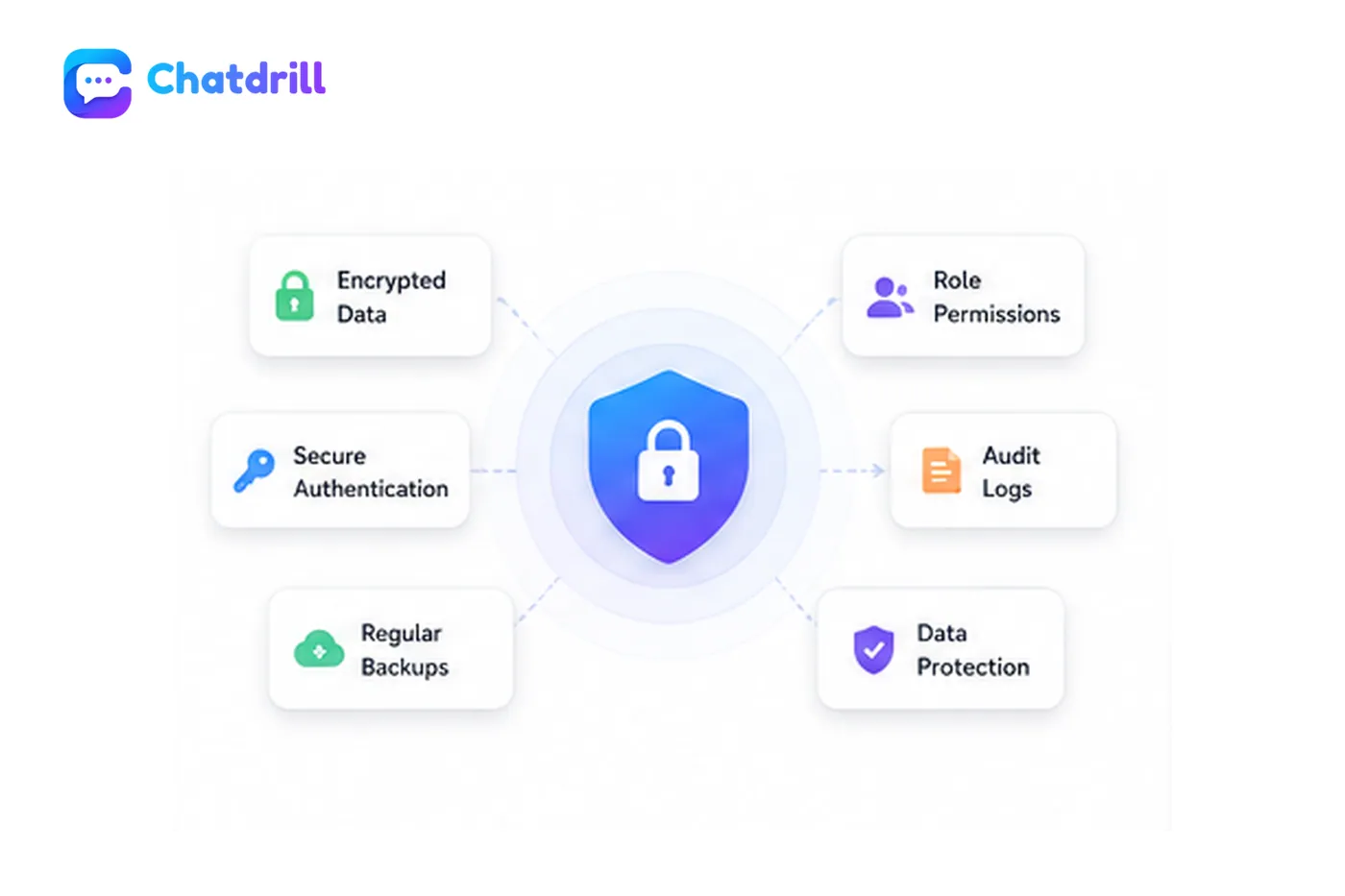
Encryption in transit and at rest
Everything moving between a browser, the chat widget, our API and our databases is encrypted, and everything sitting still is encrypted too.
- In transit: TLS 1.2 or higher on every connection, with modern cipher suites and HSTS. Plain HTTP is redirected, never served.
- At rest: databases, file attachments and backups are encrypted with industry-standard AES-256 provided by our cloud platform.
- Secrets: API keys, integration tokens and credentials live in a managed secret store, never in source control. Passwords are stored only as salted hashes.
- Payments: card details go directly to our payment provider. Full card numbers never reach our servers.
Role-based access control, for your team and ours
Two separate questions: who on your team can see what, and who at Chatdrill can reach production.
- Role-based permissions inside your workspace — owner, admin, agent — controlling who can read conversations, change settings, invite people or export data.
- Workspace isolation: data is scoped per workspace at the query layer. An agent in one workspace cannot address another one's data, including through the API.
- Least privilege for staff: production access is individually attributed, granted only where a role requires it, protected by multi-factor authentication, and reviewed when someone changes role or leaves.
- Support access: we look at your data only to fix a problem you have reported, or where the law requires it. Ask us and we will describe what was accessed.
The infrastructure your conversations run on
Chatdrill runs on major cloud infrastructure. We do not operate our own hardware, and we do not host customer data on anything we cannot patch centrally.
- Certified data centres operated by our cloud provider, with physical security, redundant power and environmental controls handled at that layer.
- Separated environments: production, staging and development are isolated. Production customer data is not copied into test environments.
- Automated encrypted backups on a regular schedule, retained on a fixed cycle and periodically restore-tested — because a backup nobody has restored is a hope, not a backup.
- Managed patching and dependency scanning on our images and libraries, with security updates prioritised over feature work.
- Monitoring and alerting on availability and on anomalous access patterns. Live uptime is published on the Chatdrill system status page.
Data export, data retention and data residency
Conversations, contacts and knowledge base content belong to you. We hold them to run the service, and the three questions a data protection officer always asks — can we get it out, how long do you keep it, and where does it live — have plain answers.
- Export any time — conversations, contacts and reports in standard formats, from inside the application. No support ticket, no exit fee, no waiting period.
- Data retention you control — set how long conversations are kept so you are not storing personal data you no longer need, and redact a message or attachment when a customer sends something they should not have.
- Deletion on request — remove individual conversations and contacts, or close the workspace entirely. Production data is deleted within 90 days of closure; encrypted backups roll off on their normal cycle.
- Data residency: every workspace is served from our primary cloud region today, and we will tell you which region that is before you sign. Region-pinned hosting elsewhere is an Enterprise arrangement — see the roadmap below.
GDPR, the data processing agreement and sub-processors
For the conversations you collect through Chatdrill you are the controller and we are the processor. GDPR customer support software has to make that split workable, not just declare it.
- Data Processing Agreement incorporating the Standard Contractual Clauses and the UK Addendum — read the Chatdrill data processing agreement, signable on request.
- Data subject requests: search, export, correct and delete an individual's data from the application, so you can answer an access or erasure request without opening a ticket with us. We assist where you need us to.
- Sub-processor transparency: a current list of every sub-processor and the country it operates from, with at least 30 days' notice before we add a new one and a right to object.
- Data minimisation: the widget collects what you configure it to collect. Nothing is enabled by default that quietly gathers more.
Full detail sits in the Chatdrill privacy policy and the cookie policy for the chat widget.
How the AI agent treats your customer data
The AI agent is the part security reviewers ask about most, so here is exactly how it treats what you give it.
- Your content trains your agent only. The pages, articles and documents you connect build a knowledge base scoped to your workspace and are never shared with another customer.
- No training of shared models on your conversations without an explicit, separate written agreement. Our model provider agreements prohibit training on the data we send.
- Grounded answers with citations, so you can see which source produced a reply — and a confidence threshold that hands over to a person instead of guessing.
- You can turn it off. The AI agent trained on your own content is a feature, not a condition of using the inbox.
Incident response and breach notification
Things break. What matters is how quickly you hear about it and how much of the truth you get.
- A documented process covering detection, triage, containment, recovery and a written post-incident review.
- Breach notification to affected customers without undue delay and within 72 hours of becoming aware, with what we know at the time rather than a polished summary a week later.
- Status published while it is happening, not after it is fixed. Outages appear on the status page as we work through them.
Responsible disclosure for security researchers
If you have found a vulnerability, we want to hear from you before anyone else does.
- Email security@chatdrill.com with steps to reproduce, the affected endpoint and any proof-of-concept. We acknowledge within two business days.
- Give us reasonable time to fix the issue before disclosing it publicly. We will keep you updated and tell you when it is patched.
- Please test only against your own workspace. Do not access other customers' data, degrade the service, or run automated scanning against production without asking us first.
- We do not run a paid bounty programme yet. We do credit researchers who want to be named, and we will say so publicly.
Certifications, penetration testing and the Enterprise roadmap
Chatdrill is an early-stage company. Some things a large vendor would list here are not done yet, and the honest way to handle that is to name them rather than to word around them.
SOC 2 Type II
Not certifiedWe are not SOC 2 certified and will not imply otherwise. We are building the control evidence a Type II audit needs; ask where that stands and we will tell you honestly.
ISO 27001
Not certifiedNo certification today. Our internal practices follow the same shape — access control, change management, vendor review — but a shape is not an audit.
Independent penetration test
Planned, not yet doneWe have not commissioned a third-party penetration test yet, so please do not assume a report exists. It is planned, and when it happens we will share the scope and the findings summary under NDA — including anything we failed.
SSO / SAML
Enterprise — ask usPlanned for Enterprise plans. If single sign-on is a requirement for your rollout, raise it during the demo and we will give you a straight answer on timing.
Audit logs
Enterprise — ask usAdmin and access event logging for Business and Enterprise plans. Some events are recorded today; a complete, exportable audit trail is on the roadmap.
Data residency options
Enterprise — ask usRegion-pinned hosting is an Enterprise arrangement, agreed in writing before you sign rather than after. Ask us which regions we can actually serve today.
If a control on this list is a hard requirement for your organisation, ask us where it stands before you buy. We would rather lose the deal than win it on an implication.
What we will never do with customer conversations
Commitments are easier to check when they are written as prohibitions.
- Sell your conversation data, or share it with advertisers, data brokers or anyone else who wants to buy an audience.
- Train shared or third-party AI models on your customers' conversations without your explicit, separate consent.
- Hide a breach. If your data is affected you hear it from us — quickly, with what we know, before it is comfortable to say.
- Hold your data hostage. Export works on every plan, including the free one, and keeps working while you are cancelling.
- Claim a certification we do not hold, or let a badge on a marketing page imply an audit that has not happened.
Live chat security questions buyers ask before signing.
Chatdrill is built to be run in a GDPR-compliant way. We act as processor for the conversations you collect, offer a Data Processing Agreement incorporating the Standard Contractual Clauses and the UK Addendum, publish a sub-processor list, and give you search, export, correction and deletion tools inside the application. Compliance also depends on how you configure and use the tool, so no vendor can hand it to you finished — but nothing here works against it.
Yes. TLS 1.2 or higher on every connection in transit, and AES-256 encryption at rest for databases, file attachments and backups. Passwords are stored only as salted hashes, and full card numbers never reach our servers because payments go straight to our payment provider.
No. Chatdrill holds neither certification today and we will not imply otherwise on this page or in a sales call. We are an early-stage company building the control evidence a SOC 2 Type II audit needs. If a certificate is a hard requirement for your organisation, tell us before you buy rather than after.
Yes, both on request. The data processing agreement covers processing scope, security measures, sub-processors, international transfers, audit rights and deletion on termination. We give at least 30 days' notice before adding a new sub-processor, and you have a right to object.
No. The content you connect trains your workspace's AI agent only, and it is never shared with another customer. Our model provider agreements prohibit training on the data we send. Training a shared model on your conversations would require an explicit, separate written agreement from you.
Send us your security questionnaire
We complete it ourselves — including the questions where the honest answer is "not yet". We can also provide the Data Processing Agreement and the current sub-processor list, and walk your reviewer through anything on this page. Still comparing tools? Start with plans and limits on the pricing page.