
Chatway has built its reputation specifically within the Shopify ecosystem, offering a simple, accessible widget designed to integrate smoothly with Shopify stores and their common ecommerce support patterns.
ChatDrill supports Shopify integration as well but isn't built exclusively around it, instead offering deeper AI training capability that applies across Shopify and other platforms equally.
For a Shopify merchant specifically, this comparison often comes down to whether Chatway's Shopify-native simplicity or ChatDrill's deeper, more broadly applicable AI training better serves your actual store's needs.
This comparison covers Shopify integration approach, AI capability, pricing, and which type of Shopify store each platform tends to fit, along with practical guidance for evaluating your store's specific needs.
Quick answer: Chatway is built specifically for Shopify stores with a simple, free-to-start widget and basic automation, making it a natural first choice for a new Shopify merchant, while ChatDrill offers deeper AI training capability that works with Shopify and other
platforms, making it the better fit for a Shopify store with genuine, growing support volume wanting more accurate automated resolution.
Shopify Integration Approach
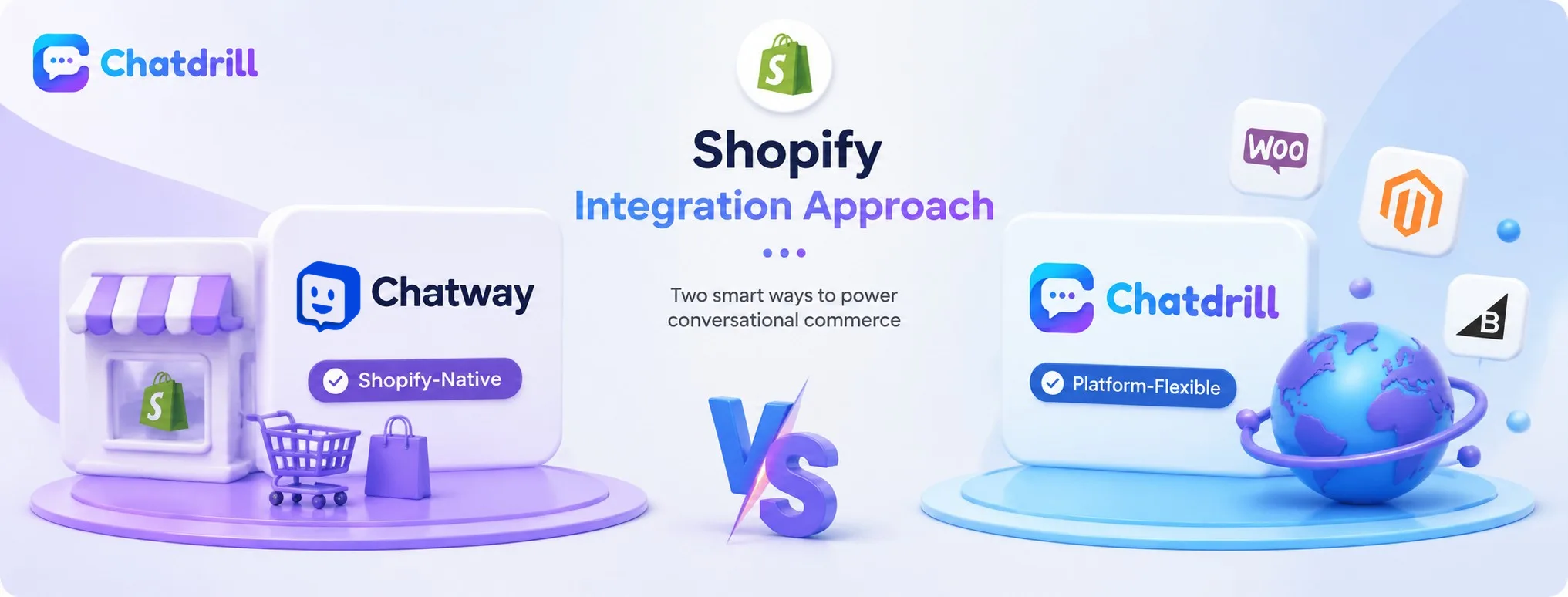
Chatway is built specifically for Shopify with deep, native integration, while ChatDrill supports Shopify through a more general integration approach that also works across other platforms.
Chatway's Shopify-native design
Chatway's entire product is designed around Shopify specifically, meaning its widget and automation patterns are tuned closely to common Shopify store structures and typical ecommerce support scenarios from the start.
This native design genuinely simplifies setup for a Shopify merchant, since less general-purpose configuration is needed to fit typical Shopify store patterns.
ChatDrill's platform-flexible integration
ChatDrill integrates with Shopify through its standard integration layer, syncing order and customer data, but its core AI training approach applies the same way regardless of which ecommerce platform you use.
This flexibility matters for a merchant who might use Shopify alongside another platform, or one who values not being tied specifically to one platform's chat ecosystem.
AI Training and Accuracy for Ecommerce Questions
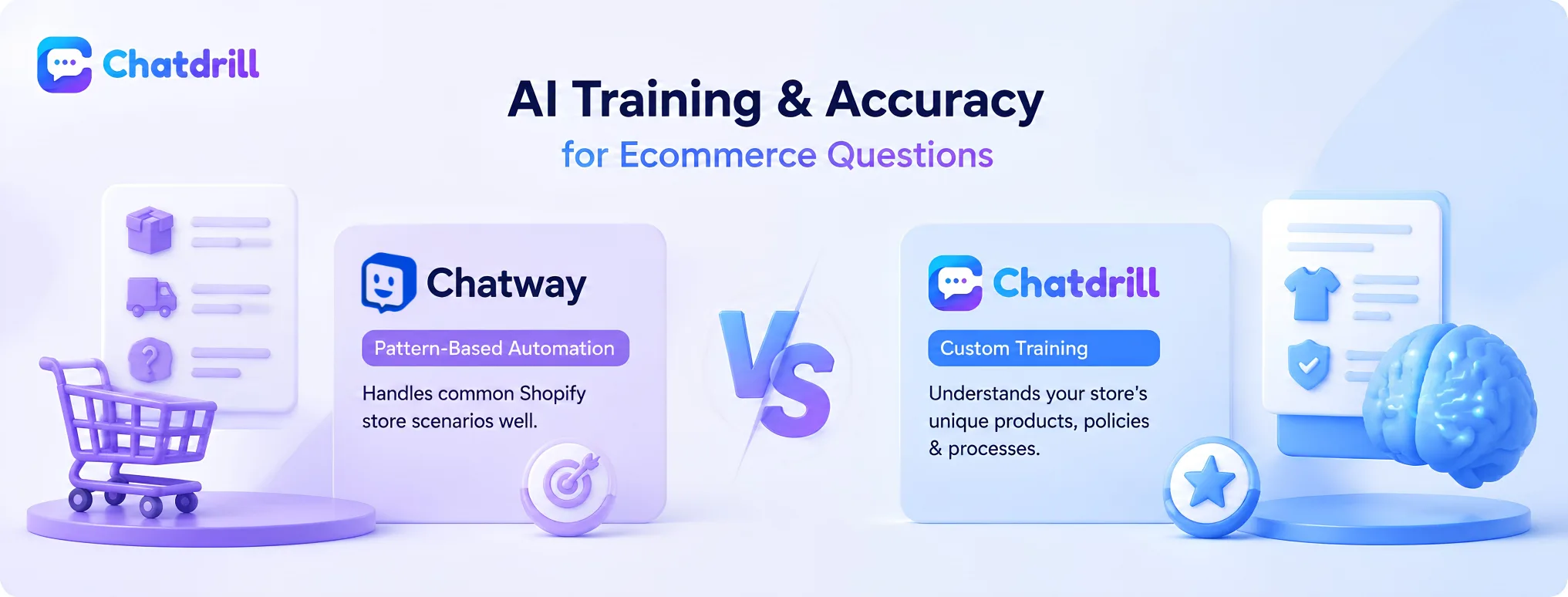
ChatDrill's deeper, custom training approach tends to handle nuanced or store-specific ecommerce questions more accurately than Chatway's more general, Shopify-pattern-based automation.
Chatway's pattern-based automation
Chatway's automation handles common, predictable Shopify store scenarios, order status, shipping timing, basic product questions, reasonably well by design, since these represent the most typical patterns across many Shopify stores.
This works well for a store whose questions closely match these common ecommerce patterns without much store-specific nuance.
ChatDrill's custom training for store-specific nuance
ChatDrill's training approach handles genuinely specific product details, unusual policies, or a support process unique to your particular store more accurately, since its AI is trained directly on your actual content rather than general ecommerce patterns.
This accuracy advantage compounds for a store with distinctive products, policies, or a customer base with more specific, less generic questions.
Pricing for Shopify Merchants
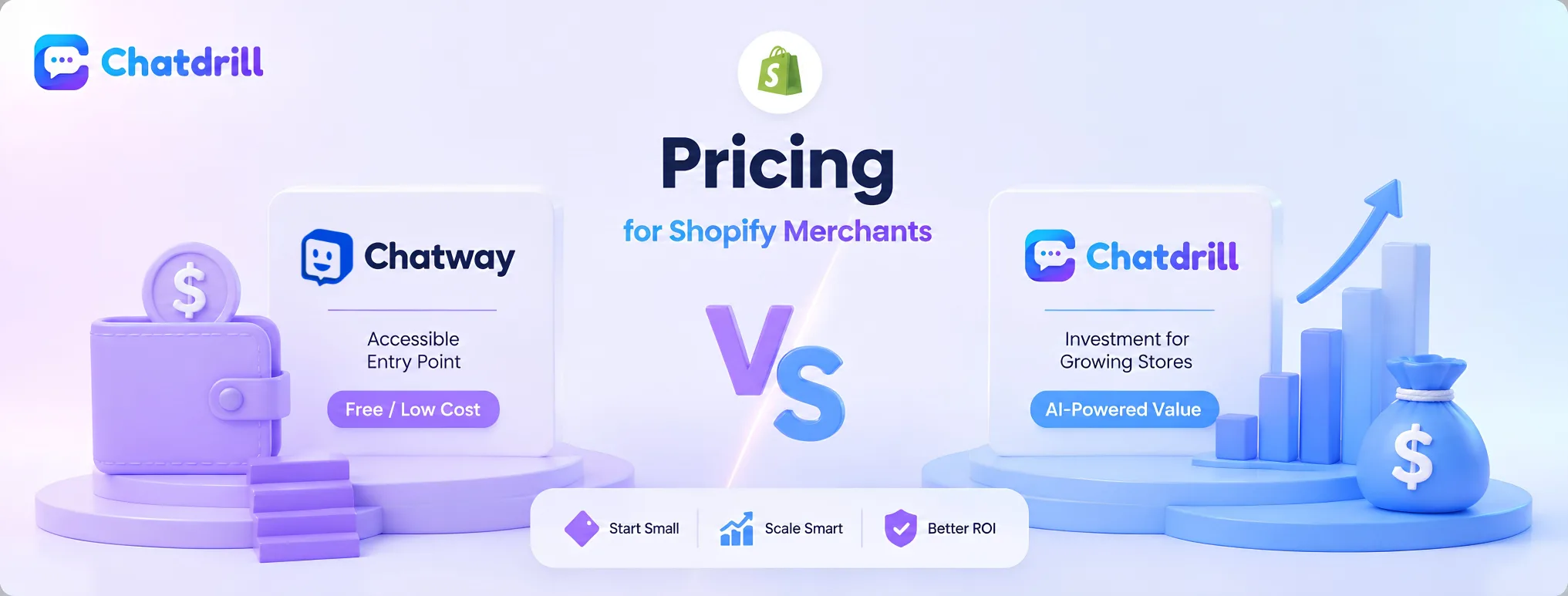
Chatway's pricing is generally accessible, often with a free starting tier appealing to a new Shopify store, while ChatDrill's pricing reflects deeper AI investment better suited to a store with growing, genuine support volume.
Chatway's accessible entry point
Chatway often offers a free or very low-cost starting tier, making it genuinely accessible for a brand-new Shopify store not yet ready to invest significantly in a chat tool.
This accessibility matters most for a store still validating its business model, where minimizing tool costs is a reasonable early priority.
ChatDrill's investment for growing stores
ChatDrill's pricing reflects deeper AI training capability, representing a reasonable investment once a Shopify store has validated demand and is experiencing genuine, growing support volume worth automating more thoroughly.
This investment tends to pay off specifically once repetitive question volume reaches a level where deeper, more accurate automation delivers clear time savings.
Which Shopify Store Each Platform Fits
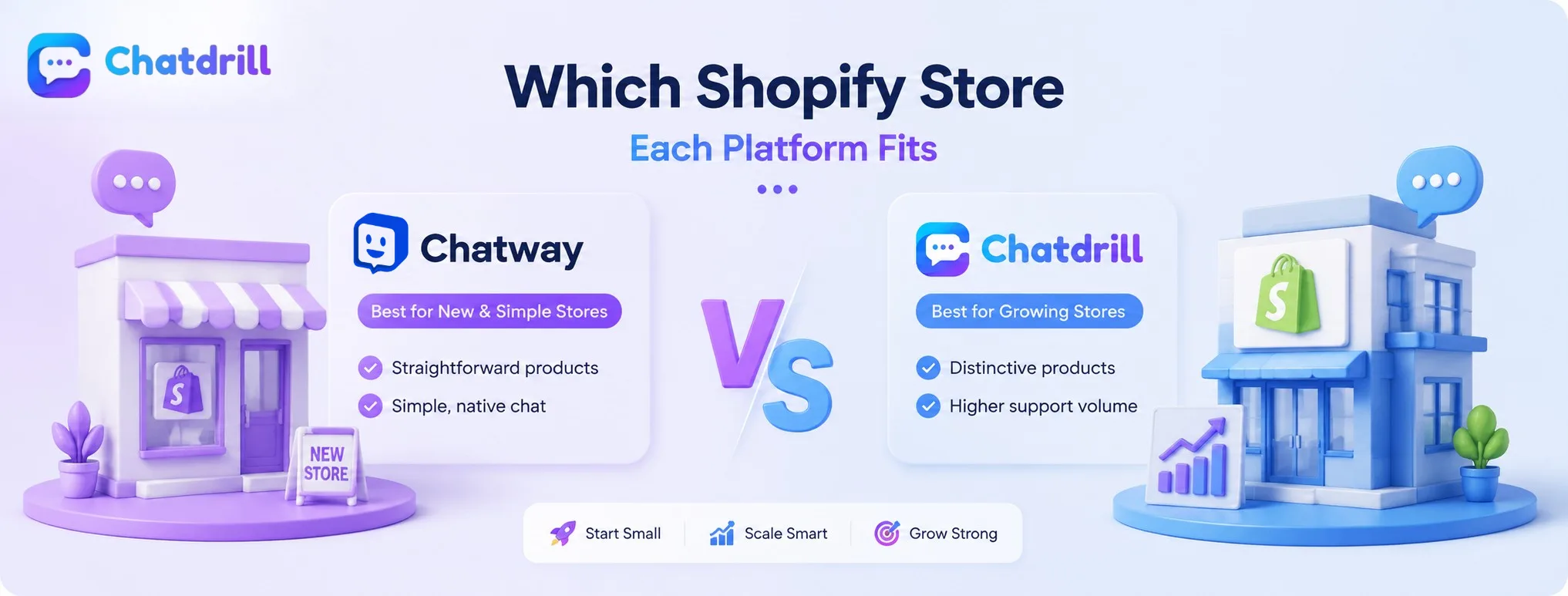
Chatway fits a new or straightforward Shopify store wanting simple, native chat, while ChatDrill fits a growing Shopify store with more specific or higher-volume support needs.
When Chatway is likely the better fit
A new or straightforward Shopify store with fairly standard products and support questions, wanting simple, native chat integration without significant investment, tends to find Chatway's Shopify-specific approach a genuinely good match.
This fit is strongest for a store still early in its growth, prioritizing accessible setup over deep AI customization.
When ChatDrill is likely the better fit
A Shopify store with more distinctive products, growing support volume, or genuine need for accurate automated resolution beyond common ecommerce patterns, tends to find ChatDrill's deeper training investment delivers more value as the store matures.
This fit is strongest for a store willing to invest more for meaningfully more accurate, tailored AI responses reflecting its own specific business.
Evaluating Your Store's Specific Needs
Reviewing your store's actual product complexity and support volume clarifies whether Chatway's simplicity or ChatDrill's deeper training investment better fits your genuine situation.
Assessing your product and policy complexity
If your store sells fairly standard products with typical shipping and return policies, Chatway's common-pattern automation likely handles most questions adequately without needing deeper customization.
If your store has distinctive products, custom policies, or a support process that doesn't match typical ecommerce patterns, ChatDrill's custom training tends to deliver more accurate results.
Reviewing your actual support volume trend
Tracking whether your support conversation volume is still low and manageable, or has grown to a point where deeper automation would meaningfully reduce manual workload, helps determine which platform's investment level genuinely matches your current stage.
This honest volume assessment, rather than assumption, produces a more practical decision than choosing based on store size alone.