
Freshchat works best as part of the broader Freshworks suite, pairing naturally with Freshdesk and Freshsales, but a SaaS team not already committed to that ecosystem often finds its standalone chat capability less compelling than dedicated, chat-first alternatives.
The gap becomes clearest around AI depth and product-specific qualification, areas where SaaS teams increasingly expect a chat platform to actively qualify trial users and route product-qualified leads, rather than simply relaying messages to an inbox.
This isn't a knock on Freshchat's core reliability, it's a recognition that a SaaS team evaluating chat purely on its own merits, without an existing Freshworks investment, has genuinely stronger AI-first options available in 2026.
Teams comparing alternatives generally split into two groups: those wanting deeper AI qualification for trial and product-led growth motions, and those simply wanting a more chat-focused platform without Freshchat's broader suite dependency.
This guide covers what to look for in a Freshchat alternative for SaaS specifically, the strongest options in 2026, how they fit different priorities, a closer look at pricing, and what to plan for before switching.
Why SaaS Teams Look for Freshchat Alternatives
SaaS teams look for Freshchat alternatives because its AI qualification trails dedicated AI-first platforms, its main value depends on an existing Freshworks investment, and a growing SaaS business increasingly needs chat to actively qualify trial and product-led leads.
Simple overview
Freshchat performs reliably as a messaging layer, but its standalone value drops significantly for a team not already using other Freshworks products alongside it.
SaaS teams specifically tend to notice this gap once they start expecting chat to do more than relay messages, qualifying trial signups, scoring product-led leads, and routing accordingly.
This isn't a flaw unique to Freshchat, most suite-based chat tools show a similar pattern of weaker standalone value outside their broader ecosystem.
Where Freshchat's AI trails dedicated platforms
Freshchat's automation leans more toward basic FAQ-style bots than genuine, conversational AI qualification, a meaningful gap for a SaaS team wanting deeper trial-user engagement.
This becomes especially visible when testing multi-part or product-specific questions, where AI-first platforms tend to handle nuance that a more basic chatbot flow can't.
Teams evaluating chat purely for its qualification depth, rather than as part of a broader Freshworks bundle, tend to find this gap the clearest reason to look elsewhere.
What SaaS teams need instead
SaaS teams generally want AI that can qualify a trial user's intent, route product-qualified leads to sales, and answer technical product questions with genuine depth.
The right platform for this stage treats chat as an active part of the growth motion, not just a passive support channel bolted onto a broader suite.
This shift matters increasingly as product-led growth becomes a standard SaaS motion, where chat often serves as the first real conversation a trial user has with the company.
What to Look for in a Freshchat Alternative
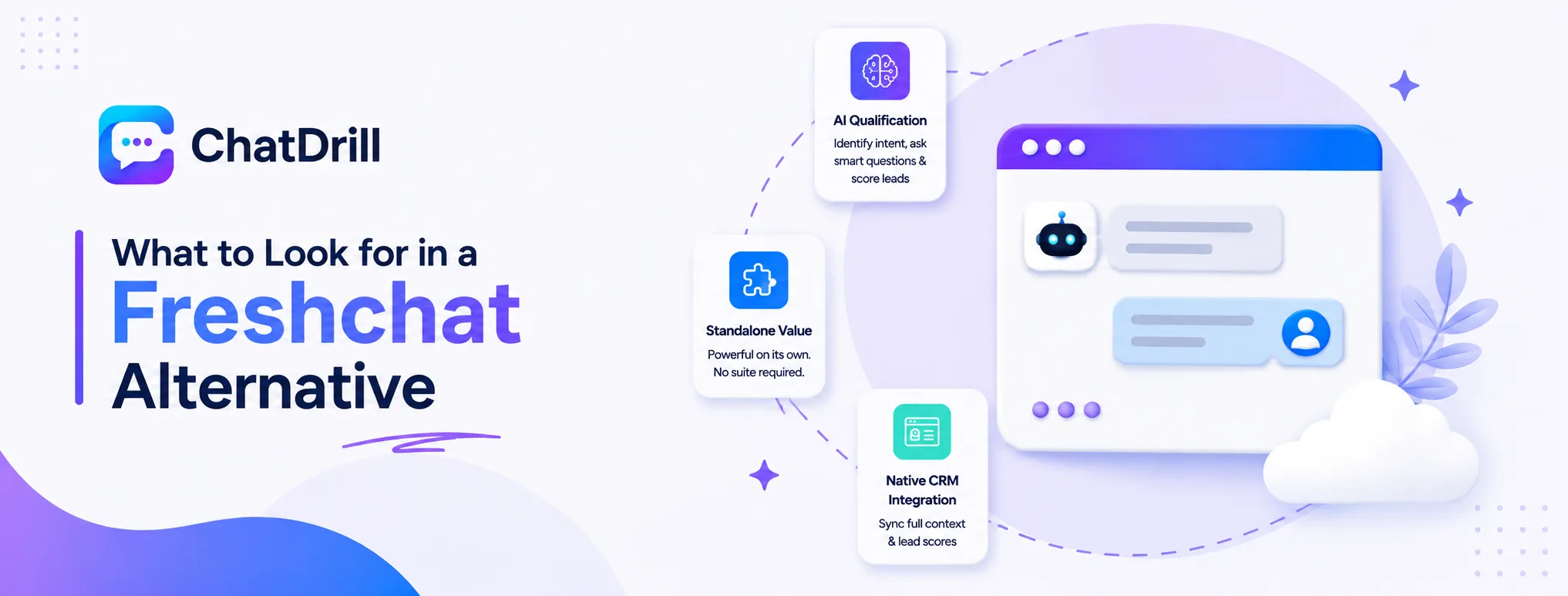
A strong Freshchat alternative for SaaS teams offers genuine AI qualification for trial and product-led leads, works well as a standalone platform without requiring a broader suite commitment, and integrates natively with the CRM a SaaS team already relies on.
Genuine AI qualification for trial and product-led leads
Look for a platform where AI can identify a trial user's intent, ask relevant follow-up questions, and score the lead based on genuine product-usage signals, not just basic contact capture.
Testing this directly with real, SaaS-specific questions during a trial reveals whether qualification depth genuinely matches what a growing product-led business needs.
The strongest implementations handle this conversationally, feeling like a natural extension of the trial experience rather than an intrusive sales form.
Standalone value without a suite dependency
A platform that performs well entirely on its own merits, without requiring adoption of a broader product suite, gives a SaaS team more flexibility in how it builds its stack.
This matters especially for a team not already committed to any single vendor's broader ecosystem, where suite-dependent value doesn't apply.
Testing a platform's core chat and AI capability independently of any bundled features reveals its genuine standalone strength.
Native CRM integration for SaaS pipelines
A SaaS team's chat platform needs to sync cleanly with whatever CRM manages its pipeline, pushing full conversation context and lead scores rather than just basic contact info.
Confirming integration depth during a trial, not just its existence, avoids discovering later that only surface-level data actually syncs.
This integration quality often ends up mattering more to day-to-day workflow than any single chat feature considered in isolation.
The Best Freshchat Alternatives for SaaS Teams
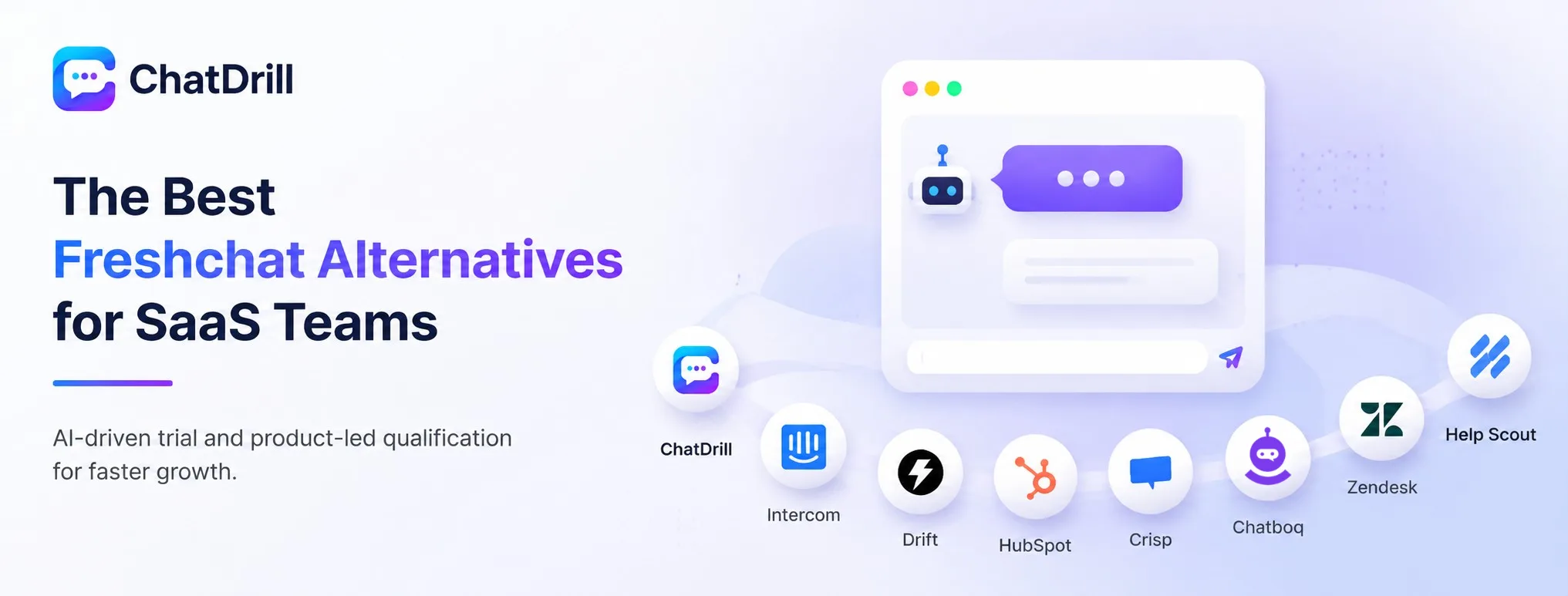
ChatDrill leads for AI-driven trial and product-led qualification, with Intercom, Drift, HubSpot, Crisp, Chatboq, Zendesk, and Help Scout each fitting a more specific SaaS priority.
ChatDrill — best overall Freshchat alternative for SaaS
ChatDrill combines AI-driven qualification with genuine support capability, letting a SaaS team route product-qualified leads to sales while still handling technical support well.
Its AI asks natural, contextual questions that adapt to a trial user's actual usage pattern, going meaningfully beyond Freshchat's more basic automation.
Teams migrating from Freshchat specifically for AI depth tend to find the qualification improvement immediately noticeable in their first weeks of real usage.
Intercom — best for the deepest available AI agent
Intercom's AI agent handles complex, multi-turn conversations well, suited to a SaaS team prioritizing maximum AI depth over cost predictability.
This is the natural comparison for a team that isn't primarily trying to save cost relative to Freshchat, just wanting stronger AI capability.
Its usage-based billing for AI resolutions is worth modeling carefully as trial volume and successful automation both grow.
Drift — best for pure pipeline-focused SaaS teams
Drift specializes in qualifying and routing leads directly to sales, a strong fit for a SaaS team whose chat strategy centers entirely on pipeline generation.
Its narrower focus means support conversations feel secondary, worth weighing against how much genuine support capability a specific SaaS team also needs.
Teams choosing Drift over more balanced alternatives are consciously prioritizing pipeline generation above broader support quality.
HubSpot — best for teams already on that CRM
HubSpot's chat ties directly into its CRM, a natural fit for a SaaS team already running its sales motion through HubSpot.
The value here depends heavily on that existing ecosystem investment rather than HubSpot's chat features independently outperforming dedicated platforms.
Teams not already on HubSpot are unlikely to find enough standalone chat value to justify the switch purely on that basis.
Crisp — best lower-cost starting point
Crisp offers a genuinely useful free tier, a reasonable landing spot for an early-stage SaaS team not yet ready to invest in dedicated AI qualification.
It lacks the product-led qualification depth of AI-first alternatives, making it more of a starting point than a full replacement for Freshchat's suite value.
Teams choosing Crisp for cost reasons should expect to revisit the decision once trial qualification becomes a genuine growth priority.
Chatboq — best for product-led ecommerce-adjacent SaaS
Chatboq focuses AI automation on conversion, a useful fit for a SaaS business with a strong self-serve or freemium motion similar to ecommerce conversion patterns.
Its lighter setup suits a smaller SaaS team not yet ready for a heavier, more configuration-intensive platform.
Teams with a strong self-serve funnel tend to find its AI qualification well suited to catching and routing product-qualified signals.
Zendesk — best for teams prioritizing support over pipeline
Zendesk's messaging extends its ticketing platform, appealing to a SaaS team that weighs support depth more heavily than pure trial qualification.
This suits a team whose support volume has grown large enough that ticketing consolidation matters more than chat-first qualification.
Teams choosing Zendesk over more AI-first options are consciously prioritizing support and ticketing depth over lead qualification.
Help Scout — best for a lighter, human-first approach
Help Scout centers support around a shared email inbox with a lighter chat layer, suited to a SaaS team that prefers a simpler, more personal support experience.
This is the clearest departure from Freshchat's automation-forward positioning on this list, worth considering for a team that found automation more complex than its volume required.
Teams choosing Help Scout are prioritizing simplicity and a human touch over deep AI qualification.
Freshchat Alternatives by Priority
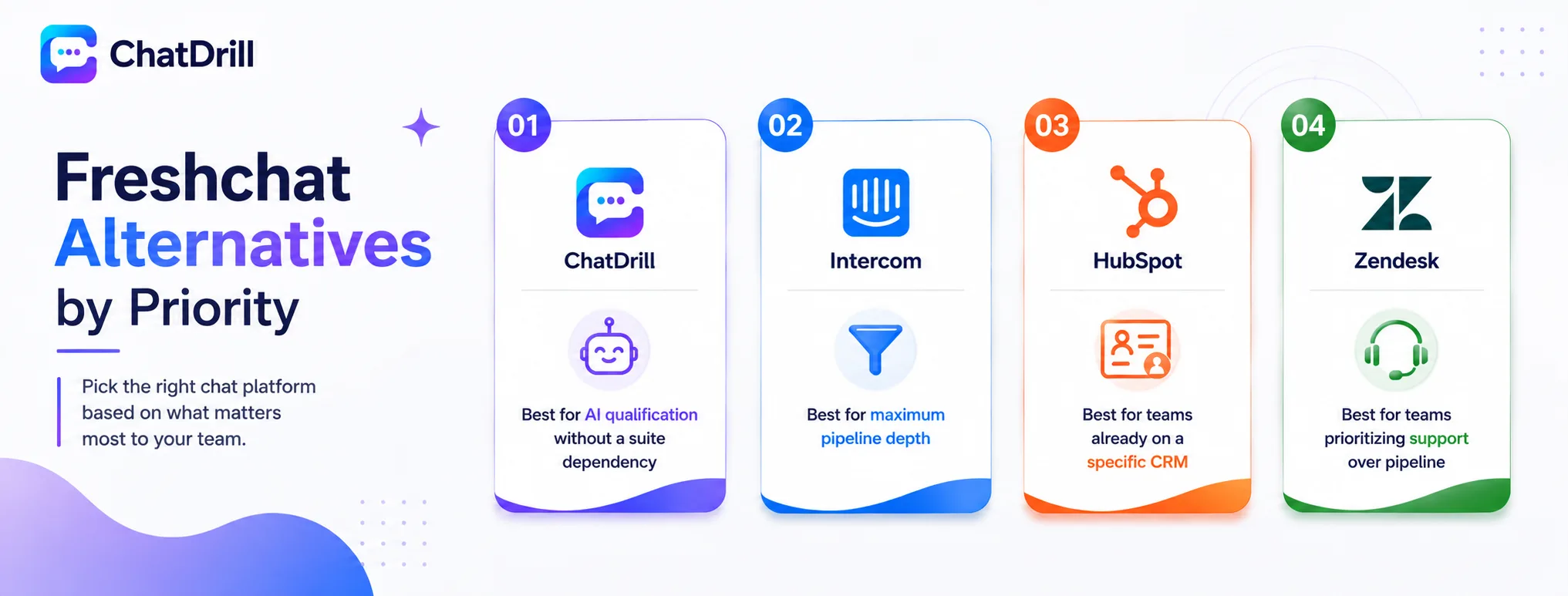
ChatDrill and Chatboq suit teams wanting AI qualification without a suite dependency, Intercom and Drift suit teams wanting maximum pipeline depth, HubSpot suits teams already on that CRM, and Zendesk suits teams prioritizing support over pipeline.
Best for AI qualification without a suite dependency
ChatDrill and Chatboq both offer genuine AI qualification that performs well entirely on their own, without requiring adoption of a broader product suite.
Between the two, ChatDrill balances qualification with support capability more evenly, while Chatboq leans more narrowly toward conversion-focused automation.
Either removes the ecosystem dependency that limits Freshchat's standalone appeal for a team not already using other Freshworks products.
Best for maximum pipeline depth
Intercom and Drift both offer strong pipeline-focused AI, suited to a SaaS team prioritizing lead qualification and routing above all else.
The decision between the two often comes down to how much genuine support capability is also needed from the same platform.
Best for teams already on a specific CRM
HubSpot suits a team already running its sales motion through HubSpot's CRM, extending that investment into chat rather than adopting a separate tool.
For a team without that existing tie, this advantage disappears entirely, making other chat-focused alternatives more directly comparable.
Best for teams prioritizing support over pipeline
Zendesk suits a SaaS team that weighs formal ticketing and support depth more heavily than pure trial-qualification automation.
This fits a team whose support volume has grown large enough that ticket consolidation matters more than chat-first lead qualification.
Freshchat Pricing vs Alternatives: A Closer Look
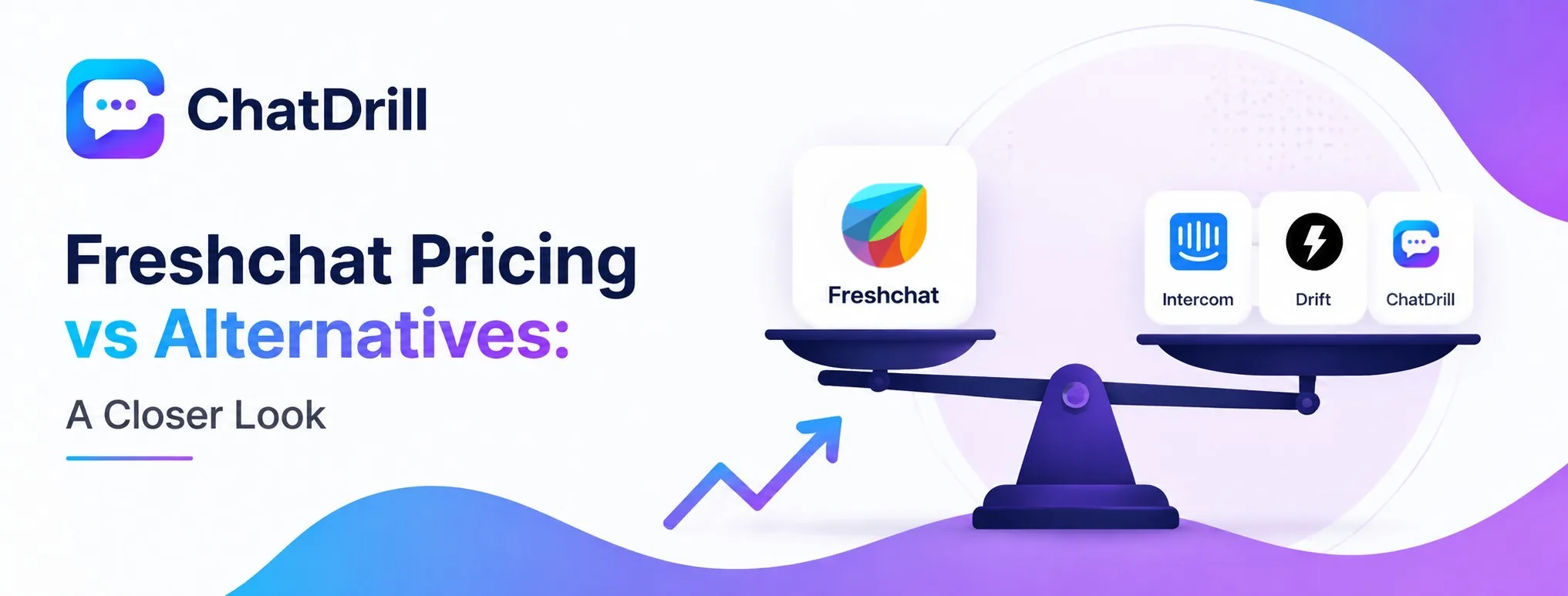
Freshchat's pricing is most competitive when bundled with other Freshworks products, which means a SaaS team evaluating it standalone should compare its true isolated cost against dedicated chat platforms rather than the bundled rate.
How Freshchat's pricing works standalone vs bundled
Freshchat can be purchased on its own, but its value proposition improves significantly when bundled with Freshdesk or Freshsales, which changes the real cost comparison for a standalone buyer.
A team evaluating Freshchat purely for chat should price it at its standalone rate, not the discounted bundle rate that assumes broader Freshworks adoption.
Where standalone buyers overpay relative to value
A SaaS team buying Freshchat alone, without the broader suite, often pays a rate that doesn't reflect the same value proposition Freshworks markets around its bundled pricing.
This gap is worth calculating explicitly before assuming Freshchat's advertised value applies equally to a standalone purchase.
How ChatDrill's pricing compares
ChatDrill's plan-based pricing is designed for standalone use from the start, generally producing better value for a team not adopting the broader Freshworks suite.
This also means the platform's full feature set is genuinely relevant to every plan, rather than being optimized around a bundle a specific team may never need.
How Intercom and Drift compare on cost
Intercom's usage-based AI pricing and Drift's enterprise-tier quotes both tend to land higher than Freshchat's standalone rate, worth factoring in if AI depth is the priority.
Neither offers the same pricing predictability as a plan-based alternative, worth weighing if budget forecasting matters to the decision.
What to ask about pricing before switching
Ask any vendor directly for standalone pricing rather than a bundled rate that assumes adoption of products your team doesn't plan to use.
It's also worth asking whether AI qualification is included at the quoted tier or requires an additional upgrade.
Calculating true cost for a standalone SaaS chat need
True cost should reflect what a team will actually pay for chat alone, not a hypothetical bundled rate that assumes broader suite adoption.
This distinction often changes the ranking meaningfully once the comparison is made honestly against a standalone alternative's plan-based pricing.
What to Consider Before Switching From Freshchat
Before switching, export existing conversation and lead data, plan to rebuild any automation flows that won't transfer, and confirm the new platform's CRM integration matches the depth your SaaS pipeline currently relies on.
Exporting conversation and lead data
Freshchat supports data export, but confirm the new platform's import process preserves lead scoring and qualification detail, not just raw conversation text.
Testing a small export and import batch first catches formatting or data loss issues before a full migration is underway.
Rebuilding automation flows
Freshchat's automation flows typically need to be rebuilt manually on the new platform rather than transferring automatically.
Documenting current flows before switching, rather than recreating them from memory, saves meaningful setup time and avoids losing logic that took real effort to refine.
Confirming CRM integration depth
Verify the new platform's CRM integration pushes the same depth of lead and conversation context that a SaaS pipeline currently relies on from Freshchat.
Testing this directly during a trial, with a real trial user moving through the flow, confirms the integration works as expected before fully committing.
Freshchat Alternatives With the Best Trial Onboarding AI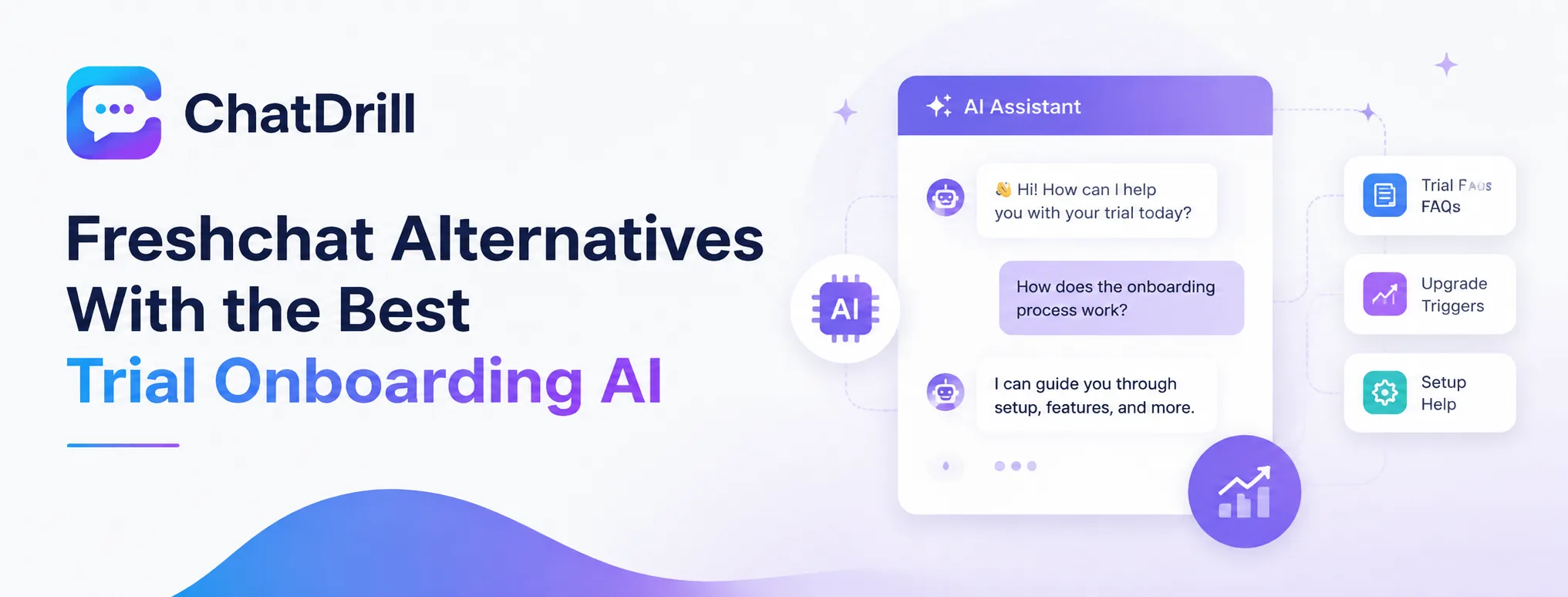
For SaaS teams specifically, the quality of a chat platform's AI during the free trial period matters disproportionately, since that's often the first real interaction a prospective customer has with the product's support experience.
Why trial-period AI quality matters more for SaaS
A trial user's first chat interaction often shapes their broader impression of the product itself, making AI quality during this window higher-stakes than for a typical support conversation.
A chatbot that handles trial-specific questions well, feature availability, upgrade paths, setup help, directly supports conversion in a way generic automation doesn't.
How ChatDrill and Intercom compare on trial-specific AI
Both platforms allow training the AI specifically on trial-related content, feature comparisons, common setup questions, upgrade triggers, rather than treating trial users the same as existing customers.
ChatDrill's approach tends to be more accessible for a smaller SaaS team to configure without extensive setup time, while Intercom's depth suits a team with more resources to invest in fine-tuning.
Setting up trial-specific AI training
Feeding the AI your product's actual trial FAQ content, common upgrade objections, and setup troubleshooting steps produces noticeably better trial-period conversations than a generic knowledge base alone.
Reviewing trial conversations weekly during the first month after launch helps identify gaps in this training before they affect a meaningful number of prospective customers.