
A SaaS company's live chat needs differ meaningfully from a typical ecommerce or general business use case, prioritizing trial-user qualification, technical support depth, and tight CRM integration over the order-status and product-question automation an online store needs most.
The chat experience often becomes a genuine part of the product funnel for SaaS specifically, a well-qualified trial conversation can shape whether a prospect converts to a paying customer, making chat's role extend well beyond traditional support.
This also means SaaS-specific evaluation criteria matter more here than in a general live chat comparison, AI that understands product-led growth signals, integration depth with the CRM managing the sales pipeline, and support for the more technical questions SaaS customers tend to ask.
Getting this choice right has outsized impact for a SaaS business specifically, since chat sits at the intersection of both support and pipeline generation in a way it often doesn't for other business types.
This guide covers what SaaS companies should specifically look for, the strongest live chat platforms for this use case in 2026, how they fit different SaaS priorities, a closer look at pricing, and what to plan for before switching.
What SaaS Companies Need From Live Chat Specifically
SaaS companies need live chat that can qualify trial and product-led leads, integrate tightly with the CRM managing their sales pipeline, and handle genuinely technical product questions with real depth rather than generic FAQ-style responses.
Trial and product-led qualification
A SaaS trial user's first chat interaction often shapes their broader impression of the product, making AI that genuinely qualifies intent and usage patterns more valuable than generic message relaying.
This qualification depth is where a SaaS-focused evaluation of live chat diverges most clearly from a general-purpose comparison, since the stakes of getting this specific interaction right are higher.
Tight CRM and pipeline integration
SaaS sales motions typically run through a CRM tracking pipeline stages, making it essential that chat-captured leads sync with full context, not just basic contact info, into that same system.
A shallow integration that only passes a name and email loses much of the qualification value chat could otherwise contribute to the sales process.
Genuine technical support depth
SaaS customers often ask nuanced, technical questions about integrations, API behavior, or specific feature edge cases, requiring AI trained on real product depth rather than a surface-level FAQ.
This depth requirement tends to separate platforms genuinely suited to SaaS from those built primarily for simpler, more transactional use cases like ecommerce.
What to Look for in Live Chat for a SaaS Company
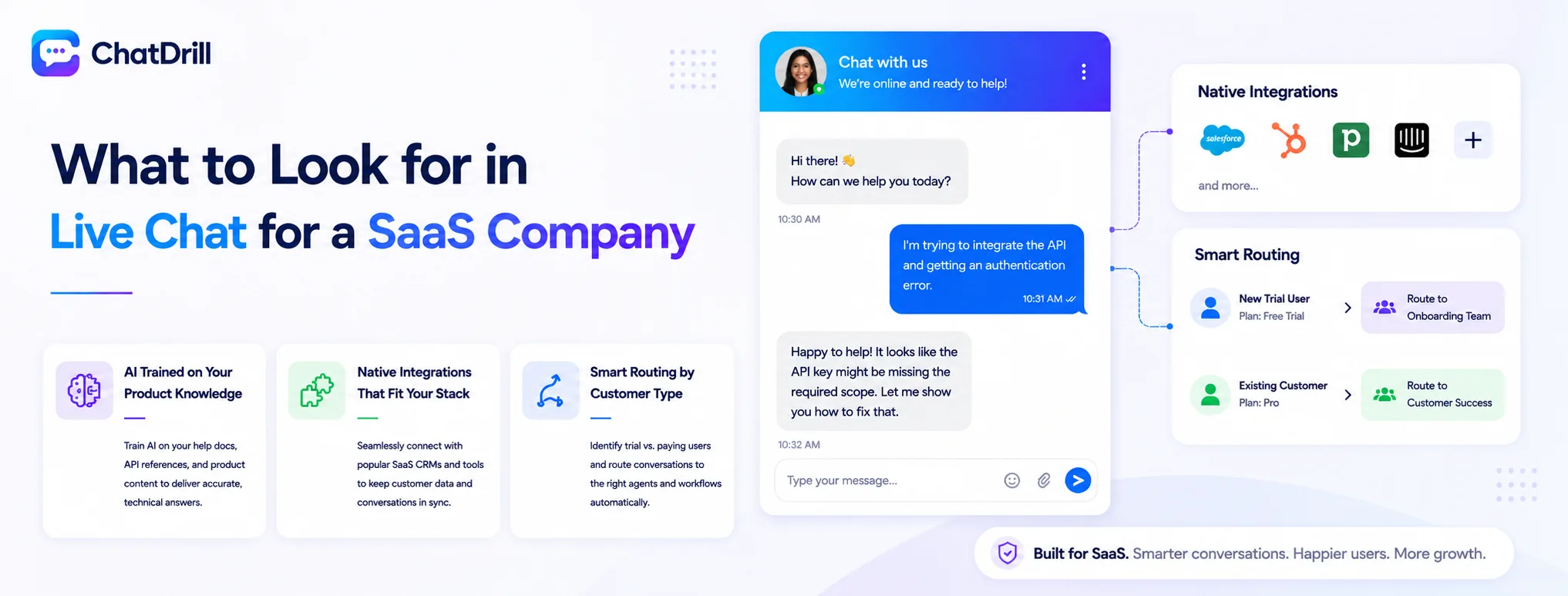
A strong SaaS live chat platform offers AI that can be trained on genuinely technical product content, native integration with common SaaS CRMs, and the ability to distinguish and route trial users differently than existing paying customers.
AI trainable on technical product content
Confirm the AI can be trained on genuinely technical documentation, API references, integration guides, not just a simplified consumer-facing FAQ.
Testing this directly with real, nuanced technical questions during a trial reveals whether the AI genuinely handles SaaS-level complexity or falls back to generic deflection.
Native CRM and sales pipeline integration
Verify the platform integrates natively and deeply with your specific CRM, pushing full conversation context and lead scores rather than just basic contact fields.
This integration depth often ends up mattering more to daily workflow than any single chat-specific feature considered in isolation.
Distinguishing trial users from existing customers
A platform that can identify and route a trial user differently, prioritizing qualification and conversion-focused conversation, than an existing customer needing support serves both audiences better than one-size-fits-all routing.
This distinction is particularly valuable for a product-led growth motion, where trial-user chat behavior directly signals conversion likelihood.
The Best Live Chat Software for SaaS Companies
ChatDrill leads for combining trial qualification with technical support depth, with Intercom, Drift, HubSpot, Crisp, and Zendesk each fitting a more specific SaaS priority.
ChatDrill — best overall for SaaS trial qualification and support
ChatDrill's AI handles both trial-user qualification and genuine technical support questions well, avoiding the common trade-off of a platform being strong in one and weak in the other.
Its CRM integration pushes full conversation context and lead scores, giving sales teams the depth needed to prioritize and follow up effectively on chat-sourced leads.
SaaS teams specifically valuing this dual capability, pipeline generation and support, from one platform tend to find ChatDrill's balance particularly well suited.
Intercom — best for the deepest available AI agent
Intercom's AI agent handles complex, multi-turn technical conversations well, suited to a SaaS team prioritizing maximum AI depth over cost predictability.
This is a natural fit for a well-funded SaaS company that isn't primarily optimizing for cost relative to alternatives, but wants the strongest available AI capability.
Its usage-based AI billing is worth modeling carefully as trial volume and successful automation both scale with company growth.
Drift — best for pure pipeline-focused SaaS teams
Drift specializes in qualifying and routing leads directly to sales, a strong fit for a SaaS company whose chat strategy centers primarily on pipeline generation.
Its narrower focus means genuine technical support conversations feel secondary, worth weighing against how much support depth a specific SaaS team also needs from the same tool.
Teams choosing Drift are consciously prioritizing sales pipeline generation above balanced support capability.
HubSpot — best for teams already on that CRM
HubSpot's chat ties directly into its CRM, a natural fit for a SaaS team already running its sales motion through HubSpot's platform.
The chat and AI capability itself is lighter than a dedicated platform, but the CRM integration is genuinely native rather than layered on afterward.
Teams not already on HubSpot are unlikely to find enough standalone chat value to justify adopting it purely for this purpose.
Crisp — best lower-cost starting point for early-stage SaaS
Crisp offers a genuinely useful free tier, a reasonable landing spot for an early-stage SaaS company not yet ready to invest in dedicated AI qualification.
It lacks the trial-qualification depth of AI-first alternatives, making it more of a starting point than a full solution for a growing SaaS company.
Teams choosing Crisp for cost reasons should expect to revisit the decision once trial qualification becomes a genuine growth priority.
Zendesk — best for SaaS companies prioritizing formal ticketing
Zendesk's messaging extends its established ticketing platform, appealing to a SaaS company with a support-heavy operation that wants formal ticket tracking alongside chat.
This suits a company whose support volume has grown complex enough that ticketing structure matters more than chat-first trial qualification.
Teams choosing Zendesk over more chat-first alternatives are consciously prioritizing support ticketing depth over pipeline-focused chat capability.
SaaS Live Chat Platforms by Priority
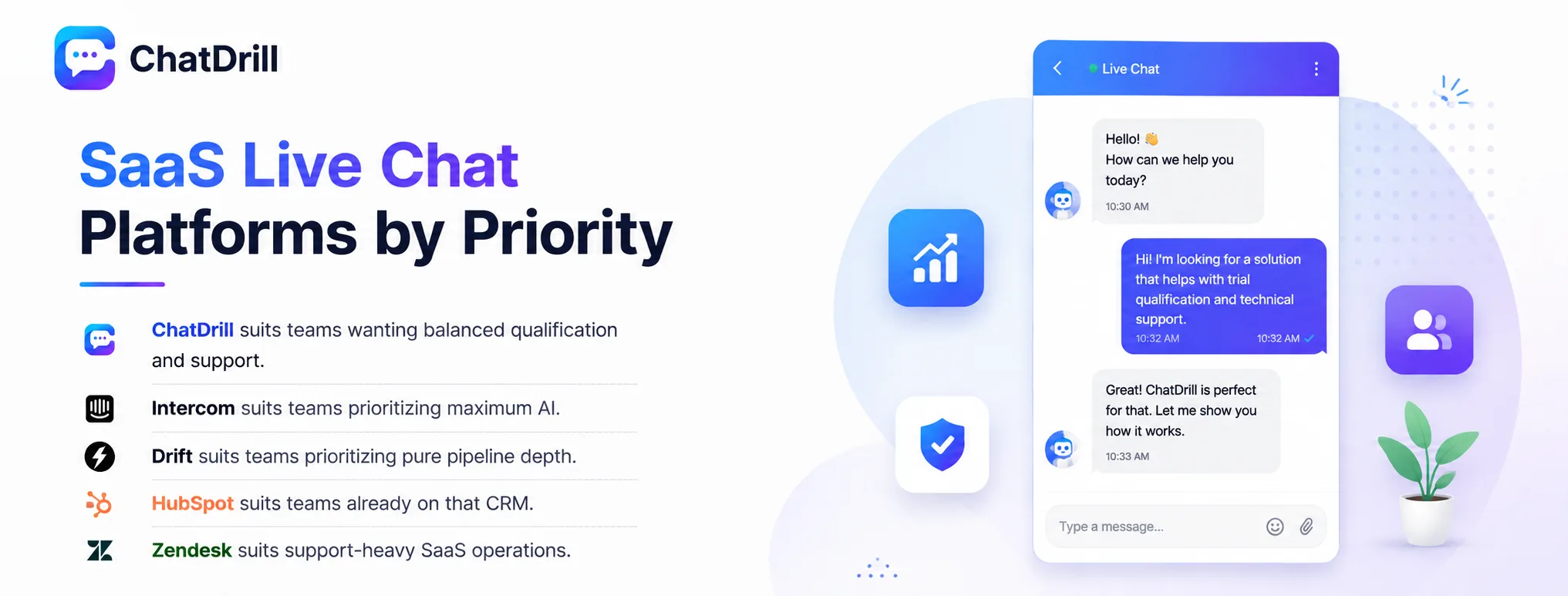
ChatDrill suits teams wanting balanced qualification and support, Intercom and Drift suit teams prioritizing maximum AI or pure pipeline depth respectively, HubSpot suits teams already on that CRM, and Zendesk suits support-heavy SaaS operations.
Best for a balance of qualification and support
ChatDrill's balance of trial qualification and technical support depth suits a SaaS company that needs both functions genuinely well served from one platform.
This balance tends to matter most for a growing SaaS company where both pipeline generation and support quality are equally important priorities.
Best for maximum AI depth or pure pipeline focus
Intercom and Drift both push toward one extreme, maximum AI capability or maximum pipeline focus, suited to a team with a clear, singular priority.
The decision between the two often comes down to whether support depth or sales-pipeline generation matters more to that specific team's chat strategy.
Best for teams already on a specific CRM
HubSpot suits a SaaS company already running its sales motion through HubSpot's CRM, extending that existing investment into chat.
For a team without that existing tie, this advantage disappears entirely, making other chat-focused alternatives more directly comparable.
Best for support-heavy SaaS operations
Zendesk suits a SaaS company whose support volume and complexity justify formal ticketing structure alongside chat capability.
This fits a more mature SaaS company with a larger, more established customer base generating a meaningful volume of technical support needs.
SaaS Live Chat Pricing: What to Expect
Pricing for SaaS-suited live chat ranges from plan-based models that scale predictably with team size to usage-based AI billing that can grow alongside successful automation, making the pricing structure itself worth weighing as heavily as the sticker price.
Plan-based versus usage-based pricing for SaaS specifically
A growing SaaS company benefits most from predictable, plan-based pricing that doesn't penalize successful AI automation adoption with rising usage-based fees.
Modeling total cost at a projected future team and trial volume, not just today's numbers, reveals which pricing structure genuinely suits a fast-growing SaaS trajectory.
What SaaS-specific features tend to cost extra
Deeper CRM integration, trial-specific AI training, and advanced lead scoring sometimes sit behind a premium tier even on platforms otherwise well suited to SaaS needs.
Confirming these specific SaaS-relevant features are included at the tier being evaluated, rather than assuming they're standard, avoids an incomplete cost comparison.
Calculating ROI for a SaaS-specific chat investment
For SaaS specifically, ROI calculations should account for chat's contribution to trial conversion, not just support cost savings, since pipeline impact is often the larger value driver.
Tracking chat-engaged trial users' conversion rate against the overall trial base gives a concrete number to weigh against the platform's cost.
What to Plan for Before Switching SaaS Live Chat Platforms
Before switching, export existing conversation and lead data, plan to rebuild trial-specific qualification flows, and confirm the new platform's CRM integration matches the depth your sales pipeline currently relies on.
Exporting conversation and lead data
Export existing chat history and lead-scoring data before switching, confirming the new platform's import process preserves this SaaS-specific context, not just basic conversation text.
Testing a small export and import batch first catches formatting or data loss issues before a full migration is underway.
Rebuilding trial-specific qualification flows
Qualification logic tuned to your specific trial and product-led growth funnel typically needs to be rebuilt manually on the new platform rather than transferring automatically.
Documenting current qualification flows before switching, rather than recreating them from memory, preserves the specific logic that took real effort to refine.
Confirming CRM integration depth for your pipeline
Verify the new platform's CRM integration pushes the same depth of lead and conversation context your sales pipeline currently relies on.
Testing this directly during a trial, with a real trial-user scenario moving through the full flow, confirms the integration works as expected before fully committing.