
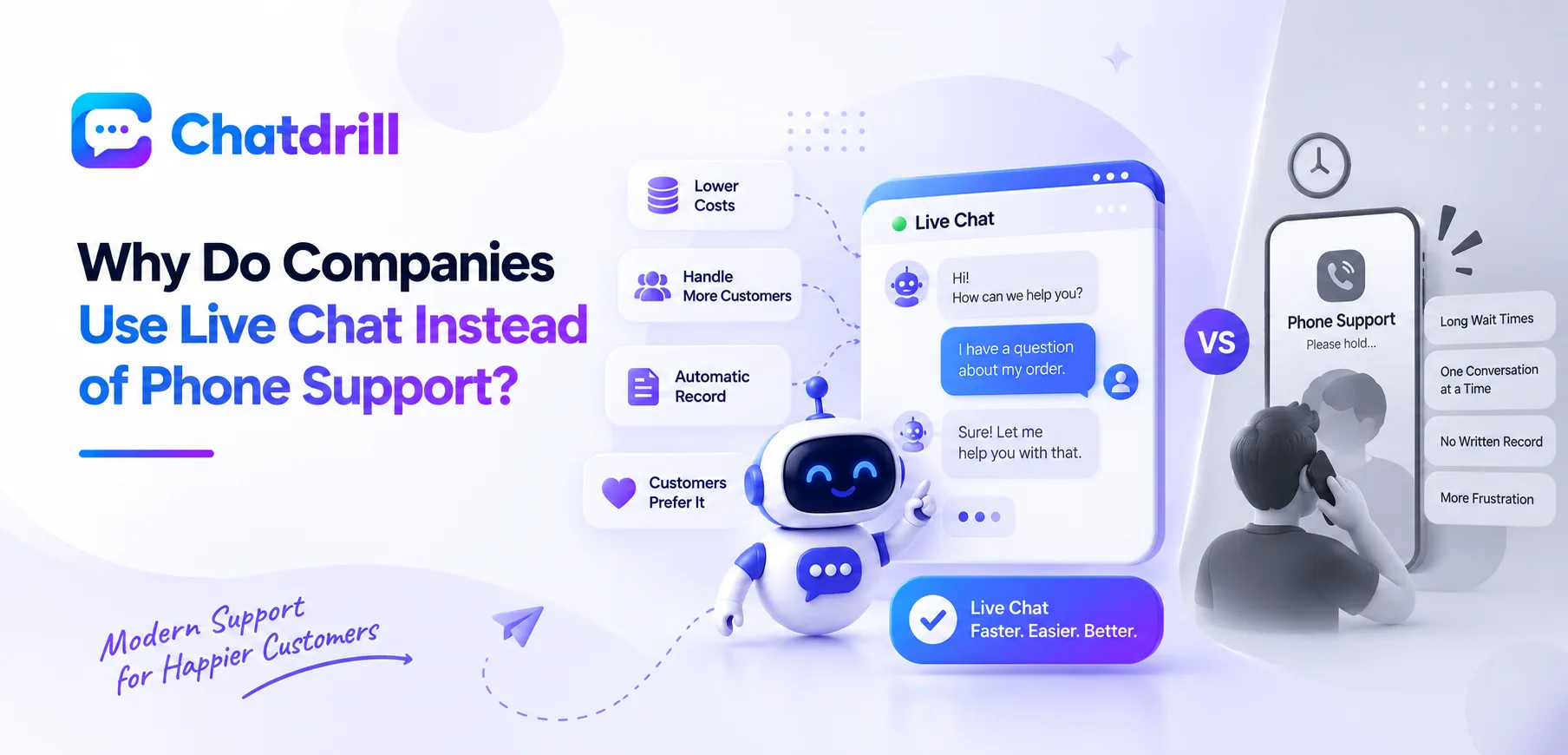
Support?
The shift from phone support toward live chat has been one of the more visible changes in customer service over the past several years, and understanding exactly why companies are making this shift clarifies whether it's a genuine improvement or simply a cost-cutting measure dressed up as innovation.
Quick answer: Companies increasingly use live chat instead of phone support because it costs less per interaction, lets one agent handle multiple conversations simultaneously, creates an automatic written record, and matches how customers increasingly prefer to communicate, without requiring a customer to wait on hold for a spoken conversation.
The honest answer includes both genuine customer experience benefits and real cost efficiency, chat isn't purely a cynical cost-cutting move, though cost genuinely is one legitimate factor among several driving the shift.
Understanding the specific, concrete reasons behind this shift helps clarify when chat genuinely serves customers better and when phone support still deserves a place in a business's overall channel strategy.
This guide covers the cost efficiency argument, the concurrency advantage, the written record benefit, evolving customer preference, and how ChatDrill supports this broader shift.
The Cost Efficiency Argument
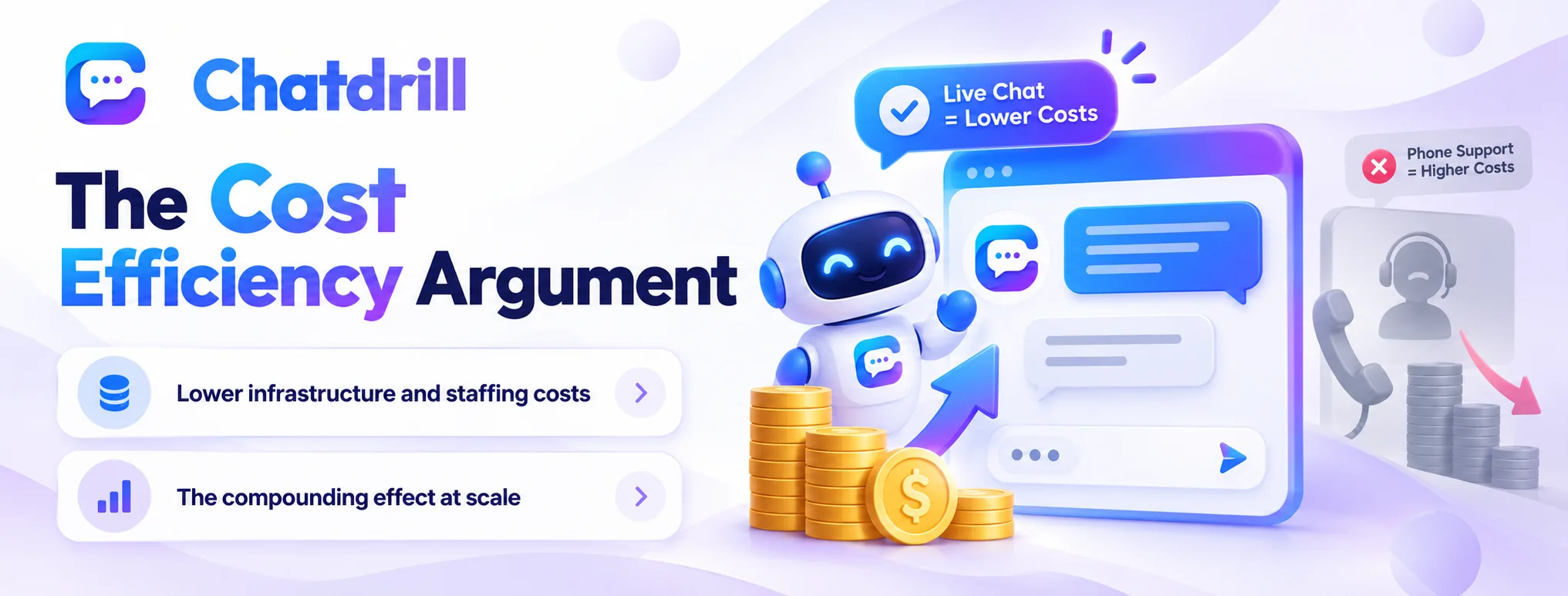
Live chat costs meaningfully less per interaction than phone support, reflecting both lower infrastructure needs and the concurrency advantage covered separately below.
Lower infrastructure and staffing costs
Chat doesn't require the same telephony infrastructure investment phone support depends on, and its text-based nature also opens hiring to a broader pool of qualified agents not constrained by voice-specific skills or accent considerations some phone support roles emphasize.
This combination of lower infrastructure and broader hiring pool contributes to chat's generally lower cost profile compared to maintaining equivalent phone support capacity.
The compounding effect at scale
This cost advantage compounds significantly at higher volume, since the savings apply per interaction, making the total efficiency gain considerably larger for a business handling meaningful support volume than for one with only occasional customer contact.
This scaling effect is part of why cost efficiency features so prominently in the business case for shifting volume toward chat specifically.
The Concurrency Advantage
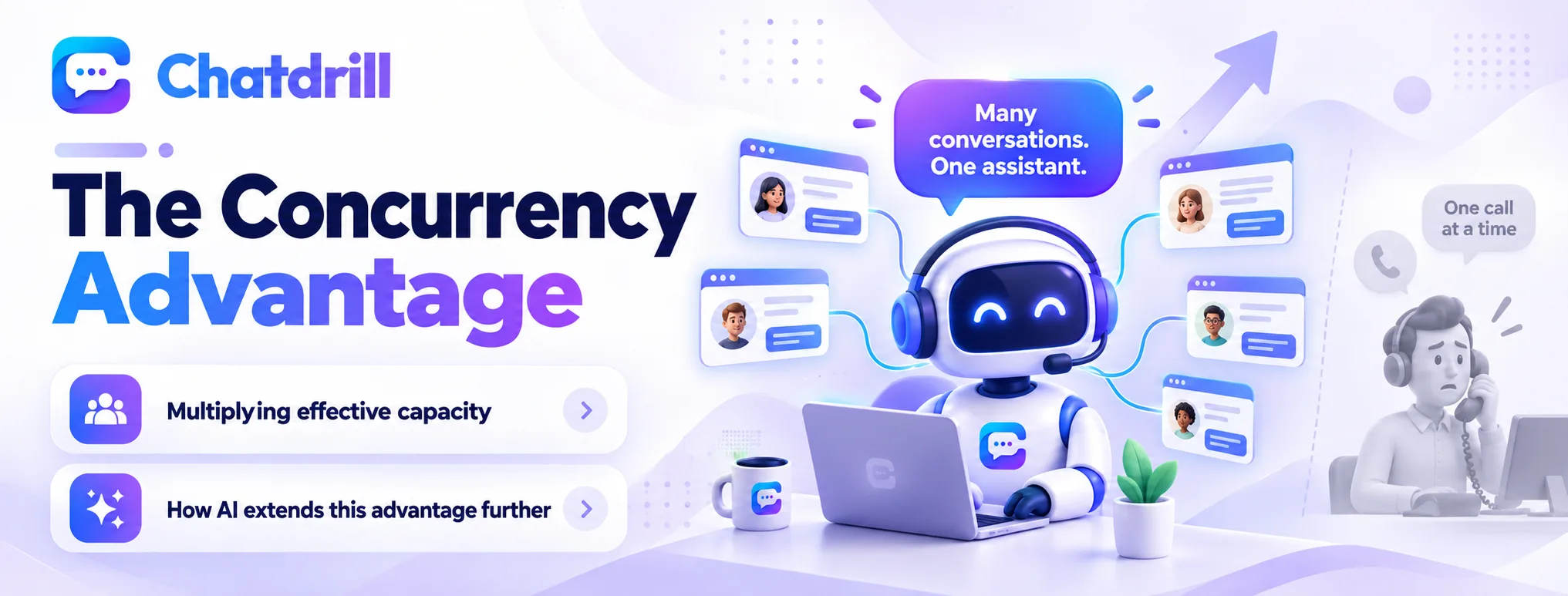
A chat agent can typically handle multiple simultaneous conversations, while a phone agent can only handle one call at a time, directly multiplying effective staffing capacity.
Multiplying effective capacity
Because a chat agent can often manage three to five conversations simultaneously depending on complexity, effective support capacity multiplies without requiring proportional headcount growth, an advantage phone support's one-call-at-a-time structure simply can't replicate.
This concurrency advantage represents one of the most direct, quantifiable reasons chat delivers genuine efficiency gains beyond simple per-interaction cost comparison alone.
How AI extends this advantage further
Layering AI on top of human chat concurrency extends this advantage even further, since AI can handle a large number of simultaneous conversations without the cognitive limits a human agent faces.
This AI-extended concurrency represents the next evolution of the same underlying efficiency principle that already made chat more scalable than phone support.
The Written Record Benefit
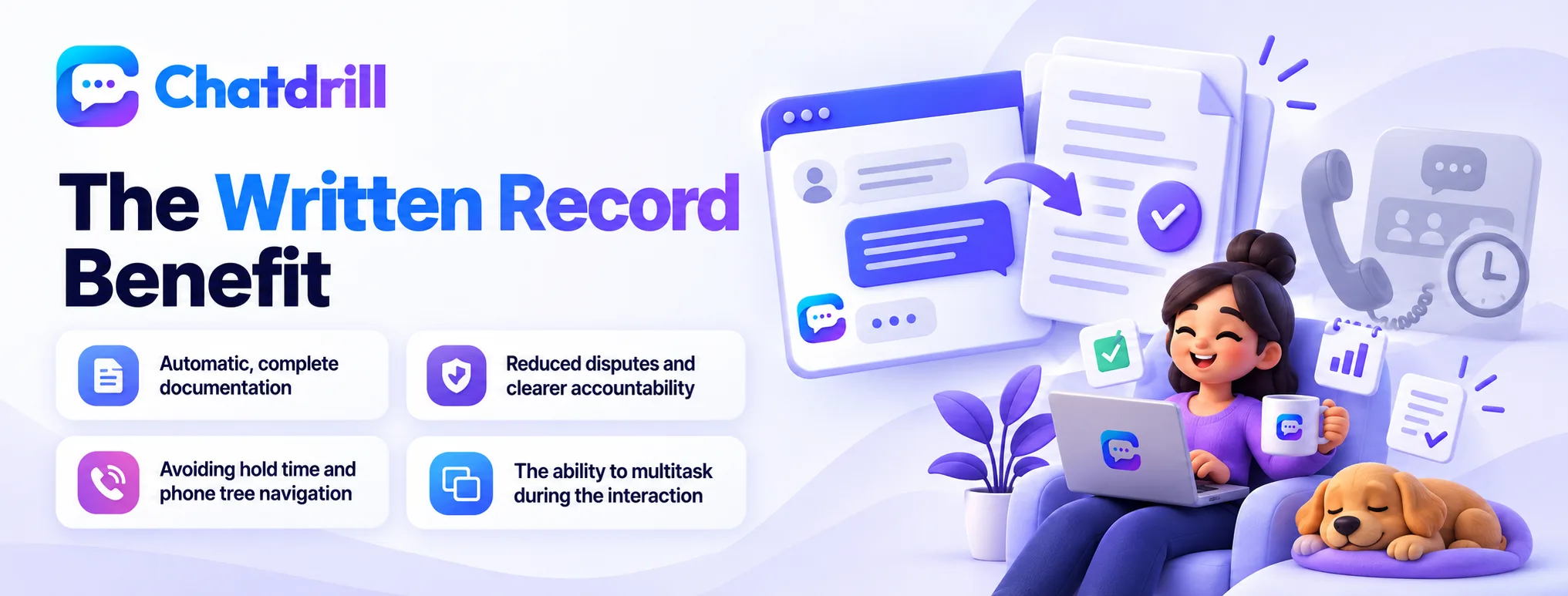
Chat automatically creates a complete written transcript, while phone support requires separate, often incomplete manual note-taking to capture the same conversation detail.
Automatic, complete documentation
Every chat conversation is automatically preserved as a complete, accurate written record, while a phone conversation depends on an agent's manual notes, which are inevitably less complete and more prone to error or omission.
This automatic documentation genuinely benefits both quality assurance and any future need to reference exactly what was discussed or promised during a specific interaction.
Reduced disputes and clearer accountability
Having an exact, unambiguous record of what was said reduces the potential for disputes about what a customer was actually told, a genuine benefit for both the business and the customer compared to relying on possibly inaccurate memory or notes.
This clarity also supports more accurate coaching and quality review, since a reviewer can see exactly what happened rather than relying on a summary.
Evolving Customer Preference
Many customers, particularly for straightforward questions, now genuinely prefer chat's text-based, no-hold-time format over the traditional phone support experience.
Avoiding hold time and phone tree navigation
Chat generally avoids the frustrating experience of navigating an automated phone tree or waiting on hold, letting a customer submit their question and, ideally, receive help without either of these common phone support pain points.
This avoidance of a widely disliked phone support experience contributes meaningfully to chat's growing preference among many customers.
The ability to multitask during the interaction
Chat lets a customer continue other tasks while waiting for or reading a response, unlike a phone call that generally demands full, undivided attention throughout the interaction.
This multitasking flexibility fits naturally into how many people already manage their digital communication throughout the day, another genuine factor behind the shift.
How ChatDrill Supports This Broader Shift
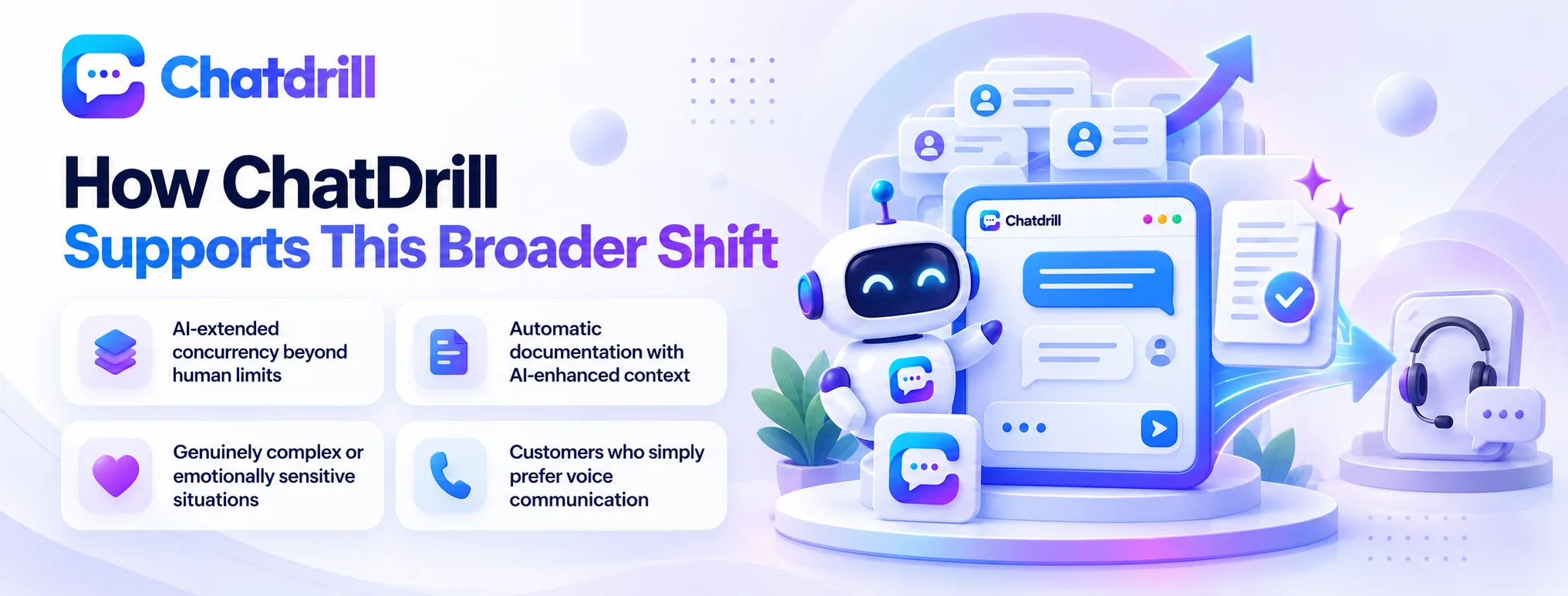
ChatDrill extends chat's core advantages, concurrency, documentation, and speed, through AI-assisted automation that pushes the efficiency case for chat over phone even further.
AI-extended concurrency beyond human limits
ChatDrill's AI can handle a substantial share of conversations automatically, extending the concurrency advantage this guide describes well beyond what human agents alone could achieve, regardless of how many simultaneous conversations a person can reasonably manage.
This extension represents the next step in the same underlying efficiency principle that already made chat more scalable than phone support.
Because this extension scales automatically with volume, it holds up during unexpected traffic spikes in a way that adding more human phone agents on short notice simply couldn't match.
Automatic documentation with AI-enhanced context
Beyond simply preserving a written transcript, ChatDrill's system can highlight key details or summarize a conversation automatically, extending the written-record benefit this guide identifies into a genuinely more useful, easily reviewable format.
This enhancement makes the already-strong documentation advantage of chat even more valuable for quality review and future reference.
When Phone Support Still Makes Sense Alongside Chat
Rather than eliminating phone support entirely, many businesses find genuine value in keeping it available specifically for situations where voice communication conveys something text can't.
Genuinely complex or emotionally sensitive situations
A situation involving significant emotional weight, a serious complaint or a sensitive personal circumstance, often benefits from the nuance and warmth voice communication conveys in a way text-based chat, however well-designed, doesn't fully replicate.
Recognizing these specific situations and maintaining a genuine phone option for them respects that the shift toward chat doesn't need to be absolute to still capture most of its efficiency benefit.
Customers who simply prefer voice communication
A meaningful share of customers, particularly for certain demographics or in certain cultural contexts, genuinely prefer voice communication regardless of how well-designed the chat alternative is.
Maintaining phone as an available option respects this genuine preference variation rather than forcing every customer into a channel that doesn't match how they'd prefer to communicate.