
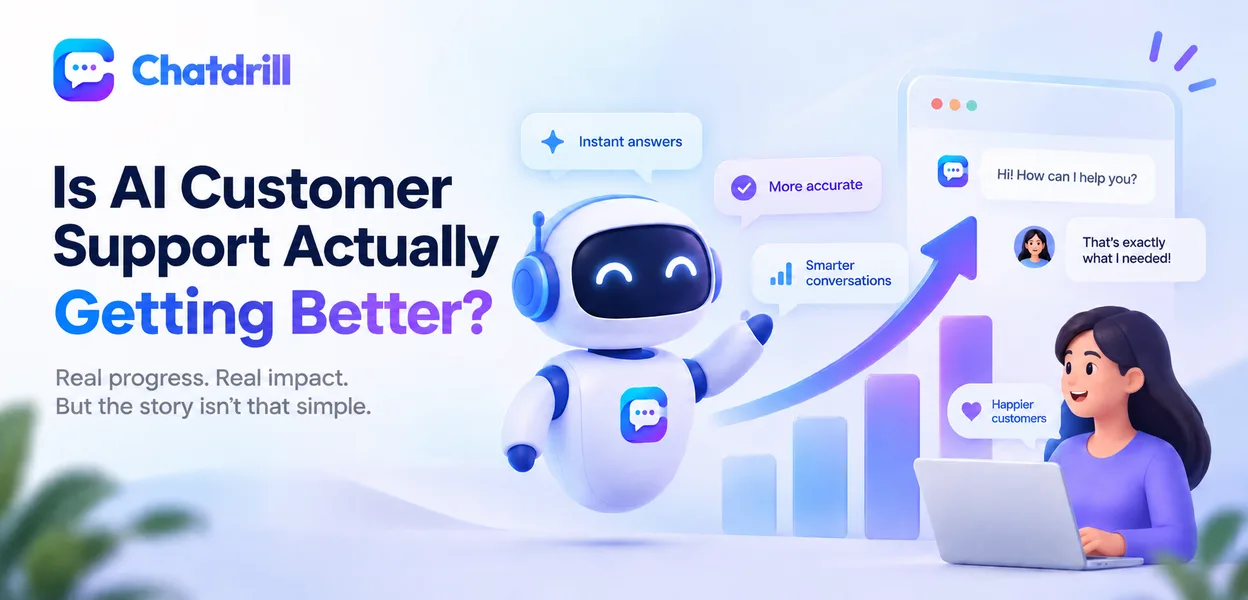
Whether AI customer support is genuinely getting better, rather than simply being marketed as improved without real substance behind the claim, is a fair question given how much hype surrounds AI generally.
Quick answer: Yes, AI customer support has genuinely improved significantly in recent years, with better natural language understanding, more accurate responses, and growing agentic capability, though genuine limitations still remain for emotionally complex or highly novel situations, meaning the improvement is real but not yet complete.
The honest answer is yes, genuine, measurable improvement has occurred, particularly in natural language understanding and response accuracy, though this progress hasn't yet closed every gap between AI and human capability.
Understanding specifically where genuine improvement has occurred, and where meaningful limitations persist, provides a more accurate picture than either uncritical AI enthusiasm or reflexive skepticism about the technology's real progress.
This guide covers where genuine improvement has occurred, what's driving it, where limitations persist, how to evaluate current AI quality, and how ChatDrill reflects this real, ongoing progress.
Where Genuine Improvement Has Occurred
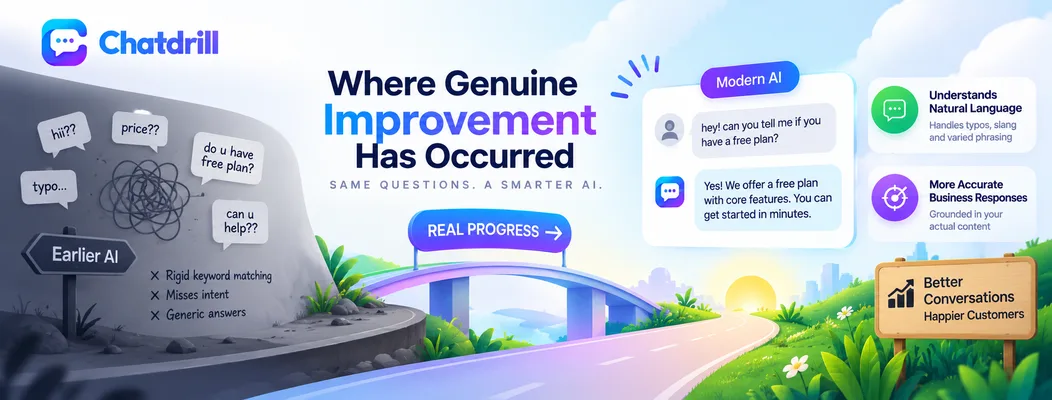
Natural language understanding, response accuracy, and the ability to maintain context across a conversation have all genuinely improved substantially in recent AI generations.
Better understanding of natural, varied phrasing
Current AI systems handle genuinely varied, natural phrasing, typos, slang, indirect questions, considerably better than earlier generations, which often required a visitor to match specific anticipated wording to get a useful response.
This improvement in understanding represents one of the most practically meaningful advances, since it directly determines how often a real customer's actual message gets correctly interpreted.
More accurate, business-specific responses
Modern AI training approaches allow considerably more accurate, business-specific responses grounded in a company's actual content, rather than relying on generic, potentially inaccurate general knowledge.
This grounding improvement directly addresses one of the most common historical complaints about AI customer support, generic or subtly incorrect answers that didn't reflect the actual business's specific situation.
What's Driving This Improvement
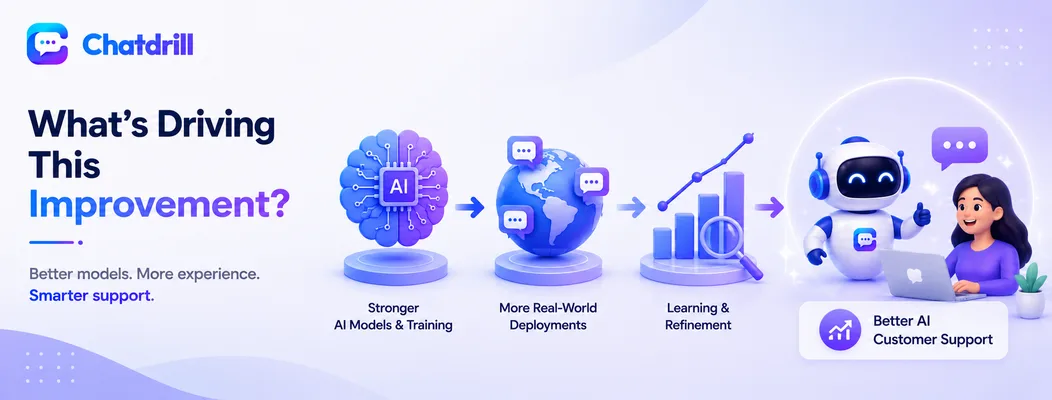
Underlying model and training advances
real-world deployment experience all contribute to the genuine progress AI customer support has made.
Underlying model and training advances The foundational AI models powering customer support tools have genuinely advanced in their core language understanding capability, providing a stronger technical base for any specific customer support application built on top of them.
This foundational progress benefits every application built using these improved underlying models, including customer support specifically.
Growing deployment experience and refinement
As more businesses have deployed AI customer support and refined it based on real usage, accumulated practical knowledge about what genuinely works has improved the broader field's collective understanding, not just any single vendor's product.
This real-world learning effect compounds over time, meaning current AI customer support benefits from genuine, accumulated practical experience beyond pure technical model improvement alone.
Where Meaningful Limitations Persist
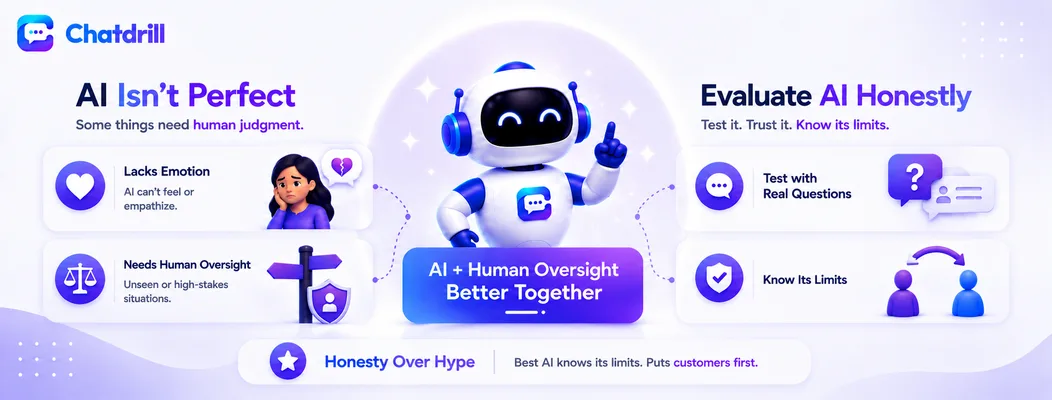
Highly novel or consequential judgment calls
calls remain areas where current AI still falls meaningfully short of human capability.
Emotional nuance and genuine empathy
Despite improved language generation, AI still doesn't genuinely possess the authentic emotional understanding a thoughtful human brings to a genuinely distressing or sensitive customer situation.
This gap remains one of the most consistently cited limitations, even as other AI capabilities have advanced considerably.
Highly novel or consequential judgment calls A situation genuinely outside anything an AI system has been trained to anticipate, or one requiring a consequential judgment call with significant stakes, still benefits from human oversight rather than full AI autonomy.
This limitation is why even the most advanced current AI customer support systems still maintain human escalation paths rather than operating with complete independence.
How to Evaluate Current AI Quality Honestly
Testing a system against your own genuinely varied, real customer questions reveals actual current quality more reliably than relying on general claims about AI progress.
Testing with your own real, varied questions
Running actual, representative customer questions through a candidate AI system, rather than relying on a vendor's polished demonstration, reveals genuine current quality specific to your business's actual needs.
This hands-on evaluation matters more than general industry claims about AI progress, since quality genuinely varies across different implementations and training approaches.
Watching for honest limitation acknowledgment
A system that gracefully acknowledges uncertainty and escalates appropriately, rather than confidently guessing on genuinely difficult questions, demonstrates a more mature, trustworthy implementation than one that always attempts a confident answer regardless of genuine capability.
This honest-limitation behavior is often a better quality signal than raw accuracy claims alone, since it reflects whether a system genuinely understands its own boundaries.
How ChatDrill Reflects This Genuine Progress
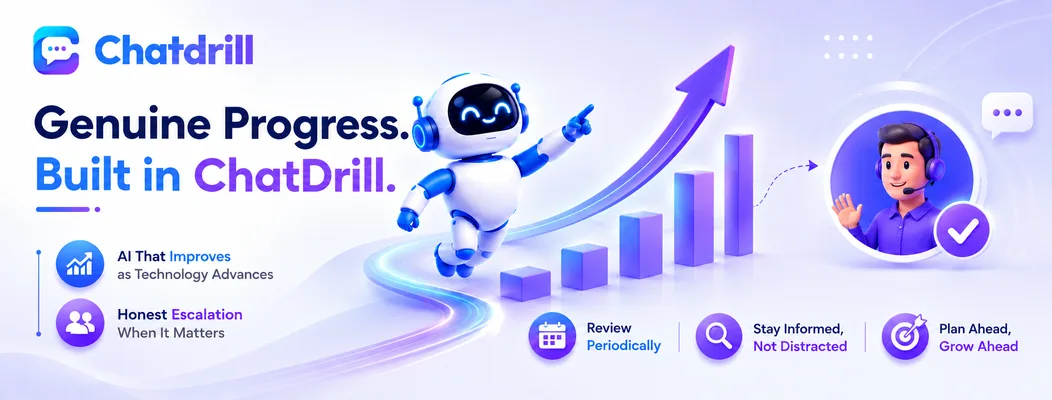
ChatDrill's AI incorporates the genuine understanding and accuracy improvements this guide describes, while maintaining honest escalation for situations that still genuinely benefit from human judgment.
Benefiting from genuine underlying model progress
ChatDrill's AI capability reflects the genuine, ongoing improvement in underlying language understanding this guide describes, providing considerably more accurate and natural conversation handling than earlier chatbot generations achieved.
This foundation means ChatDrill's capability genuinely improves as the broader underlying technology continues to advance, rather than remaining static at an earlier technical level.
This ongoing improvement also means training content prepared today continues to deliver increasing value as the underlying model capability it runs on continues to mature.
Honest escalation reflecting genuine current limitations
Rather than pretending to handle every situation, ChatDrill escalates genuinely complex or emotionally sensitive conversations to a human agent, reflecting an honest, mature understanding of where current AI capability still has genuine limitations.
This honesty aligns with the evaluation approach this guide recommends, prioritizing genuine quality signals over overstated capability claims.
What Genuine Progress Means for Your Own Planning
Given that AI capability continues genuinely improving, planning for periodic reassessment rather than a one-time adoption decision keeps a business aligned with where the technology actually stands.
Revisiting your own AI configuration periodically
Since genuine capability continues advancing, periodically reviewing whether your current AI training and configuration still reflect the best available approach helps ensure you're benefiting from ongoing progress rather than staying fixed at an earlier setup.
This periodic reassessment doesn't need to be frequent, but treating it as a deliberate, recurring practice rather than a one-time decision keeps your implementation genuinely current.
Staying informed without chasing every new claim
Following genuine, credible sources of AI progress information, rather than reacting to every marketing claim, helps a business distinguish real improvement worth adopting from hype that doesn't yet reflect genuine, tested capability.
This balanced awareness supports informed decisions about when to invest in expanding AI capability further, without either dismissing genuine progress or chasing unproven claims prematurely.