
AI hallucination happens when a chatbot generates a confident, plausible-sounding answer that's actually incorrect, not because it's malfunctioning, but because the underlying technology can produce fluent text even when it doesn't genuinely have accurate information to draw on.
In customer support specifically, this is a genuinely serious risk, a hallucinated answer about pricing, a return policy, or a technical capability can mislead a customer and create real business and trust consequences beyond just an awkward moment.
The good news is hallucination risk can be meaningfully reduced, though not entirely eliminated, through deliberate technical and process choices, grounding responses in real content, setting clear escalation boundaries, and monitoring for patterns.
Understanding why hallucinations happen in the first place helps clarify why certain prevention strategies work, rather than treating this as an unsolvable mystery inherent to all AI systems equally.
This guide covers what AI hallucination actually means, why it happens, the real business risk involved, concrete prevention strategies, how to respond when it occurs, and how ChatDrill's architecture specifically reduces this risk.
What AI Hallucination Actually Means
AI hallucination refers to a chatbot generating a fluent, confident-sounding response that's factually incorrect, a byproduct of how language models generate text based on patterns rather than verified, guaranteed facts.
Simple definition
Unlike a system error or a crash, hallucination produces output that looks entirely normal and confident, making it genuinely harder to detect than an obvious technical failure would be.
This is a known characteristic of language model technology broadly, not a sign of a specific platform being poorly built, though different architectures and safeguards produce meaningfully different hallucination rates in practice.
Understanding this as a genuine, inherent characteristic of the technology, rather than an occasional bug, shapes how seriously prevention strategies should be taken.
Why this differs from a simple wrong answer
A hallucination isn't the AI saying "I don't know" incorrectly, it's generating specific, detailed, entirely plausible-sounding information that simply isn't true, a meaningfully more dangerous failure mode.
This confident presentation is exactly what makes hallucination risky, a customer has no obvious signal that the information they received might be fabricated rather than genuinely accurate.
Why Hallucinations Happen
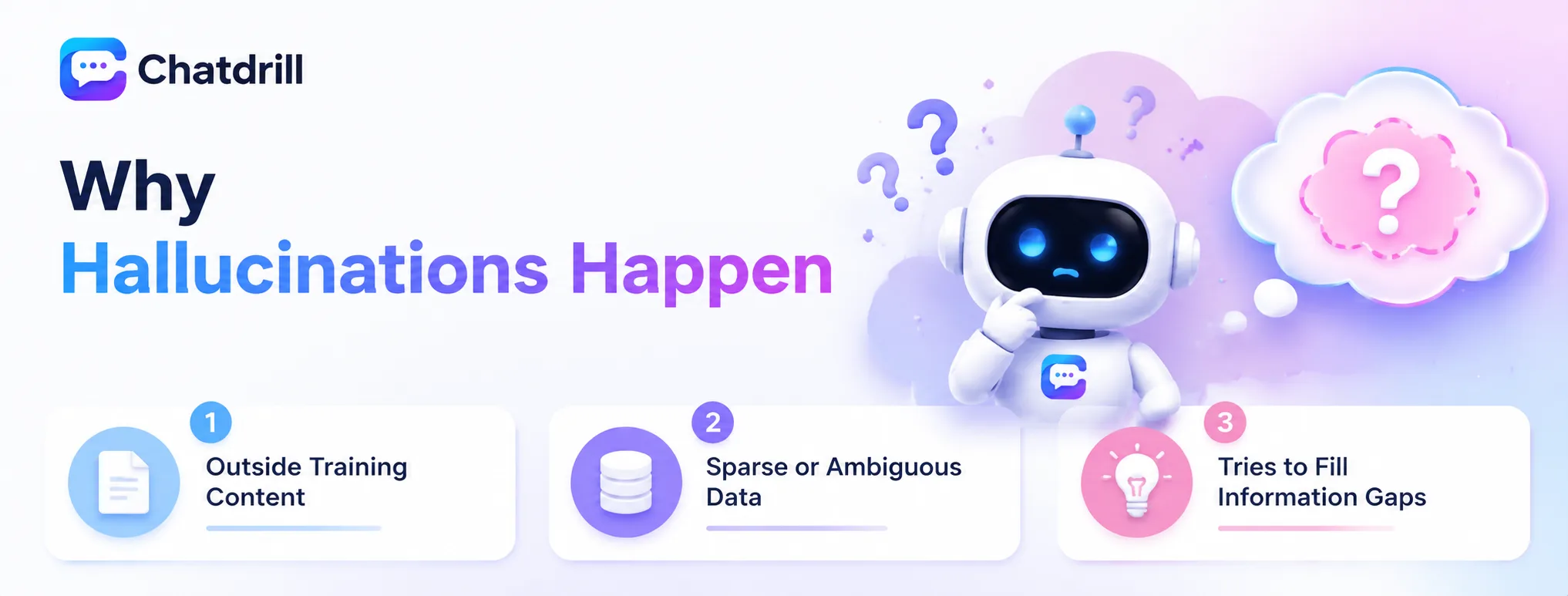
Hallucinations happen most often when an AI is asked something outside its training content, when training data is sparse or ambiguous on a specific topic, and when a model attempts to be helpful by filling a genuine information gap with plausible-sounding content.
Questions outside available training content
When asked something the AI genuinely wasn't trained on, it can still generate a fluent-sounding response by drawing on general patterns rather than acknowledging the actual gap in its specific knowledge.
This is precisely why training content completeness, covered in a related guide on knowledge base training, directly affects hallucination risk, a well-trained AI has less need to fill gaps this way.
Sparse or ambiguous training data
Even within its training scope, if source content is thin or genuinely ambiguous on a specific point, the AI may generate a plausible-sounding but ultimately fabricated specific detail to fill the gap.
This risk is why training content quality, not just volume, genuinely matters, clear and unambiguous source documentation reduces this specific failure mode.
The model's inherent tendency toward helpfulness
Language models are generally optimized to be helpful and responsive, which can inadvertently encourage generating a specific-sounding answer rather than an honest acknowledgment of genuine uncertainty.
This tendency is a genuine architectural characteristic worth understanding, since it explains why hallucination isn't simply a matter of the AI being poorly trained on a narrow topic alone.
The Real Business Risk of Hallucinations
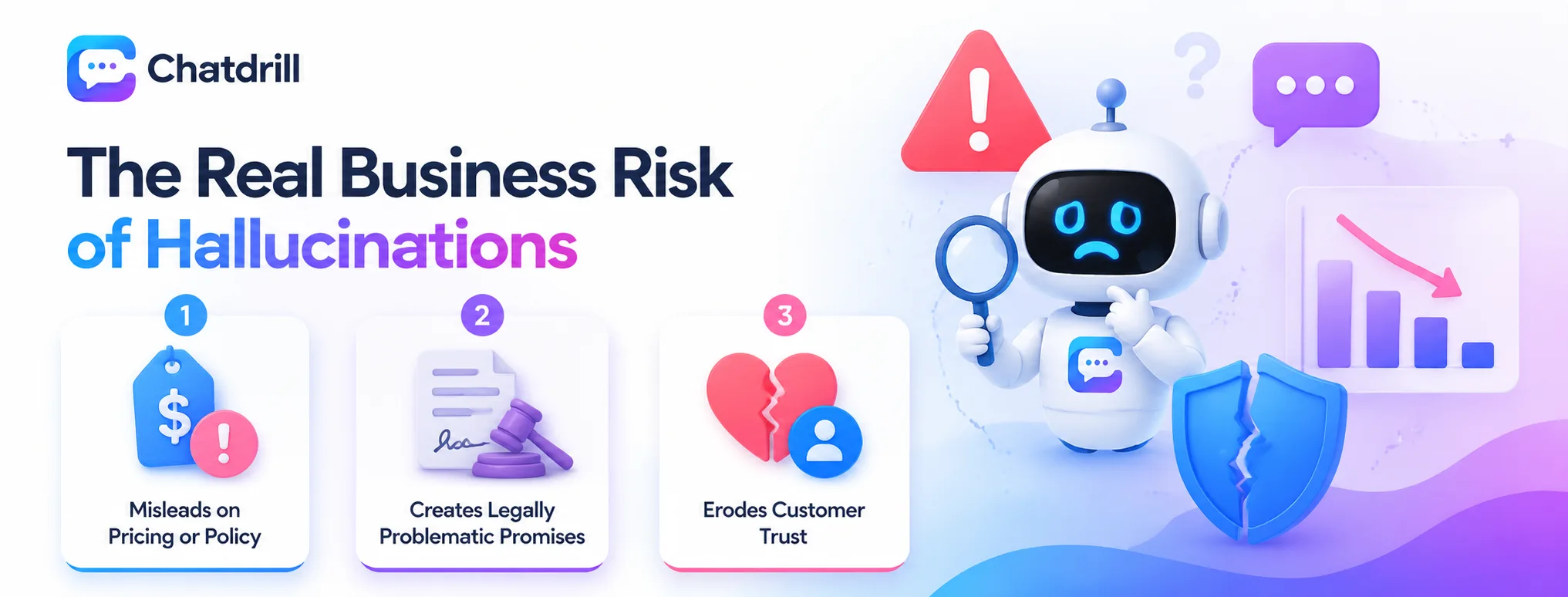
Hallucinations in customer support carry real risk, misleading a customer about pricing or policy, creating a legally or contractually problematic promise, and eroding trust once a customer discovers the information they received was fabricated.
Misleading customers on concrete details
A hallucinated answer about pricing, availability, or a specific policy detail can lead a customer to make a decision based on inaccurate information, creating a real downstream problem for both the customer and the business.
This is meaningfully worse than a slow or unhelpful response, since it actively provides bad information the customer reasonably trusted, rather than simply failing to help.
Creating problematic commitments
In some cases, a hallucinated response can effectively promise something the business never actually offers, a specific discount, a policy exception, creating a genuine dispute when the business can't honor what the AI stated.
This risk is why clear escalation boundaries around sensitive topics, pricing exceptions, legal questions, matter so much as a prevention strategy specifically.
Eroding trust once discovered
A customer who discovers they received fabricated information, even unintentionally, often loses meaningful trust not just in that specific interaction but in the business's chat channel and AI capability more broadly.
This trust erosion can have a longer-lasting effect than the original factual error itself, making prevention genuinely worth prioritizing over simply accepting an occasional hallucination as an unavoidable cost.
How to Prevent Hallucinations
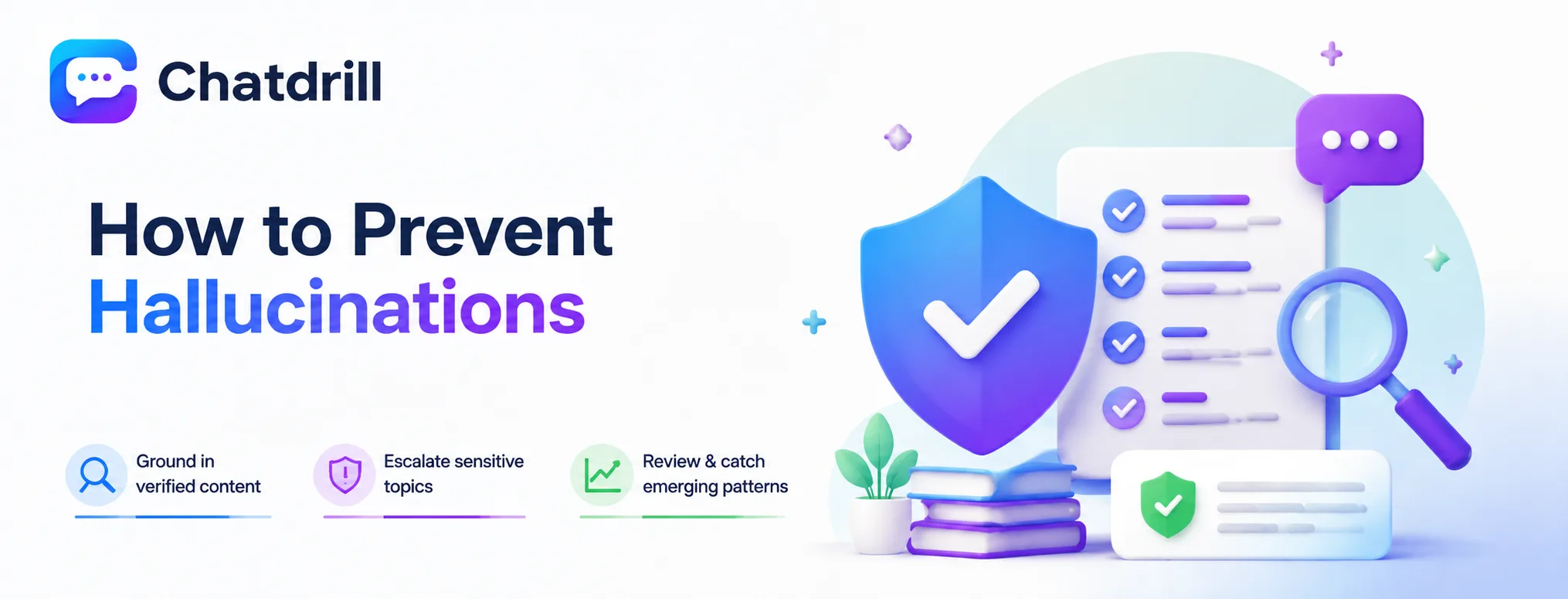
Preventing hallucinations means grounding AI responses in retrieved, verified content rather than open-ended generation, defining clear topics the AI should always escalate rather than attempt, and regularly reviewing conversations to catch emerging patterns.
Using retrieval-grounded architecture
AI systems that retrieve specific, relevant content before generating a response, rather than relying purely on general training, meaningfully reduce hallucination risk by anchoring answers to verified source material.
This retrieval-augmented approach, covered in more depth in a related guide on RAG chatbots, is currently the most effective architectural defense against hallucination available.
Defining clear escalation boundaries
Explicitly configuring the AI to always escalate specific high-stakes topics, pricing exceptions, legal questions, medical or safety-related content, rather than attempting a confident answer, prevents hallucination in exactly the situations where it would be most damaging.
This boundary-setting is a deliberate business decision, not a technical limitation, worth making thoughtfully based on where a wrong answer would carry the most real consequence.
Regular conversation review
Periodically reviewing a sample of AI conversations specifically for hallucination patterns, not just general satisfaction, catches emerging issues before they affect a meaningful number of customers.
This review is worth treating as a distinct, deliberate practice from general quality monitoring, since hallucination can occur even in conversations that otherwise appear satisfactory on the surface.
What to Do When a Hallucination Occurs
When a hallucination is identified, correct the specific customer interaction directly if possible, review and update the underlying training content that led to the gap, and track the incident to identify any broader pattern worth addressing.
Correcting the specific interaction
If a hallucination is caught while the customer relationship is still active, proactively reaching out to correct the misinformation directly demonstrates accountability and helps rebuild any trust damage.
This direct correction, while not always possible after the fact, is worth prioritizing when feasible, since it's meaningfully better than leaving inaccurate information uncorrected.
Addressing the underlying training gap
Investigating why the hallucination occurred, typically a training content gap or ambiguity, and addressing it directly prevents the same issue from recurring for future customers.
This root-cause approach is what actually improves the system over time, rather than treating each hallucination as an isolated, unrelated incident.
Tracking for broader patterns
Logging hallucination incidents over time reveals whether they cluster around specific topics or question types, informing where additional training investment or escalation boundaries would have the most impact.
This pattern-level view is considerably more valuable than reacting to each individual incident in isolation without connecting them to a broader trend.
How ChatDrill Reduces Hallucination Risk
ChatDrill grounds AI responses in a business's actual trained content, supports explicit escalation boundary configuration, and surfaces conversations worth reviewing, combining technical and process-level protections against hallucination risk.
Content-grounded response generation
ChatDrill's AI draws on the specific business content it's been trained on when generating a response, reducing the likelihood of fabricating a plausible-sounding but ultimately incorrect answer.
This grounding is directly tied to training quality, reinforcing why the training investment covered in our related knowledge base guide matters so directly for hallucination prevention specifically.
Configurable escalation boundaries
Businesses can define specific topics ChatDrill's AI should always escalate to a human rather than attempt to answer, providing a deliberate safeguard around the highest-stakes question categories.
This configurability puts control directly in the business's hands, letting each team set boundaries appropriate to their specific risk tolerance and industry.