
Voice AI and chat AI have historically been built and evaluated as separate tools, but customers don't experience your support this way, they call when driving, chat when at a desk, and increasingly expect one to pick up exactly where the other left off.
The real value of combining them isn't running two AI systems side by side, it's the shared context layer underneath, the same customer profile, conversation history, and intent detection feeding both channels so neither one starts from zero.
This becomes especially valuable for a genuinely urgent issue that starts as a quick chat message but needs the nuance of a voice conversation, or the reverse, a phone call that ends with a text-based summary and next steps sent to chat.
This guide covers why combining these channels matters, what a unified setup actually needs, a practical implementation approach, and mistakes worth avoiding.
Quick answer: Combining voice AI and chat support means routing a customer to whichever channel fits their situation while keeping context, intent, and conversation history synced between both, so a customer who starts on a phone call and moves to chat (or the reverse) never has to repeat themselves.
Why Voice AI and Chat Support Work Better Together
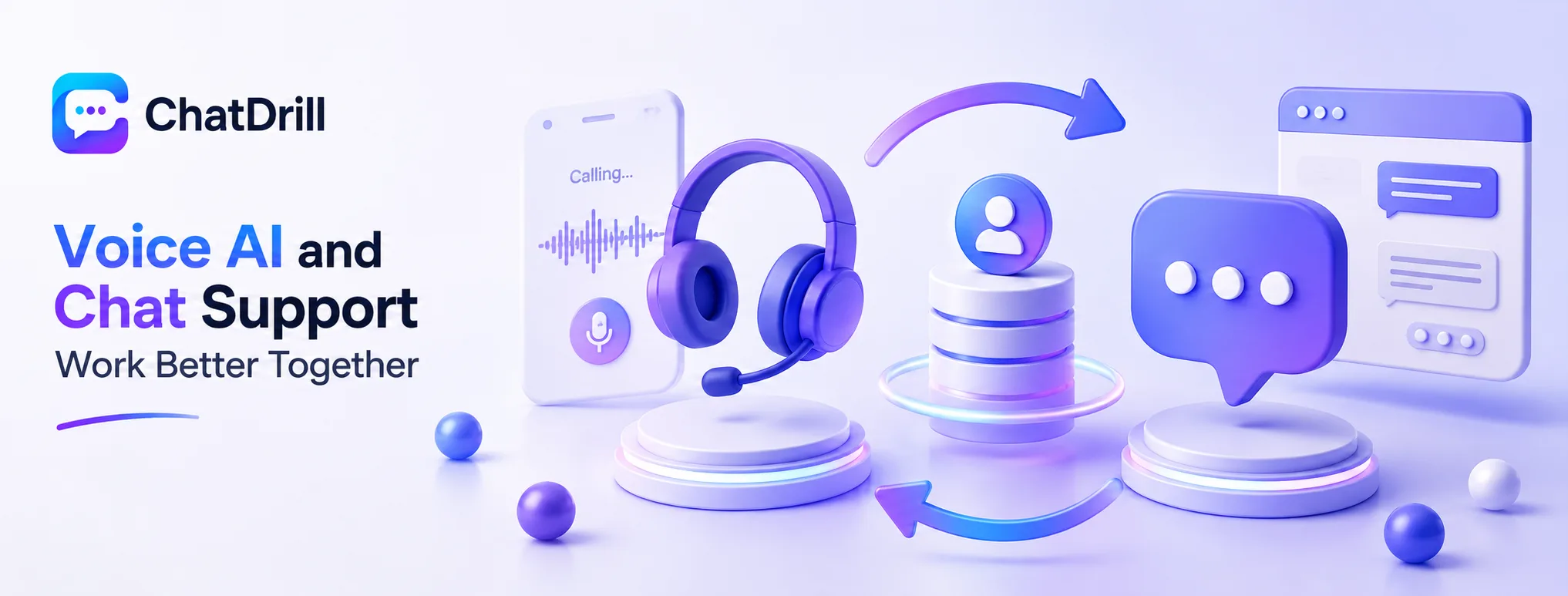
Combining voice and chat AI matters because customers move between channels naturally, and a shared context layer prevents them from repeating information or intent every time they switch.
How customers actually move between channels
A customer might start with a quick chat question, realize the issue is more complex than expected, and want to talk it through by phone, or the reverse, ending a call and wanting a written summary in chat.
Treating these as one continuous interaction, rather than two disconnected sessions, matches how people actually behave rather than forcing them into a single channel's limitations.
The shared context advantage
When voice and chat AI draw from the same customer data and conversation history, a handoff between them feels seamless rather than like starting over with a new agent.
This shared layer is what actually delivers the combined value, running two separate, disconnected AI systems side by side doesn't achieve the same result.
What a Unified Voice and Chat Setup Actually Needs
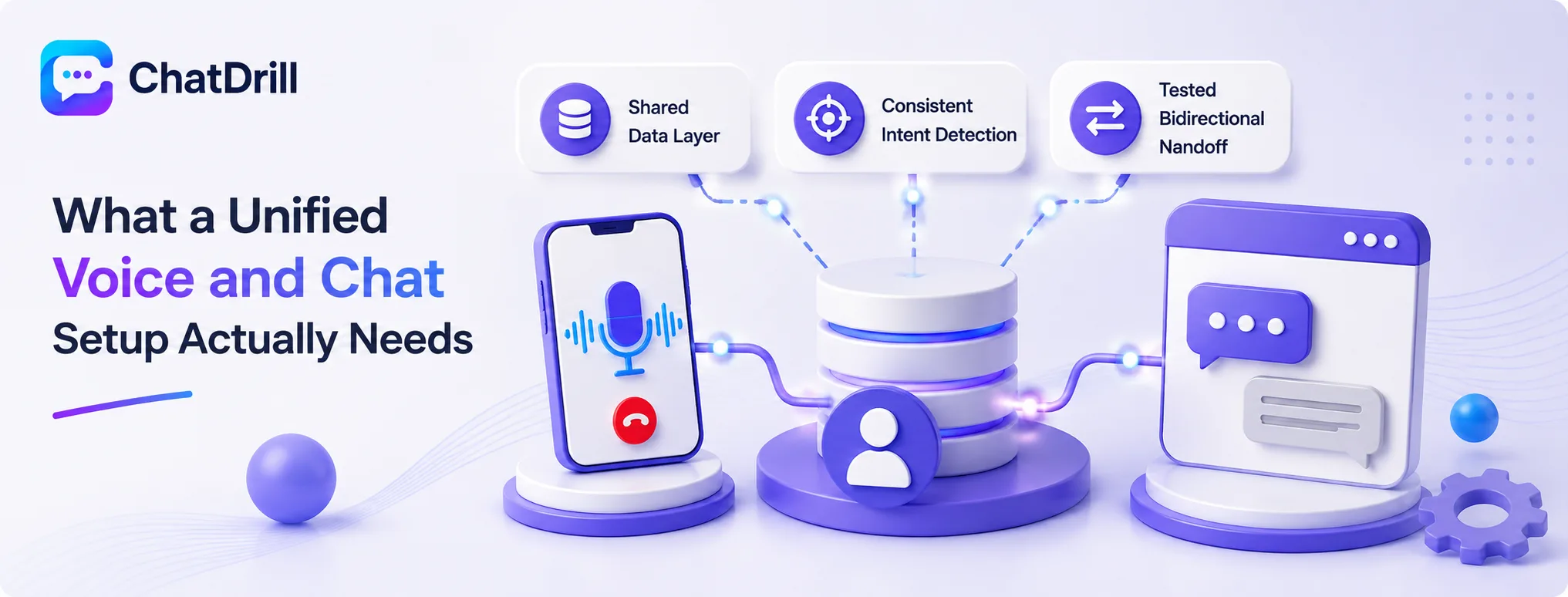
A genuinely unified setup needs a shared customer and conversation data layer, consistent intent detection across both channels, and a clear, tested handoff path in both directions.
A shared data layer
Both voice and chat AI need to read from and write to the same customer record and conversation history, rather than maintaining separate, disconnected logs for each channel.
This is the foundational requirement, without it, any perceived integration between voice and chat is largely cosmetic rather than functional.
Consistent intent detection
Training both channels' AI to recognize the same core intents and escalation triggers ensures a customer gets consistent treatment regardless of which channel they started in.
Inconsistent intent handling between channels creates a jarring experience where a question resolved easily in chat suddenly requires extra explanation over the phone, or the reverse.
Tested bidirectional handoff
Building and testing a clear path for a chat conversation to escalate to voice, and a voice conversation to generate a chat-based summary, ensures the handoff genuinely works in both directions.
Testing this with real, realistic scenarios before launch catches gaps a purely theoretical design review might miss.
Implementation Approach for Combining Voice and Chat AI
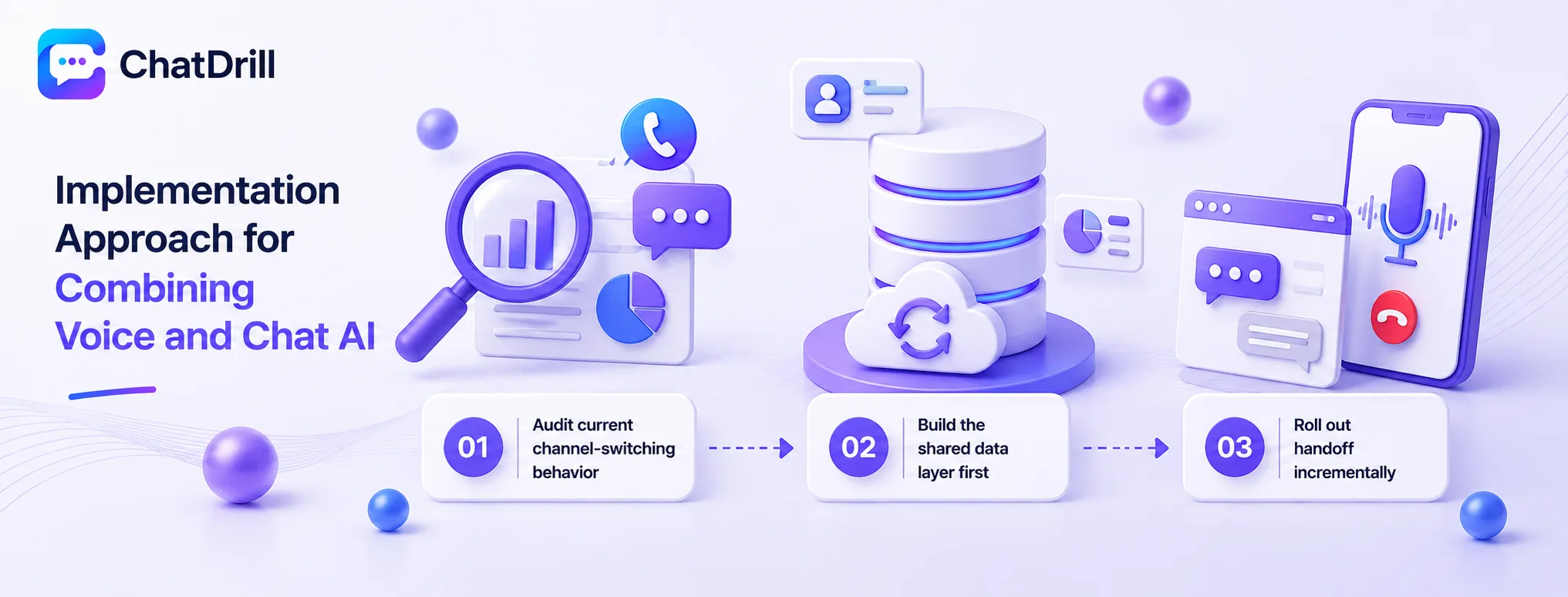
A practical implementation starts by auditing where customers currently switch channels, builds the shared data layer first, and rolls out handoff capability incrementally rather than all at once.
Step 1: Audit current channel-switching behavior
Reviewing how often and why customers currently move between phone and chat support reveals where a unified experience would deliver the most immediate value.
This audit also helps prioritize which specific handoff scenario, chat-to-voice or voice-to-chat, matters most for your particular customer base.
Step 2: Build the shared data layer first
Prioritizing the underlying data integration before attempting any handoff logic ensures the foundation is solid before building more visible features on top of it.
This sequencing avoids the common mistake of building handoff features that only work in a demo because the underlying data isn't genuinely synced.
Step 3: Roll out handoff incrementally
Launching one direction of handoff first, most commonly chat escalating to voice for complex issues, before adding the reverse direction, keeps the rollout manageable and testable.
This incremental approach also makes it easier to gather real usage data on one handoff pattern before adding the complexity of the second.
Common Mistakes When Combining Voice and Chat AI
A practical implementation starts by auditing where customers currently switch channels, builds the shared data layer first, and rolls out handoff capability incrementally rather than all at once.
Step 1: Audit current channel-switching behavior
Reviewing how often and why customers currently move between phone and chat support reveals where a unified experience would deliver the most immediate value.
This audit also helps prioritize which specific handoff scenario, chat-to-voice or voice-to-chat, matters most for your particular customer base.
Step 2: Build the shared data layer first
Prioritizing the underlying data integration before attempting any handoff logic ensures the foundation is solid before building more visible features on top of it.
This sequencing avoids the common mistake of building handoff features that only work in a demo because the underlying data isn't genuinely synced.
Step 3: Roll out handoff incrementally
Launching one direction of handoff first, most commonly chat escalating to voice for complex issues, before adding the reverse direction, keeps the rollout manageable and testable.
This incremental approach also makes it easier to gather real usage data on one handoff pattern before adding the complexity of the second.
Does combining voice and chat AI require replacing existing systems?
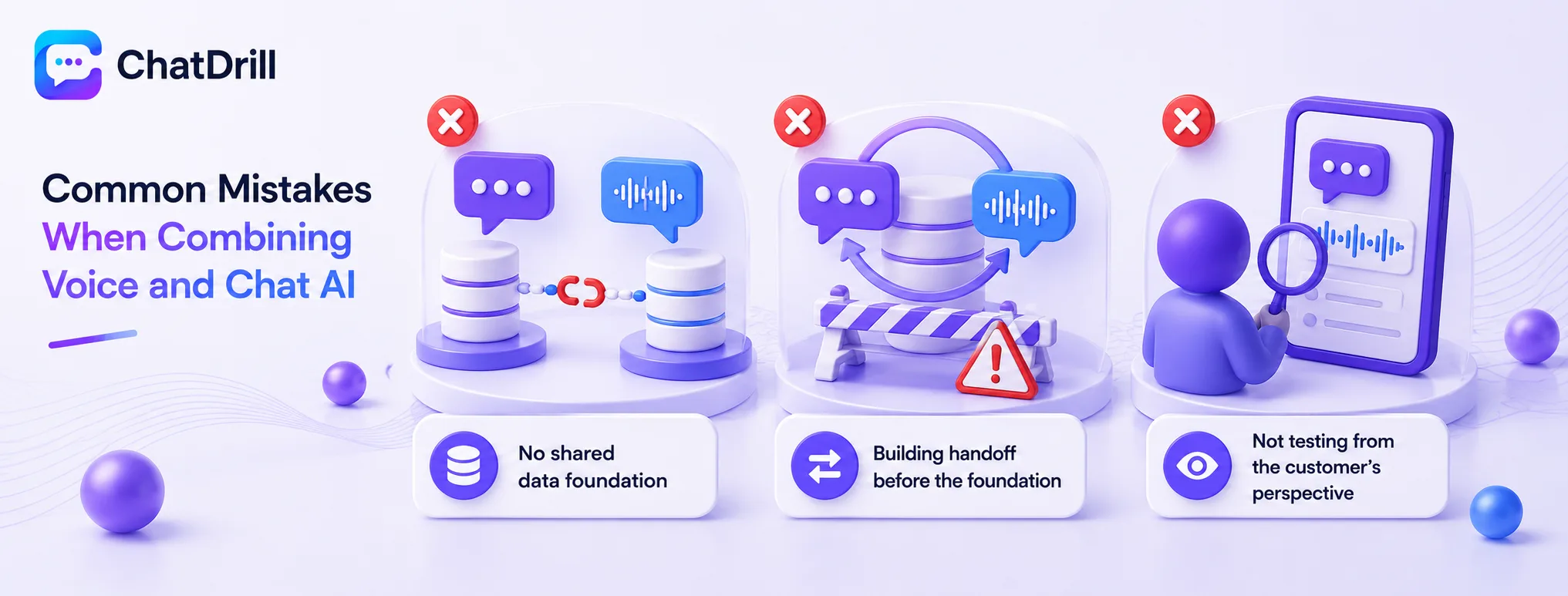
The most common mistakes are treating voice and chat as separate projects with no shared data, building handoff logic before the data foundation exists, and neglecting to test the handoff experience from the customer's actual perspective.
No shared data foundation
Running voice and chat AI as genuinely separate systems, each with its own customer data, produces two disconnected experiences that happen to share a company name rather than one coherent support experience.
This gap is worth addressing first, before any other integration work, since it undermines the entire premise of combining these channels.
Building handoff before the foundation
Attempting to build a smooth handoff experience without first solving the shared data problem tends to produce a feature that works in a demo but breaks down with real, messy customer data.
Sequencing the foundational work first avoids this common trap.
Not testing from the customer's perspective
Reviewing handoff logic only from a technical or internal perspective can miss how genuinely disorienting a poorly executed handoff feels to an actual customer.
Testing with real customer scenarios, ideally including people unfamiliar with the internal system design, surfaces friction a purely technical review would miss.