
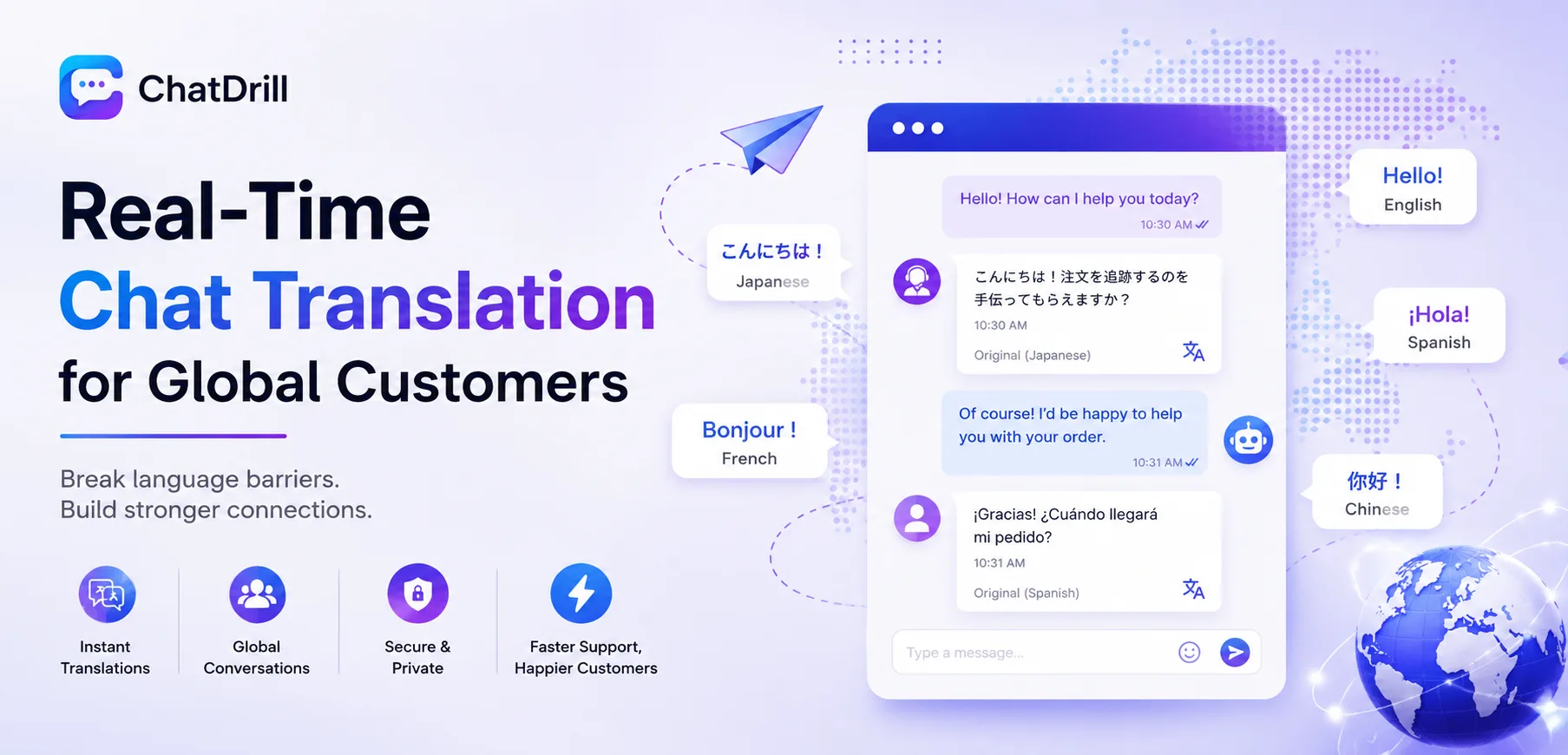
Real-time chat translation automatically converts messages between a customer's language and an agent's, letting each party type in their own language while the other reads it in theirs, without requiring either to be bilingual or waiting for a separate translation step.
This capability matters increasingly for any business selling internationally, where hiring native speakers for every language a customer base spans simply isn't practical, but leaving those customers with no adequate language support genuinely hurts their experience.
The technology has matured considerably, modern real-time translation is meaningfully more capable than older machine translation tools, though it still isn't flawless, worth understanding both its genuine strengths and remaining limitations.
Getting real value from this capability requires more than just enabling it, understanding where it works best, where human review still adds value, and how to set realistic expectations for translation quality across different language pairs.
This guide covers what real-time chat translation does, how it works technically, the genuine benefits for global support, its current limitations, best practices for using it well, and how ChatDrill approaches real-time translation.
What Real-Time Chat Translation Does
Real-time chat translation automatically converts each message between languages as a conversation happens, letting a customer and agent communicate naturally in their own respective languages without either needing to manually translate anything themselves.
Simple definition
A customer types in their native language, the system translates it for the agent's view, and the agent's response translates back automatically, all happening within the natural flow of the conversation.
This is distinct from a customer manually using a separate translation tool before typing, which introduces friction and often produces lower-quality results than a purpose-built integrated system.
Modern implementations aim to keep this translation invisible to the flow of conversation, preserving the real-time, natural feel chat is meant to provide even across language barriers.
Why this matters beyond simple convenience
Without real-time translation, a business serving international customers either needs native-speaking staff for every relevant language, a genuinely difficult staffing challenge, or accepts a degraded support experience for customers outside its primary language.
Real-time translation offers a practical middle path, extending genuinely usable support to a broader customer base without requiring impractical staffing investment across every language spoken.
How Real-Time Translation Works Technically
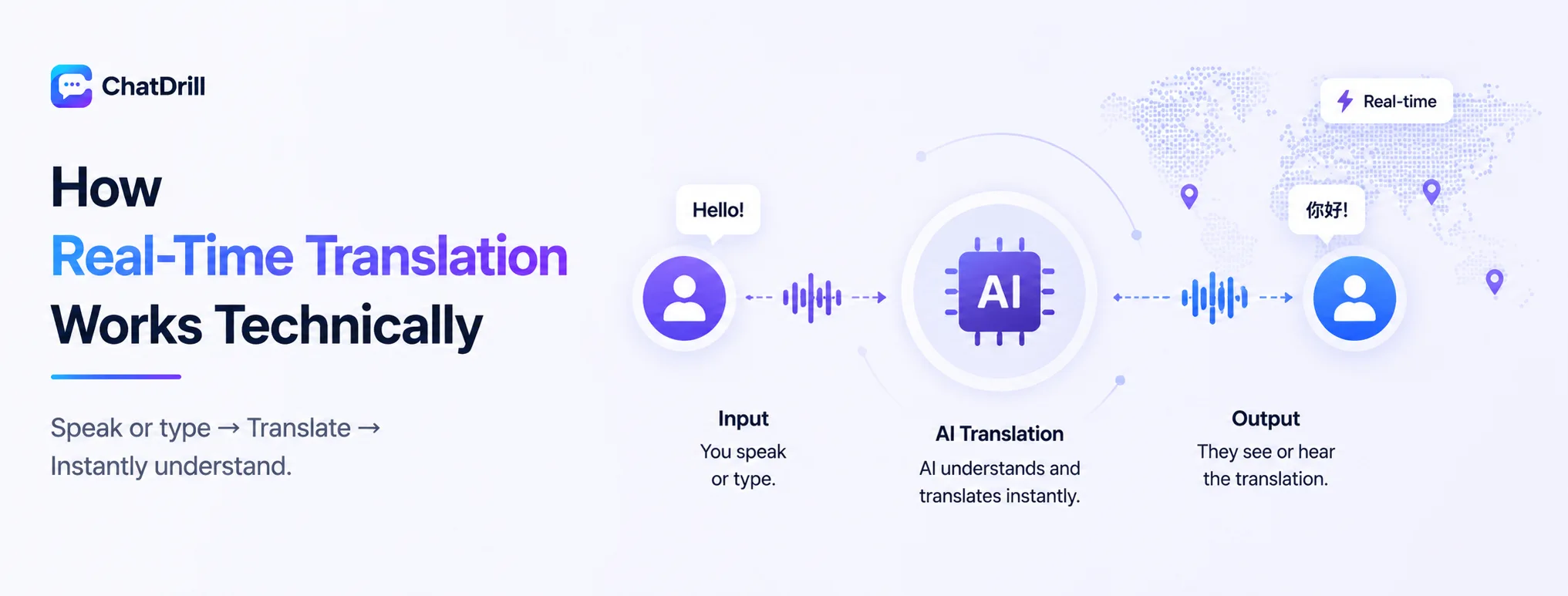
Real-time translation typically uses AI-powered language models to convert text between languages nearly instantaneously, integrated directly into the chat interface so both parties see the conversation in their own language without any manual action.
The underlying translation technology
Modern real-time translation relies on AI language models specifically trained for translation tasks, producing meaningfully more natural, context-aware results than older rule-based translation systems.
This technology has improved considerably in recent years, with current systems handling nuance and context better than the machine translation tools many people remember from years past.
Integration into the chat interface
A well-built implementation makes translation invisible to the actual conversation flow, each party simply sees messages in their own language, without a separate manual translation step interrupting the natural back-and-forth.
This seamless integration is what distinguishes a genuinely useful real-time translation feature from a clunky, manual workaround requiring extra steps from either party.
Benefits for Global Customer Support
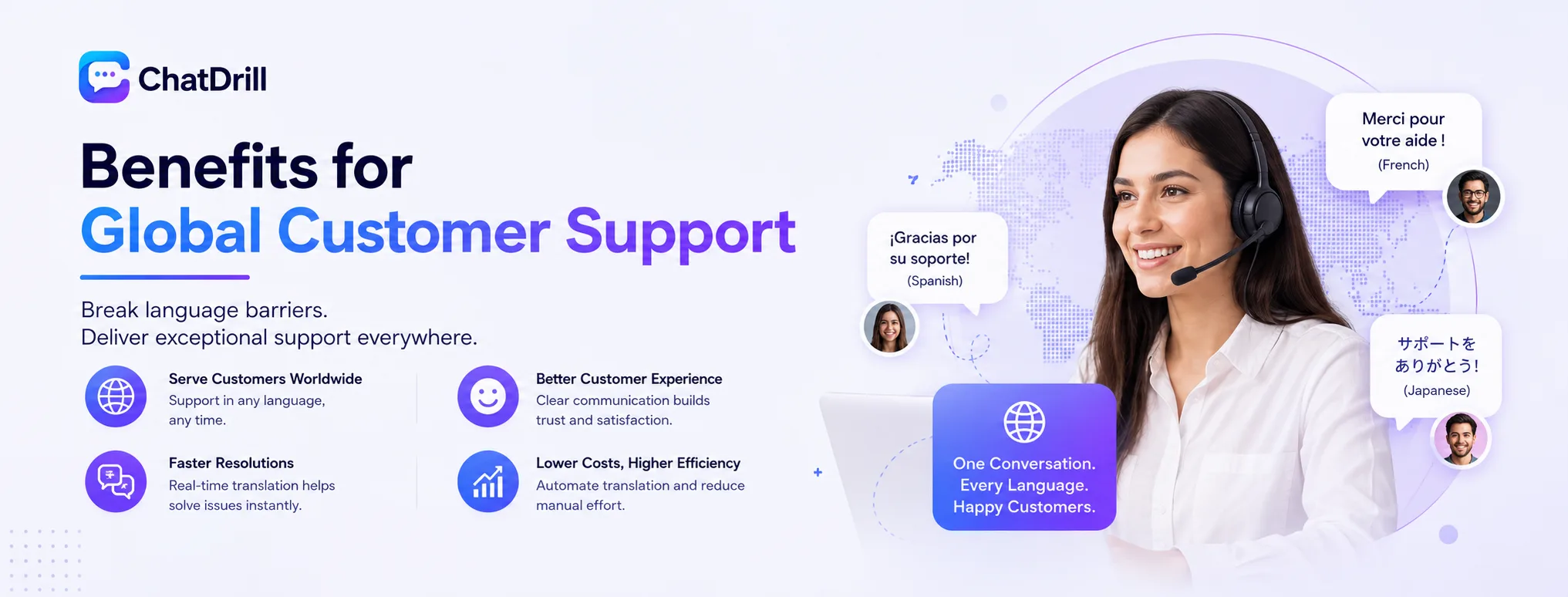
Real-time translation extends genuine support coverage to customers in any language without requiring native-speaking staff for each one, improves response speed compared to routing to a specific-language specialist, and supports business expansion into new markets without a proportional support staffing investment.
Extended language coverage without proportional staffing
A single support team can genuinely serve customers across many languages, rather than requiring dedicated native speakers hired specifically for each language a customer base includes.
This coverage extension is often the most immediately compelling benefit, making genuinely global support economically feasible for a business that couldn't otherwise staff every relevant language.
Faster response than language-specific routing
Rather than waiting for a specific-language specialist to become available, real-time translation lets any available agent handle a conversation immediately, regardless of the customer's language.
This speed advantage directly ties back to first response time, one of the strongest predictors of chat engagement and satisfaction, covered in more depth in a related guide.
Supporting market expansion
A business expanding into a new international market can offer genuine support coverage from day one, without needing to hire and train native-speaking staff before entering that market.
This removes a real barrier to international expansion, letting support capability scale alongside business growth rather than becoming a bottleneck to entering new markets.
Limitations to Be Aware Of
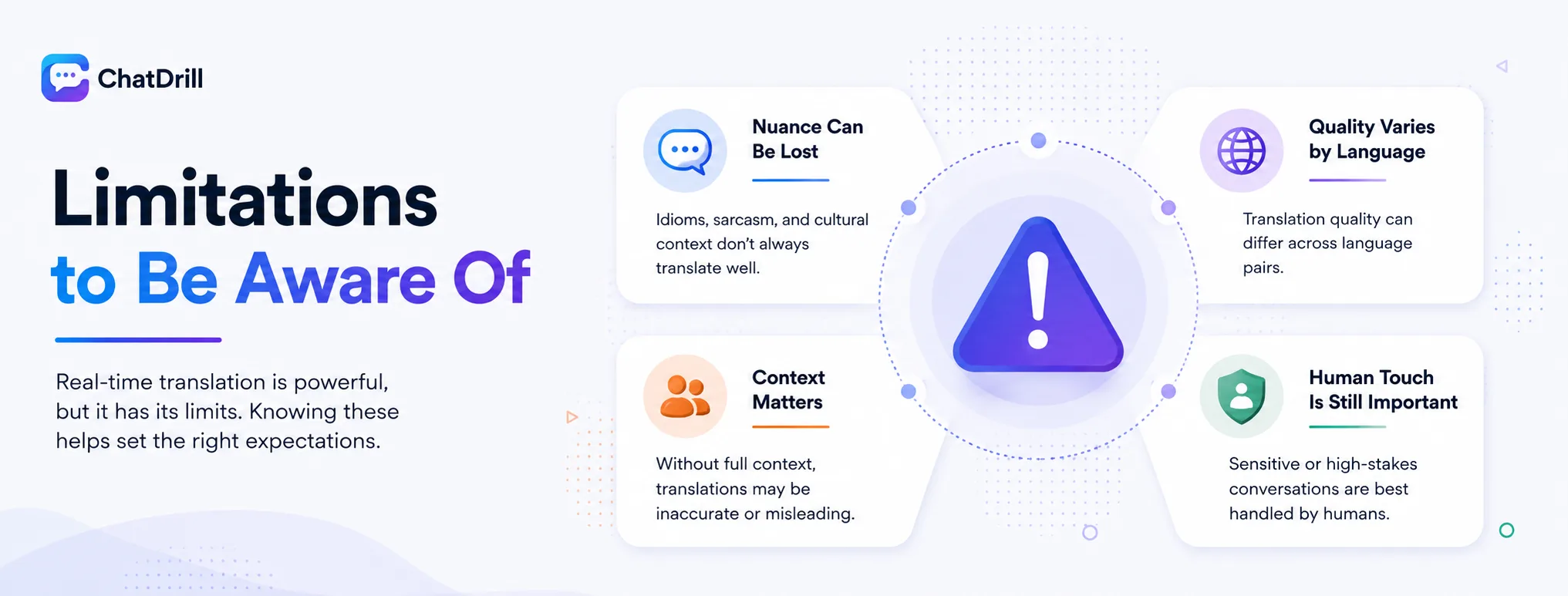
Real-time translation isn't flawless, nuanced idioms and cultural context can be lost in translation, quality varies meaningfully across different language pairs, and genuinely sensitive or high-stakes conversations may still benefit from a native-speaking human.
Nuance and idiom limitations
Idioms, cultural references, and subtle tone can be genuinely difficult to translate accurately, occasionally producing a technically correct but slightly off or confusing translated message.
This limitation is worth understanding realistically rather than assuming translation is always perfectly accurate, particularly for conversations involving genuine emotional nuance or cultural specificity.
Variable quality across language pairs
Translation quality between widely spoken language pairs, like English and Spanish, tends to be stronger than between less common pairings, worth testing directly for your specific customer base's actual language needs.
This variability means a business should evaluate translation quality specifically for its own relevant languages, rather than assuming uniform quality across every possible language combination.
When human, native-speaking support still matters
Genuinely high-stakes or emotionally sensitive conversations, a serious complaint, a legal matter, may still benefit from a native-speaking human agent rather than relying purely on translation, even a well-functioning one.
Recognizing this limitation and building appropriate escalation paths for these situations keeps translation technology used appropriately, within its genuine strengths.
Best Practices for Multilingual Support With Translation
Best practices include testing translation quality directly for your specific customer languages, training agents to recognize when a translated message might be unclear, and maintaining an escalation path to native-speaking support for genuinely sensitive conversations.
Testing quality for your specific languages
Rather than assuming uniform quality, test the translation feature directly with real, representative conversations in each language your customer base actually uses.
This direct testing reveals whether a specific language pair performs well enough for your use case, or whether supplemental human review is worth maintaining for that particular language.
Training agents on translation awareness
Agents should understand they're working through a translation layer, developing awareness of when a customer's translated message might be slightly unclear and worth a clarifying follow-up question.
This awareness prevents an agent from confidently misinterpreting a slightly off translation, adding a valuable human judgment layer on top of the underlying technology.
Maintaining an escalation path
Keeping a path to native-speaking human support available for genuinely sensitive or high-stakes conversations, even with strong translation technology in place, provides an important safety net.
This escalation path doesn't need to be heavily used, its value is in being available for the specific situations where translation alone genuinely isn't sufficient.
How ChatDrill Approaches Real-Time Translation
ChatDrill's real-time translation integrates directly into the chat interface, letting agents and customers communicate naturally across languages, with escalation options available for conversations that would benefit from native-speaking support.
Integrated, invisible translation flow
ChatDrill's translation happens within the natural chat flow, each party seeing messages in their own language without a separate manual translation step interrupting the conversation.
This seamless integration keeps the real-time, responsive feel of chat intact, even when the customer and agent are communicating across different languages entirely.
Supporting broader global support strategy
Combined with ChatDrill's AI chatbot, which also supports multilingual conversation as covered in a related guide, real-time translation extends genuine language coverage across both automated and human-handled conversations.
This combination gives a business flexibility in how it structures global support, whether leaning more heavily on AI automation or human agents assisted by translation.