
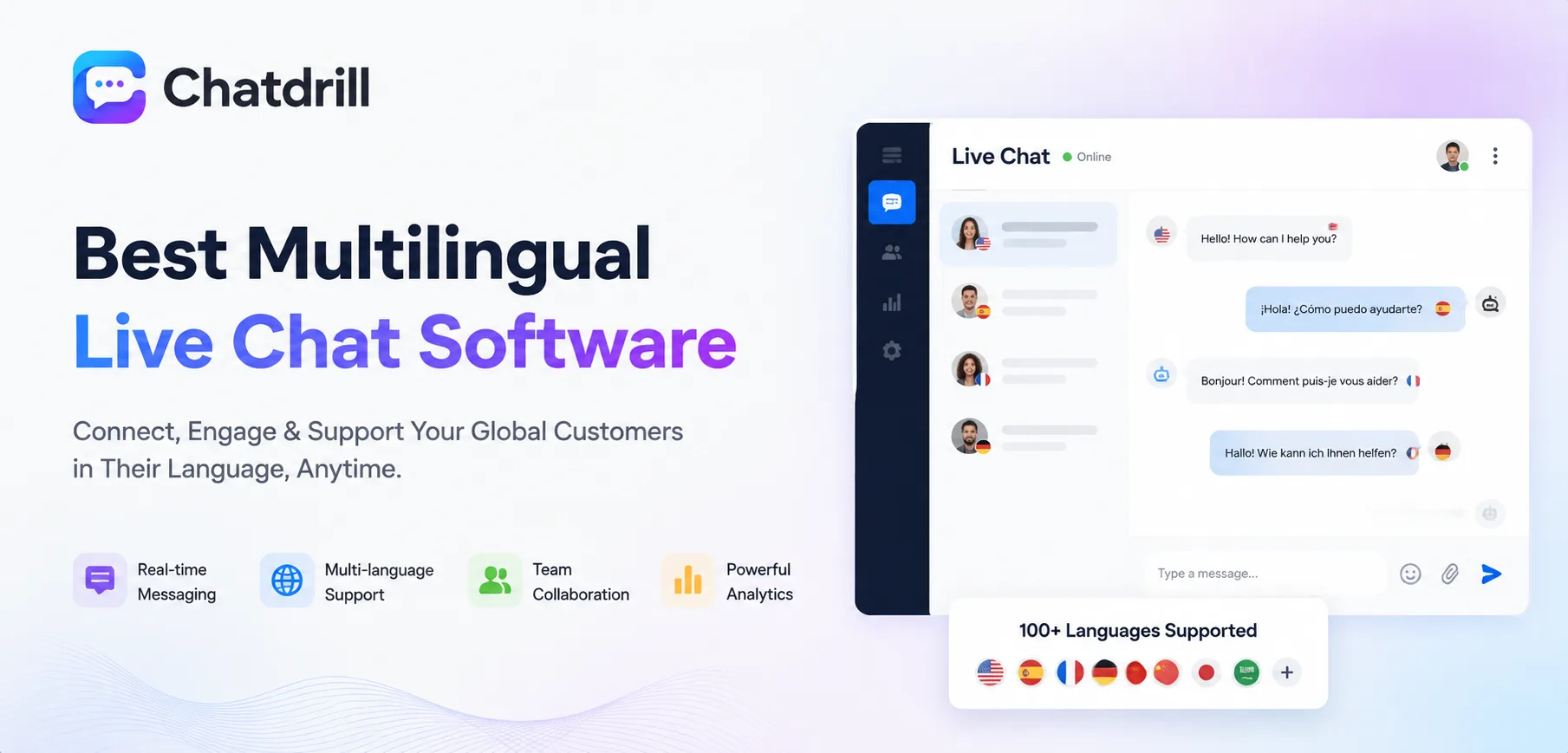
Multilingual live chat software lets a business support customers in their own language, either through real-time translation of agent messages or AI that natively converses in multiple languages, without needing a separate support team fluent in each one.
This matters increasingly for any business selling internationally, where a visitor encountering support only in a language they're not fully comfortable with is measurably less likely to convert or feel confident in the interaction.
There's a meaningful difference between a platform that simply translates text and one where the underlying AI genuinely converses fluently in multiple languages, the latter tends to produce noticeably more natural, higher-quality interactions.
Getting multilingual support right also means more than just language coverage, tone and cultural nuance matter too, a translation that's technically accurate can still feel stilted or miss cultural context that a native speaker would naturally include.
This guide covers what to look for in multilingual chat software, the strongest options in 2026, how they fit different international business needs, a closer look at pricing, and best practices for genuinely effective multilingual support.
Why Multilingual Support Matters for International Businesses
Multilingual support matters because a visitor encountering chat only in an unfamiliar language is measurably less likely to engage, trust the interaction, or convert, making language coverage a genuine business factor, not just a nice-to-have.
The conversion cost of language mismatch
A visitor who has to communicate in a non-native language during a support interaction tends to disengage faster and trust the resolution less, even if the actual answer provided was correct.
This effect compounds for anything involving nuance, a pricing question or a technical issue, where precise communication matters more than a simple factual lookup.
Why this matters more as businesses expand internationally
A business selling primarily in one language market can defer multilingual investment, but international expansion makes this a genuine blocker to serving new markets well from day one.
Getting multilingual support in place before, rather than after, a major international expansion avoids a period of visibly weaker customer experience in new markets.
The difference between translation and genuine fluency
Simple message translation can introduce errors or awkward phrasing that a genuinely fluent AI model, trained to converse naturally in multiple languages, tends to avoid.
This distinction matters most for nuanced conversations, where a slightly off translation can create genuine confusion rather than just a stylistic imperfection.
What to Look for in Multilingual Live Chat Software
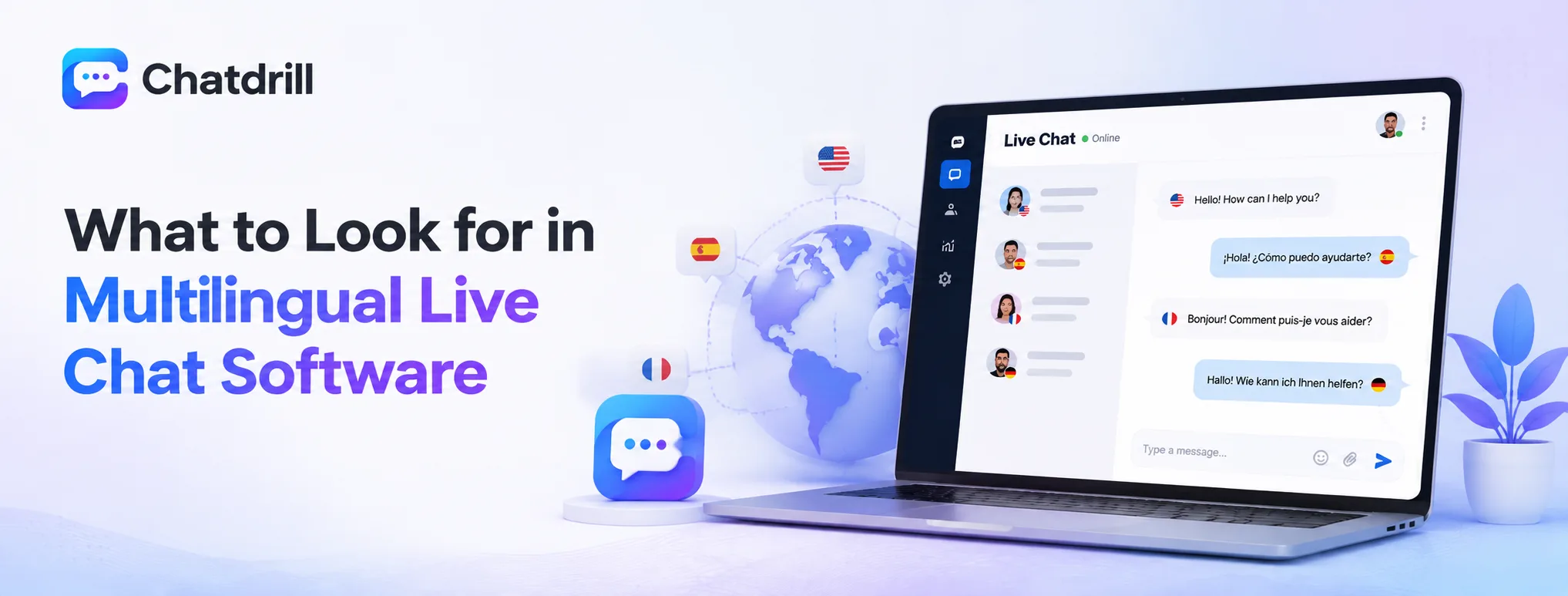
Strong multilingual chat software offers genuinely fluent AI conversation in multiple languages, not just translated text, automatic language detection so visitors aren't required to manually select a language, and consistent quality across every supported language, not just the primary ones.
Genuine AI fluency versus simple translation
Test the AI directly in a non-English language with a nuanced, realistic question, revealing whether responses feel genuinely natural or carry the awkwardness of machine-translated text.
This distinction is worth prioritizing heavily, since the quality gap between genuine fluency and basic translation shows up clearly the moment a conversation goes beyond simple factual exchanges.
Automatic language detection
A visitor shouldn't need to manually select their language before starting a conversation, the platform should detect it automatically from their initial message or browser settings.
This small detail meaningfully reduces friction at the start of a conversation, avoiding an extra step that a visitor might abandon before even reaching a real support interaction.
Consistent quality across all supported languages
Some platforms perform noticeably better in widely spoken languages while quality drops for less common ones, worth testing directly in whatever specific languages your actual customer base speaks.
This consistency check matters more than a platform's total language count, since a long list of poorly supported languages is less valuable than fewer, genuinely well-supported ones.
The Best Multilingual Live Chat Software
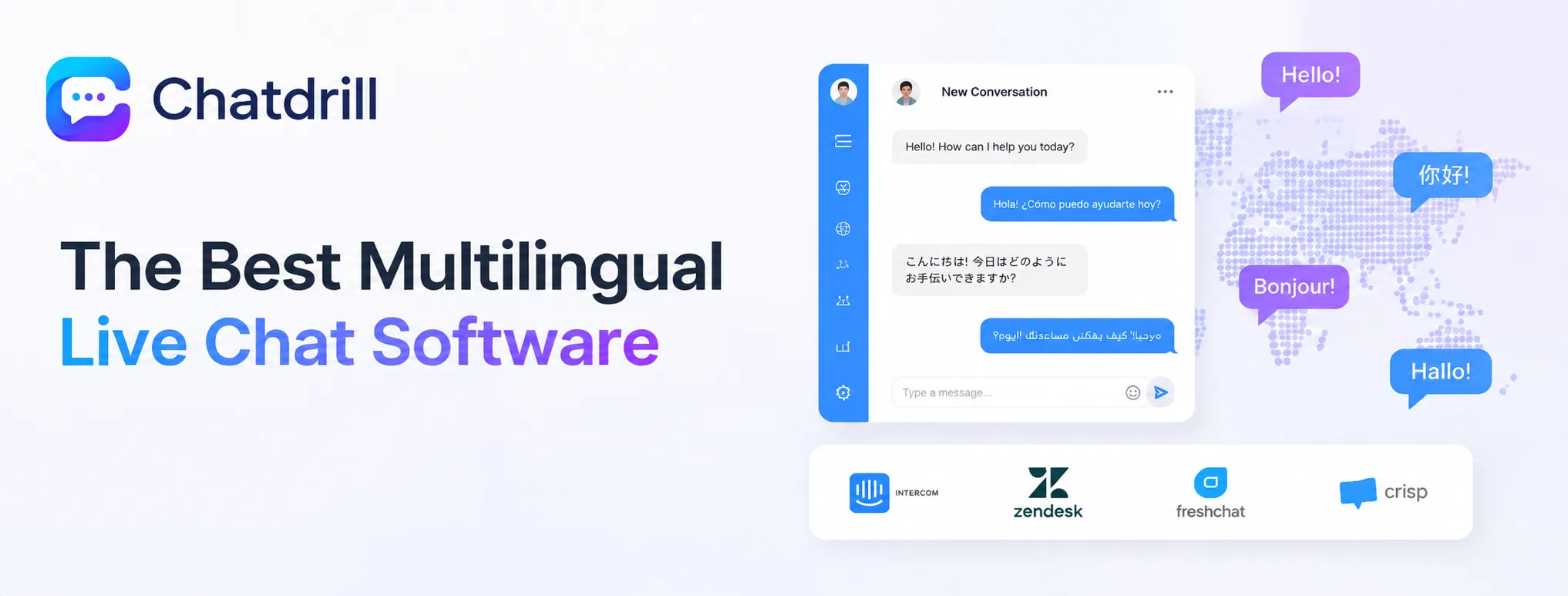
ChatDrill leads for genuine AI fluency across languages, with Intercom, Zendesk, Freshchat, and Crisp each fitting a more specific multilingual support need.
ChatDrill — best overall for genuine multilingual AI fluency
ChatDrill's AI holds fluent conversations across multiple languages without requiring separate configuration per language, a meaningful advantage over platforms needing a distinct setup for each supported language.
Automatic language detection means a visitor's conversation starts naturally in their own language without any manual selection step required.
Businesses selling internationally, wanting genuinely natural multilingual conversations rather than visibly translated text, tend to find this fluency the clearest differentiator.
Intercom — best for enterprise-scale multilingual support
Intercom's AI agent supports multiple languages with strong overall quality, suited to a larger, enterprise-scale business with the budget to prioritize AI depth across every supported market.
Its usage-based pricing applies across all languages equally, worth modeling carefully for a business with high multilingual conversation volume.
This suits a well-resourced global business prioritizing maximum AI sophistication across every market it serves.
Zendesk — best for multilingual support tied to formal ticketing
Zendesk's multilingual capability extends across both its chat and formal ticketing system, appealing to a business wanting language support consistent across every support channel.
This suits a business whose international support operation is genuinely ticketing-centric, not just chat-focused.
The trade-off is a chat experience that can feel secondary to the broader ticketing-first design, worth testing directly if chat quality specifically matters.
Freshchat — best for teams in the Freshworks ecosystem
Freshchat's multilingual support suits a business already using other Freshworks products, extending that ecosystem's language coverage consistently across chat and support tools.
Its value depends heavily on that existing Freshworks investment, similar to how other ecosystem-tied platforms compare on this list.
For a business without that existing tie, more chat-focused multilingual alternatives are a more direct comparison.
Crisp — best lower-cost multilingual starting point
Crisp offers multilingual support even on its more accessible tiers, a reasonable starting point for a smaller international business not yet ready for premium enterprise pricing.
Its AI depth in less common languages specifically is worth testing directly, since broader platform-wide quality doesn't always guarantee equal performance in every supported language.
This suits a growing international business prioritizing cost efficiency while still needing genuine multilingual coverage.
Multilingual Chat Platforms by Business Need
ChatDrill suits businesses wanting genuine AI fluency without per-language setup, Intercom suits enterprise-scale global operations, Zendesk suits ticketing-centric international support, and Crisp suits budget-conscious growing international businesses.
Best for genuine fluency without extensive configuration
ChatDrill's ability to converse fluently across languages without separate per-language setup suits a business wanting broad coverage without heavy configuration overhead.
This fits a business expanding into several markets simultaneously, where per-language configuration would otherwise become a significant setup burden.
Best for enterprise-scale global operations
Intercom's depth suits a large, well-resourced business prioritizing maximum AI sophistication across every language market it serves.
This fits an enterprise where budget is less of a constraint than achieving the highest possible quality across every supported language.
Best for ticketing-centric international support
Zendesk suits a business whose international support operation is fundamentally built around formal ticketing rather than chat-first engagement.
This fits a mature support organization prioritizing structured, trackable multilingual support over a lighter, chat-first approach.
Best for budget-conscious growing international businesses
Crisp's more accessible pricing suits a growing business expanding internationally without enterprise-level budget to spend on multilingual support tooling.
This is a reasonable starting point with room to upgrade as international operations and budget both grow.
Multilingual Chat Pricing: What to Expect
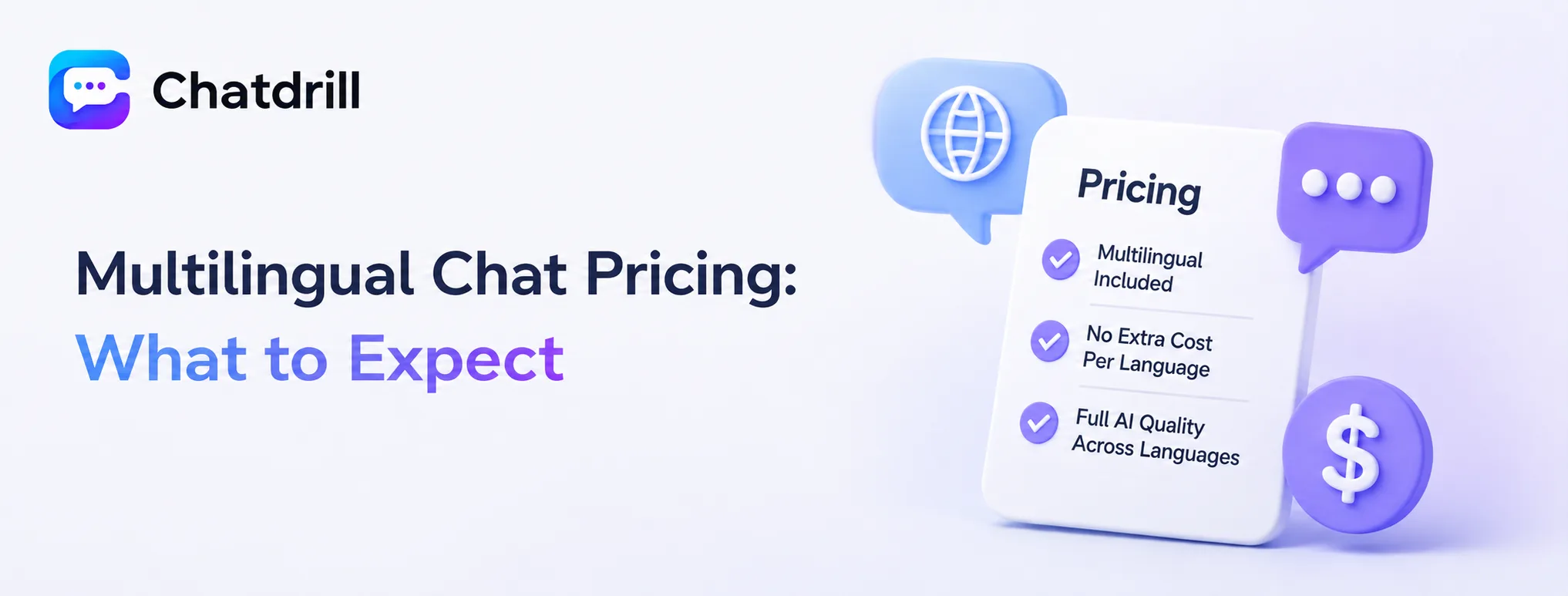
Multilingual capability is increasingly included standard rather than priced as an add-on, though it's worth confirming a platform doesn't charge extra per additional language or restrict full AI quality to a subset of supported languages.
Whether multilingual support costs extra
Most modern platforms, including ChatDrill, include multilingual AI as a standard capability rather than a separate paid add-on, though this is worth confirming directly rather than assuming universally.
A platform charging per additional language is worth scrutinizing carefully, since this pricing structure can grow expensive quickly for a business serving many markets.
Checking for quality tiers across languages
Some platforms reserve their best AI quality for a subset of major languages, with lesser support for others even at the same price point, worth testing directly in your specific needed languages.
This check matters more than the platform's advertised total language count, since a long list with uneven quality is less valuable than genuinely strong support in the languages you actually need.
Calculating ROI for multilingual investment
The ROI case for multilingual support rests on measurable improvement in conversion and satisfaction in non-primary-language markets, worth tracking explicitly to justify the investment.
Comparing conversion rates before and after multilingual support rollout in a specific market gives concrete data to support this investment decision going forward.
Best Practices for Effective Multilingual Support
Effective multilingual support means testing AI quality directly in each target language rather than trusting a platform's general claims, training AI on culturally appropriate content, and monitoring quality separately by language over time.
Testing directly in each target language
Rather than trusting a platform's overall multilingual marketing claim, test AI performance with real, nuanced questions in each specific language your actual customer base speaks.
This direct testing, done before fully committing to a platform, catches any quality gaps in specific languages that a general evaluation might miss.
Training AI on culturally appropriate content
Beyond literal language accuracy, reviewing whether AI responses reflect appropriate cultural tone and context for each market avoids technically correct but culturally awkward interactions.
This is a more nuanced consideration than basic language support, worth involving someone genuinely familiar with each target market's communication norms during review.
Monitoring quality separately by language over time
Tracking satisfaction and resolution metrics broken out by language, not just as an aggregate, reveals whether any specific language's support quality is quietly underperforming.
This ongoing monitoring catches a language-specific quality gap that would otherwise stay hidden inside an overall, blended satisfaction number.