
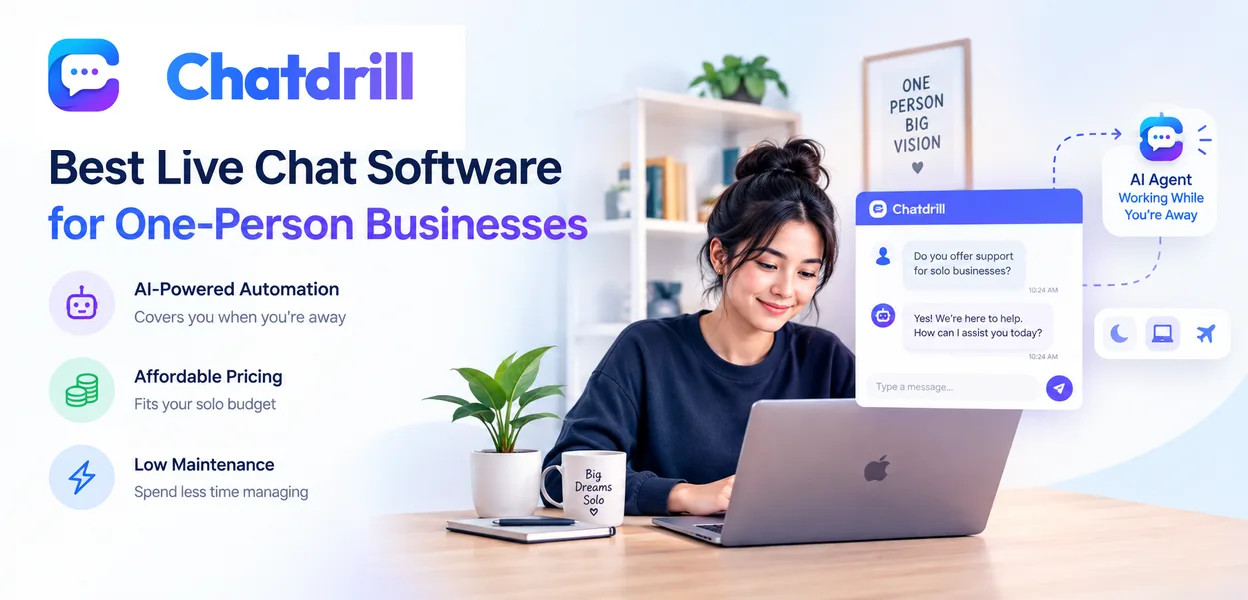
A one-person business faces a genuinely distinct chat challenge, since the owner is inevitably unavailable at some point, whether sleeping, working on client deliverables, or simply stepping away, without a team to cover the gap.
Quick answer: For a one-person business, the best live chat software prioritizes
AI trained to genuinely cover for the owner
affordable entry pricing since there's no team to split cost across, and minimal ongoing maintenance, making tawk.to, Crisp, and Tidio commonly cited strong starting points, alongside ChatDrill for stronger AI coverage when the owner is away.
This reality shapes what genuinely matters most in a chat platform choice, favoring AI-assisted automation and low-maintenance simplicity over the team-collaboration features a larger business might prioritize.
Understanding this specific priority helps a solo entrepreneur choose a platform that genuinely reduces, rather than adds to, their already-full workload.
This guide covers what one-person businesses specifically need, genuinely strong options, common evaluation mistakes, key questions to ask, and how ChatDrill fits this use case.
What One-Person Businesses Specifically Need
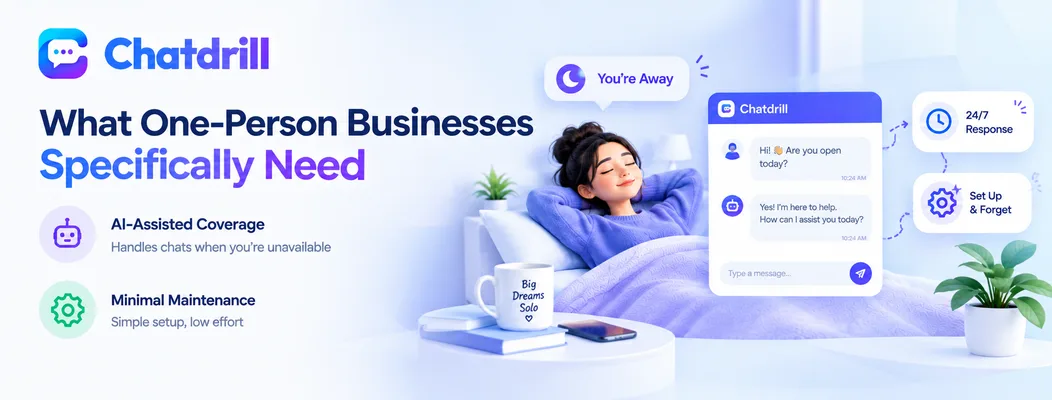
AI-assisted coverage for inevitable unavailability and genuinely low-maintenance operation matter more here than team-collaboration features a solo owner will never use.
Coverage for inevitable unavailability
A one-person business owner is genuinely unavailable at some point every single day, meaning a chat platform's ability to handle at least basic questions automatically during these gaps directly determines whether visitors get help or simply leave.
This coverage need is considerably more acute here than for a business with even a small team able to rotate availability across a broader window.
Minimal ongoing maintenance and setup burden
A solo owner typically has no dedicated time for extensive platform configuration or ongoing technical maintenance, making genuine simplicity a practical requirement rather than merely a nice-to-have convenience.
This priority means evaluation should weight ease of use and low maintenance burden heavily, more than a larger business with dedicated staff might need to.
Genuinely Strong Options for This Use Case
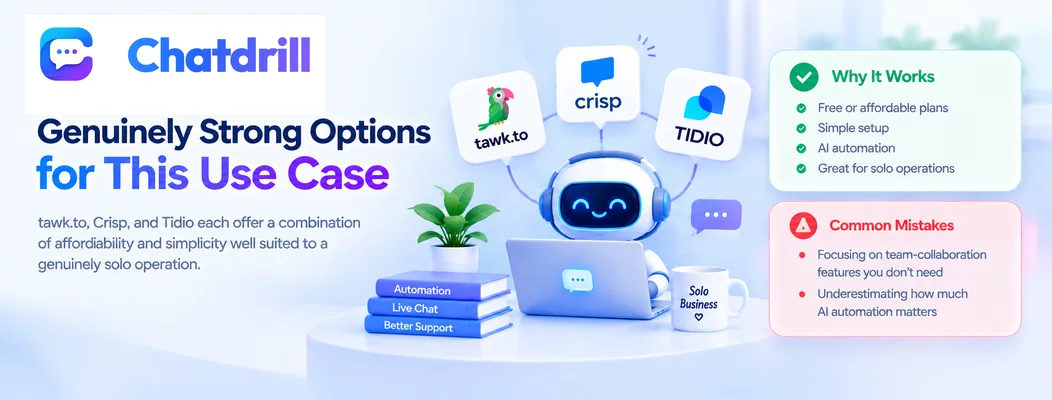
tawk.to, Crisp, and Tidio each offer a combination of affordability and simplicity well suited to a genuinely solo operation.
tawk.to for a genuinely free, low-maintenance start
tawk.to's completely free core offering, with unlimited agents and chats at no cost, makes it a genuinely practical starting point for a solo owner not yet ready to commit budget to chat software.
This free-tier approach lets a one-person business validate genuine value before considering any paid upgrade as the business potentially grows.
Crisp and Tidio for accessible automation
Crisp's accessible free tier and Tidio's combination of live chat with AI-assisted automation, including its Lyro AI agent, both offer a genuinely practical path to automated coverage without requiring significant technical setup effort.
This automation capability directly addresses the unavailability-coverage need this guide identifies as particularly important for a genuinely solo operation.
How ChatDrill Fits This Use Case
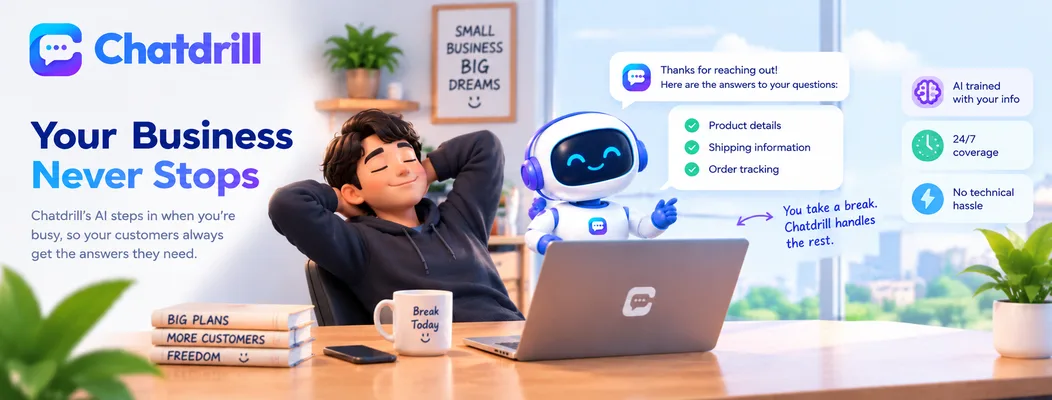
AI trained to genuinely cover for the owner
ChatDrill's AI can be trained on your specific business's common questions, providing accurate coverage during the inevitable gaps every solo owner experiences throughout a typical day.
This capability directly addresses the coverage need this guide identifies as the single most important priority for a genuinely one-person business.
Setup designed for someone without dedicated technical time
ChatDrill's setup process reflects the genuine simplicity priority this guide identifies as essential for a solo owner without dedicated technical resources or extensive available time.
This accessibility, combined with genuine AI coverage capability, positions ChatDrill as a practical option for this specific, resource-constrained use case.
Common Evaluation Mistakes for This Use Case
Choosing based on team-collaboration features never needed, and underestimating how much AI automation genuinely matters here, are common mistakes.
Evaluating based on unnecessary team features
Comparing platforms primarily on team-routing, multi-agent collaboration tools, or department-based workflows wastes evaluation time on capability a genuinely solo business will never use.
Focusing evaluation on the automation and simplicity factors this guide identifies as genuinely relevant produces a more efficient, appropriate decision process.
Underestimating AI automation's genuine importance here
Assuming basic, human-only chat suffices without considering how much unavailability a genuinely solo owner experiences underestimates just how valuable AI coverage becomes for this specific business structure.
Prioritizing genuine AI capability, not just as a nice bonus but as a core requirement, reflects the unavailability reality this guide identifies as central to this use case.
Key Questions to Ask Before Choosing
Confirming genuine AI automation quality and honest setup time expectations are the most useful evaluation questions for this specific use case.
How well does the AI genuinely handle common questions?
Testing a candidate platform's AI directly with your own typical customer questions, rather than relying on marketing claims, reveals whether it will genuinely provide useful coverage during your inevitable unavailability.
This hands-on test matters more for a solo business than for one with human backup readily available to catch whatever the AI misses.
How much ongoing time will this genuinely require?
Asking directly about ongoing maintenance needs, training updates, and configuration upkeep helps confirm a platform genuinely fits a solo owner's limited available time.
This honest time-cost assessment prevents choosing a platform that looks appealing on features but proves impractical given genuinely limited solo-operator bandwidth.