
A small business needs live chat software that installs quickly without technical help, costs reasonably at a low agent count, and includes enough automation to handle repetitive questions without requiring dedicated support staff to manage full-time.
This is a genuinely different set of priorities than what a larger enterprise optimizes for, extensive configurability and complex workflow automation matter far less than getting a working, useful tool live quickly and affordably.
The right small business tool also needs to grow reasonably alongside the business, since a tool that requires a disruptive full migration the moment a business scales past its earliest stage creates unnecessary friction down the road.
Getting this choice right early saves real time and money, a tool well matched to small business needs from the start avoids both overpaying for enterprise capability and underinvesting in automation that would genuinely help.
This guide covers what small businesses should look for, the strongest live chat platforms for this use case in 2026, how they fit different small business priorities, a closer look at pricing at small scale, and what to watch for as the business grows.
What Small Businesses Need From Live Chat Software
Small businesses need live chat that installs without developer help, costs reasonably at a low agent count, and includes AI automation capable enough to reduce the burden on a small, often generalist team.
Fast, self-serve installation
A small business rarely has dedicated technical staff to manage a complex integration, making a simple script or plugin-based install genuinely important rather than a nice-to-have.
This priority should weigh heavily in evaluation, even for a technically capable small business owner, since time spent on tool setup is time not spent on the core business.
Reasonable cost at small scale
Pricing that stays reasonable specifically at two to ten agents matters more to a small business than a platform's overall market reputation for value at larger scale.
Modeling actual cost at your specific, current team size avoids assuming a platform's general affordability reputation applies equally at every scale.
AI automation that reduces team burden
A small business team, often wearing multiple roles, benefits significantly from AI that handles repetitive questions without requiring extensive ongoing configuration to work well.
This automation directly frees time for other business priorities, a genuine benefit beyond just faster customer response.
What to Look for in Small Business Live Chat Software
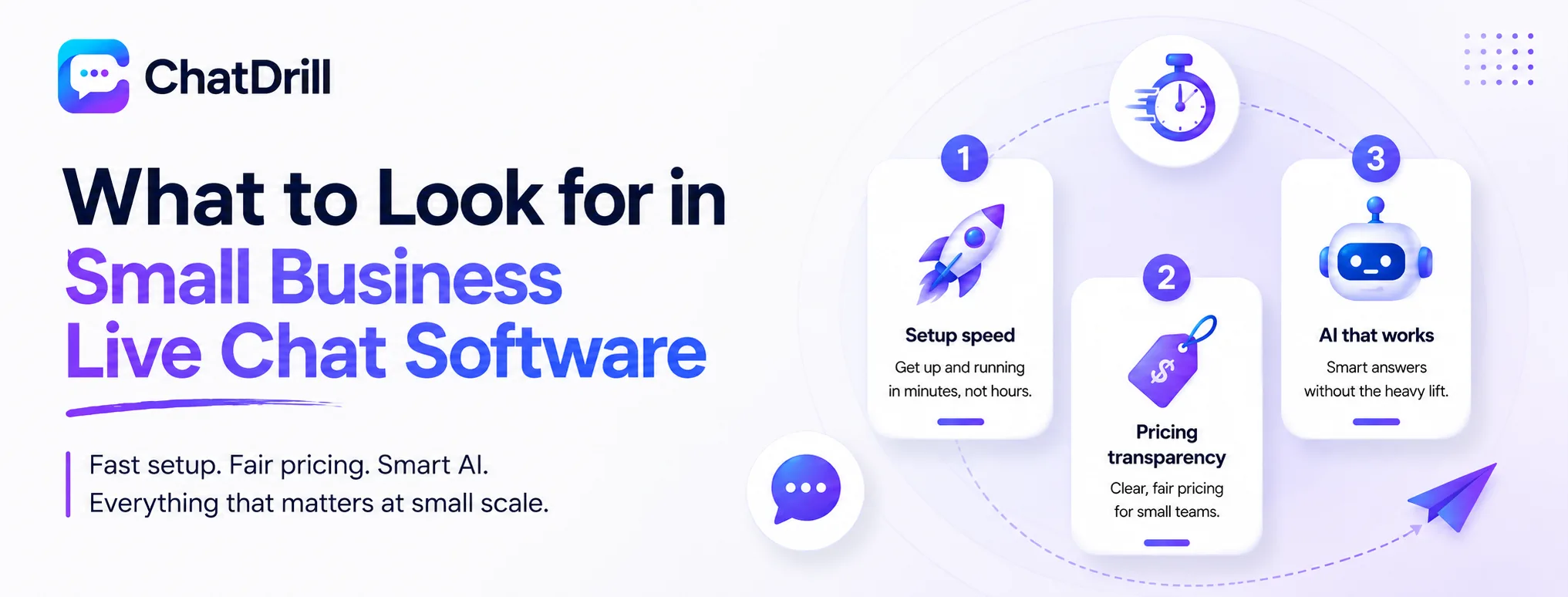
Strong small business chat software offers a genuinely fast setup process, pricing that stays reasonable at low agent counts specifically, and AI that performs well without requiring extensive configuration time.
Setup speed as a genuine priority
Testing actual setup time directly during a trial, rather than trusting a vendor's general claim, reveals whether a platform genuinely fits a small business's limited available setup time.
A platform requiring a lengthy configuration process before delivering real value is a poor fit regardless of its other capabilities.
Pricing transparency at small scale
Look specifically at published pricing for a two to five agent team, since some platforms' general value proposition only holds at a considerably larger scale.
A platform requiring a sales call to understand pricing at small scale is worth extra scrutiny, since this often signals pricing not genuinely designed for this segment.
AI that works without extensive setup
Testing AI performance directly with a handful of real customer questions during a trial reveals whether it delivers genuine value quickly or requires more configuration time than a small team can spare.
This directly affects how quickly a small business sees real return on the tool, rather than spending weeks fine-tuning before genuine value emerges.
The Best Live Chat Software for Small Business
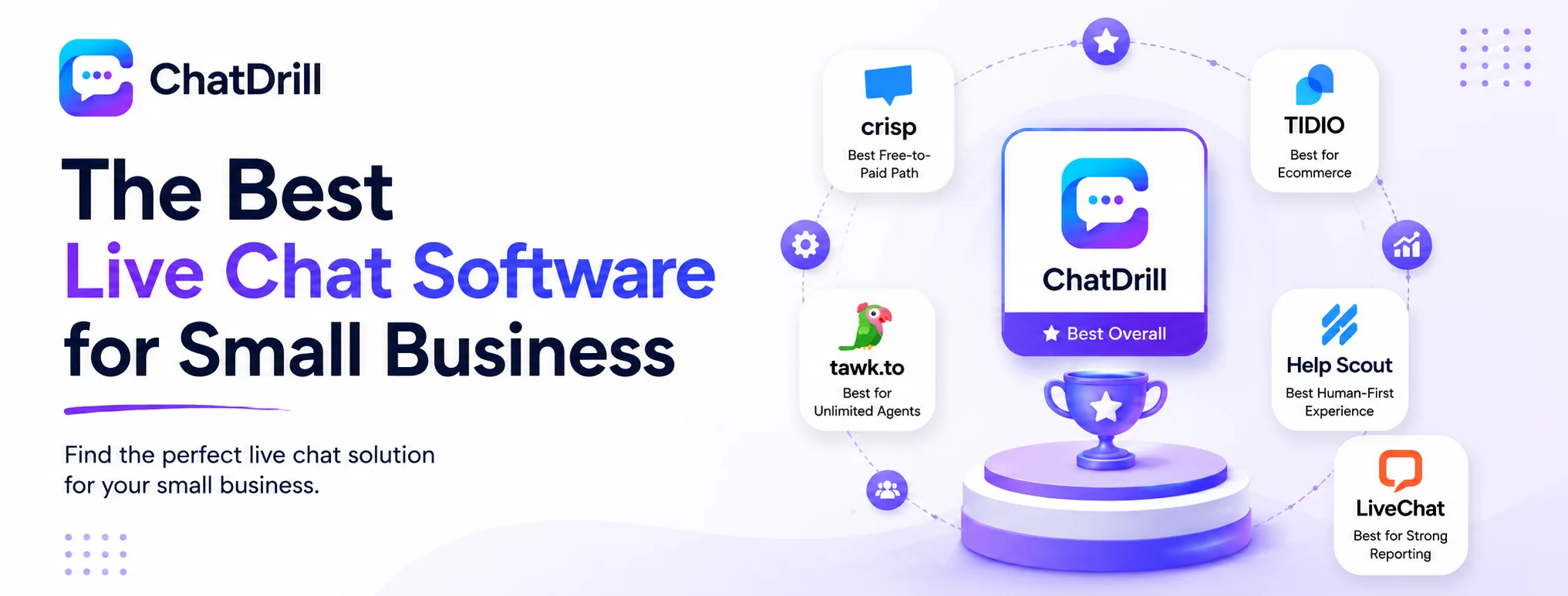
ChatDrill leads for fast setup with genuine AI at small-business pricing, with Crisp, tawk.to, Tidio, Help Scout, and LiveChat each fitting a more specific small business priority.
ChatDrill — best overall for small businesses wanting AI
ChatDrill combines fast setup with AI automation included at pricing scoped for a small team, avoiding the common trade-off between affordability and genuine automation capability.
Its setup process is genuinely fast enough for a non-technical small business owner to get a working, AI-trained widget live within an afternoon.
Small businesses specifically prioritizing automation to reduce team burden tend to find this combination particularly well suited to their actual constraints.
Crisp — best free-to-paid path for a growing small business
Crisp's genuinely useful free tier, with a reasonable upgrade path to paid plans, suits a small business at any stage from just starting out to genuinely established.
Its unified inbox across chat, email, and social gives broad channel coverage even at accessible pricing.
This flexibility across price points makes it a reasonable choice for a small business uncertain about its exact near-term budget for chat tooling.
tawk.to — best for unlimited agents at minimal cost
tawk.to remains the most cost-effective option for a small business with several team members needing chat access, given its unlimited free agents.
AI automation requires a paid add-on, worth weighing against ChatDrill's included automation if AI is a genuine current priority.
This suits a small business purely optimizing for cost with multiple people needing chat access simultaneously.
Tidio — best for a small ecommerce business
Tidio's AI trained on product and order data suits a small online store specifically, handling shopping questions more relevantly than a generic small business chat tool.
Its fast Shopify setup reduces the time investment needed from a small store owner already juggling many other responsibilities.
Small businesses outside ecommerce are less likely to find Tidio's specific strengths as directly applicable to their situation.
Help Scout — best for a personal, human-first small business
Help Scout's shared email inbox with a lighter chat layer suits a small business wanting a personal touch over heavy automation in customer interactions.
This fits a small business whose owner or team wants to personally handle most customer conversations rather than routing heavily through AI.
Its pricing and design both reflect genuine small-team focus, avoiding enterprise complexity a small business would never use.
LiveChat — best for a small business wanting strong reporting
LiveChat's reporting depth, even accessible at a reasonable price point, suits a small business owner wanting genuine visibility into support performance despite a small team size.
Its large integration library also suits a small business connecting chat to several other tools already in use.
This suits a small business specifically prioritizing data visibility over maximum AI automation depth.
Small Business Chat Software by Priority
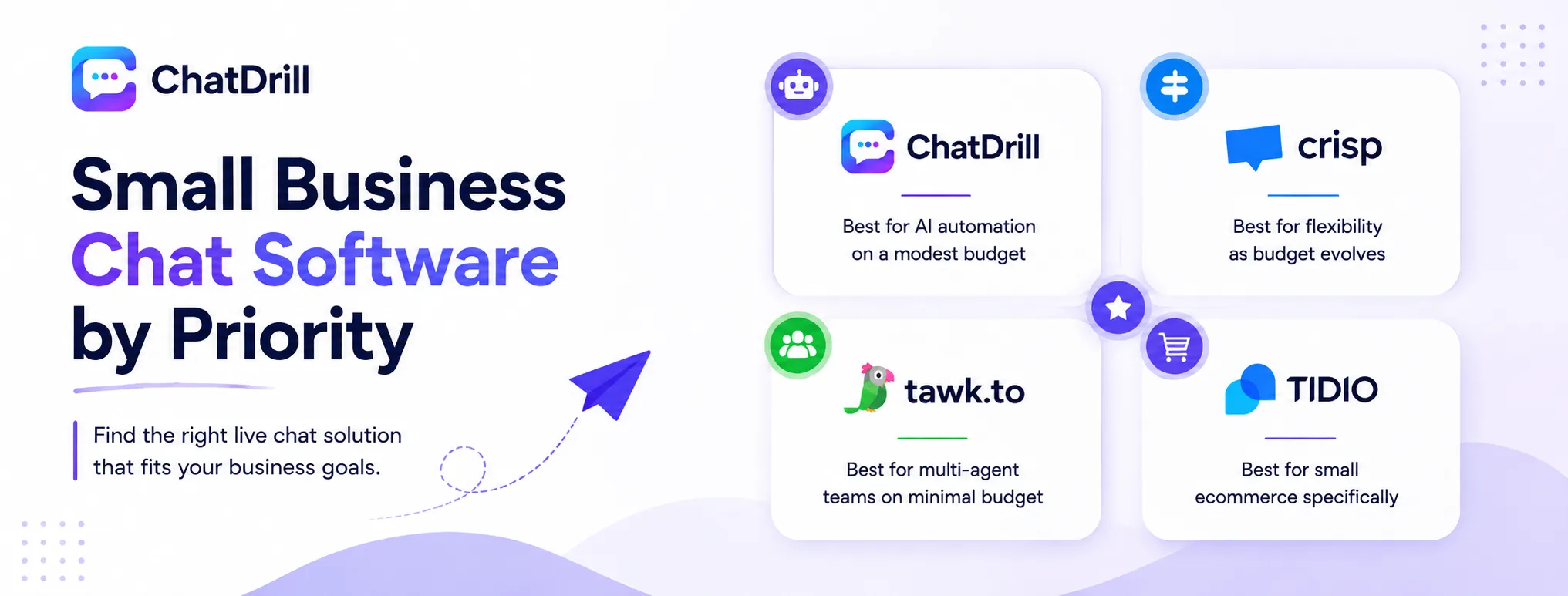
ChatDrill suits small businesses wanting AI without a big budget, Crisp suits businesses uncertain about budget with room to grow, tawk.to suits multi-agent teams on minimal budget, and Tidio suits small ecommerce specifically.
Best for AI automation on a modest budget
ChatDrill's combination of accessible pricing and included AI automation suits a small business wanting genuine automation without enterprise-level spend.
Best for flexibility as budget evolves
Crisp's free-to-paid path suits a small business uncertain about its exact near-term chat software budget, offering room to grow within the same platform.
Best for multi-agent teams on minimal budget
tawk.to's unlimited free agents suit a small business with several team members needing chat access without per-seat cost.
Best for small ecommerce specifically
Tidio's ecommerce-specific AI suits a small online store better than a generic, non-specialized small business chat tool.
Small Business Chat Pricing: What to Expect
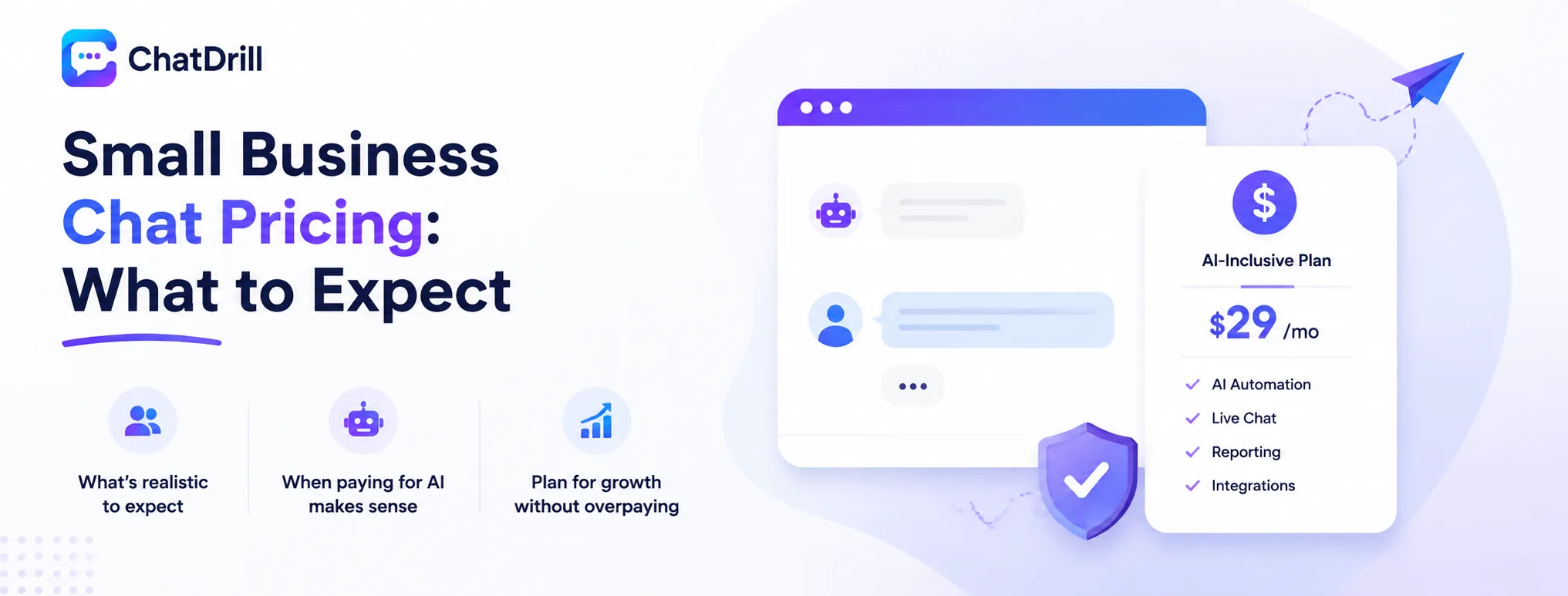
At small business scale, pricing ranges from fully free to a modest monthly cost for AI-inclusive plans, with the key question being whether genuine AI automation justifies paying before revenue alone would otherwise support the expense.
What's realistic to expect at small scale
Most platforms price their entry tiers reasonably for a two to ten agent team, though AI depth and reporting quality still vary meaningfully within that similar price range.
Comparing actual included capability at a comparable price point, not just the sticker price, reveals real differences between platforms.
When paying for AI makes sense even for a small business
If AI automation would meaningfully reduce time a small team spends on repetitive questions, a modest paid plan can be worth the cost well before it feels like a major budget decision.
This calculation is worth revisiting specifically once support volume starts genuinely competing with other core business priorities for attention.
Planning for the next stage without overpaying now
Choosing a platform with a reasonable growth path avoids a disruptive full switch later, without requiring a small business to pay for enterprise capability it doesn't currently need.
This balance, present-day affordability with a reasonable future path, is worth weighing explicitly rather than optimizing purely for either extreme.
What to Watch for as Your Small Business Grows
As a small business grows, watch for AI deflection plateauing as question variety increases, reporting needs outgrowing a basic tier, and chat volume starting to require staffing decisions a small, informal team can no longer make by feel alone.
AI performance plateauing
As a growing business's questions become more varied, the same AI setup that worked well early on may start missing a growing share of nuanced or unusual questions.
Reviewing AI performance periodically, and investing in richer training content as the business evolves, keeps automation value from quietly declining.
Reporting needs outgrowing a basic tier
Once a small business grows enough to need real, data-driven staffing or process decisions, a basic reporting tier may no longer provide sufficient visibility.
This is often the clearest trigger for a paid upgrade, worth anticipating rather than reacting to once the gap becomes a genuine operational problem.
Chat volume requiring genuine staffing decisions
A small business's growing chat volume eventually reaches a point where informal, ad hoc coverage no longer suffices, requiring genuine scheduling and staffing planning.
Recognizing this transition early, rather than after response times have already suffered, keeps the customer experience consistent through the growth.