

A business serving customers in regions with genuinely variable or limited internet connectivity faces a distinct chat evaluation priority most mainstream buying guides don't address directly, since a heavy, poorly optimized widget performs noticeably worse under these real-world conditions.
Quick answer: For businesses serving customers in low-connectivity areas, the best live chat software prioritizes a genuinely lightweight widget, graceful reconnection after a dropped connection, and offline message capture so a customer can still leave a message even without an active connection, with lightweight-focused platforms like tawk.to and Tidio worth evaluating specifically for this quality, alongside ChatDrill for its efficiency-focused widget design.
This priority centers on genuine technical characteristics, widget file size, loading efficiency, and graceful handling of connection interruptions, rather than the feature-richness most chat comparisons emphasize.
Understanding these specific technical factors, and how to actually test for them rather than relying on marketing claims alone, helps a business genuinely serving low-connectivity customers make a more appropriate choice.
This guide covers what low-connectivity performance specifically requires, how to evaluate this directly, common mistakes, key questions to ask, and how ChatDrill approaches this specific challenge.
What Genuine Low-Connectivity Performance Requires
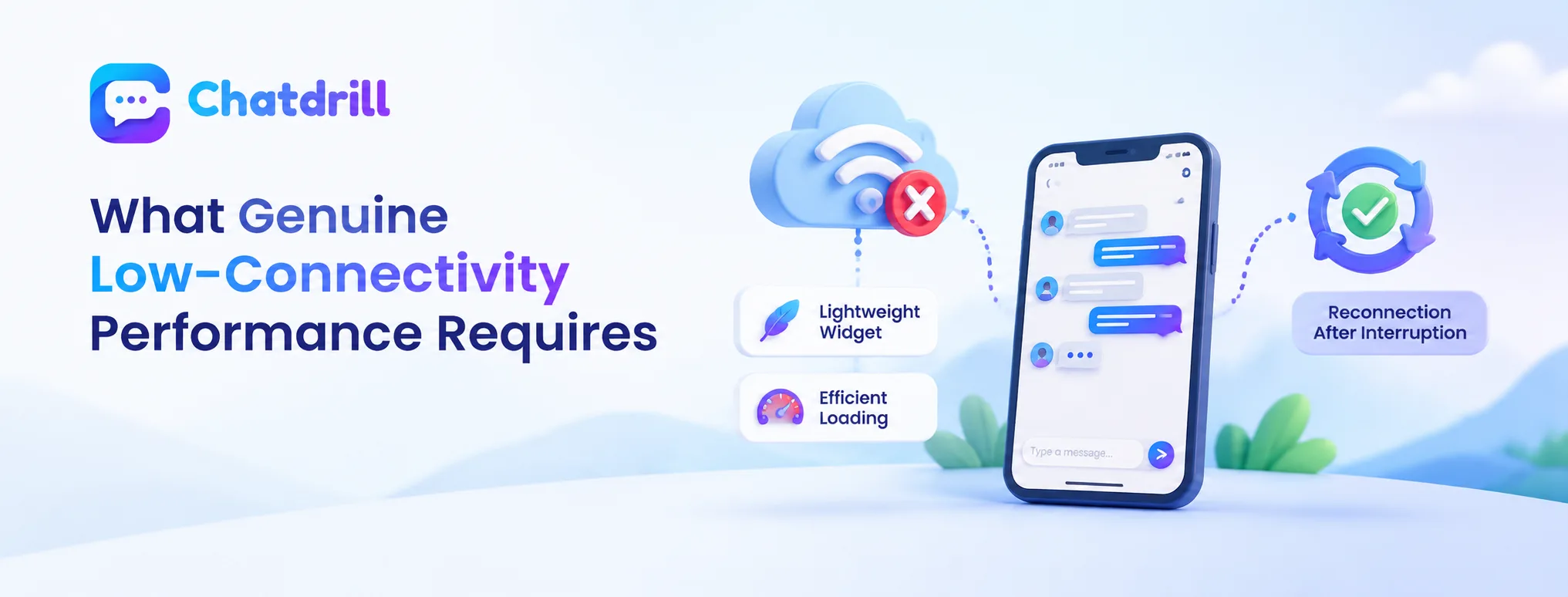
A lightweight widget, efficient loading, and graceful reconnection after interruption together determine genuine performance under constrained bandwidth.
Widget size and loading efficiency
A chat widget's actual file size and loading efficiency directly determine how it performs under genuinely slow or intermittent connections, with a lighter, more efficiently coded widget loading and functioning more reliably than a heavier, feature-dense one.
This technical characteristic matters more for this specific use case than for a business primarily serving customers on fast, reliable connections, where widget weight has less practical impact on the actual experience.
Graceful handling of connection interruptions
A well-designed chat system reconnects automatically after a brief connection drop, preserving the conversation rather than losing it entirely, a genuinely important quality given how routine connection interruptions are in many low-connectivity contexts.
This resilience should be evaluated directly, since marketing materials rarely emphasize this specific, technically detailed characteristic even when it matters considerably for this use case.
How to Evaluate This Directly
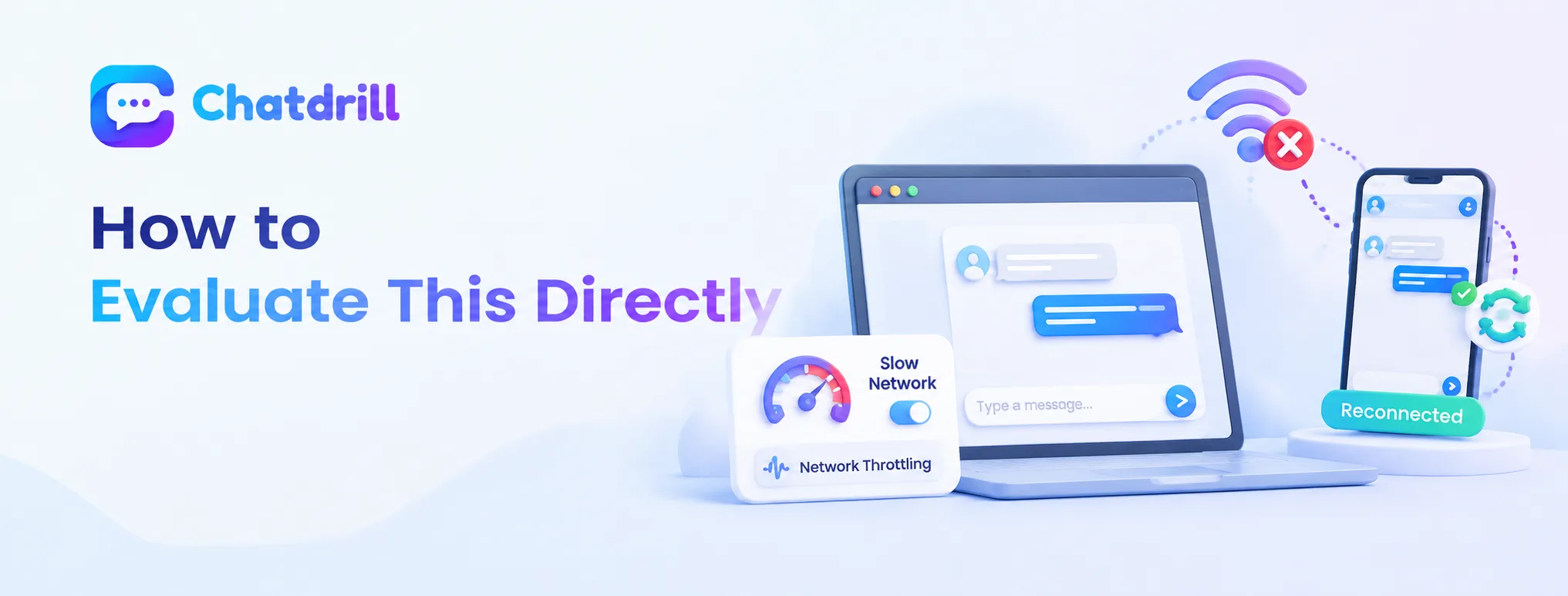
Testing a candidate platform under simulated slow-connection conditions, rather than relying on marketing claims, reveals genuine performance differences.
Simulating slow connections during evaluation
Using a browser's built-in network throttling feature to simulate a genuinely slow connection while testing a candidate widget reveals real performance differences that a quick test on fast office Wi-Fi would never expose.
This hands-on testing approach produces considerably more reliable evaluation than relying on a vendor's general claims about efficiency or performance.
Testing reconnection behavior specifically
Deliberately interrupting a test connection mid-conversation and observing whether the widget reconnects gracefully, preserving the conversation, reveals this specific resilience quality directly rather than assuming it based on general reputation.
This targeted test addresses the specific technical characteristic this guide identifies as particularly important for genuinely low-connectivity use cases.
Common Mistakes in This Evaluation
Assuming a popular, well-reviewed platform automatically performs well under low connectivity, and testing only on a fast connection, are common mistakes.
Assuming popularity implies low-connectivity performance
A widely popular, well-reviewed chat platform isn't automatically optimized for genuinely constrained bandwidth conditions, since most reviews and comparisons are conducted under typical, fast-connection assumptions.
Testing directly, as this guide recommends, rather than assuming general popularity implies this specific technical quality, produces a more reliable evaluation.
Testing only under fast, ideal conditions
Evaluating a candidate platform only on a fast office connection misses exactly the performance characteristics that matter most for a business genuinely serving low-connectivity customers.
Simulating realistic, constrained conditions during evaluation, as this guide's tactics recommend, avoids this common, evaluation-invalidating gap.
Key Questions to Ask Before Choosing
Asking directly about widget file size and reconnection behavior surfaces the specific technical details most relevant to this use case.
What is the widget's actual file size and loading approach?
Asking a vendor directly for specific technical detail about widget size and loading optimization, rather than accepting a general claim of "lightweight," produces more genuinely useful evaluation information.
A vendor genuinely confident in this characteristic should be able to provide concrete, specific detail rather than only a vague, general assurance.
How does the system handle a dropped connection?
Asking specifically how the platform handles a connection interruption, and confirming this through direct testing as this guide recommends, addresses the resilience quality most relevant to genuinely constrained connectivity conditions.
This specific question, beyond general reliability claims, targets exactly the technical behavior this use case depends on most.