

A genuinely no-card-required free trial removes a real barrier to honest evaluation, since requiring payment information upfront introduces a subtle psychological commitment and a genuine risk of an unexpected charge if a trial isn't canceled in time.
Quick answer: For businesses wanting to genuinely test chat software without an upfront payment commitment, LiveAgent, Intercom, and LiveChat all offer explicitly no-credit-card-required trials of 14 to 30 days, while tawk.to's permanently free tier removes the trial-expiration pressure entirely, making all of these worth evaluating before committing budget to any paid chat platform.
Several established chat platforms explicitly advertise trials that require no card at signup, a detail worth confirming directly rather than assuming based on general trial availability alone.
Understanding which platforms genuinely offer this no-friction trial experience, and how to use the trial period most effectively, helps a business evaluate chat software honestly before committing real budget.
This guide covers platforms genuinely offering no-card trials, how to use a trial period most effectively, common mistakes, key questions to ask, and how ChatDrill approaches trial evaluation.
Platforms Genuinely Offering No-Card Trials
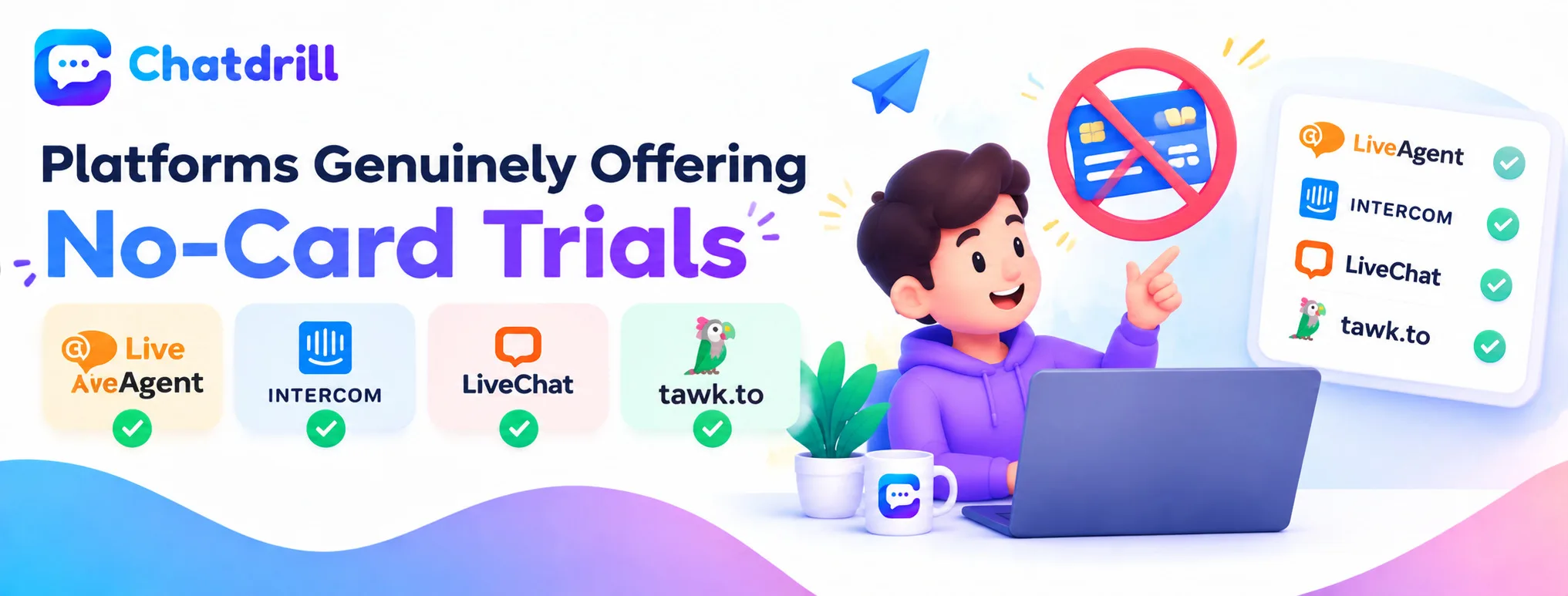
LiveAgent, Intercom, and LiveChat explicitly advertise no-credit-card-required trials, while tawk.to's permanently free tier removes trial pressure entirely.
LiveAgent and Intercom's explicit no-card trials
LiveAgent explicitly offers a 30-day free trial with no credit card required, giving a genuinely extended window to test live chat, AI automation, ticketing, and reporting before any payment commitment.
Intercom similarly offers a 30-day trial with no card required, letting a business evaluate its more comprehensive proactive messaging and AI capability without upfront payment risk.
LiveChat's trial and tawk.to's permanently free option
LiveChat offers a 14-day free trial with no credit card required, providing a genuine, if somewhat shorter, evaluation window compared to some alternatives.
tawk.to sidesteps the trial-timing question entirely by offering a permanently free core tier, letting a business evaluate genuine, ongoing value without any expiration pressure at all.
How to Use a Trial  Period Most Effectively
Testing with genuine, real customer questions and involving actual team members who would use the platform daily both maximize a trial's evaluation value.
Testing with genuine, real customer questions
Using your own actual, historical customer questions during a trial, rather than generic test messages, reveals how the platform genuinely performs for your specific business rather than under artificial, idealized conditions.
This realistic testing approach applies whether evaluating AI response quality, human-agent workflow, or any other platform capability genuinely relevant to your actual use case.
Involving the actual team members who would use it daily
Having the specific people who would genuinely operate the platform day-to-day test it during the trial, rather than evaluating purely from a decision-maker's higher-level perspective, surfaces practical usability issues that matter for actual daily operation.
This inclusive testing approach produces a more genuinely informed final decision than an evaluation conducted in isolation from the people who'll actually use the tool.
Common Mistakes When Using a Free Trial
Testing only with idealized, simple scenarios, and failing to test genuine edge cases, are common mistakes that undermine trial evaluation value.
Testing only with idealized, simple scenarios
Limiting trial testing to a few simple, easy questions misses the genuinely more complex or ambiguous scenarios your actual customers regularly present, producing an overly optimistic evaluation that doesn't reflect real-world performance.
Deliberately including some genuinely difficult or ambiguous test questions, as this guide's testing approach recommends, produces a more honest, complete evaluation.
Not testing genuine edge cases and failure scenarios
Failing to test how a platform handles a genuinely confusing question, or observe its fallback and escalation behavior, misses important information about how it will perform when things don't go smoothly.
This edge-case testing matters particularly for AI-assisted features, where graceful failure handling often distinguishes a genuinely mature platform from a less capable one.