
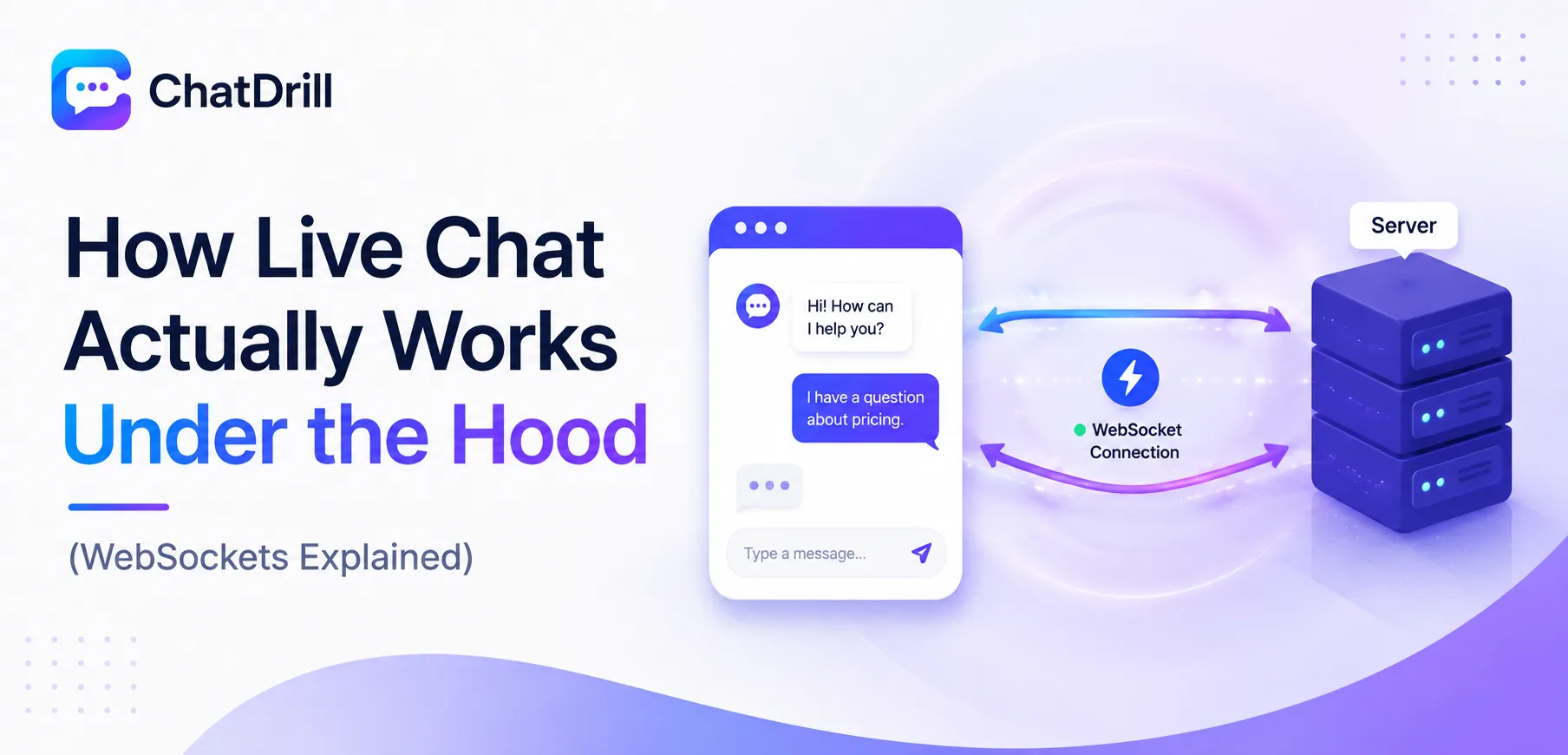
Explained) Live chat feels instant because it typically runs over a WebSocket connection, a persistent, two-way link between a visitor's browser and a server that stays open for the duration of the conversation, rather than the traditional request-response pattern a standard web page uses.
This underlying mechanism is what makes features like instant message delivery and typing indicators possible, since the server maintains constant awareness of both sides of the conversation rather than waiting for each side to periodically ask "anything new?"
Understanding this architecture isn't just academic curiosity, it explains real, practical behavior a business might notice, why chat feels faster than a form submission, why a dropped connection sometimes causes a message to seem to disappear, and why certain network environments occasionally cause chat issues.
This guide breaks down what actually happens from the moment a chat widget loads to a message being delivered, comparing WebSockets against the traditional web request model, and explaining what this means practically for anyone running or evaluating live chat software.
This guide covers what WebSockets actually are, how a chat message travels from sender to recipient step by step, how this compares to traditional HTTP requests, what happens when a connection drops, and what this technical foundation means practically for a business.
What Is a WebSocket Connection?
A WebSocket is a persistent, two-way communication channel between a browser and a server that stays open for the duration of an interaction, allowing either side to send a message instantly without needing to initiate a new connection each time.
Simple definition
Unlike a traditional web request, which opens a connection, sends data, receives a response, and closes, a WebSocket connection stays open continuously, letting data flow in either direction the moment it's ready.
This persistence is the fundamental technical difference that makes real-time, instant-feeling communication possible, rather than requiring either side to repeatedly ask if anything new has happened.
The connection is established once, typically when a chat widget first loads on a page, and then remains active for as long as the conversation continues.
Why this matters specifically for chat
Chat is inherently a real-time, back-and-forth interaction, exactly the use case WebSockets were designed to support well, compared to technologies built around the traditional request-response pattern.
Without this persistent connection, achieving the same instant feel would require constantly re-establishing new connections, a meaningfully less efficient and less responsive approach.
Where else WebSockets show up
This same underlying technology powers other real-time features across the web, live sports score updates, collaborative document editing, real-time notifications, anywhere instant, bidirectional communication matters.
Recognizing this broader pattern helps clarify that chat's real-time feel isn't unique magic, it's the same well-established technology solving a similar underlying problem.
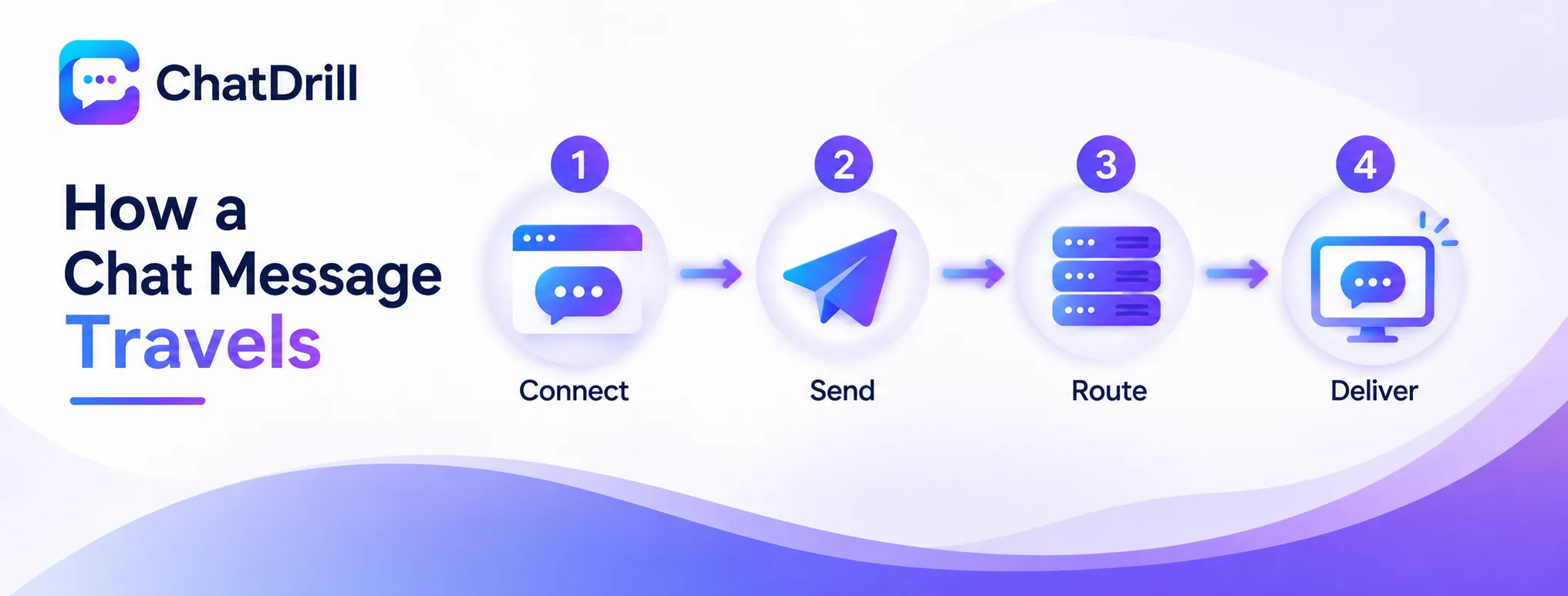
How a Chat Message Travels: Step by Step
Step 2: A message is sent through the open connection
connection to the server, which processes and routes it, then pushes it instantly to the recipient's browser through their own open connection, all within a fraction of a second.
Step 1: The widget establishes a connection
When a visitor loads a page with a chat widget, the widget's script establishes a WebSocket connection to the chat platform's server, a handshake that typically completes within milliseconds.
This connection remains open in the background even before the visitor sends their first message, ready to transmit data the instant it's needed.
Step 2: A message is sent through the open connection When the visitor types and sends a message, it travels immediately through the already-open WebSocket connection to the server, without needing to establish a new connection for this specific message.
This is the key efficiency gain over a traditional request, the connection overhead was already paid once at the start, not repeated for every single message sent afterward.
Step 3: The server processes and routes the message
The server receives the message, determines where it needs to go, an agent's dashboard, an AI system for processing, or both, and prepares to deliver it accordingly.
This routing logic is also where features like AI response generation or agent assignment rules get applied, before the message reaches its final destination.
Step 4: The message is pushed to the recipient instantly
Rather than waiting for the recipient's browser to ask "anything new?", the server actively pushes the message through the recipient's own open WebSocket connection the moment it's ready.
This push mechanism is what makes the message appear to arrive instantly, rather than the delay that would occur if the recipient's browser had to periodically check for updates.
WebSockets vs Traditional HTTP Requests
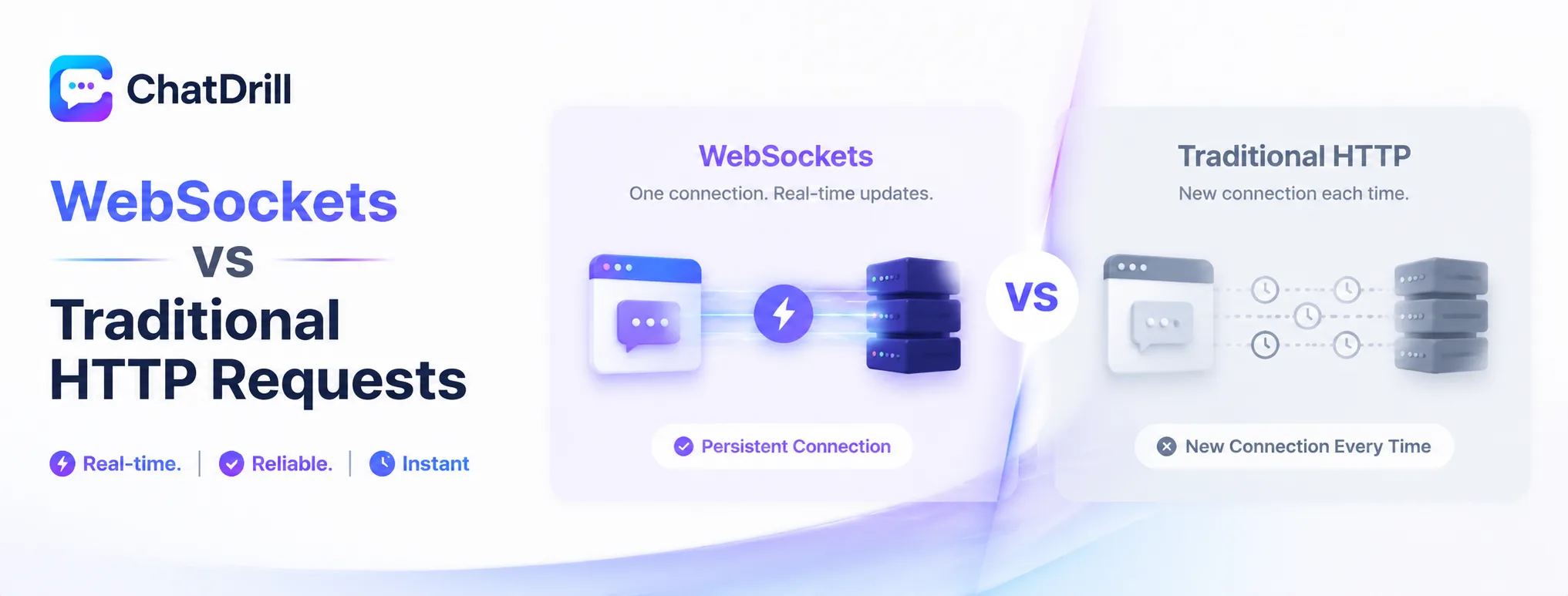
Traditional HTTP requests open a new connection for each request-response cycle and close it afterward, while a WebSocket connection stays open continuously, a fundamental difference that explains why chat feels considerably faster than a typical web form submission.
How traditional HTTP requests work
A standard web page loads content, submits a form, or fetches new data by opening a new connection for each specific request, receiving a response, and then closing that connection.
This pattern works well for most typical web browsing, but introduces meaningful overhead and latency if repeated frequently for something requiring truly real-time updates.
Why polling was the older workaround
Before WebSockets became widely supported, some real-time-feeling features were approximated through polling, repeatedly sending new HTTP requests every few seconds to check for updates.
This approach works but is meaningfully less efficient and less instant-feeling than a genuine persistent connection, since there's always some delay between an update happening and the next poll actually catching it.
Why WebSockets are the modern standard for chat
WebSockets eliminate both the connection-reestablishment overhead and the polling delay, delivering messages the instant they're ready rather than on the next scheduled check.
This is why virtually every modern live chat platform, including ChatDrill, relies on WebSocket technology as its core real-time communication mechanism.
What Happens When a Connection Drops
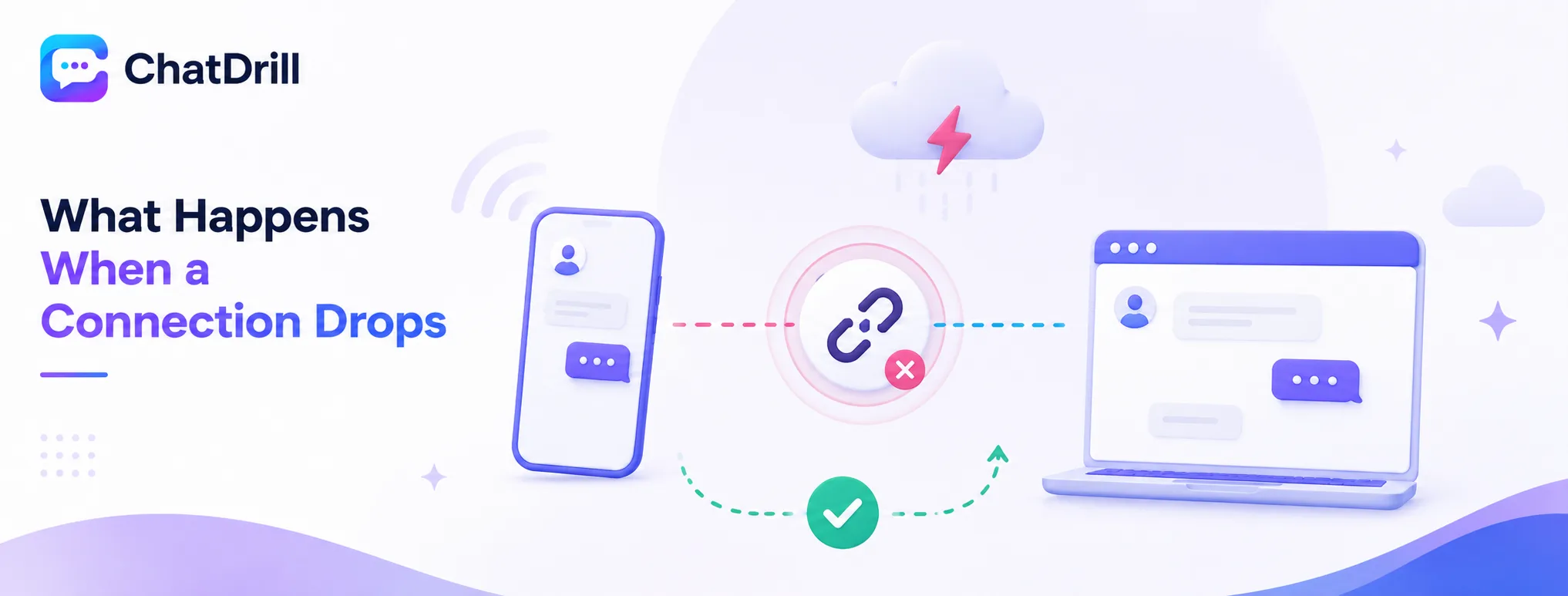
When a WebSocket connection drops, most modern chat platforms automatically attempt to reconnect and sync any missed messages, though a poorly built implementation can occasionally cause a message to appear delayed or temporarily missing.
Common causes of a dropped connection
Network instability, a visitor switching between WiFi and mobile data, or a device going to sleep can all interrupt an active WebSocket connection unexpectedly.
This is a normal, expected occurrence in real-world usage, not a sign of something fundamentally broken, well-built systems are designed to handle this gracefully.
How a well-built system recovers
A robust chat platform automatically detects the dropped connection, attempts to reconnect, and syncs any messages that may have been sent or received during the brief interruption.
This recovery typically happens within seconds and is invisible to the end user, who simply sees the conversation continue normally once the connection restores.
What a poor implementation can get wrong
A less carefully built system might lose a message sent during the interruption, or fail to sync properly upon reconnection, leading to a confusing gap in the visible conversation history.
This is worth testing directly when evaluating a chat platform, deliberately interrupting a connection during a trial to see how gracefully the platform actually recovers.
What This Means Practically for Your Business
This technical foundation explains why chat consistently outperforms email on speed, why occasional connection hiccups are normal rather than a sign of a broken platform, and why evaluating a platform's connection reliability matters as much as its feature list.
Why chat is inherently faster than email or forms
The persistent connection underlying chat is architecturally built for real-time speed in a way email and standard web forms simply aren't, explaining the fundamental speed advantage beyond just convenience alone.
Understanding this helps set realistic expectations, chat's speed advantage isn't just about a business choosing to prioritize fast responses, it's built into the underlying technology itself.
Why occasional glitches don't mean a platform is broken
A brief, rare connection interruption reflects normal network variability, not necessarily a flaw in the chat platform, since well-built systems are specifically designed to recover gracefully from this.
What matters more than avoiding interruptions entirely, which isn't fully possible, is how gracefully a platform recovers when they inevitably occur.
Why connection reliability is worth evaluating directly
When choosing a chat platform, testing behavior under a simulated connection interruption reveals real-world reliability that a features page alone won't clarify.
This technical due diligence is worth the extra evaluation time, since a platform's underlying connection handling quality directly affects the actual customer experience during real-world usage.