
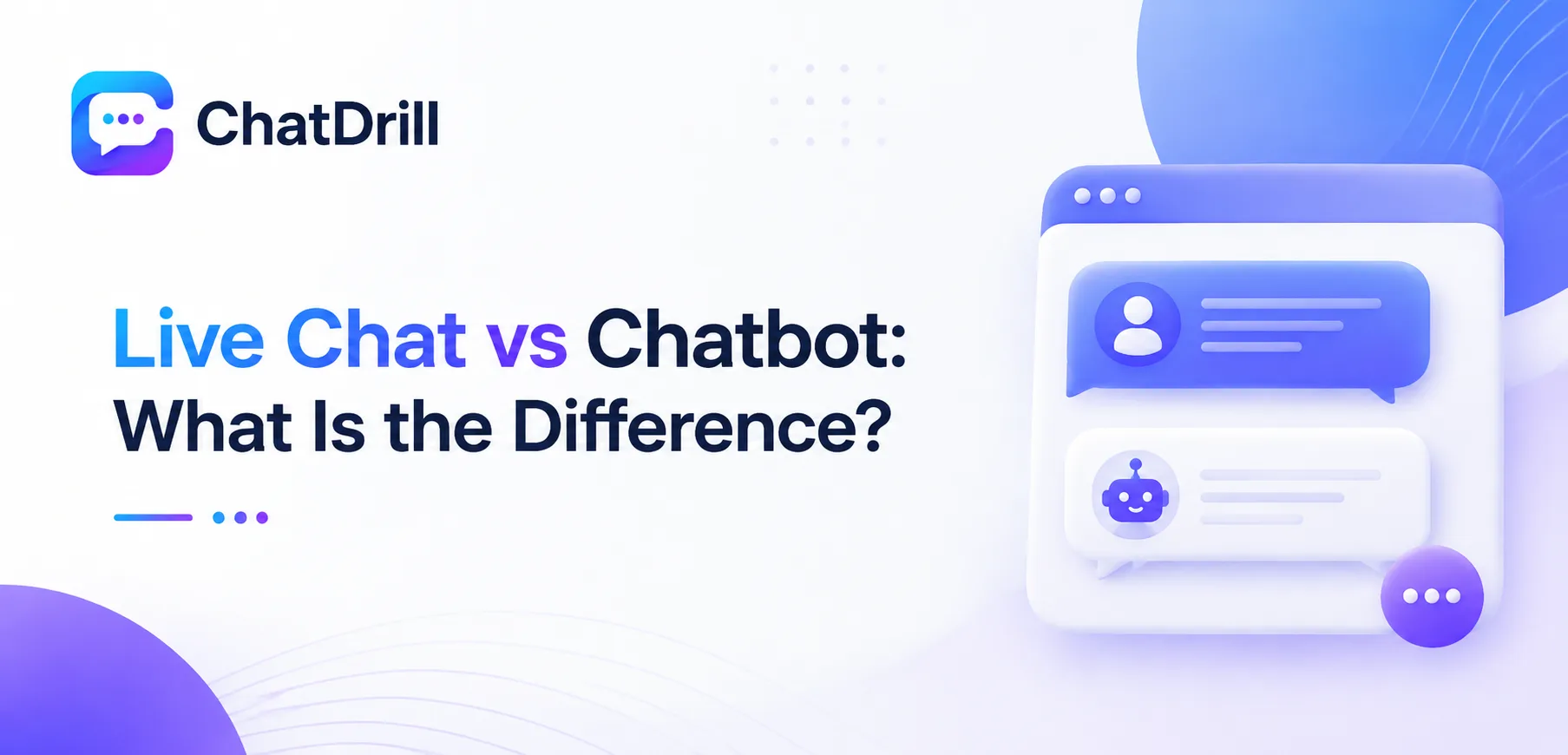
Live chat is the real-time messaging channel itself, the widget and infrastructure letting a visitor and a business communicate instantly, while a chatbot is the automation that can operate within that channel, answering questions without a human needing to be involved in every conversation.
This distinction gets genuinely confused in everyday conversation, since most modern platforms bundle both together, but understanding the difference matters when evaluating a platform or explaining to a team what a specific tool actually does.
In practice, live chat and chatbots work together rather than as competing alternatives, a chat widget provides the channel, and a chatbot, if present, handles some share of the conversations happening within it, with a human agent handling the rest.
The right balance between chatbot automation and human involvement depends heavily on a business's specific needs, question complexity, and volume, rather than one universally correct ratio applying to every business equally.
This guide covers what live chat and chatbots each actually are, how they differ specifically, how they typically work together in a real deployment, when a business needs one, the other, or both, and how to think about this distinction when evaluating a platform.
What Is Live Chat?
Live chat is the real-time messaging channel and infrastructure, the widget, the underlying connection technology, the shared inbox, that lets a website visitor and a business communicate instantly, regardless of whether a human or an automated system is on the other end.
Simple definition
Live chat refers to the channel itself, the mechanism by which a conversation happens in real time, distinct from what specifically powers the responses within that conversation.
This channel can be staffed entirely by human agents, entirely by a chatbot, or a combination of both, live chat as a category doesn't specify which.
The defining characteristic of live chat is its real-time nature, distinguishing it from asynchronous channels like email where a meaningful delay between messages is normal and expected.
What live chat infrastructure actually includes
Beyond the visible widget, live chat infrastructure includes the underlying real-time connection technology, a shared team inbox, routing logic, and reporting on conversation metrics.
This infrastructure exists regardless of whether automation is layered on top, a purely human-staffed live chat setup still relies on this same underlying real-time messaging foundation.
What Is a Chatbot?
A chatbot is the automation layer that can operate within a live chat channel, answering questions or handling tasks without requiring a human agent to be actively involved in that specific conversation.
Simple definition
A chatbot is software designed to simulate a conversation, ranging from simple rule-based decision trees to genuinely sophisticated AI capable of understanding varied, nuanced questions.
The chatbot itself doesn't require live chat to exist, some chatbots operate through other channels entirely, SMS, a standalone app, but in the customer support context specifically, it typically operates within a live chat widget.
The range of chatbot sophistication
Chatbots span from basic decision-tree bots offering only predefined response paths, to genuinely AI-powered systems capable of understanding varied phrasing and generating natural, accurate responses.
This range matters significantly when evaluating a specific chatbot's actual capability, since the term "chatbot" alone doesn't clarify where on this spectrum a given system falls.
Chatbots outside the live chat context
Chatbots also exist independently of live chat, powering SMS-based automated systems, standalone messaging apps, or voice-based interactions, all sharing the same underlying automation concept applied to a different channel.
This broader context helps clarify that a chatbot is fundamentally about automated conversation, not specifically tied to the live chat widget context alone.
Live Chat vs Chatbot: The Key Differences
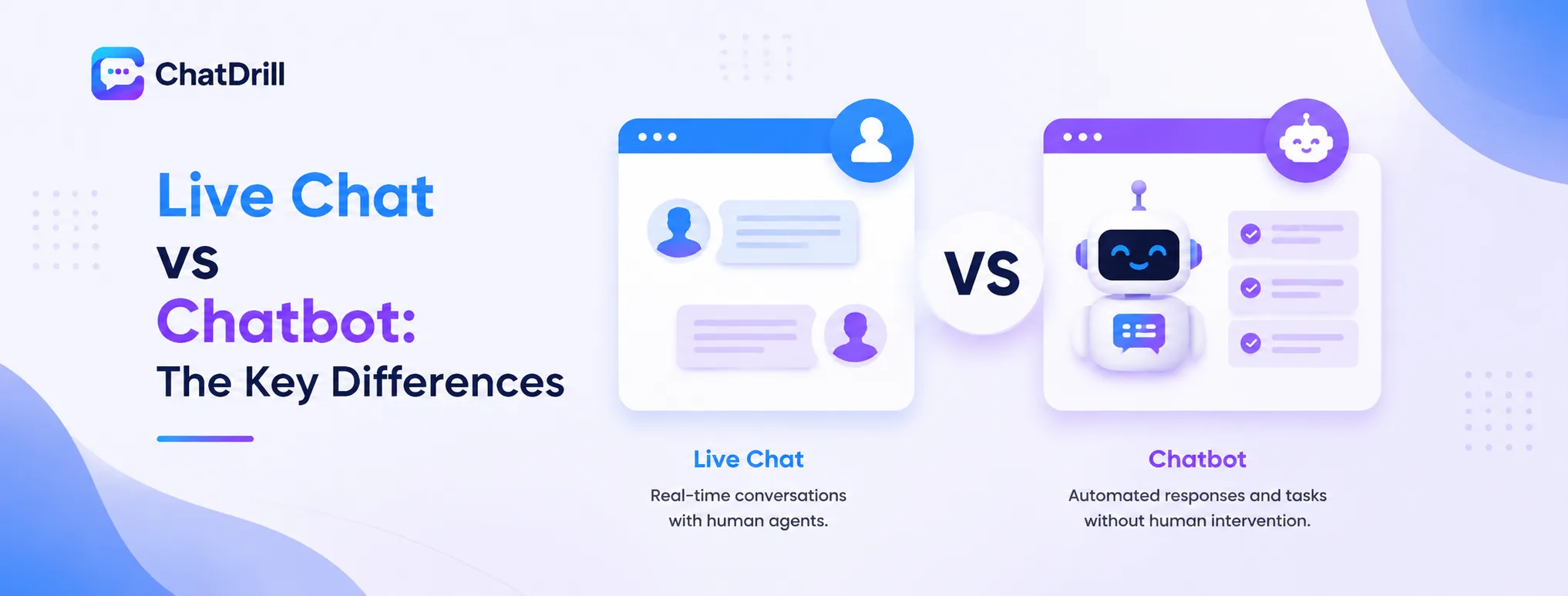
Live chat is the real-time channel itself, while a chatbot is the automation that can operate within it, meaning a business can have live chat without a chatbot, but a customer-support chatbot typically operates through some real-time channel like live chat.
Channel vs automation layer
Live chat describes the real-time communication mechanism; a chatbot describes the automated intelligence that can respond within that mechanism, a category distinction rather than a feature comparison.
This means asking "live chat or chatbot?" as a binary choice is somewhat of a category error, the real question is usually how much chatbot automation to layer onto an existing or planned live chat channel.
Can exist independently, but usually don't in practice
Live chat can exist entirely without a chatbot, purely human-staffed conversations, and a chatbot can technically operate through channels other than live chat.
In practice, most modern business deployments combine both, live chat as the channel, with a chatbot handling some share of the conversation volume within it.
Different metrics matter for each
Live chat performance is typically measured by response time, resolution time, and overall conversation volume; chatbot performance is measured by deflection rate, accuracy, and successful resolution without human escalation.
Understanding this distinction helps a business track the right metrics for the right layer, rather than conflating overall chat performance with chatbot-specific effectiveness.
How Live Chat and Chatbots Work Together
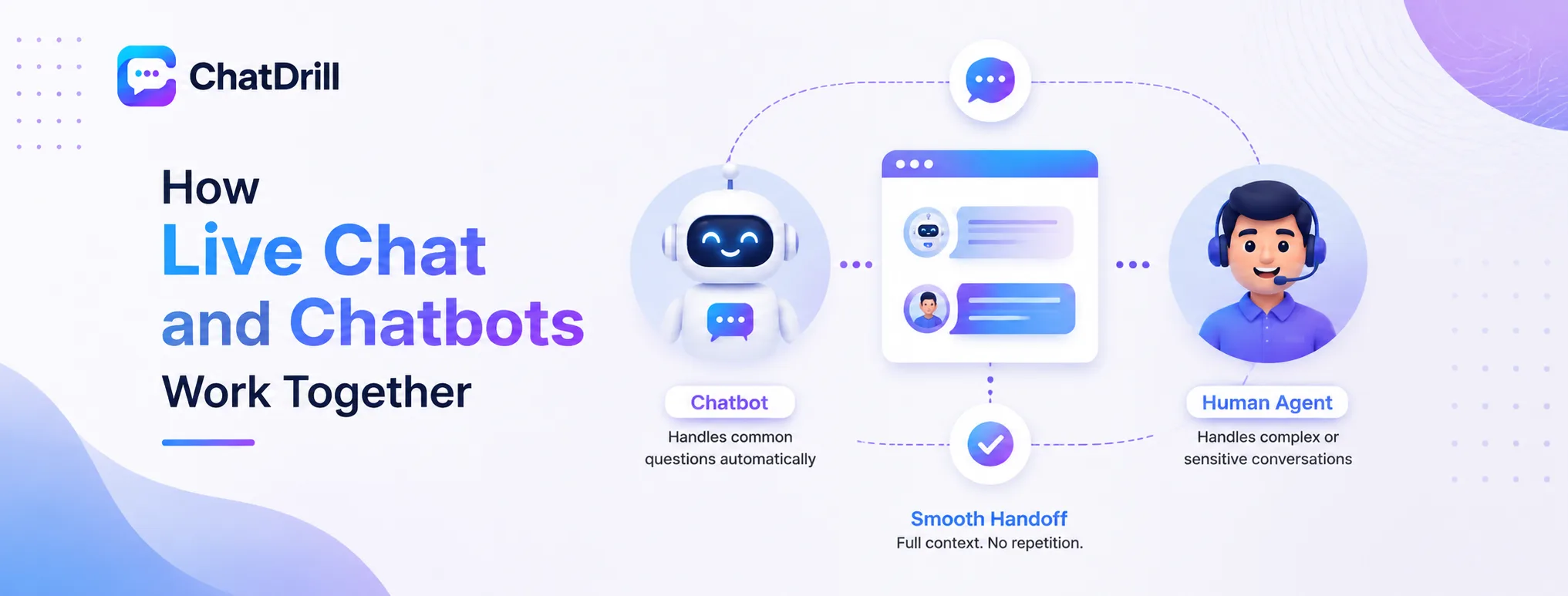
In a typical modern deployment, live chat provides the channel and infrastructure, a chatbot handles well-defined, repetitive questions automatically, and human agents handle everything the chatbot can't resolve, with a smooth handoff between the two.
The typical division of labor
A chatbot commonly handles FAQ-style questions, basic order status lookups, and initial qualification, while a human agent handles genuinely complex, nuanced, or emotionally sensitive conversations.
This division isn't fixed, it shifts as chatbot capability improves, with more sophisticated AI handling an increasingly larger share of what used to require human involvement.
The importance of a smooth handoff
When a chatbot can't resolve a conversation, a well-built system passes full conversation history and context to the human agent, avoiding the frustration of a customer needing to repeat themselves.
This handoff quality is often what separates a genuinely good chatbot-plus-human setup from one that feels disjointed and frustrating despite having both components technically present.
How this balance evolves over time
As a chatbot's training and capability improve, businesses typically see deflection rate, the share of conversations resolved without human involvement, climb steadily over time.
This evolution is a genuine, measurable sign of a maturing chatbot deployment, worth tracking explicitly rather than assuming the initial human-to-bot balance stays fixed indefinitely.
When You Need Live Chat, a Chatbot, or Both
Every business engaging in real-time website conversation needs live chat as the underlying channel, while whether to add a chatbot, and how much automation to layer on, depends on question volume, repetition, and available staffing.
When live chat alone is enough
A business with low chat volume, or one specifically prioritizing a fully human, personal touch in every conversation, may reasonably operate live chat without significant chatbot automation.
This is a genuine, valid choice for the right business context, not simply a less advanced setup compared to one with heavy automation.
When adding a chatbot makes sense
Once a business notices the same handful of questions repeating frequently, or wants coverage during hours a human team isn't available, a chatbot starts delivering clear, measurable value.
This is usually a gradual realization based on observed patterns, rather than a decision made purely based on general industry trends toward automation.
When a business genuinely needs both working well together
A business with meaningful chat volume, a mix of simple and complex questions, and a need for both efficiency and genuine human judgment on harder cases needs both live chat and a well-integrated chatbot.
This combined setup is increasingly the norm for a business genuinely serious about optimizing its support and sales chat experience.