
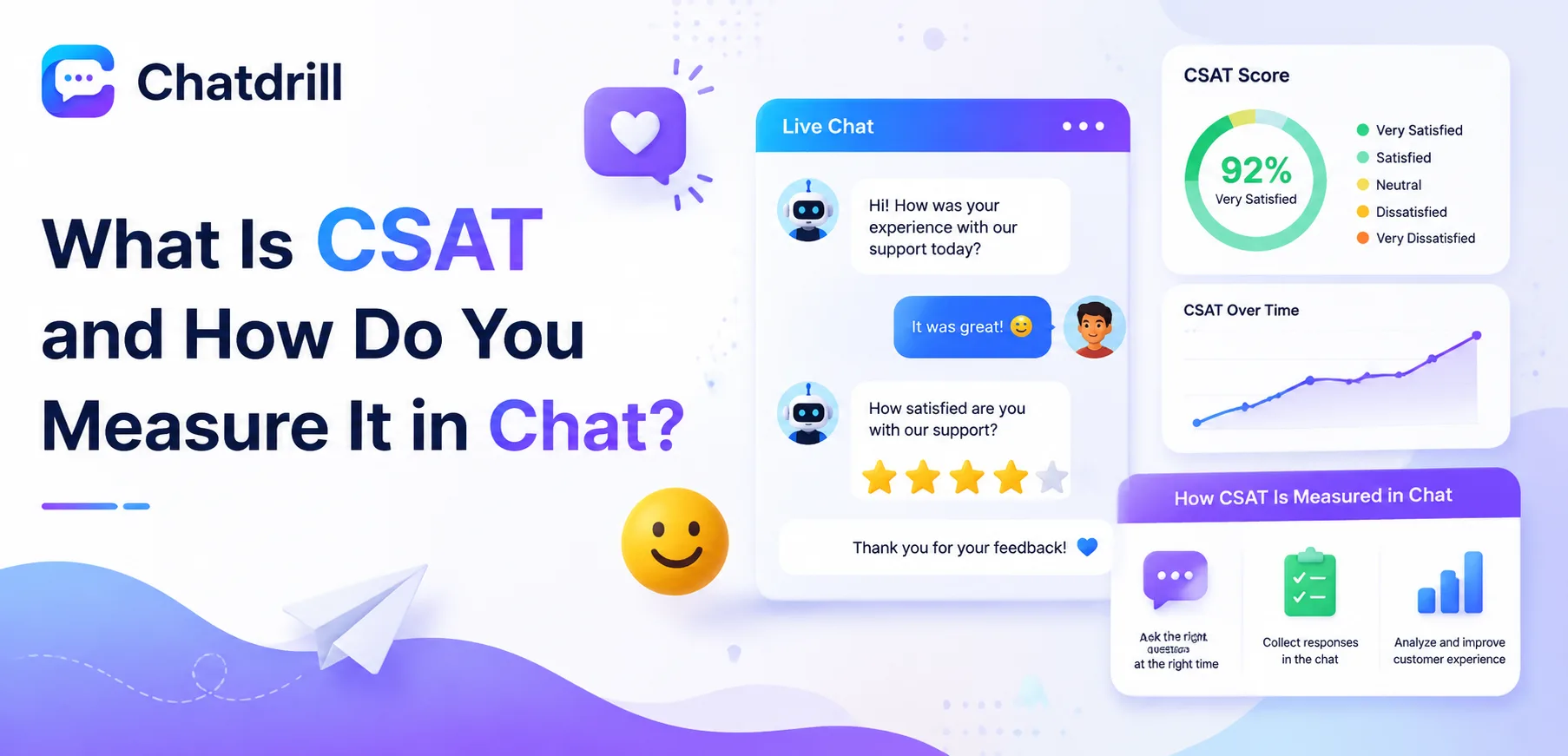
CSAT, or customer satisfaction score, measures how satisfied a customer felt with a specific interaction, typically captured through a brief post-chat survey asking the customer to rate their experience on a simple scale.
For live chat specifically, CSAT is one of the most direct, actionable quality signals available, since it's collected immediately after the interaction while the experience is still fresh in the customer's mind.
Unlike broader satisfaction metrics measuring an entire customer relationship, CSAT is intentionally narrow, focused on one specific interaction, which makes it especially useful for pinpointing exactly which conversations or agents need attention.
Getting genuine value from CSAT requires more than just collecting the score, it means calculating it correctly, understanding what a good benchmark looks like, and actually acting on what low scores reveal.
This guide covers what CSAT actually measures, how it's typically calculated, what counts as a good chat CSAT benchmark, how to collect it effectively in a chat context, and what to do with the data once you have it.
What Is CSAT?
CSAT, short for customer satisfaction score, is a metric capturing how satisfied a customer felt with a specific interaction, typically measured through a simple post-interaction survey question rated on a numeric or emoji-based scale.
Simple definition
CSAT is intentionally narrow in scope, asking about one specific interaction, a single chat conversation, rather than a customer's overall relationship with the business, which is measured by broader metrics like NPS.
This narrow focus is actually a strength for chat specifically, since it lets a business pinpoint satisfaction at the level of an individual conversation, agent, or even a specific type of question.
The survey itself is typically brief, a single rating question, sometimes with an optional comment field, designed to minimize friction and maximize response rate.
Why CSAT matters specifically for chat
Chat's real-time nature makes it especially well suited to immediate post-interaction surveying, capturing genuine, fresh sentiment right after the conversation ends rather than relying on a delayed follow-up.
This immediacy tends to produce more accurate, less faded sentiment data than a survey sent hours or days after the actual interaction occurred.
How CSAT Is Calculated
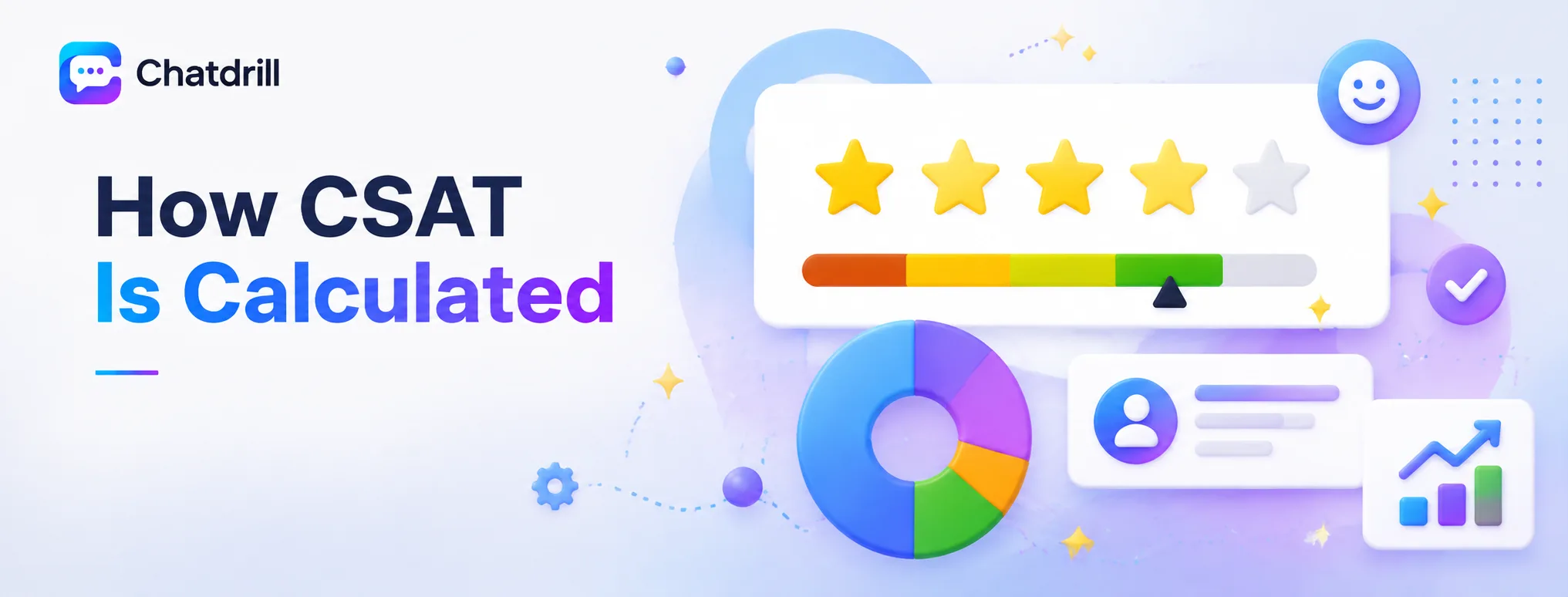
CSAT is calculated as the percentage of positive ratings out of all ratings submitted, typically treating the top one or two points on a scale as "satisfied" and everything below as not meeting that bar.
The basic calculation formula
Dividing the number of positive responses, often a 4 or 5 on a 5-point scale, by the total number of responses submitted, then multiplying by 100, produces the CSAT percentage.
This straightforward formula is what most chat platforms, including ChatDrill, calculate automatically once post-chat surveys are enabled.
Common scale variations
Some businesses use a simple binary thumbs up or down; others use a 5-point numeric scale; still others use emoji faces ranging from very unsatisfied to very satisfied.
The specific scale matters less than consistency, using the same scale over time keeps the resulting CSAT trend comparable and meaningful across different reporting periods.
What response rate genuinely means for reliability
A CSAT score based on a very small number of responses, say under ten, should be treated with caution, since a handful of unusually positive or negative ratings can skew the percentage significantly.
Tracking response rate alongside the score itself helps assess how reliable a given period's CSAT number genuinely is before drawing strong conclusions from it.
What Is a Good CSAT Score for Live Chat?

85 percent or higher is generally considered a strong CSAT score for live chat, though the right benchmark depends on industry, question complexity, and your own historical baseline more than any single universal number.
The general 85 percent benchmark
This figure reflects broad industry data across many businesses using live chat, though it should be treated as a rough directional reference rather than a precise target every business must hit exactly.
A business consistently below this benchmark has real room for improvement, while one consistently above it is performing well relative to typical chat support outcomes.
Why your own baseline matters more than external benchmarks
Comparing current CSAT against your own historical trend, rather than only an external number, gives a more meaningful sense of whether specific changes are genuinely improving the customer experience.
A business in a genuinely more complex or high-stakes industry may reasonably see a lower CSAT than a simpler, more transactional business, without that reflecting worse actual performance.
How question complexity affects the realistic benchmark
Simple, quickly resolved questions tend to produce higher CSAT than genuinely complex, multi-step issues, worth factoring into how you interpret a given period's overall score.
Segmenting CSAT by conversation complexity or topic, where possible, provides a more accurate and actionable picture than one blended number across every conversation type.
How to Collect CSAT Effectively in Chat
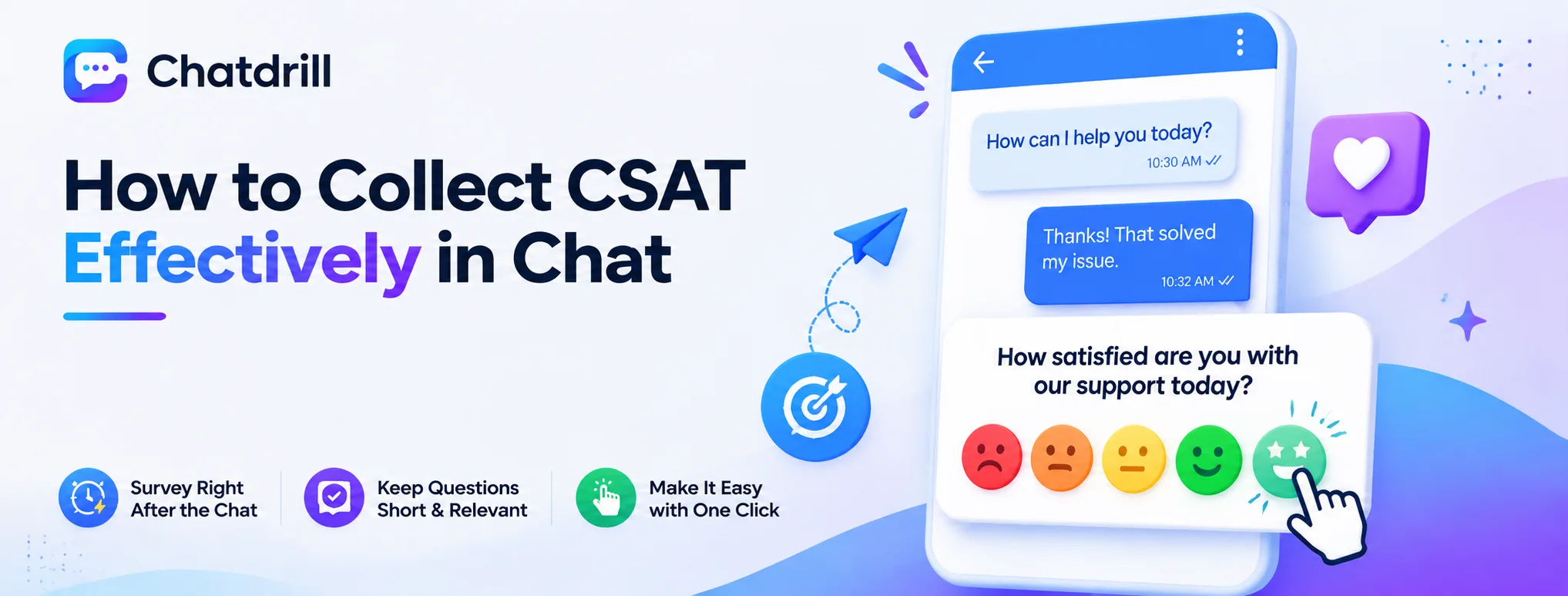
Effective CSAT collection means surveying immediately after the conversation ends, keeping the question genuinely brief, and making participation easy with a single click or tap rather than a lengthy form.
Timing the survey immediately
Presenting the CSAT question right as the conversation closes captures sentiment while it's still fresh, before the customer has moved on and their impression has faded.
This immediate timing is one of chat's genuine advantages for CSAT collection compared to a delayed email survey sent well after the interaction.
Keeping the question brief
A single rating question, without additional required fields, maximizes response rate by minimizing the effort required from an already-finished customer.
An optional comment field can add valuable qualitative context without making it mandatory, which would otherwise reduce overall response rate.
Making participation genuinely easy
A single click or tap to submit a rating, rather than requiring additional steps, keeps the friction low enough that a meaningful share of customers actually complete the survey.
This ease of participation directly affects response rate, which in turn affects how reliable the resulting CSAT data genuinely is.
What to Do With Your CSAT Data
Acting on CSAT data means following up personally on low scores to understand what went wrong, tracking trends over time rather than reacting to single data points, and sharing results with the team to reinforce what's working well.
Following up on low scores
Reviewing the transcript behind a low CSAT rating, and reaching out personally where appropriate, often reveals a specific, fixable issue worth addressing beyond just the numeric score itself.
This qualitative follow-up frequently surfaces insights a pure numbers-only review would miss entirely, since the actual conversation content reveals the specific reason behind the dissatisfaction.
Tracking trends, not just single scores
A single period's CSAT can be noisy, especially with a small sample size, making the trend over multiple periods a more reliable signal than any one snapshot.
Watching for a sustained decline, rather than reacting to a single lower-than-usual week, avoids overreacting to normal statistical variation in the data.
Sharing results with the team
Regularly reviewing CSAT data with the support team, including highlighting what's working well, not just what needs improvement, reinforces good practices and keeps the whole team invested in the metric.
This transparency also helps the team understand how their individual conversations contribute to a broader, shared quality goal.