
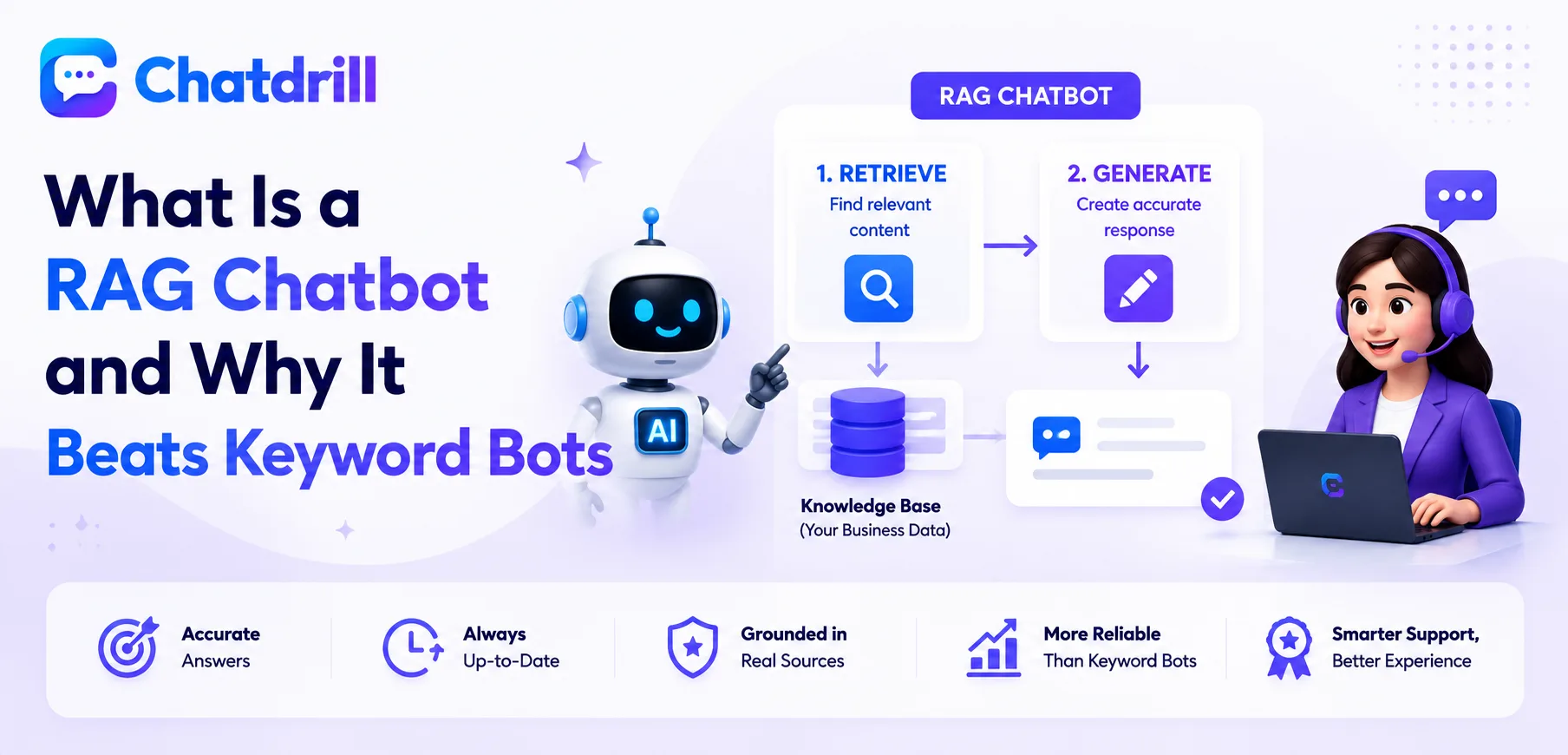
A RAG chatbot, short for retrieval-augmented generation, answers questions by first retrieving relevant, specific content from a business's actual knowledge base, then using that retrieved content to generate an accurate, grounded response, rather than relying purely on matched keywords or a generic language model's general training.
This retrieval step is what fundamentally separates a RAG chatbot from an older-style keyword-matching bot, instead of hunting for a pre-written answer tied to specific trigger words, it pulls the actual relevant passage from real documentation and builds a response grounded in that specific content.
The practical result is a chatbot considerably more accurate and current than a keyword bot, since it's drawing on live, up-to-date source content rather than a fixed, manually maintained set of question-answer pairs that inevitably goes stale.
This architecture has become the standard approach behind most genuinely capable modern AI chatbots, including the AI powering platforms like ChatDrill, making it worth understanding both how it works and where its limitations still lie.
This guide covers what RAG actually means, how a RAG chatbot works step by step, how it compares directly to a keyword-matching bot, why it produces more accurate answers, where RAG chatbots still have limitations, and what to look for in a RAG-powered chat platform.
What Is RAG (Retrieval-Augmented Generation)?
RAG is an AI architecture that combines a retrieval step, searching a knowledge base for the most relevant content to a specific question, with a generation step, using that retrieved content to produce a natural, accurate response grounded in real source material.
Simple definition
Rather than relying purely on what a language model learned during its original training, or hunting for a matched keyword, RAG actively searches a business's own current documentation for the most relevant passage before generating a reply.
This means the AI's answer is grounded in actual, specific source content, dramatically reducing the risk of a confidently incorrect answer that plagues systems relying solely on general training.
The name itself describes the two-step process directly, retrieval of relevant content, then generation of a response using that content as grounding.
Why retrieval matters so much
A language model's general training reflects a broad, fixed snapshot of information, not a specific business's current pricing, policies, or product details, which is exactly the gap retrieval closes.
By retrieving the actual, current source content before answering, a RAG chatbot stays accurate to a business's real, up-to-date information rather than relying on outdated or generic training data.
Where RAG fits in the broader AI chatbot landscape
RAG has become the dominant architecture behind most genuinely capable business chatbots today, since it solves the accuracy and currency problem that pure language-model-only systems struggle with.
Understanding this architecture helps explain why some AI chatbots feel noticeably more accurate and trustworthy than others, even when both are described simply as "AI-powered."
How a RAG Chatbot Works Step by Step
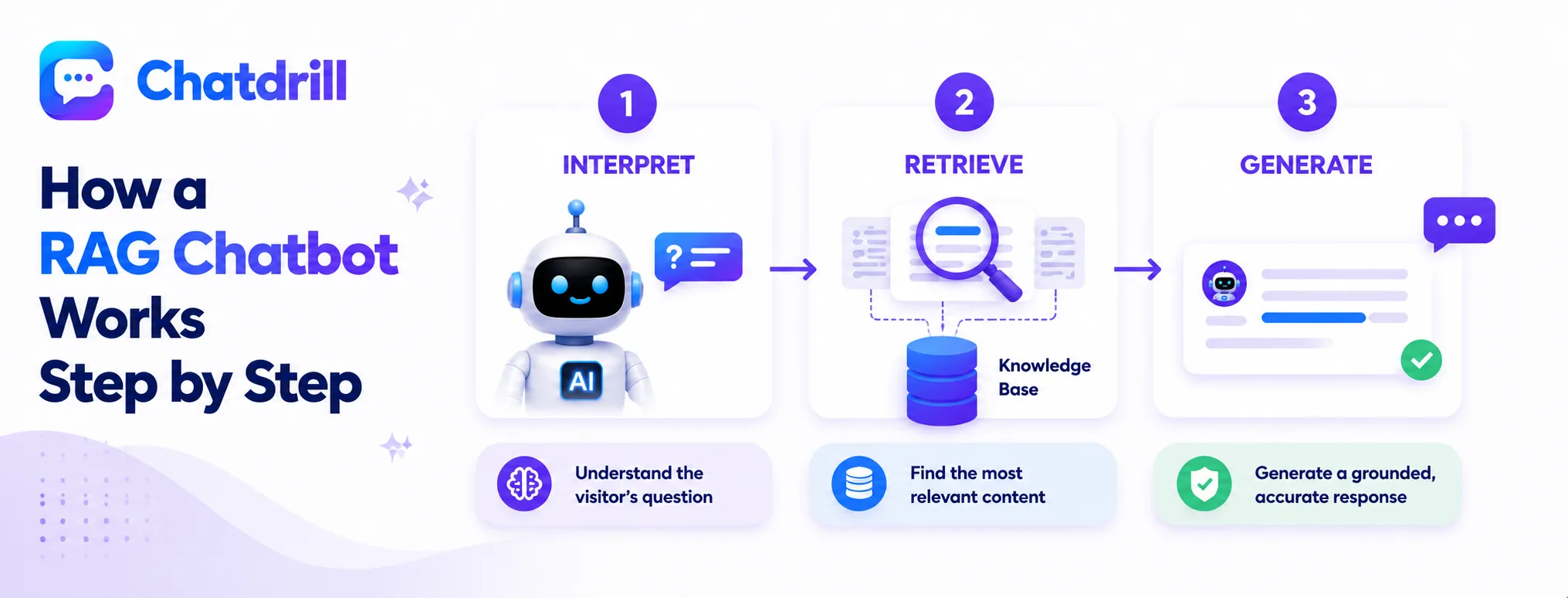
A RAG chatbot works in three stages: it interprets the visitor's question, retrieves the most relevant content from a searchable knowledge base, and generates a natural response grounded specifically in that retrieved content.
Step 1: Interpreting the question
The system first interprets the visitor's actual question, understanding intent and meaning rather than just matching literal keywords, similar to how any modern language-understanding AI processes an incoming message.
This interpretation step is what allows the system to search effectively in the next stage, since a poor understanding of the question would lead to retrieving irrelevant content.
Step 2: Retrieving relevant content
The system searches a knowledge base, help documentation, FAQ content, product pages, for the passages most relevant to the interpreted question, typically using a technique that matches meaning rather than exact wording.
This retrieval step is what keeps the eventual answer grounded in real, current content rather than the AI's general, potentially outdated training knowledge.
Step 3: Generating a grounded response
Using the retrieved content as context, the system generates a natural-sounding response that reflects the specific, actual information found, rather than a generic answer disconnected from real source material.
This grounding is what dramatically reduces the risk of the AI confidently stating something inaccurate, since the response is built directly from verified, retrieved content rather than free-floating generation.
RAG vs Keyword-Matching Chatbots
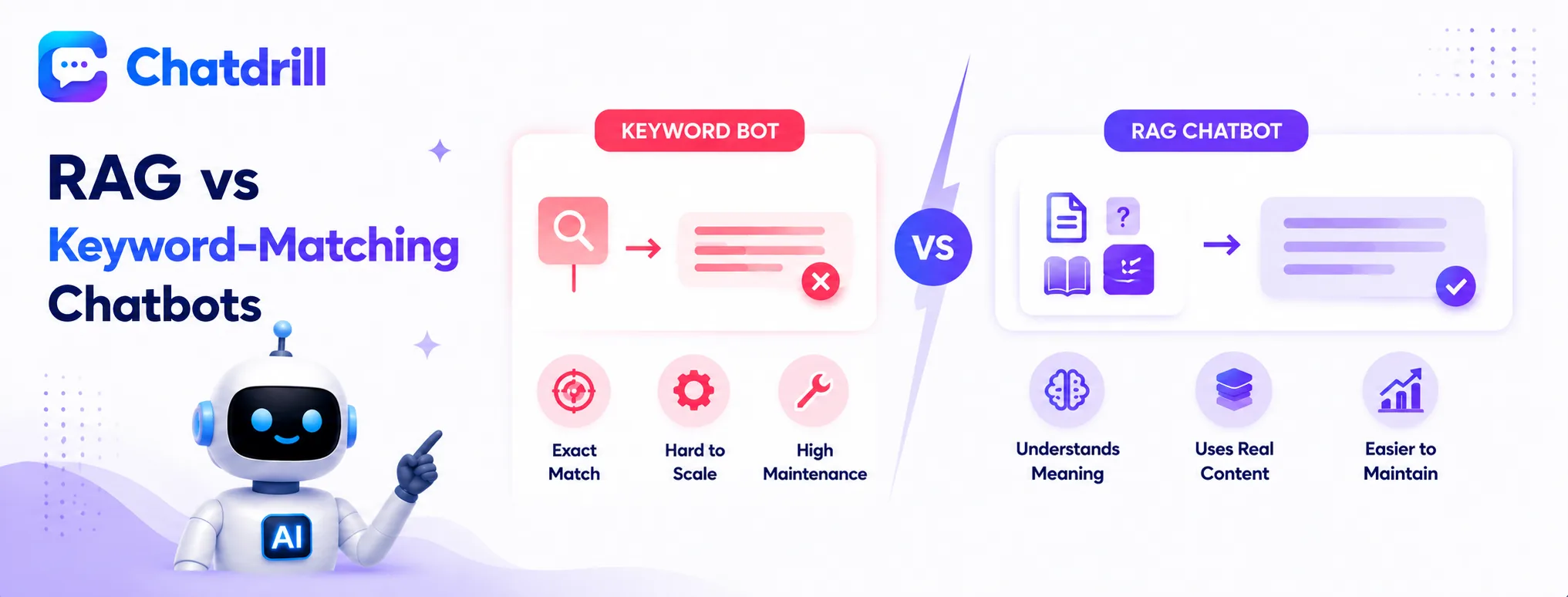
A keyword-matching chatbot searches for literal trigger words and returns a fixed, pre-written answer, while a RAG chatbot understands meaning, retrieves relevant content dynamically, and generates a fresh, contextually appropriate response every time.
How keyword matching works and where it breaks down
A keyword bot scans an incoming message for specific trigger words or phrases, returning a matching pre-written answer, a rigid approach that fails the moment a question is phrased differently than expected.
This rigidity means a keyword bot's effective coverage is limited entirely to the exact phrasings its builders anticipated, missing a meaningful share of real, varied customer questions.
How RAG handles the same limitation differently
Because RAG interprets meaning rather than matching literal words, it correctly handles a question phrased in an unexpected way, as long as the relevant content exists somewhere in the knowledge base.
This flexibility is the core practical advantage RAG offers over keyword matching, dramatically expanding the range of real questions a chatbot can answer correctly without requiring every possible phrasing to be manually anticipated.
The maintenance burden comparison
A keyword bot requires manually anticipating and mapping every question phrasing, a maintenance burden that grows unmanageably as a business's question variety increases over time.
A RAG chatbot instead requires maintaining the underlying knowledge base itself, updating documentation as things change, a more sustainable and naturally occurring maintenance pattern for most businesses.
Why RAG Produces More Accurate Answers
RAG produces more accurate answers because responses are grounded in actual retrieved content rather than the AI's general training, meaning the system is less likely to confidently generate an incorrect answer disconnected from real, current business information.
Grounding reduces confident inaccuracy
A language model relying purely on general training can generate a fluent, confident-sounding answer that's simply wrong, a failure mode significantly reduced when the response is grounded in specific, retrieved source content instead.
This grounding doesn't eliminate errors entirely, but it meaningfully narrows the gap between what the AI says and what's actually documented as true for the business.
Currency stays aligned with the actual knowledge base
Since RAG retrieves live content at the moment of the question, an update to the underlying documentation, a pricing change, a new policy, immediately reflects in future answers without needing to retrain the entire AI system.
This currency advantage is a genuine practical benefit for a business whose information changes over time, avoiding the staleness that would otherwise creep into a purely trained, non-retrieval-based system.
Traceable answers support trust and review
Because a RAG chatbot's response traces back to specific retrieved content, it's often possible to review exactly which source material informed a given answer, supporting both quality review and troubleshooting.
This traceability is valuable specifically for a business wanting to audit AI performance, identifying whether an inaccurate response traces to poor documentation or a genuine retrieval or generation error.
Limitations of RAG Chatbots
RAG chatbots are only as accurate as the knowledge base they retrieve from, can still occasionally retrieve less relevant content for an ambiguous question, and require ongoing content maintenance to stay genuinely useful.
Only as good as the underlying knowledge base
If the source documentation is incomplete, outdated, or poorly organized, retrieval quality suffers correspondingly, since the system can only ground its answers in content that actually exists and is findable.
This means investing in genuinely good documentation is as important to RAG chatbot quality as the underlying AI technology itself, a point worth not underestimating.
Retrieval isn't always perfectly precise
For a genuinely ambiguous or poorly phrased question, the retrieval step can occasionally pull less relevant content, leading to an answer that's grounded but not quite on target for what the visitor actually meant.
This is a real limitation worth monitoring through regular conversation review, rather than assuming retrieval-based grounding eliminates every possible accuracy issue.
Ongoing content maintenance still matters
A RAG chatbot doesn't eliminate the need for content upkeep, it shifts that upkeep from manually writing chatbot responses to maintaining the underlying documentation the system draws from.
Treating this as a genuinely ongoing responsibility, rather than a one-time setup task, is essential for a RAG chatbot to stay reliably accurate over time.
What to Look for in a RAG-Powered Chat Platform
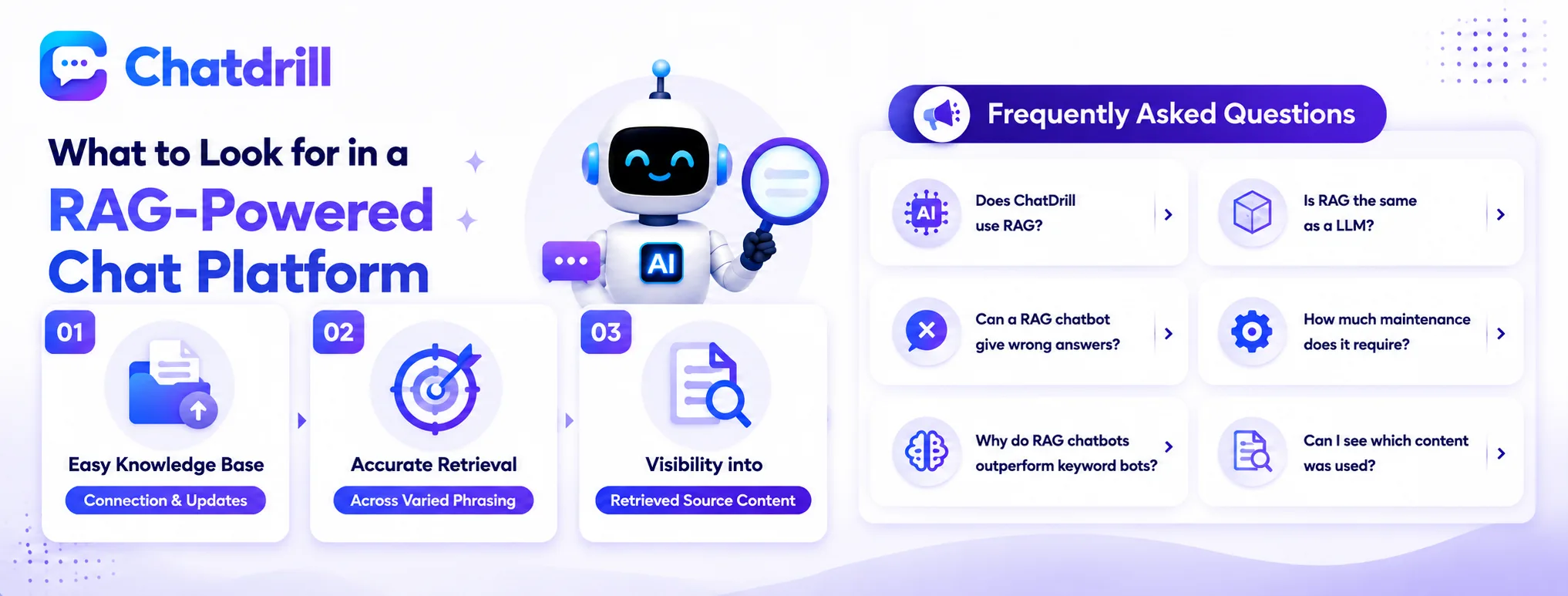
A strong RAG-powered chat platform makes it easy to connect and update your actual knowledge base, retrieves content accurately even for varied question phrasing, and provides visibility into which source content informed a given answer.
Easy knowledge base connection and updates
Look for a platform that can ingest existing documentation directly, help pages, FAQ content, product descriptions, without requiring extensive manual reformatting before the AI can use it effectively.
Equally important is how easy it is to update this content later, since a platform requiring a lengthy re-processing step for every small documentation change creates real friction over time.
Accurate retrieval across varied phrasing
Testing the platform with intentionally varied phrasings of the same underlying question during a trial reveals whether retrieval genuinely handles this variation well, rather than only performing well on questions closely matching the documentation's own wording.
This is one of the most telling tests available for distinguishing a genuinely strong RAG implementation from a weaker one.
Visibility into retrieved source content
A platform that shows which specific source content informed a given AI answer supports meaningful quality review, letting a team trace and fix an inaccurate response back to its root cause.
This transparency is worth prioritizing specifically for a business planning to actively review and improve AI performance over time, rather than deploying and forgetting.