
What Is Conversational Marketing?
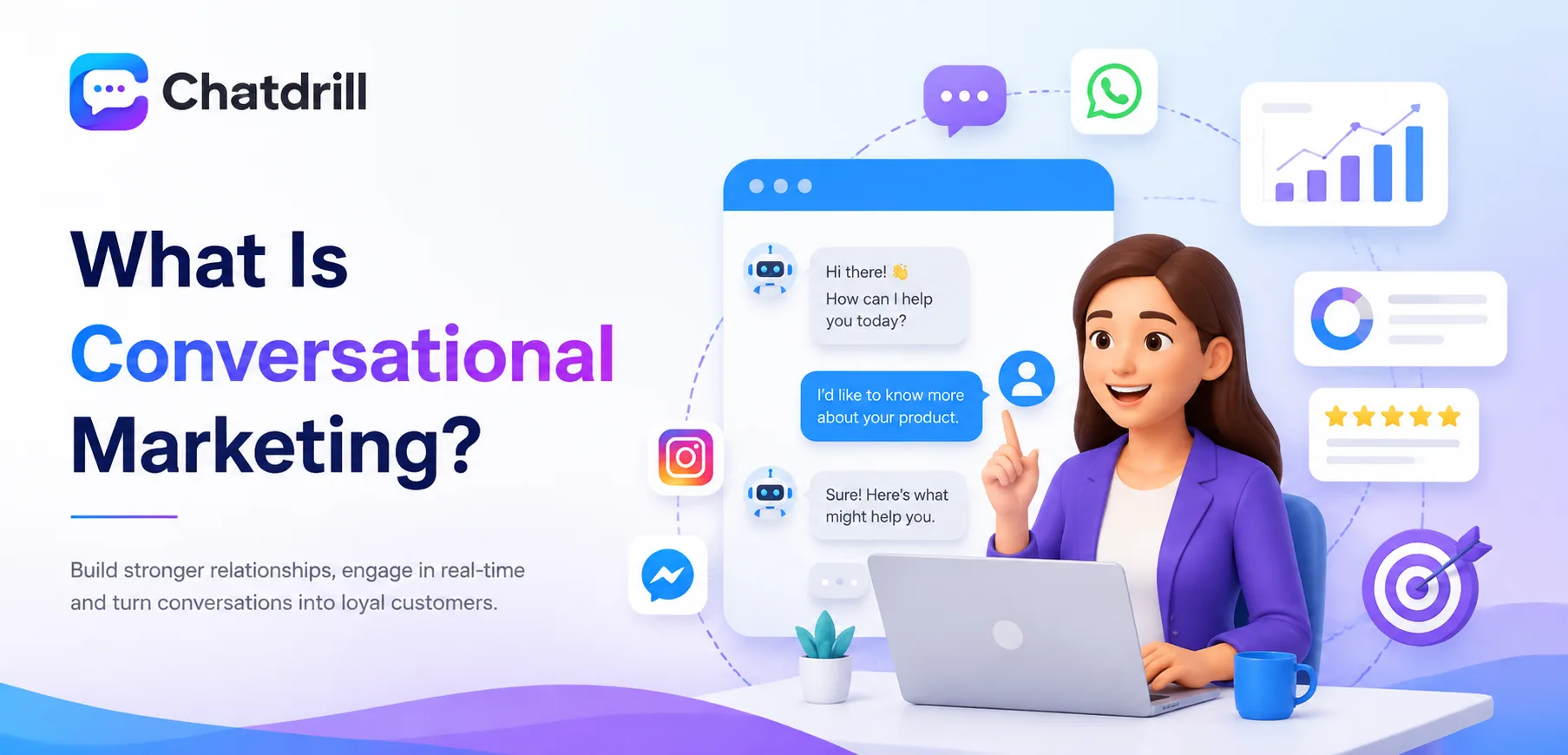
Conversational marketing uses real-time, two-way dialogue, most commonly through live chat, to engage a website visitor, qualify their interest, and move them toward a purchase or a booked meeting, rather than relying solely on static content and one-way forms to generate leads.
This approach flips the traditional marketing funnel's usual sequence, instead of a visitor filling out a form and waiting for a follow-up, conversational marketing engages them immediately, in the moment their interest is highest.
The category gained real traction because it directly addresses a persistent gap in traditional lead generation, a static landing page and a contact form can't adapt to a specific visitor's actual questions the way a real conversation can.
Done well, conversational marketing shortens the path from initial interest to a genuine sales conversation, though done poorly it can feel like an aggressive, poorly timed sales pitch that actively drives visitors away.
This guide covers what conversational marketing actually is, how it differs from traditional lead generation, its core tactics and components, genuine benefits, and how to implement it without it feeling pushy or intrusive.
How is conversational marketing different from a chatbot?
engage a website visitor directly, qualifying their interest and guiding them toward a next step, in contrast to traditional, one-way content and form-based lead generation.
Simple definition
Rather than a visitor consuming static content and independently deciding to fill out a form, conversational marketing actively engages them in dialogue, asking questions and responding to their specific interest in real time.
This real-time, adaptive quality is the defining characteristic, distinguishing it from a marketing approach that remains fundamentally one-directional regardless of how well-designed the content itself is.
The channel is most commonly live chat, though conversational marketing principles can extend to other real-time or near-real-time channels as well.
Why the term emerged as its own category
As live chat platforms matured to support genuine lead qualification and routing, marketers began treating chat as a distinct strategic channel, worthy of its own dedicated approach and terminology, rather than simply a support add-on.
This framing shift, treating chat as a marketing channel rather than purely a support tool, is what gave rise to conversational marketing as a distinct discipline with its own best practices.
Conversational Marketing vs Traditional Lead Generation
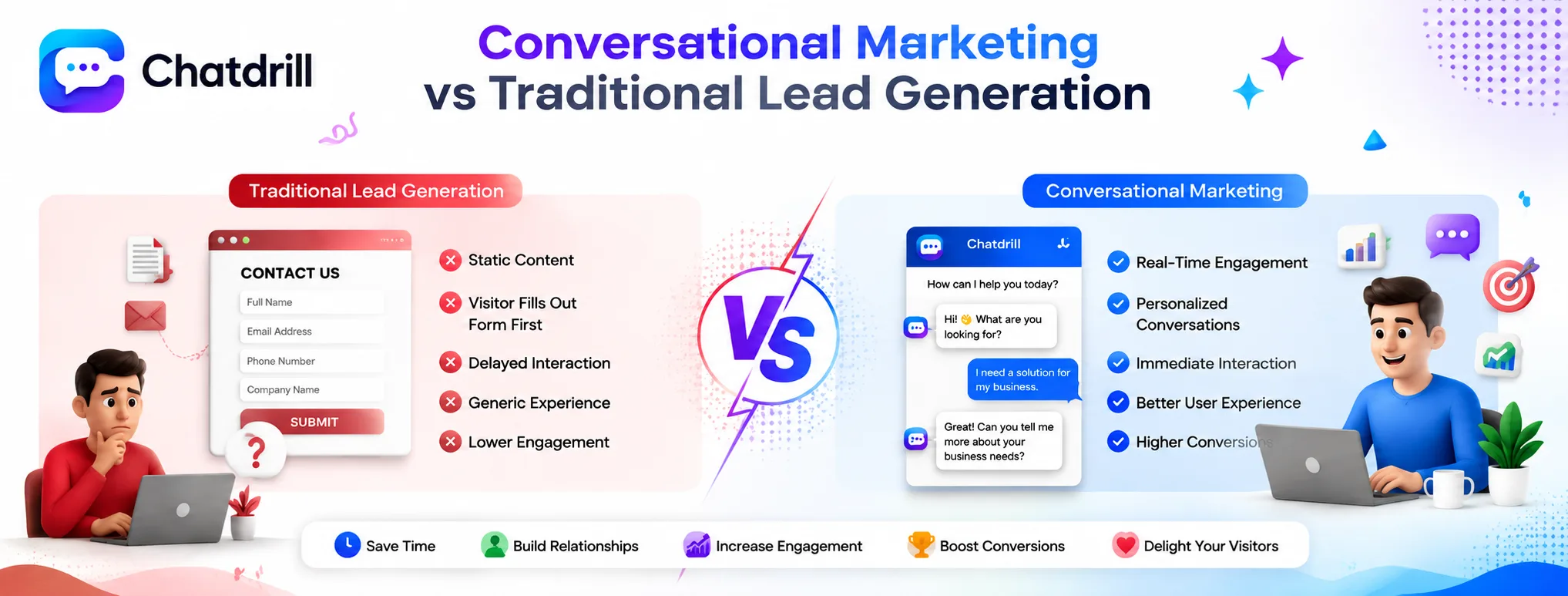
Traditional lead generation relies on static content and a form a visitor fills out before any interaction happens, while conversational marketing engages a visitor directly and immediately, adapting to their specific questions in real time.
How traditional lead generation works
A visitor reads content, decides to fill out a contact form, and then waits, often hours or days, for a follow-up response from a sales or marketing team member.
This delay creates a real gap between the moment of interest and any actual human engagement, during which a visitor's intent can meaningfully cool or shift to a competitor.
The form itself is also inherently static, unable to adapt to a specific visitor's actual, individual question or concern the way a real conversation naturally would.
How conversational marketing closes this gap
By engaging a visitor immediately, through proactive chat or an AI-driven conversation, conversational marketing addresses interest and questions at the exact moment they're happening, rather than after a delay.
This immediacy is the core structural advantage, capturing intent while it's still at its peak rather than hoping it survives the wait inherent to a form-and-follow-up approach.
The adaptive, back-and-forth nature of conversation also lets a visitor's specific concern get addressed directly, something a static form and generic follow-up email simply can't replicate.
Core Tactics of Conversational Marketing
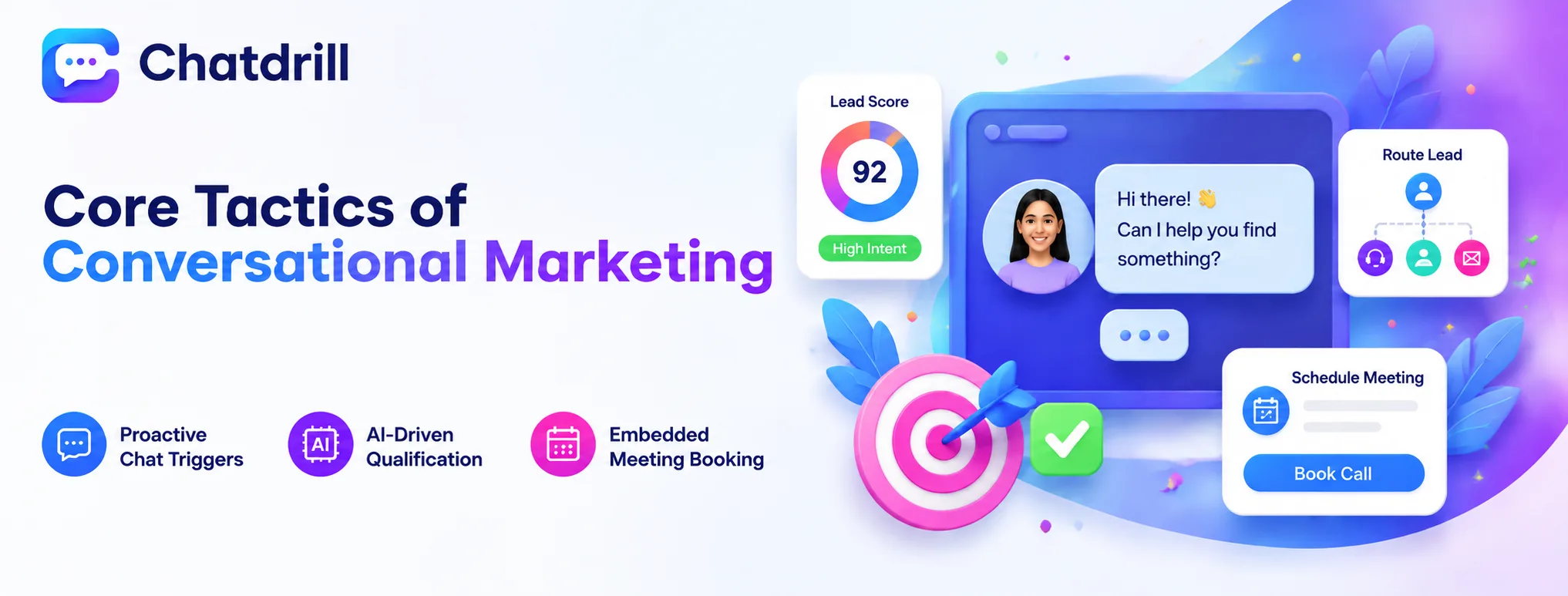
Core conversational marketing tactics include proactive chat triggers on high-intent pages, AI-driven qualification that scores and routes leads automatically, and embedded meeting booking that lets a conversation flow directly into a scheduled call.
Proactive engagement on high-intent pages
Triggering a chat conversation proactively on pages showing clear buying intent, pricing, product comparison, catches a visitor at exactly the moment conversational marketing is most valuable.
This targeted timing is what separates a genuinely effective conversational marketing strategy from simply having a passive chat widget available somewhere on the site.
AI-driven qualification and scoring
AI can ask relevant qualifying questions during the conversation itself, scoring the visitor's fit and intent in real time rather than requiring a separate, later qualification step.
This qualification happening within the conversation, rather than as a follow-up task, is what makes conversational marketing genuinely efficient compared to a traditional lead-then-qualify sequence.
Embedded meeting booking
Letting a qualified conversation flow directly into a booked meeting, without requiring the visitor to navigate to a separate scheduling page, removes friction at exactly the moment commitment is highest.
This seamless transition from conversation to booked meeting is often the clearest, most concrete outcome conversational marketing delivers for a B2B business specifically.
Benefits of Conversational Marketing
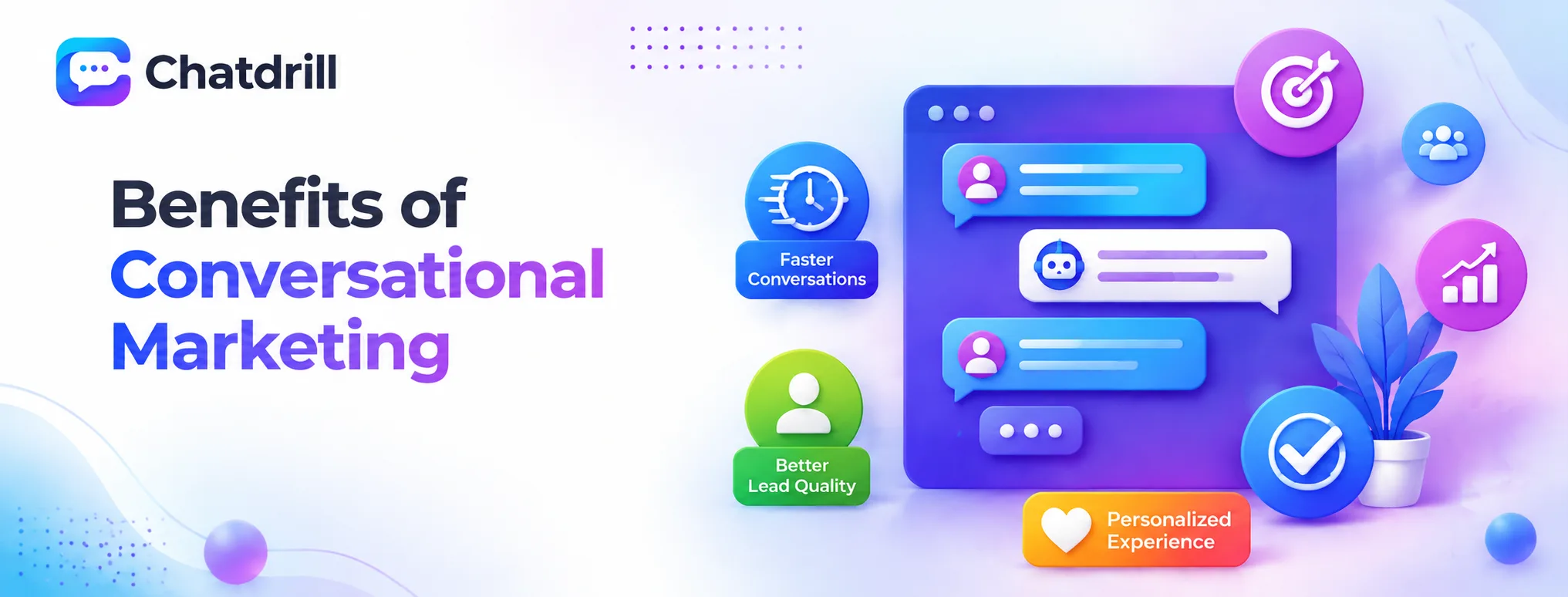
Conversational marketing shortens the time from initial interest to a qualified sales conversation, improves lead quality through real-time qualification, and creates a more personalized, responsive experience than static content alone can provide.
Shortening the sales cycle
By engaging and qualifying a lead immediately rather than after a delay, conversational marketing can meaningfully compress the time between initial visitor interest and an actual sales conversation.
This speed advantage compounds across a sales pipeline, faster initial engagement often correlates with faster overall deal velocity for businesses tracking this relationship.
Improving lead quality
Real-time qualification during the conversation itself tends to produce more accurately scored leads than a static form alone, since the AI or agent can ask relevant follow-up questions based on actual responses.
This improved quality means sales teams spend less time on genuinely unqualified leads, focusing their effort on conversations already shown to be worth pursuing.
Creating a more personalized experience
A real conversation, adapting to a visitor's specific questions and context, feels more personal and responsive than a generic form and follow-up sequence, improving overall visitor experience.
This personalization advantage matters increasingly as visitors come to expect more responsive, tailored interactions from the businesses they engage with online.
How to Implement Conversational Marketing Without It Feeling Pushy
Implementing conversational marketing well means timing engagement thoughtfully rather than interrupting immediately, leading with genuine value rather than a sales pitch, and giving visitors an easy way to opt out of the conversation at any point.
Timing engagement thoughtfully
A reasonable delay before proactively engaging, and reserving triggers for genuinely high-intent pages, avoids the interruption feel that an overly aggressive implementation creates.
This restraint in timing is what separates conversational marketing done well from the aggressive, poorly timed chat popups that give the broader tactic a negative reputation.
Leading with value, not a pitch
Opening a conversation by offering to answer a specific, relevant question, rather than immediately pushing toward a sale, builds trust and keeps the interaction feeling genuinely helpful.
This value-first framing tends to produce better long-term results than an aggressive, sales-forward opening, even though it might feel slower in the moment.
Giving visitors an easy exit
Making it simple and unambiguous for a visitor to close the chat and decline engagement respects their autonomy and avoids the frustration of feeling trapped in an unwanted conversation.
This respect for visitor choice, rather than aggressive persistence, actually tends to improve long-term brand perception even among visitors who decline to engage in that specific moment.