
What Is Chat Deflection Rate?
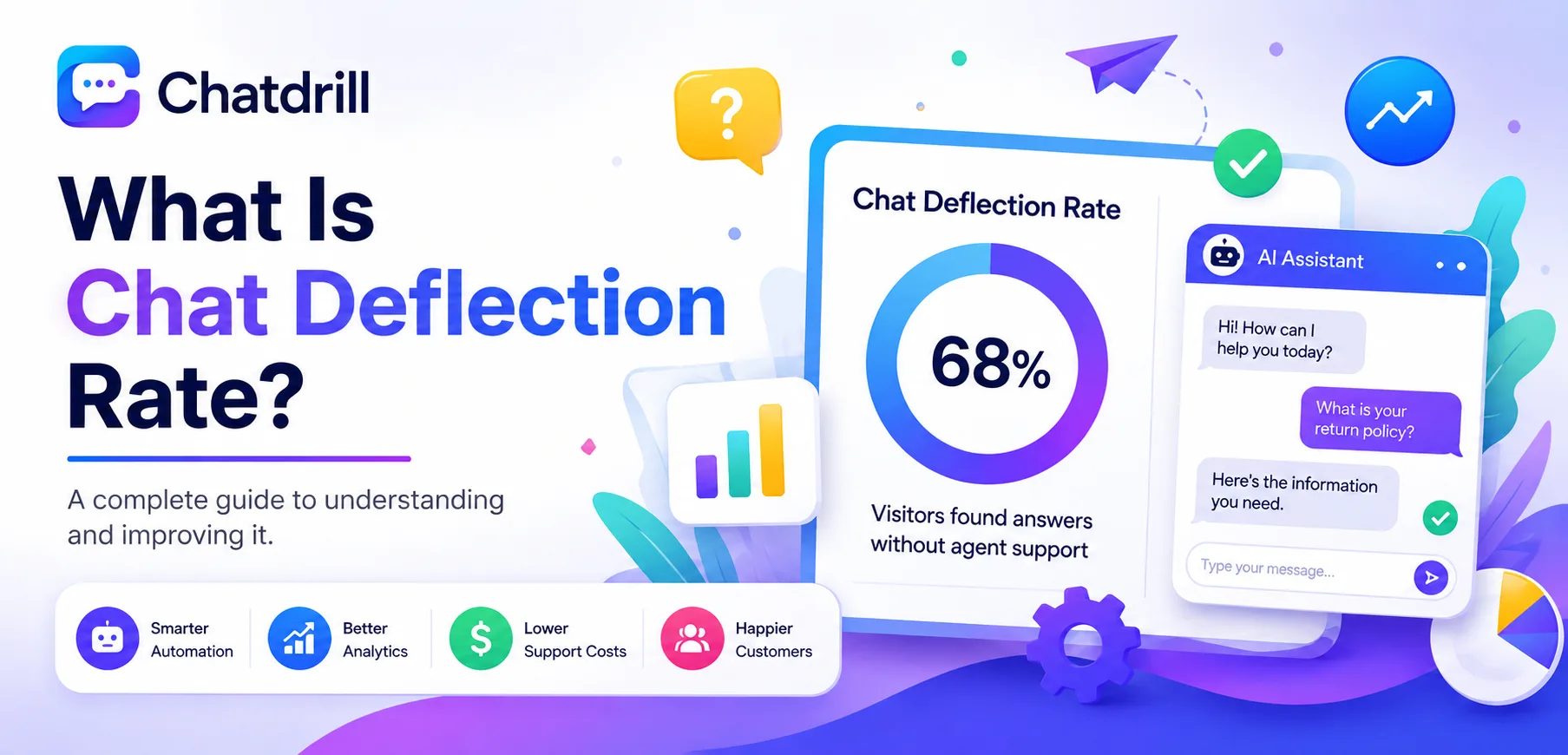
Chat deflection rate measures the percentage of conversations an AI chatbot resolves without any human agent involvement, one of the clearest indicators of how much genuine value automation is delivering to a support operation.
This metric matters because it directly translates into cost savings and capacity, every conversation successfully deflected is one a human agent didn't need to spend time on, freeing that time for conversations that genuinely require human judgment.
A healthy deflection rate isn't just a nice-to-have vanity metric, it's a concrete, trackable signal of whether an AI investment is delivering real operational value or falling short of its potential.
Understanding what counts as a good deflection rate, what actually drives it, and how it relates to other quality metrics helps a business set realistic goals and avoid over-optimizing for deflection at the expense of genuine resolution quality.
This guide covers what chat deflection rate actually measures, how it's calculated, what counts as a healthy benchmark, what factors influence it most, and how to improve it without sacrificing quality.
Chat deflection rate is the percentage of total chat conversations that an AI chatbot resolves independently, without requiring escalation to or involvement from a human agent.
Simple definition
This metric captures how much of a support operation's total conversation volume is being handled entirely by automation, a direct measure of AI's practical contribution to overall capacity.
A conversation only counts as deflected if it's genuinely resolved by AI, not simply routed away from a queue without actual resolution, an important distinction worth understanding clearly.
This is distinct from, though related to, broader automation metrics, deflection specifically measures full resolution without human involvement, not partial assistance.
Why deflection rate is a genuinely meaningful metric
Unlike some automation metrics that can be gamed by simply routing conversations away without real resolution, deflection rate specifically tracks conversations customers didn't need further human help with.
This makes it a relatively honest signal of AI's genuine contribution, provided it's tracked alongside quality metrics to confirm deflected conversations were actually resolved well.
How Chat Deflection Rate Is Calculated
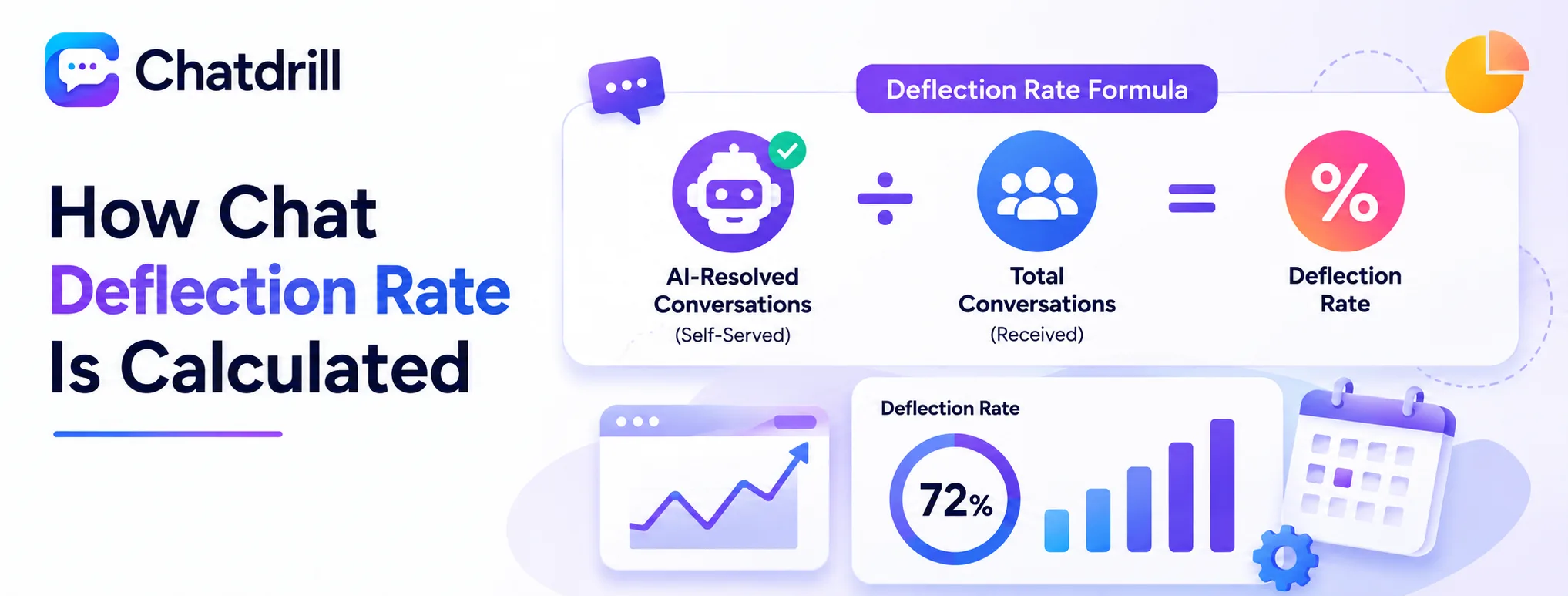
Deflection rate is calculated as the number of AI-resolved conversations divided by the total number of conversations received, expressed as a percentage, typically tracked over a consistent reporting period like a week or month.
The basic calculation formula
Dividing conversations the AI fully resolved, without human escalation, by the total conversation volume for the period, then multiplying by 100, produces the deflection rate percentage.
Most modern chat platforms, including ChatDrill, calculate this automatically within their analytics dashboard, without requiring manual tracking or a separate spreadsheet.
What counts as "resolved" for this calculation
A conversation should only count as deflected if it reached a genuine conclusion, the customer's question was answered or their issue addressed, not simply because the conversation ended or timed out.
Confirming your specific platform applies this stricter definition, rather than counting any AI-only conversation regardless of outcome, keeps the metric meaningful rather than inflated.
Tracking the metric over a consistent period
Calculating deflection rate weekly or monthly, using a consistent period, produces a trend that's genuinely comparable over time, rather than a noisy, hard-to-interpret daily fluctuation.
This consistency in measurement period matters for spotting genuine trends versus normal day-to-day variation in conversation mix and volume.
What Is a Healthy Chat Deflection Rate?
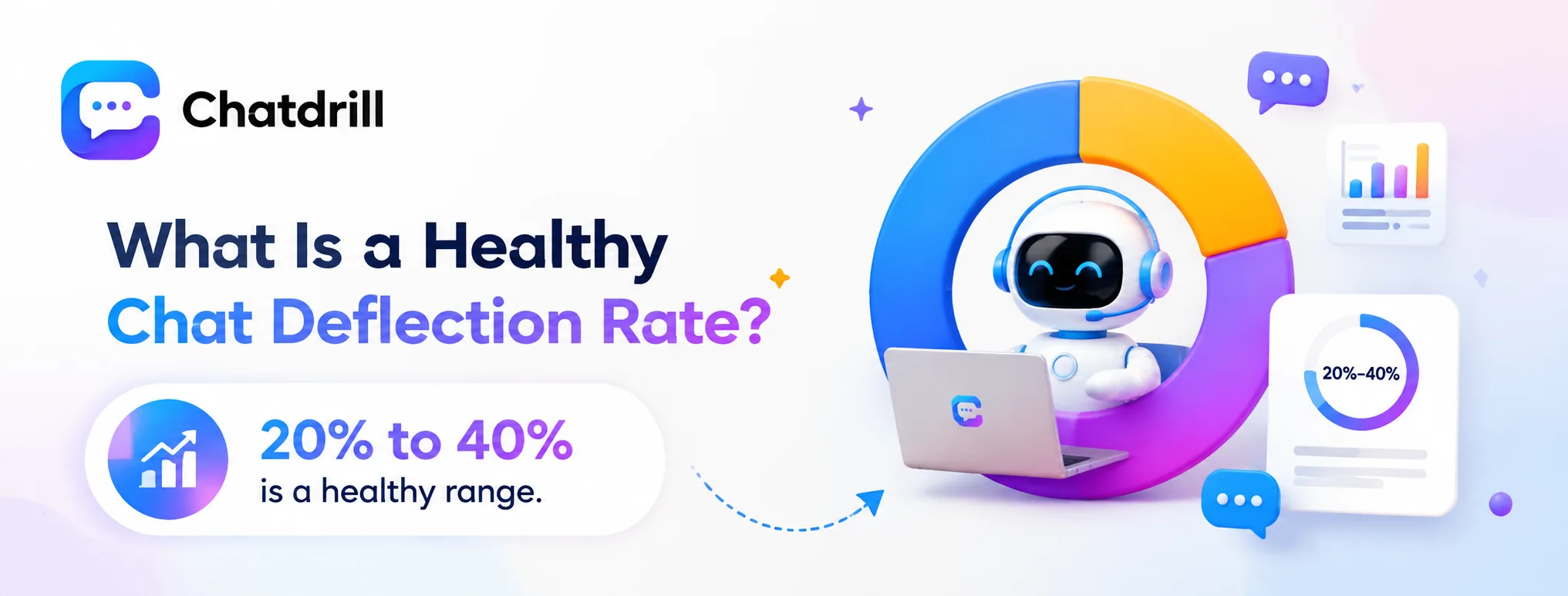
20 to 40 percent is generally considered a healthy deflection rate for a team with a reasonably mature AI chatbot, though this range varies based on question complexity, AI training quality, and how long the chatbot has been actively refined.
The general 20 to 40 percent range
This range reflects typical outcomes for a business with a genuinely well-trained chatbot handling a reasonable mix of common, repetitive questions alongside more complex ones requiring human attention.
A rate below this range often signals room for improvement in AI training or scope, while a rate significantly above it may reflect either exceptional AI quality or a support operation dominated by very simple, repetitive questions.
Why deflection rate should climb over time
As a chatbot's training improves and its knowledge base expands to cover more question types, deflection rate should show a steady, meaningful improvement rather than staying flat indefinitely.
A plateaued or declining deflection rate, even with earlier strong performance, often signals the training hasn't kept pace with evolving customer questions or product changes.
Why higher isn't always automatically better
Deflection rate should be tracked alongside quality metrics like CSAT and repeat contact rate, since a very high deflection rate paired with declining satisfaction suggests the AI may be closing conversations without genuinely resolving them well.
This balanced view prevents a business from over-optimizing purely for deflection at the expense of the actual customer experience the metric is ultimately meant to serve.
What Factors Influence Deflection Rate
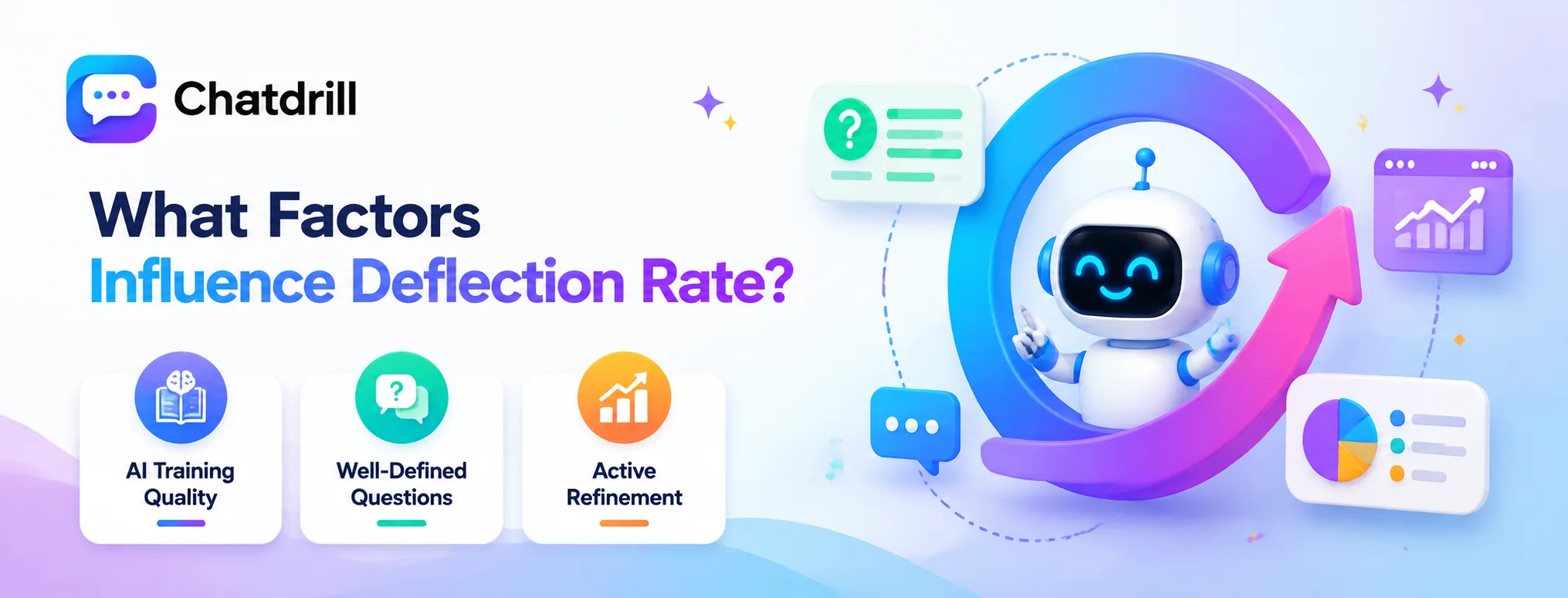
Deflection rate is influenced most by the quality and breadth of AI training content, how well-defined and repetitive a business's typical questions are, and how long the chatbot has been actively refined based on real conversation data.
AI training quality and breadth
A chatbot trained on comprehensive, accurate, and current documentation deflects meaningfully more conversations than one with sparse or outdated training content.
This is often the single largest lever available for improving deflection rate, since even sophisticated AI can only resolve what it's actually been given the information to answer correctly.
Question repetition and predictability
A business fielding a high volume of the same handful of questions naturally sees higher deflection potential than one with genuinely varied, less predictable conversation topics.
Understanding your own question distribution helps set realistic deflection expectations rather than assuming a universal benchmark applies regardless of your specific business's conversation patterns.
Ongoing refinement based on real data
A chatbot's deflection rate typically improves over its first several months as real conversation data reveals gaps worth addressing through additional training content.
Businesses that skip this ongoing refinement, treating initial setup as a one-time task, tend to see deflection rate plateau well below what continued investment could achieve.
How to Improve Deflection Rate Without Sacrificing Quality
Improving deflection rate responsibly means expanding AI training based on real conversation gaps, monitoring quality metrics alongside deflection to catch any decline, and setting clear escalation boundaries so the AI doesn't attempt resolution beyond its genuine competence.
Expanding training based on real gaps
Reviewing conversations the AI couldn't resolve reveals specific content gaps worth addressing, a more targeted approach than broadly expanding training without clear direction.
This gap-driven approach tends to improve deflection rate more efficiently than a generic, unfocused training expansion effort.
Monitoring quality alongside deflection
Tracking CSAT and repeat contact rate specifically for AI-deflected conversations confirms whether rising deflection reflects genuine improvement or the AI closing conversations without truly resolving the underlying issue.
This paired monitoring is essential for responsible deflection rate improvement, preventing the metric from being optimized in a way that actually harms customer experience.
Setting clear escalation boundaries
Defining specific topics or situations the AI should always escalate, rather than attempting resolution, prevents deflection rate gains that come at the cost of a customer receiving an inadequate or incorrect answer.
This deliberate boundary-setting keeps deflection rate improvement genuinely aligned with better customer outcomes, not just a higher number on a dashboard.