
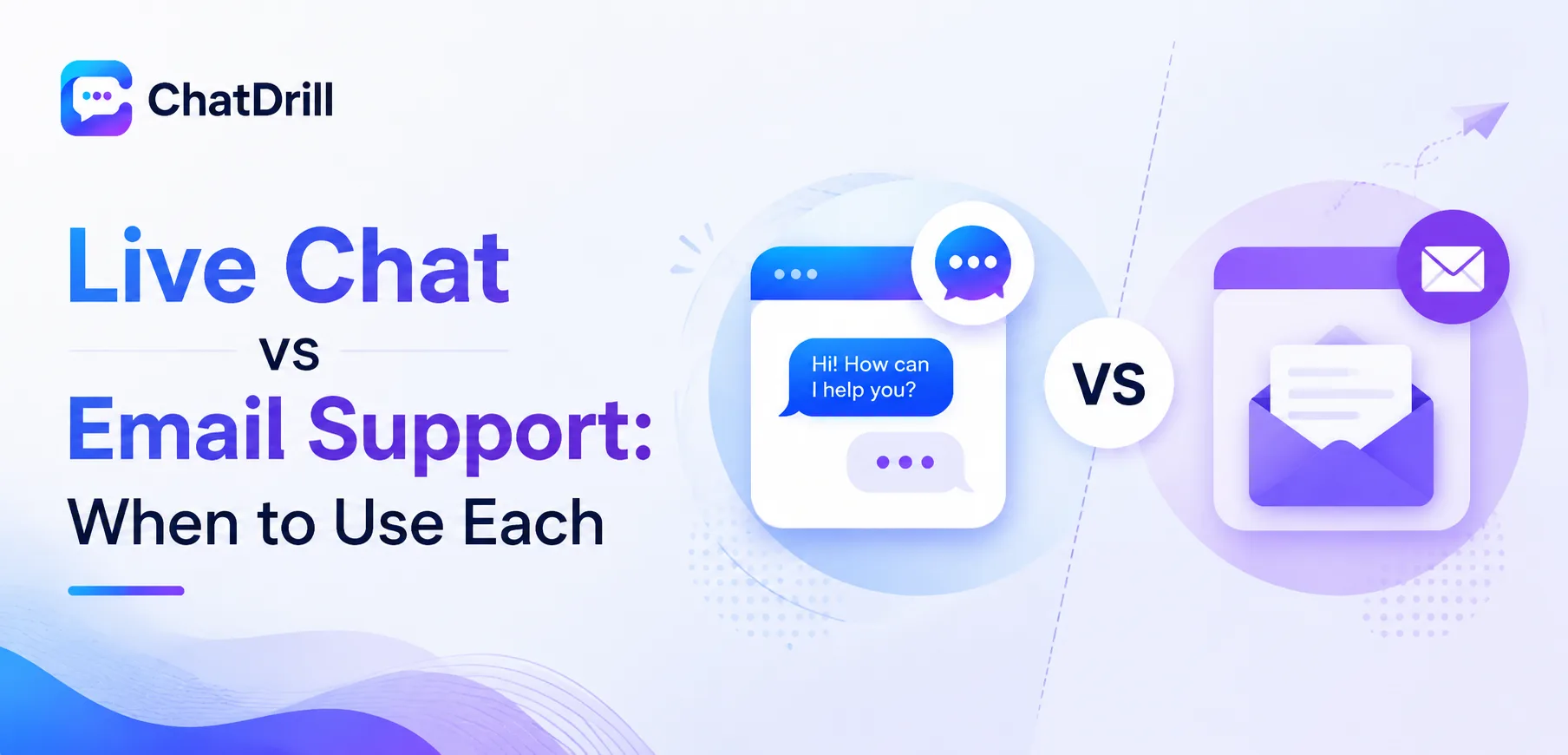
Live chat suits quick, time-sensitive questions where a visitor is actively on your site and wants an immediate answer, while email support suits complex issues needing detailed explanation, attachments, or a paper trail that doesn't require an instant response.
The two channels aren't really in competition, most businesses need both, the real question is which specific situations should route to which channel, and how to make that routing feel natural rather than forcing a customer into the wrong channel for their actual need.
Choosing the wrong channel for a given situation creates real friction, a complex technical issue crammed into a rushed chat conversation feels incomplete, while a simple question sent by email introduces unnecessary delay a customer didn't need to experience.
Understanding each channel's genuine strengths and weaknesses helps a business design a support strategy that routes customers to the right channel naturally, rather than defaulting to one channel for every situation regardless of fit.
This guide covers what each channel is genuinely best at, a direct comparison across key dimensions, when to use chat, when to use email, how to route between them effectively, and how to think about resourcing both channels well.
What Live Chat Is Genuinely Best At
Live chat excels at quick, time-sensitive questions, catching a visitor at a moment of active decision-making, and resolving straightforward issues in a single, real-time back-and-forth rather than a delayed exchange.
Speed and immediacy
Chat's real-time nature means a question gets answered in the same session a visitor is already engaged in, rather than requiring them to wait, sometimes hours, for an email reply.
This immediacy directly supports conversion-focused use cases, where resolving hesitation quickly matters more than the depth of the eventual answer.
Catching active, in-the-moment intent
A visitor engaging with chat is often at a genuine moment of decision, evaluating a purchase, comparing options, making chat uniquely positioned to influence that decision while it's actively happening.
Email, by its asynchronous nature, can't capture this same in-the-moment engagement, since a reply arrives well after the original moment of intent has passed.
Where chat's strength has limits
Chat is less well suited to genuinely complex issues requiring extensive back-and-forth, detailed technical documentation, or something a customer needs to reference and return to later.
Recognizing this limit is as important as recognizing chat's strengths, since forcing a genuinely complex issue into chat can produce a worse experience than routing it appropriately to email instead.
What Email Support Is Genuinely Best At
Email excels at complex issues needing detailed explanation, situations requiring attachments or extensive documentation, and any interaction that benefits from a searchable, referenceable written record over time.
Handling genuine complexity
A complex technical issue, a detailed billing dispute, or a situation requiring multiple pieces of supporting information is often better suited to email's format, which allows more thorough, considered communication.
This depth advantage is exactly where chat's real-time pressure works against it, a rushed chat conversation trying to cram in genuine complexity often produces a worse outcome than a well-composed email exchange.
Supporting attachments and documentation
Email natively supports attaching screenshots, documents, and other supporting files, a capability chat sometimes has more limited support for depending on the specific platform.
This matters significantly for a situation genuinely requiring visual or document-based evidence, a bug report, a formal complaint, a detailed order dispute.
Creating a searchable, referenceable record
An email thread remains easily searchable and referenceable by both the customer and the business long after the interaction, useful for a situation with an ongoing or recurring nature.
This durability advantage matters most for issues genuinely spanning multiple interactions over time, rather than a one-off question resolved in a single exchange.
Live Chat vs Email: A Direct Comparison
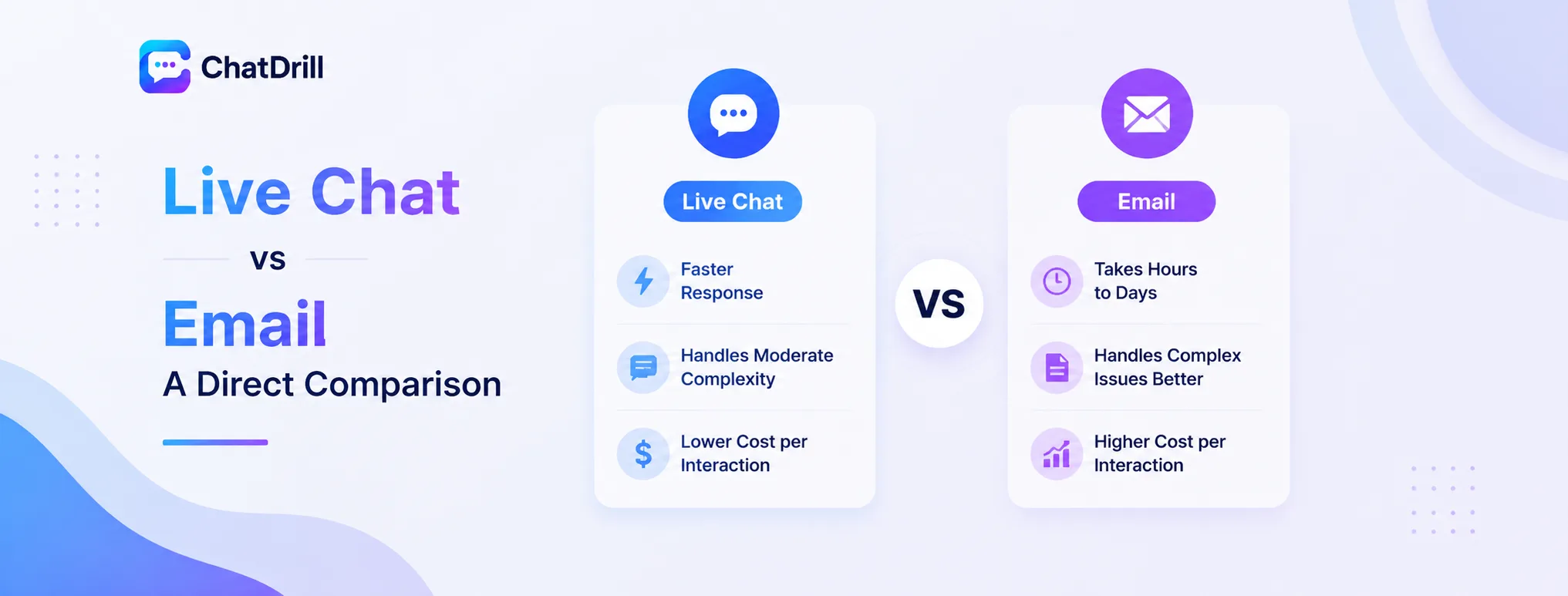
Chat wins decisively on response speed and real-time engagement, email wins on depth, documentation support, and creating a lasting record, with the right choice ultimately depending on the specific situation's urgency and complexity.
Response speed
Chat typically resolves in minutes; email typically takes hours to days for a full resolution, a fundamental speed difference rooted in each channel's underlying real-time versus asynchronous nature.
This gap makes chat clearly superior for any genuinely time-sensitive situation, while email's slower pace is often perfectly acceptable, or even preferable, for a less urgent, more considered exchange.
Depth and complexity handling
Email generally handles genuine complexity better, given its less time-pressured format and native support for detailed explanation and attachments.
Chat can handle moderate complexity well, especially with AI assistance pulling relevant information quickly, but genuinely intricate issues still tend to favor email's format.
Cost per interaction
Chat, especially with AI deflection handling a share of volume, tends to have a lower per-interaction cost than email, which typically requires more time-intensive individual handling per message.
This cost difference is worth factoring into channel strategy, though it shouldn't override matching the channel to what genuinely serves the customer's specific situation best.
When to Route Customers to Chat
Route to chat for pre-purchase questions, simple account or order status inquiries, and any situation where a customer is actively on your site and likely to benefit from an immediate, real-time answer.
Pre-purchase and sales-stage questions
A visitor actively evaluating a purchase benefits most from chat's immediacy, resolving hesitation right when it's happening rather than after a delay that risks losing the moment entirely.
This is one of the clearest, highest-value use cases for prioritizing chat over email as the default channel offered.
Simple, quick factual questions
Order status, basic account questions, or a quick factual lookup are well suited to chat's speed, especially when AI can pull the relevant information instantly.
Directing these simple questions to chat, rather than email, avoids unnecessary delay for something that genuinely doesn't need extensive consideration to answer.
Active, real-time engagement moments
Any situation where a customer is already actively on your site, engaged and available in that moment, is a natural fit for chat over email specifically.
This is where proactive chat triggers add the most value, catching exactly this kind of already-engaged, real-time-available visitor.
When to Route Customers to Email
Route to email for genuinely complex issues requiring detailed explanation, anything needing attachments or documentation, and situations where the customer isn't necessarily available for a real-time exchange right now.
Genuinely complex, multi-step issues
A situation requiring extensive back-and-forth, detailed troubleshooting, or careful consideration is often better served by email's less time-pressured format.
Recognizing this and proactively suggesting email, rather than forcing a complex issue through a rushed chat exchange, produces a better outcome for both the customer and the support team.
Situations needing attachments or documentation
A bug report needing a screenshot, a dispute needing supporting documents, or any interaction genuinely requiring file attachments favors email's native support for this.
Directing these specific situations to email from the start avoids the friction of trying to work around chat's more limited attachment support.
When immediate availability isn't required
A customer who doesn't need an instant answer, and would prefer to compose a thorough message and receive an equally thorough response later, is well served by email over chat.
Respecting this preference, rather than defaulting every interaction to chat regardless of urgency, produces a better overall customer experience.
Resourcing Both Channels Well
Resourcing both channels well means staffing chat for its real-time demands specifically, using AI to handle a meaningful share of both channels' repetitive volume, and setting realistic response-time expectations that match each channel's actual nature.
Staffing chat for real-time responsiveness
Chat's real-time nature requires staffing, or AI coverage, specifically calibrated to actual chat volume patterns, since a slow chat response undermines the channel's core value proposition.
This is a genuinely different staffing consideration than email, where a slightly longer queue is more acceptable given the channel's inherently asynchronous nature.
Using AI across both channels
AI can meaningfully reduce workload on both channels, resolving repetitive chat questions instantly and helping draft or triage email responses even when full automation isn't appropriate.
This dual application of AI is worth considering holistically, rather than only optimizing automation for one channel while leaving the other entirely manual.
Setting channel-appropriate response expectations
Chat should target a response within a minute or less; email can reasonably target same-day or next-business-day, expectations that reflect each channel's fundamentally different nature rather than forcing one universal standard.
Communicating these different expectations clearly to customers, through channel-specific messaging, avoids frustration from a mismatched expectation about how quickly a given channel typically responds.