

Support ticket volume has a way of quietly growing faster than a team's capacity to handle it, and live chat represents one of the most direct, practical ways to reverse that trend without simply hiring more staff.
Quick answer: Live chat reduces support ticket volume by resolving common questions in real time, through both AI-driven deflection and faster human-assisted resolution, before they turn into a formal ticket, email thread, or repeat contact that would otherwise add to your team's backlog.
The core mechanism is straightforward: a question resolved instantly in chat never becomes a ticket at all, while a question that would have taken several email exchanges to resolve gets settled in one focused conversation instead.
Understanding exactly which parts of your ticket volume chat can realistically absorb, and which specific tactics maximize that effect, helps you set a genuinely achievable reduction target rather than a vague hope that "adding chat" will fix everything.
This guide covers the mechanism behind ticket reduction, specific tactics for maximizing it, common mistakes, measuring the actual impact, building a sustainable habit, and how ChatDrill helps reduce ticket volume in practice.
The Mechanism Behind Ticket Volume Reduction
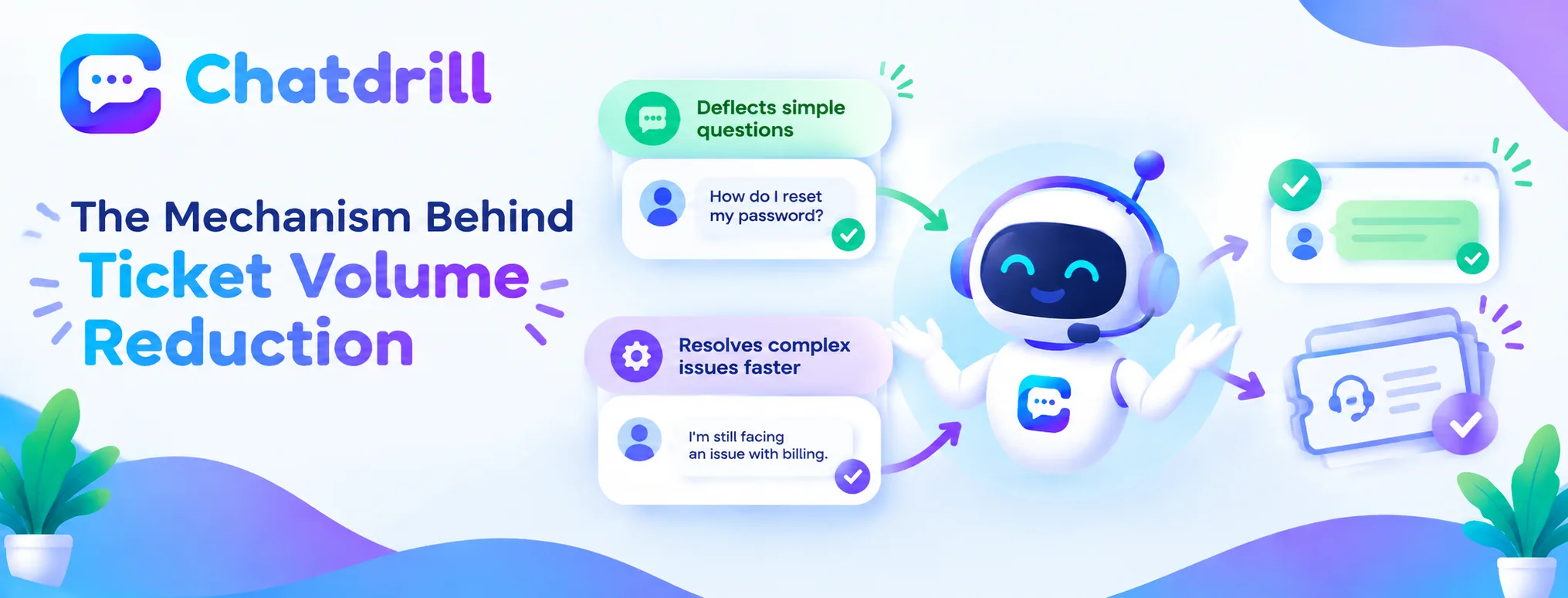
Live chat reduces ticket volume through two distinct paths: deflecting simple questions before they become tickets, and resolving complex ones faster so they don't generate repeat contact.
Deflecting simple questions before they become tickets
A visitor with a quick, factual question, order status, a policy detail, a how-to step, who gets an instant chat answer never files that question as a ticket in the first place, directly reducing your total incoming volume.
This deflection effect compounds at scale, since even a modest percentage of visitors choosing chat over a ticket form adds up to a meaningful reduction across your total monthly volume.
AI-assisted chat specifically expands how much of this deflection can happen without proportional staffing growth, since AI can absorb a large share of these repetitive, factual questions around the clock.
Resolving complex issues faster to prevent repeat contact
A genuinely complex issue that gets resolved thoroughly in one real-time chat conversation is less likely to generate a frustrated follow-up ticket than the same issue handled through a slower, back-and-forth email thread.
This resolution-quality effect matters as much as pure deflection, since a ticket that reopens or spawns a follow-up effectively counts twice against your total volume.
Chat's real-time back-and-forth also lets an agent clarify an ambiguous request immediately, avoiding the extra round trip a slower channel would need just to gather missing information.
Specific Tactics for Maximizing Ticket Reduction
Proactively surfacing chat on high-ticket-generating pages and training AI specifically on your most common ticket categories both meaningfully increase the reduction effect.
Placing chat prominently on high-ticket-generating pages
Reviewing which specific pages, a shipping policy page, an account settings page, a billing FAQ, generate the most tickets, then ensuring chat is prominently, proactively offered there specifically, captures the highest-leverage opportunities first.
This targeted placement approach produces a considerably better return than adding a generic, uniform chat widget across the entire site without this specific prioritization.
Training AI directly on your top ticket categories
Reviewing your actual historical ticket data to identify the most common categories, then training your chat AI specifically on accurate answers for exactly these categories, directly targets your largest sources of ticket volume first.
This data-driven training prioritization ensures your AI investment addresses genuinely high-volume categories before lower-value, rarely-asked edge cases.
Common Mistakes That Limit Ticket Reduction
Adding chat without addressing the underlying reasons behind your highest-volume ticket categories, and failing to actually retire the parallel ticket-submission path, both limit the reduction chat can otherwise deliver.
Not addressing root causes behind top ticket categories
If a specific ticket category exists because of a genuinely confusing product flow or unclear policy, chat alone can only mask this problem by answering the same confused question faster, rather than solving it, without also addressing the underlying confusion directly.
Pairing chat deflection with genuine root-cause fixes, clarifying the confusing flow or policy itself, produces a more durable ticket reduction than chat deflection alone.
Leaving an equally prominent ticket-submission path active
If a ticket form remains just as visible and easy to use as the chat widget, many visitors will simply continue submitting tickets out of habit, undermining much of the reduction chat could otherwise achieve.
Making chat the clearly preferred, more prominent option, while keeping the ticket form available as a genuine fallback, nudges more visitors toward the faster, ticket-reducing channel.
Measuring the Actual Ticket Reduction Impact
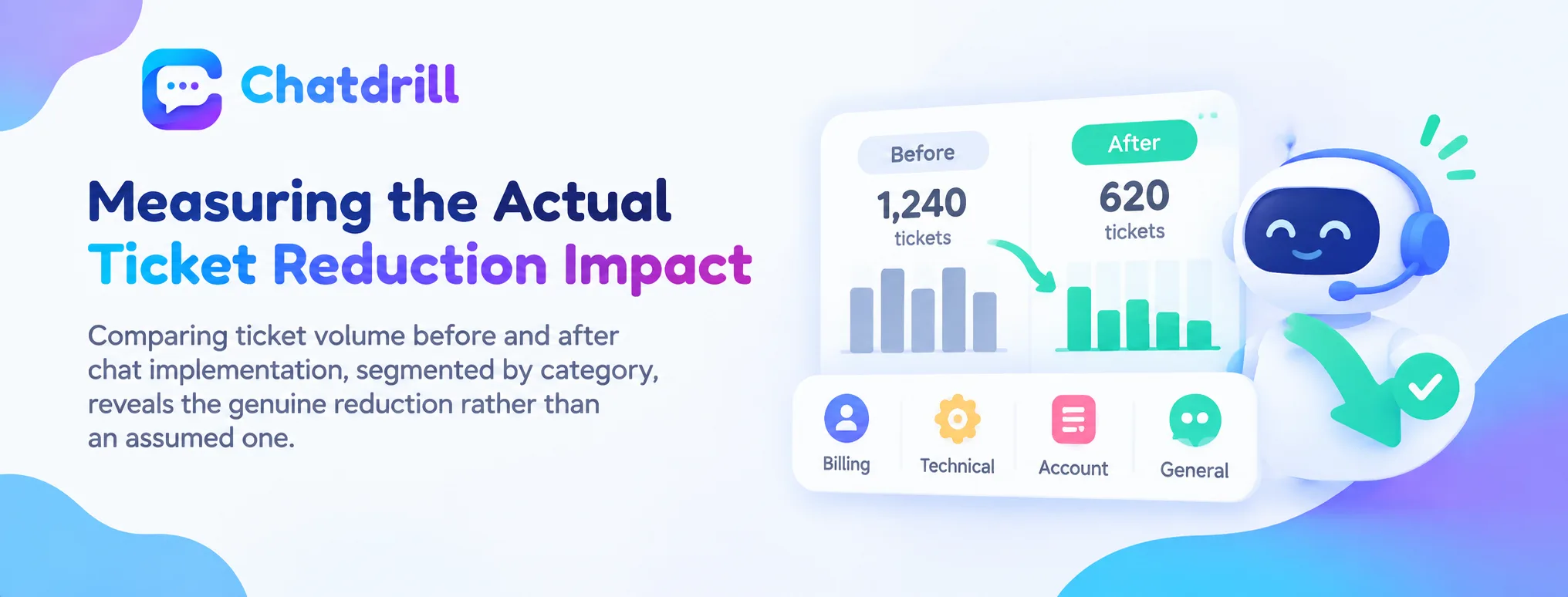
Comparing ticket volume before and after chat implementation, segmented by category, reveals the genuine reduction rather than an assumed one.
Establishing a genuine before-and-after baseline
Recording your actual monthly ticket volume, broken down by category, for a period before chat implementation gives you the genuine baseline needed to measure real reduction rather than relying on assumption.
Comparing this baseline against volume in the months following implementation, ideally controlling for any other changes happening simultaneously, isolates chat's actual contribution to the change.
Segmenting the reduction by category
Reviewing which specific ticket categories saw the largest reduction reveals where chat is genuinely delivering value, and which categories might need additional AI training or a different intervention entirely.
This category-level view also helps validate whether the reduction reflects genuine deflection, rather than simply pushing the same underlying questions into chat without actually reducing overall support burden.
Building a Sustainable Ticket-Reduction Habit
Treating ticket reduction as an ongoing process, reviewing new emerging ticket categories regularly, rather than a one-time project keeps the benefit compounding over time.
Reviewing new or shifting ticket categories periodically
As your product or business evolves, new ticket categories inevitably emerge, and periodically reviewing recent ticket data for these new patterns keeps your chat training relevant rather than static and gradually outdated.
This ongoing review habit ensures the ticket-reduction gains from chat continue compounding rather than plateauing once initial training is complete.
Feeding genuinely resolved conversations back into training
Reviewing chat conversations that resolved a question particularly well and incorporating that successful pattern into broader AI training helps extend that same success to future, similar questions.
This feedback loop turns each individual successful resolution into a scalable improvement across your entire future ticket volume, not just a one-off win.