
A remote support team loses the informal, incidental communication that happens naturally in a shared office, overheard conversations, quick desk-side questions, meaning the structure that replaces this needs to be considerably more deliberate than it would for a co-located team.
Management also shifts from something that can partly happen through physical presence and observation to something that depends entirely on structured check-ins, transcript review, and genuine, deliberate communication.
Done well, a remote support team can perform just as strongly as a co-located one, sometimes better given wider hiring pools and genuine flexibility, but this requires actively building the structure that replaces what physical proximity used to provide informally.
This guide covers what remote management requires specifically, practical strategies, common mistakes, and how ChatDrill supports visibility and cohesion for a distributed team.
Quick answer: Managing a fully remote support team well depends on deliberate, structured communication to replace informal in-office context, genuine visibility into performance through transcript and metric review rather than physical presence, and intentional effort to maintain team cohesion despite the lack of shared physical space.
What Remote Support Management Requires
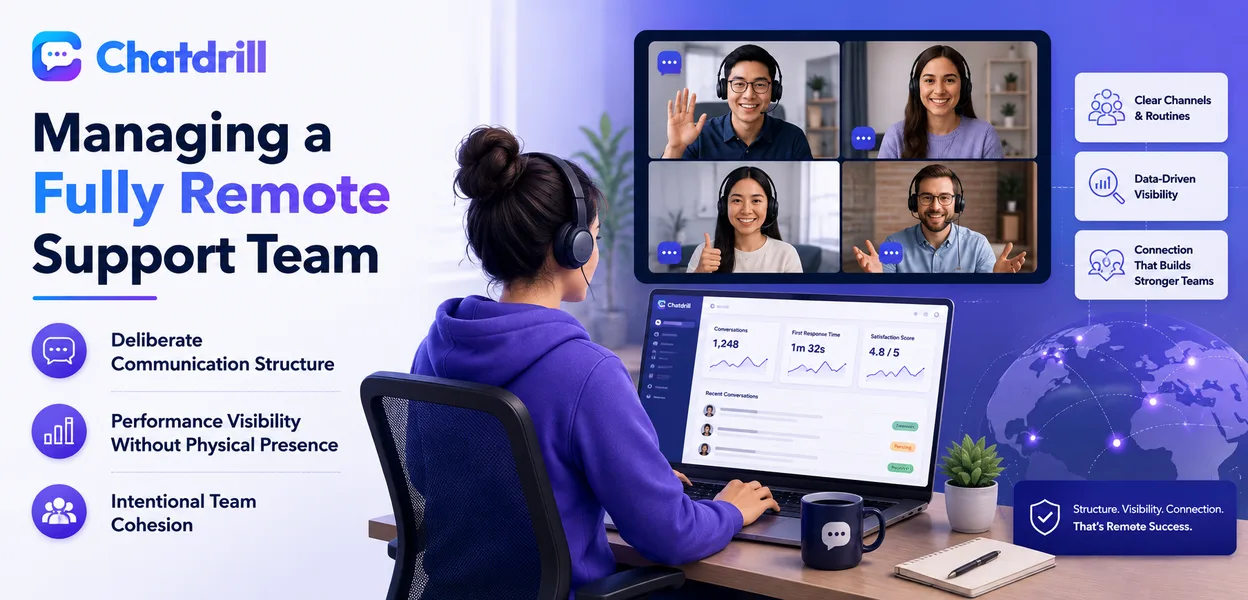
Remote management requires deliberate communication structure, genuine performance visibility without physical presence, and intentional effort toward team cohesion.
Deliberate communication structure
Without incidental office conversation, remote teams need explicit channels and routines for the kind of quick question, context-sharing, and casual knowledge transfer that happens naturally in a shared space.
This structure needs to be built intentionally rather than assumed to emerge naturally, since remote work simply doesn't replicate informal office dynamics without deliberate effort.
Performance visibility without physical presence
A remote manager can't observe an agent's work simply by walking past their desk, making structured performance visibility through data and transcript review genuinely necessary rather than optional.
This shift actually tends to produce more objective, evidence-based management than casual in-office observation, once the right visibility tools are genuinely in place.
Intentional team cohesion
Building genuine team connection without shared physical space requires deliberate effort, regular video check-ins, informal virtual social time, that wouldn't be necessary for a co-located team.
This intentionality matters for both morale and the kind of peer knowledge-sharing that naturally happens in person but needs active facilitation remotely.
Practical Strategies for Remote Team Management
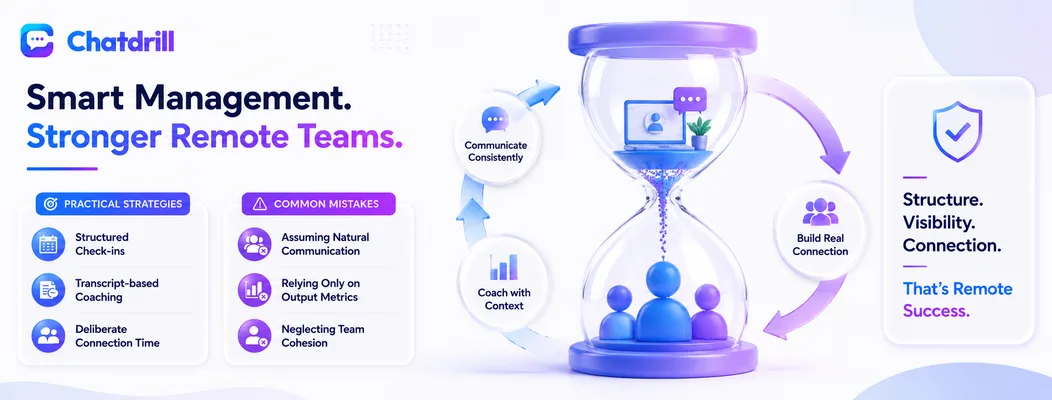
Effective strategies include structured regular check-ins, transcript-based coaching, and deliberate informal connection time built into the team's regular rhythm.
Structured regular check-ins
Consistent one-on-one and team check-ins, on a predictable schedule, replace the informal touchpoints that would happen naturally in an office, ensuring genuine communication doesn't depend on chance encounters.
These check-ins should cover both performance and genuine wellbeing, given how much easier it is for a remote agent's struggles to go unnoticed without deliberate attention.
Transcript-based coaching as the primary tool
Since a remote manager can't observe conversations live, reviewing actual transcripts becomes the primary mechanism for genuine, specific coaching feedback.
This approach, done consistently, can actually produce more thorough, evidence-based feedback than the more casual observation typical in a co-located setting.
Building in deliberate informal connection
Scheduling brief, genuinely informal virtual time, not just structured work meetings, helps recreate some of the relationship-building that happens incidentally in a shared office.
This doesn't need to be elaborate, even a short, optional virtual coffee chat rhythm can meaningfully support team cohesion over time.
Common Mistakes in Remote Support Management
The most common mistakes are assuming communication will happen naturally without structure, relying only on output metrics without genuine transcript review, and neglecting team cohesion entirely.
Assuming natural communication will emerge
Expecting remote team members to communicate and share context as naturally as they would in a shared office, without building explicit structure for it, tends to produce genuine information gaps and isolation.
Building deliberate communication routines from the start avoids discovering this gap only after it's already caused problems.
Relying only on output metrics
Managing purely by numbers, response time, resolution rate, without ever reviewing actual conversation quality through transcripts, misses the qualitative context that numbers alone can't capture.
Combining metric review with genuine transcript-based coaching produces a more complete, more accurate picture of actual performance.
Neglecting team cohesion entirely
Treating remote management as purely transactional, task assignment and metric review with no genuine relationship-building, tends to produce a team that feels disconnected and less engaged over time.
Investing deliberate, if modest, effort into cohesion protects against this drift toward a purely transactional, less engaged team dynamic.
How ChatDrill Supports Remote Team Visibility and Cohesion

ChatDrill's centralized transcript access and performance dashboards give a remote manager genuine visibility into team performance regardless of physical location, while shared conversation review can double as a team learning tool.
Centralized visibility regardless of location
Because every conversation and performance metric lives in one accessible platform, a remote manager has the same genuine visibility into team performance as they would with a co-located team, arguably with more consistent, structured data.
This centralization is what makes evidence-based, transcript-grounded coaching genuinely practical for a fully distributed team.
Shared review as a team-building opportunity
Reviewing a particularly well-handled conversation together as a team, drawn directly from ChatDrill's transcript history, doubles as both a coaching moment and a small but genuine team-cohesion activity.
This kind of shared, concrete example gives a distributed team something specific to discuss together, partially recreating the collaborative learning that happens more naturally in a shared office.
Rotating who selects the example conversation each time also gives different team members a small, genuine leadership moment within this shared review practice.
Handling Time Zone Differences on a Remote Team
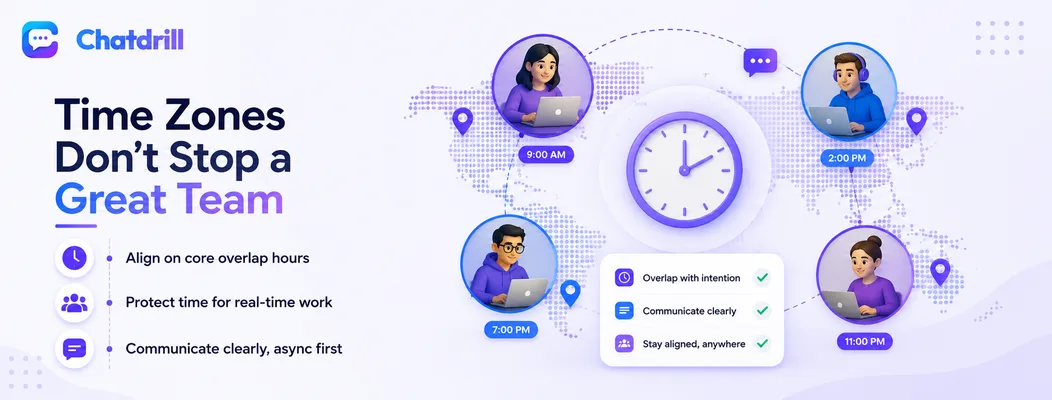
A genuinely distributed team spanning multiple time zones needs deliberate overlap planning and asynchronous-friendly habits to function well despite team members rarely being online at the exact same time.
Establishing core overlap hours
Identifying a modest window where most or all team members are genuinely online simultaneously, even if brief, preserves some capacity for real-time discussion and quick collaborative problem-solving.
This overlap window should be protected deliberately for genuinely important synchronous needs, rather than filled entirely with routine meetings that could just as easily happen asynchronously.
Building genuinely asynchronous-friendly habits
Writing updates and questions with enough context that a colleague in a different time zone can respond meaningfully without needing real-time back-and-forth respects the reality that immediate response isn't always available across a distributed team.
This habit, while it takes some initial discipline to build, ultimately makes the whole team more resilient to time zone spread rather than constantly bottlenecked on synchronous availability.
Onboarding New Remote Agents Effectively
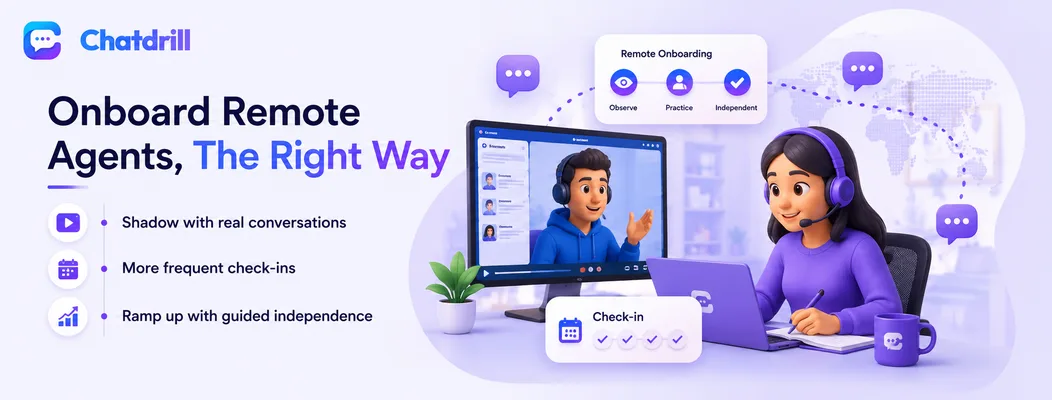
Onboarding a remote agent well requires translating the same structured, supervised-practice approach covered in broader training guidance into a format that works without shared physical space.
Recreating shadowing through recorded or live remote sessions
Screen-sharing a live conversation, or reviewing a recorded one together, replicates much of the value of in-person shadowing, letting a new remote agent observe genuine, real-time judgment in action despite the physical distance.
This deliberate substitution matters, since simply handing a new remote hire written documentation without this observational component leaves a genuine gap compared to in-office onboarding.
Increasing check-in frequency during remote ramp-up
A new remote agent benefits from more frequent, shorter check-ins during their first weeks than an equivalent in-office hire might need, since they lack the ambient visibility and easy, casual question-asking a shared office provides.
This heightened cadence can taper off as the agent demonstrates growing independence, mirroring the same progression logic used in general onboarding but compressed into a tighter, more frequent rhythm during the remote-specific early period.