
A business serving customers across multiple time zones faces a genuine staffing challenge, covering every hour with live agents either requires an expensive overnight shift or accepting real coverage gaps during certain hours.
The most sustainable approach typically combines a distributed, follow-the-sun staffing model with AI covering the gaps between regional teams, rather than relying purely on either overnight human staffing or unassisted AI everywhere.
Getting this right means understanding your actual customer distribution across time zones, not just assuming a single headquarters time zone represents your genuine average customer.
This guide covers common coverage models, how to build a genuinely sustainable approach, a practical implementation process, and mistakes worth avoiding.
Quick answer: Building chat coverage across time zones typically combines a follow-the-sun staffing model, distinct teams handing off across regions, with AI covering the gaps between staffed shifts, giving genuine around-the-clock coverage without requiring any single team to work overnight hours.
Common Time Zone Coverage Models
The main coverage models are follow-the-sun staffing across distributed teams, overlapping shifts within a smaller number of regions, and AI-augmented coverage filling gaps between staffed hours.
Follow-the-sun staffing
Distributing teams across multiple regions, each covering their local business hours, creates a genuine handoff chain that provides live coverage across most or all of a 24-hour cycle.
This model works best for a business with genuinely substantial volume across multiple regions, justifying the cost of maintaining distinct regional teams.
Overlapping shifts within fewer regions
A smaller business might instead run overlapping shifts within one or two regions, extending coverage hours without the complexity of managing genuinely distributed, multi-region teams.
This model trades some coverage breadth for lower operational complexity, often a reasonable choice for a business without truly global customer distribution.
AI-augmented gap coverage
Using AI specifically to cover the hours between staffed shifts, rather than attempting full human coverage around the clock, provides a cost-effective way to close remaining coverage gaps.
This hybrid approach is increasingly the most practical model for businesses that don't have the volume or budget to justify full follow-the-sun staffing.
Building a Genuinely Sustainable Approach
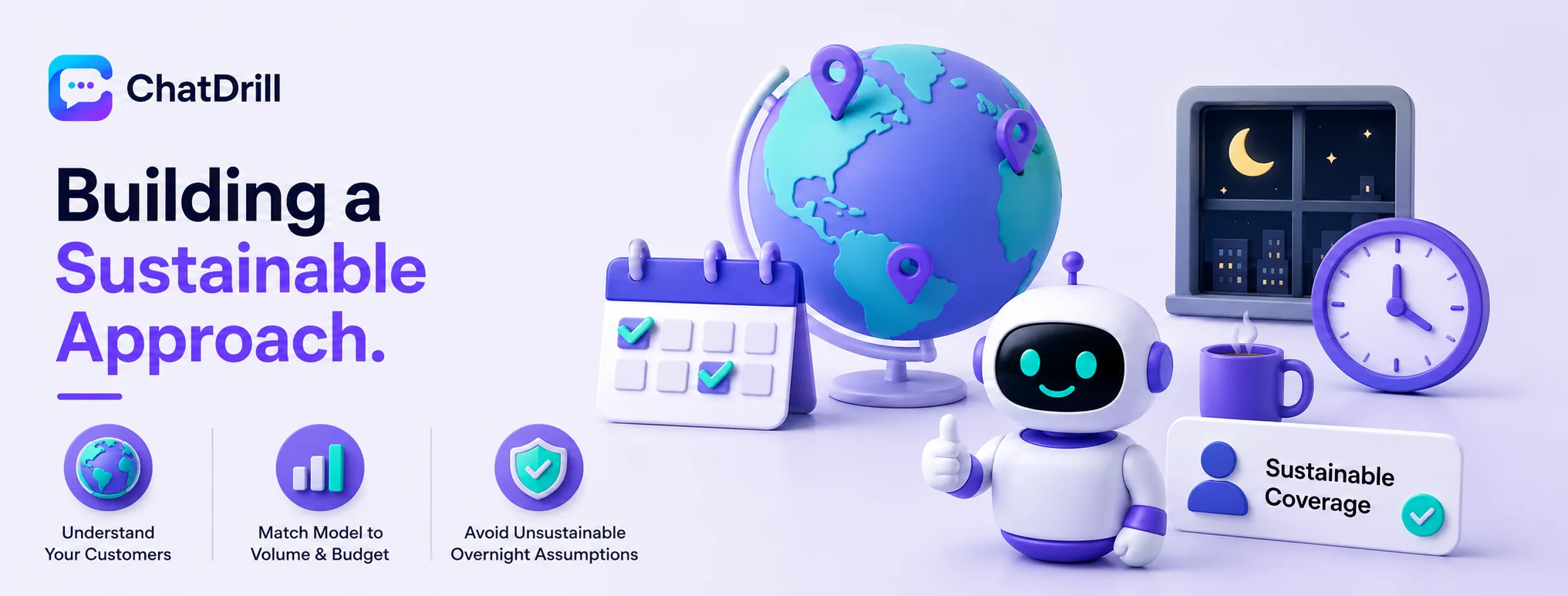
A sustainable approach starts with understanding your actual customer time zone distribution, choosing a coverage model that matches your genuine volume and budget, and avoiding unsustainable overnight shift assumptions.
Understanding your actual customer distribution
Reviewing where your chat volume actually originates by time zone, rather than assuming based on where your headquarters or largest office happens to be located, reveals your genuine coverage needs.
This data often reveals a different picture than internal assumption, sometimes showing meaningful volume from a region not previously prioritized in coverage planning.
Matching the model to your genuine volume and budget
A business without truly substantial multi-region volume may not need full follow-the-sun staffing, potentially over-investing in coverage relative to genuine need.
Choosing a coverage model proportional to your actual volume and budget avoids both under-coverage and unnecessary overinvestment.
Avoiding unsustainable overnight assumptions
Expecting a single team to sustainably cover overnight hours indefinitely, without genuine rotation or compensation for the disruption this causes, tends to produce high turnover and burnout over time.
A genuinely sustainable model respects the real human cost of overnight coverage, whether through fair rotation, appropriate compensation, or shifting toward AI-augmented coverage instead.
Implementation Approach for Time Zone Coverage
A practical implementation analyzes your actual volume distribution, pilots a coverage model with your highest-priority gap first, and builds AI training specifically for whatever hours remain unstaffed.
Step 1: Analyze your actual volume distribution
Pulling genuine chat volume data broken out by time zone or region reveals where your current coverage gaps are most significant relative to actual customer need.
This analysis grounds the rest of your coverage planning in real data rather than assumption about where your customers are located.
Step 2: Pilot coverage for your highest-priority gap
Starting with whichever coverage gap represents the most significant, quantifiable volume loss or customer frustration focuses initial investment where it delivers the most value.
This piloted approach, rather than attempting to solve every time zone gap simultaneously, keeps the initial rollout manageable and testable.
Step 3: Build AI training for unstaffed hours
Training AI specifically on the question patterns that arise during your identified unstaffed hours ensures genuine coverage during exactly the gaps human staffing doesn't reach.
This training should be reviewed against real conversations from those specific hours, confirming AI is genuinely capable of handling what actually comes up.
Common Mistakes in Time Zone Coverage Planning
The most common mistakes are assuming headquarters time zone represents your typical customer, over-investing in follow-the-sun staffing without sufficient volume to justify it, and neglecting AI training specific to off-hours question patterns.
Assuming headquarters represents typical customers
Planning coverage around your company's own time zone, rather than your actual customer distribution, risks leaving genuine, significant volume underserved.
Reviewing real volume data by region, rather than relying on internal assumption, avoids this common planning gap.
Over-investing without sufficient volume
Building full follow-the-sun staffing for a business without genuinely substantial multi-region volume represents real, avoidable cost relative to what a simpler, AI-augmented model could deliver.
Matching investment level to actual, validated need prevents this common overinvestment.
Neglecting off-hours AI training
Assuming existing AI training automatically covers whatever questions arise during unstaffed hours, without verifying this directly, can leave genuine gaps unaddressed exactly when no human alternative exists.
Reviewing off-hours-specific question patterns and training accordingly closes this gap directly.
How ChatDrill Provides Coverage Across Time Zones
ChatDrill's AI runs continuously regardless of which regional team is currently staffed, giving genuine coverage in the gaps between shifts without requiring a business to build full follow-the-sun staffing from scratch.
Always-on AI filling the gaps between shifts
Because ChatDrill's AI doesn't depend on any team being actively staffed, it can handle routine questions around the clock, closing exactly the gap hours that would otherwise go completely unstaffed.
For a business not yet at the scale to justify full multi-region human staffing, this gives a genuinely practical middle path, real coverage during off-hours without the overhead of maintaining distinct regional teams.
As your actual regional volume grows, this same AI layer continues covering the gaps even as you add follow-the-sun staffing for your highest-priority regions.
Training AI specifically for off-hours patterns
ChatDrill lets you train and review AI performance by time period, making it straightforward to confirm the AI genuinely handles whatever question patterns show up during your specific unstaffed hours.
Reviewing real off-hours conversation transcripts directly within the platform helps you spot and close any training gaps before they affect a meaningful share of after-hours visitors.