
CSAT is ultimately a lagging indicator, it reflects whatever actually happened during the conversation, meaning the most reliable way to raise the score is improving the underlying interactions rather than trying to influence the survey response itself.
The businesses that see genuine, sustained CSAT improvement focus on a small number of high-leverage changes, first-contact resolution, response speed matched to urgency, and closing the loop on negative feedback, rather than a scattered list of minor tweaks.
Getting this right also means resisting the temptation to game the metric through survey timing or wording tricks, which might move the number short-term without improving the actual experience driving it.
This guide covers the highest-leverage CSAT drivers, practical tactics for each, a measurement approach, and mistakes worth avoiding.
Quick answer: Raising CSAT reliably comes from resolving issues genuinely on the first contact, matching response speed to the urgency of the question, and following up on negative scores directly rather than only tracking the number, since these three levers address the root causes behind most low satisfaction ratings.
The Highest-Leverage CSAT Drivers
First-contact resolution, response speed matched to urgency, and genuine follow-up on negative feedback consistently drive more CSAT improvement than smaller, more superficial tweaks.
First-contact resolution
A customer whose issue is genuinely resolved in a single interaction, without needing to follow up again, consistently reports meaningfully higher satisfaction than one requiring multiple contacts for the same issue.
This driver tends to have an outsized effect on CSAT compared to many other factors, making it worth prioritizing above smaller process improvements.
Response speed matched to urgency
Speed matters, but its impact on satisfaction depends heavily on matching the response time to how urgent the customer's actual situation is, a routine question tolerates more delay than a genuinely time-sensitive issue.
Recognizing and prioritizing based on genuine urgency, rather than treating all conversations identically, improves CSAT more than uniformly fast responses across every category.
Following up on negative feedback
Reaching back out to a customer who left a low satisfaction score, understanding what specifically went wrong, and addressing it directly can meaningfully improve that customer's ongoing relationship even after an initial poor experience.
This follow-up also generates genuinely useful data about recurring, addressable issues that a raw CSAT number alone wouldn't reveal.
Practical Tactics for Each Driver

Practical tactics include training AI and agents on genuine root-cause resolution, building urgency-recognition into your routing and response process, and creating a systematic negative-feedback follow-up workflow.
Training for genuine root-cause resolution
Encouraging agents and AI to address the underlying cause of a question, not just the surface-level ask, reduces the follow-up contacts that erode first-contact resolution rates.
This deeper resolution approach sometimes takes marginally longer per conversation but tends to improve overall satisfaction and reduce total contact volume.
Building urgency recognition into routing
Configuring your system to recognize language or context suggesting genuine urgency, and prioritizing these conversations accordingly, ensures speed is allocated where it matters most for satisfaction.
This targeted prioritization delivers better overall CSAT impact than spreading the same speed investment uniformly across every conversation regardless of urgency.
Creating a negative feedback follow-up workflow
Building an explicit process to identify and follow up on every low-CSAT conversation, rather than only reviewing them occasionally, ensures this valuable feedback loop actually happens consistently.
This workflow should feed both individual customer recovery and broader pattern identification, informing training or process improvements based on what recurs.
Implementation Approach for Raising CSAT
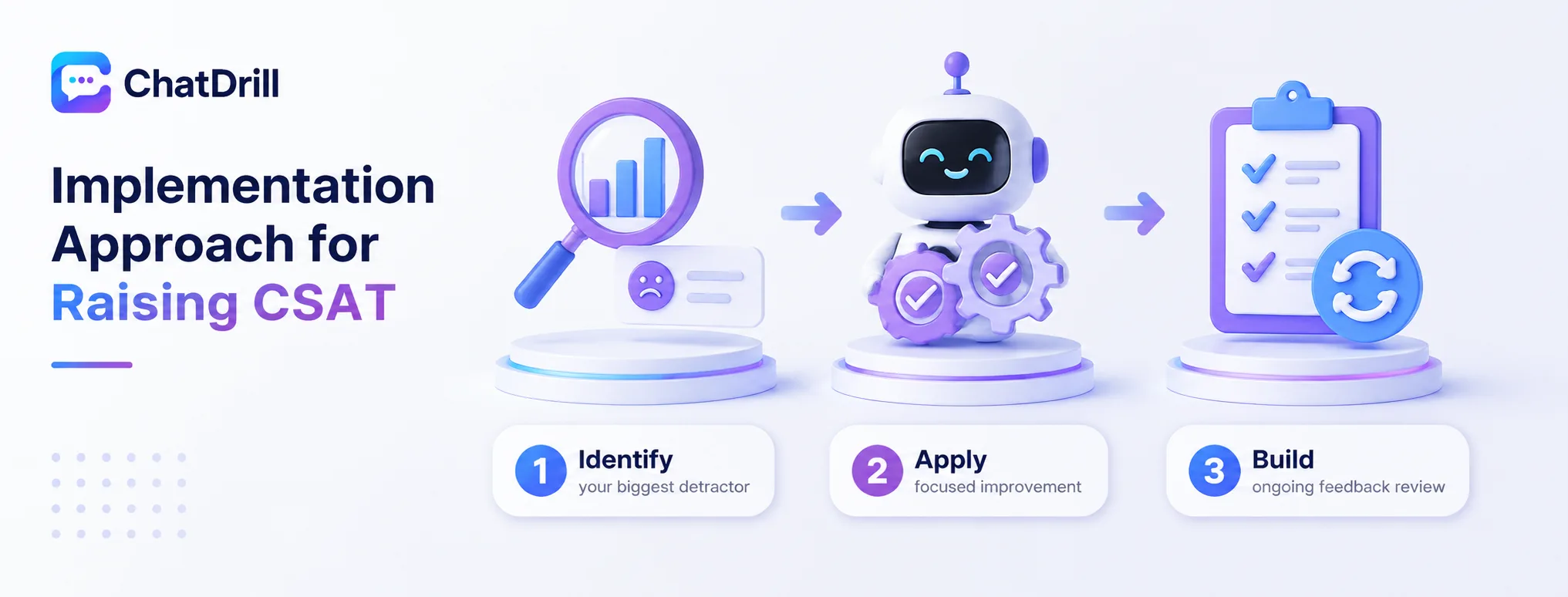
A practical implementation identifies your current biggest CSAT detractor through data, applies focused improvement to that specific driver, and builds ongoing negative-feedback review into your regular process.
Step 1: Identify your current biggest detractor
Reviewing what specifically correlates with your lowest CSAT scores, repeat contacts, slow response on urgent issues, unresolved complaints, reveals where focused improvement will deliver the most impact.
This diagnostic step ensures your effort targets the genuine root cause rather than a secondary or assumed issue.
Step 2: Apply focused improvement
Addressing whichever driver the data reveals as most significant, whether through training, routing changes, or a new follow-up process, concentrates effort where it matters most.
Tackling this systematically, rather than attempting every possible CSAT tactic simultaneously, makes it possible to measure genuine impact from each specific change.
Step 3: Build ongoing negative feedback review
Establishing a regular, systematic process for reviewing and acting on negative feedback, rather than a one-time initiative, sustains CSAT improvement over time.
This ongoing practice also surfaces new, emerging issues before they become significant enough to show up clearly in aggregate CSAT trends.
Common Mistakes When Trying to Raise CSAT
The most common mistakes are attempting to influence survey timing or wording rather than the underlying experience, treating every conversation with identical urgency, and never following up on negative scores individually.
Gaming the survey rather than the experience
Adjusting survey timing or wording to nudge the number upward without improving the actual underlying experience produces a misleading metric that doesn't reflect genuine customer sentiment.
Focusing on the actual drivers of satisfaction, rather than the measurement mechanism itself, produces genuine, sustainable improvement.
Treating every conversation identically
Applying the same response speed and handling approach regardless of genuine urgency misses the opportunity to allocate effort where it most affects satisfaction.
Recognizing and prioritizing based on real urgency signals produces better overall CSAT results than uniform treatment.
Never following up on individual negative scores
Only reviewing negative CSAT in aggregate, without following up on specific instances, misses both the chance to recover an individual customer relationship and the detailed insight into what actually went wrong.
Building a consistent follow-up practice captures both of these valuable opportunities that aggregate review alone would miss.
How ChatDrill Supports CSAT Improvement
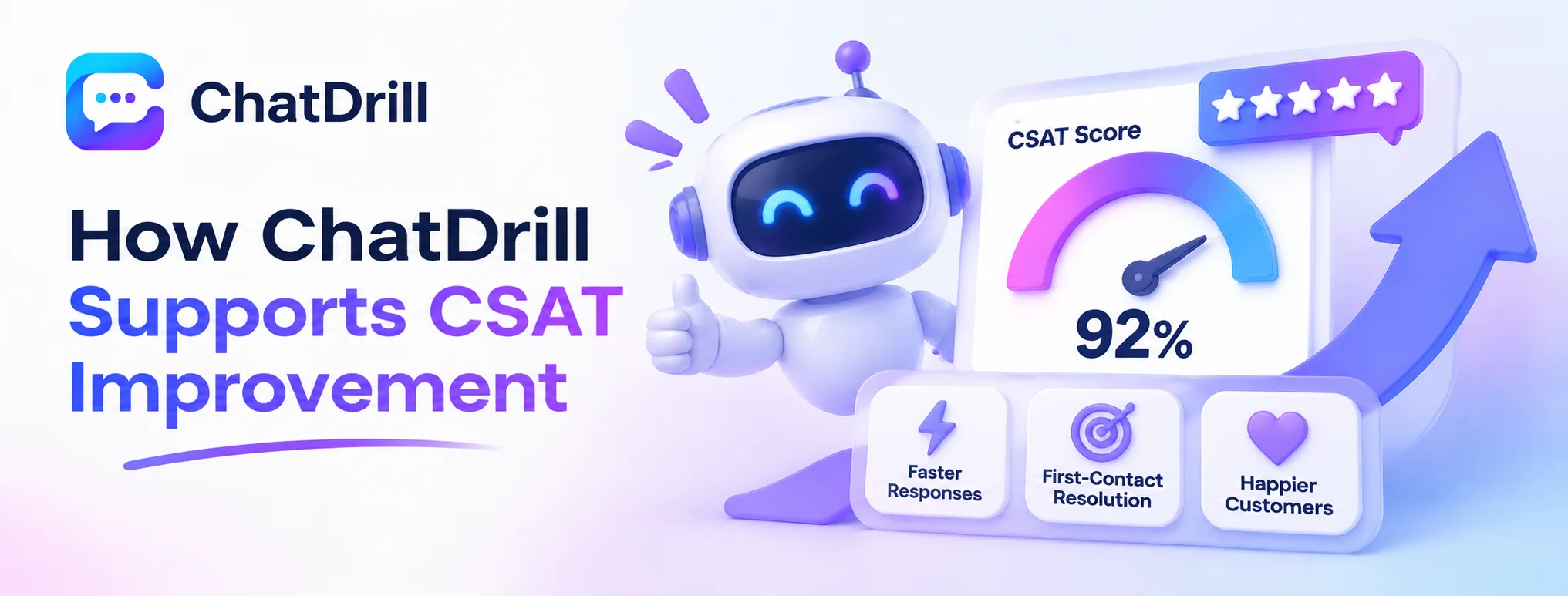
ChatDrill helps on all three major CSAT drivers directly, resolving more questions on first contact through AI, recognizing urgency to prioritize response speed, and flagging negative feedback for immediate follow-up.
Improving first-contact resolution through better AI answers
Because ChatDrill's AI is trained on your actual product and policy details, it can resolve a genuine question completely in one exchange rather than giving a partial answer that leads to a follow-up contact.
Reviewing which conversations still require a second contact, directly within ChatDrill's analytics, reveals specific training gaps worth closing to push first-contact resolution higher.
This connection between training quality and first-contact resolution makes CSAT improvement a genuinely actionable, trackable process rather than an abstract goal.
Flagging negative feedback for immediate follow-up
ChatDrill surfaces low-satisfaction conversations directly, making it straightforward to build the kind of consistent, individual follow-up practice that genuinely moves CSAT over time.
Reviewing flagged negative conversations alongside their transcripts helps identify recurring, addressable patterns, not just isolated incidents, informing broader training or policy improvements.