
In a genuinely early-stage business, founders or generalist staff handling support directly is often the right, resource-efficient choice, but there's a point where this stops being efficient and starts genuinely constraining both the founders' focus and the customer experience.
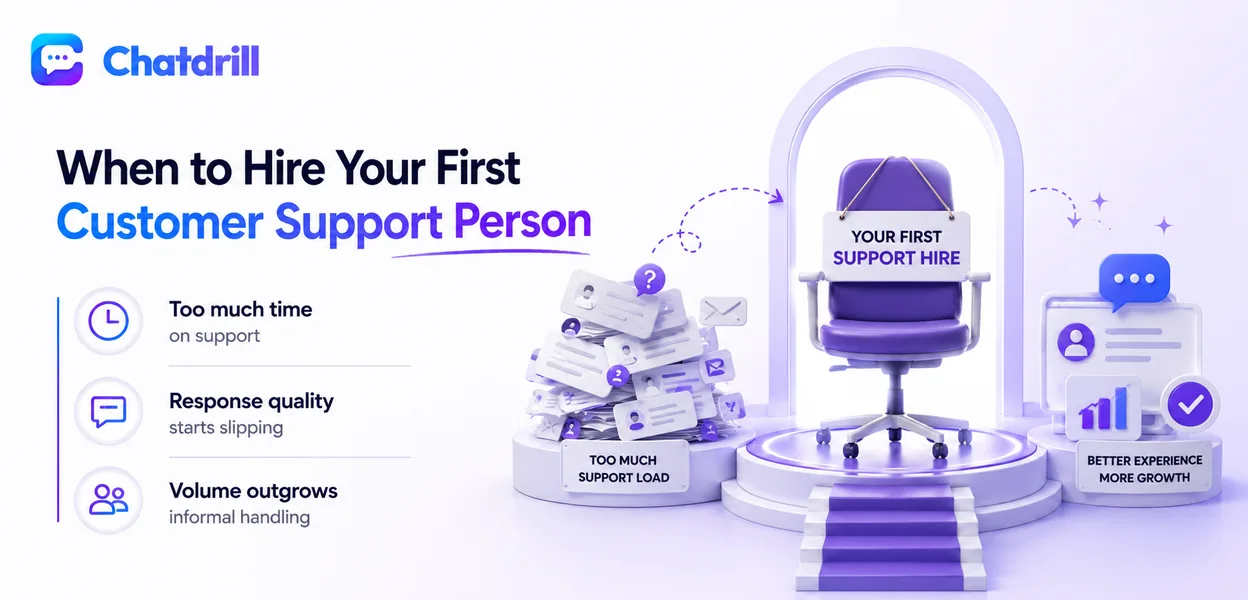
The right hiring signal isn't a fixed headcount or revenue milestone, it's a combination of time genuinely diverted from other priorities, visible strain on response quality, and volume that's outgrown what informal, ad hoc handling can sustain.
Getting the timing right matters, hiring too early wastes resources on a role that doesn't yet have enough genuine volume to justify it, while waiting too long can mean customer experience quietly degrades during the delay.
This guide covers the genuine signals worth watching for, how to prepare for this first hire, common mistakes, and how ChatDrill can extend your runway before or alongside this hire.
Quick answer: The signal to hire your first dedicated customer support person is when founders or existing staff are spending a genuinely significant, recurring share of their week on support, when response times are visibly slipping, or when support volume has outgrown what AI and self-serve resources alone can handle well.
Genuine Signals It's Time to Hire
The clearest signals are founders or staff spending significant recurring time on support, visibly slipping response quality, and volume genuinely outgrowing informal handling capacity.
Significant time diverted from core priorities
When a founder or key team member is spending several hours a week on support specifically, time genuinely needed for product, sales, or other core priorities is being displaced.
This diversion, even if each individual support interaction feels manageable, compounds into a genuine opportunity cost worth recognizing explicitly rather than treating as background noise.
Visibly slipping response quality or speed
A response time that used to be fast and thorough gradually becoming slower or more superficial signals that current informal handling has genuinely outgrown its capacity.
This decline is worth watching for proactively, since it often happens gradually enough that it's easy to normalize rather than recognize as a genuine signal.
Volume outgrowing informal capacity
A meaningful, sustained increase in support volume, beyond what AI and self-serve resources reasonably handle, represents genuine growth that ad hoc handling by non-dedicated staff can no longer sustain well.
This volume signal is worth tracking explicitly through real data, rather than relying on a general sense that things feel busier than before.
Preparing for Your First Support Hire
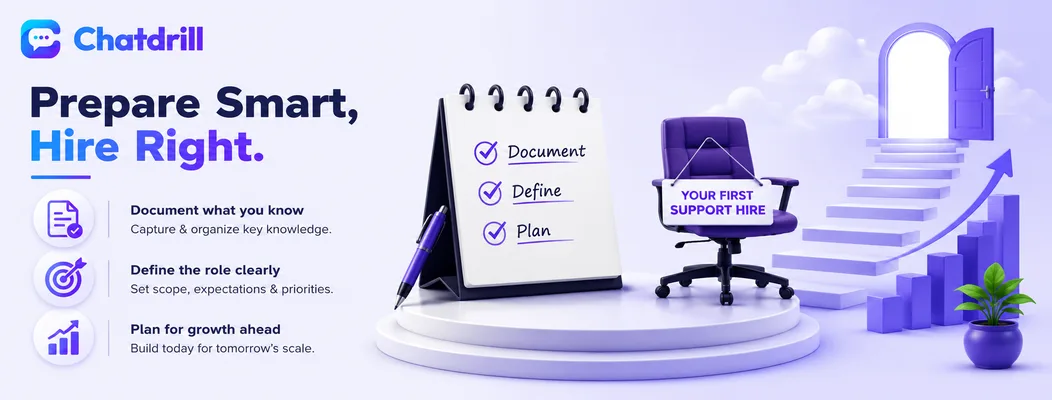
Preparing well means documenting existing informal knowledge, defining the role's actual scope clearly, and having a genuine plan for how this first hire will grow with the business.
Documenting existing informal knowledge
Whatever institutional knowledge currently lives only in a founder's head, common questions, edge cases, policy nuances, needs to be captured explicitly before a new hire can genuinely take over this responsibility.
This documentation effort, done before the hire starts, dramatically shortens their ramp-up time and reduces how much ongoing founder involvement remains necessary afterward.
Defining the role's actual scope clearly
Being explicit about what this first hire will and won't handle, pure support, or also some adjacent responsibilities like onboarding or light sales support, sets clear expectations from the start.
This clarity avoids both an overwhelmed new hire trying to cover too much and an underused one without enough genuine responsibility.
Planning for growth beyond this first hire
Considering roughly when a second support hire might be needed, based on your own growth trajectory, helps this first hire understand they're building a foundation, not necessarily staying a solo function indefinitely.
This forward-looking context also helps in evaluating candidates who may specifically value growth potential in the role.
Common Mistakes in Timing This Hire
The most common mistakes are hiring based on a fixed timeline rather than genuine signals, waiting until customer experience has already visibly suffered, and hiring without first documenting existing informal knowledge.
Hiring based on an arbitrary timeline
Deciding to hire a support person simply because a business has reached a certain age or headcount, rather than genuine support volume and strain signals, risks either premature or delayed hiring relative to actual need.
Grounding this decision in real, observable signals, time diversion, quality slippage, volume growth, produces better timing than an arbitrary milestone.
Waiting until experience has already suffered
Delaying this hire until customers have already noticed and complained about slower or lower-quality support means some genuine damage has already occurred before the fix arrives.
Watching for the earlier, more subtle signals covered above allows hiring before customer experience genuinely degrades.
Hiring without documenting existing knowledge
Bringing on a first support hire without first capturing the informal knowledge currently held only by founders leaves the new hire genuinely underprepared and dependent on constant founder involvement.
Investing in this documentation before the hire starts pays off directly in a faster, more independent ramp-up.
How ChatDrill Extends Your Runway Before This Hire
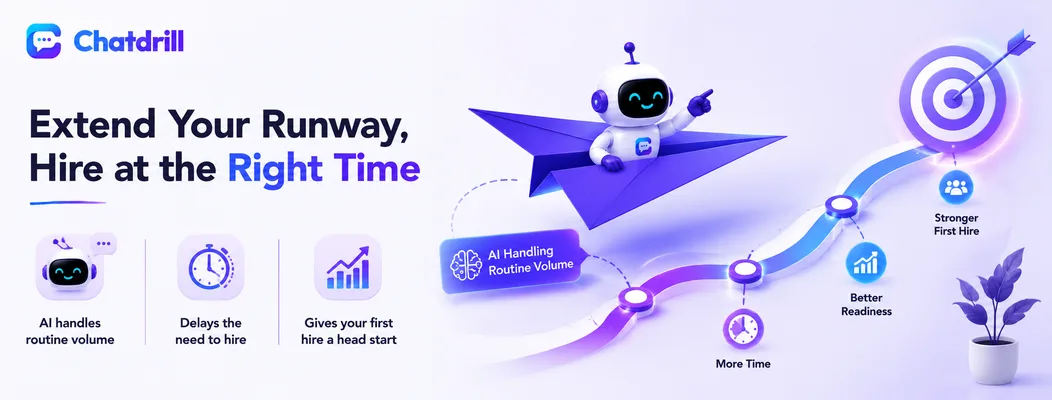
ChatDrill's AI can absorb a meaningful share of routine support volume even before a dedicated hire, potentially delaying the need or making the eventual hire's workload considerably more manageable from day one.
AI handling routine volume in the meantime
Training ChatDrill's AI on your most common questions lets it resolve a meaningful share of support volume directly, extending how long founders or generalist staff can sustainably handle the remainder informally.
This doesn't necessarily eliminate the eventual need for a dedicated hire, but it can meaningfully delay it or reduce how urgently it's needed once volume does justify the role.
Giving your first hire a running start
A first support hire starting with ChatDrill's AI already trained on your common questions and existing knowledge inherits a genuine head start, rather than needing to build this foundation from scratch themselves.
This existing foundation also means the new hire can focus their attention on the genuinely complex conversations AI can't resolve, rather than spending significant time on routine, repetitive questions.
This head start also shortens the time-to-independence discussed in broader onboarding guidance, since much of the foundational, repetitive-question knowledge is already reflected in the AI they'll work alongside.
What to Look for in This First Hire
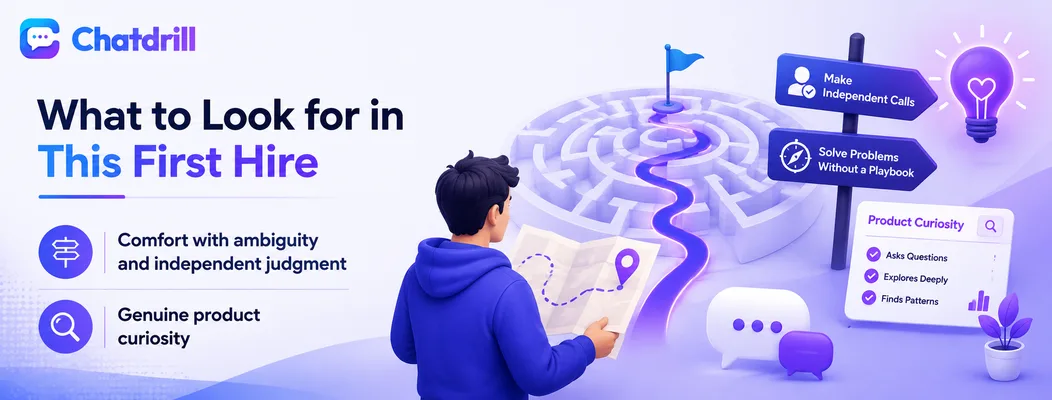
A first support hire benefits from genuine comfort with ambiguity and self-direction, since they'll often be operating without the structured team and escalation paths a larger support organization provides.
Comfort with ambiguity and independent judgment
Without a larger team or an established escalation structure, a first support hire needs to make more independent judgment calls than someone joining an already-mature support organization would.
Screening specifically for this comfort with ambiguity, rather than only technical or communication skills, helps identify someone genuinely suited to this particular, less structured role.
Genuine product curiosity
A first support hire who's genuinely curious about the product, not just following a script, tends to build the deeper understanding needed to handle the wide range of questions a solo support function typically encounters.
This curiosity also makes them more likely to proactively identify patterns worth escalating to the product or founding team, extending their value beyond pure conversation handling.
Setting This Person Up for Long-Term Success
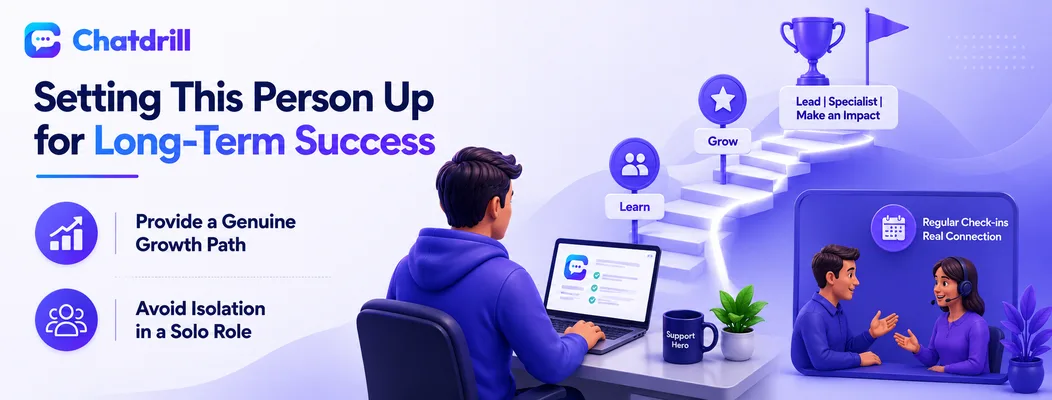
A first support hire's long-term success depends on genuine growth opportunity and a realistic path forward, not just competent handling of day-one responsibilities.
Providing a genuine growth path
Discussing openly how the role might evolve as the company and support function grow, whether toward team leadership or a more specialized track, helps retain a strong first hire who might otherwise look elsewhere for advancement.
This forward-looking conversation, had early rather than only once someone is considering leaving, signals genuine investment in their long-term career at the company.
Avoiding isolation in a solo role
A first support hire working alone, without genuine peer connection or regular check-ins from leadership, can feel isolated in a way that a hire joining an established team wouldn't experience.
Building in deliberate connection, regular one-on-ones, inclusion in broader team activities, helps offset this isolation risk inherent to being the first person in a new function.