
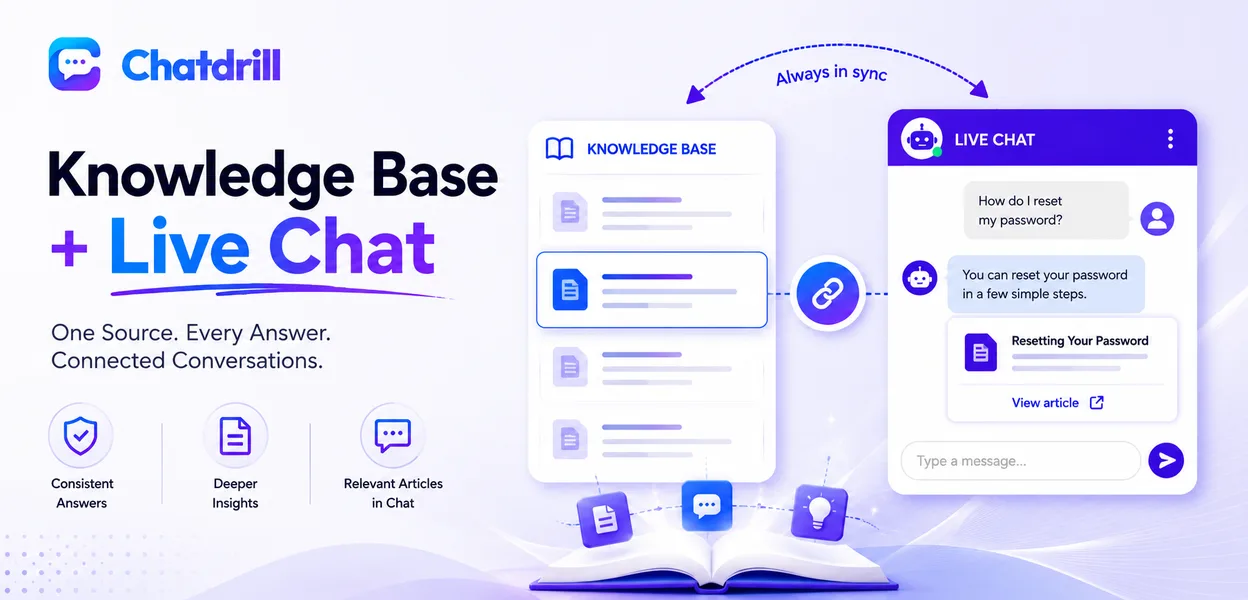
A knowledge base and a chat widget sitting side by side but never actually connected represent a missed opportunity, the knowledge base contains carefully written, accurate content that chat could be drawing from directly instead of relying on separately maintained, potentially inconsistent training.
Done well, this pairing means chat's AI answers stay automatically aligned with whatever the knowledge base says, since they're drawing from the same source, removing the risk of the two channels giving genuinely different answers to the same question.
Beyond consistency, a well-integrated pairing lets chat surface a relevant, specific article directly within a conversation, giving a customer deeper detail than a brief chat answer alone while keeping the interaction still feeling personal and responsive.
This guide covers why this pairing matters, how to implement it well, common mistakes, and how ChatDrill connects to your knowledge base directly.
Quick answer: Pairing a knowledge base with live chat works best when the chat AI is trained directly on the knowledge base content so answers stay automatically current, and when chat surfaces relevant articles proactively within the conversation rather than just deflecting customers to search on their own.
Why This Pairing Delivers Real Value
Connecting chat to your knowledge base ensures consistent answers across channels and lets chat draw on genuinely detailed content beyond what a brief conversational answer alone can provide.
Consistency between channels
When chat AI draws directly from the same knowledge base content customers can access independently, both channels give the same, current answer rather than risking a subtle inconsistency between separately maintained sources.
This consistency matters especially as your product or policies evolve, since updating the knowledge base once should automatically keep chat's answers current too, rather than requiring a separate update process.
Access to genuinely detailed content
A knowledge base article can go into considerably more depth than a typical chat response, and surfacing the relevant article directly within a conversation gives a customer access to that depth without abandoning the chat interaction.
This combination gets the best of both formats, chat's immediacy and personal feel alongside the knowledge base's genuine depth, rather than forcing a choice between the two.
How to Implement This Pairing Well
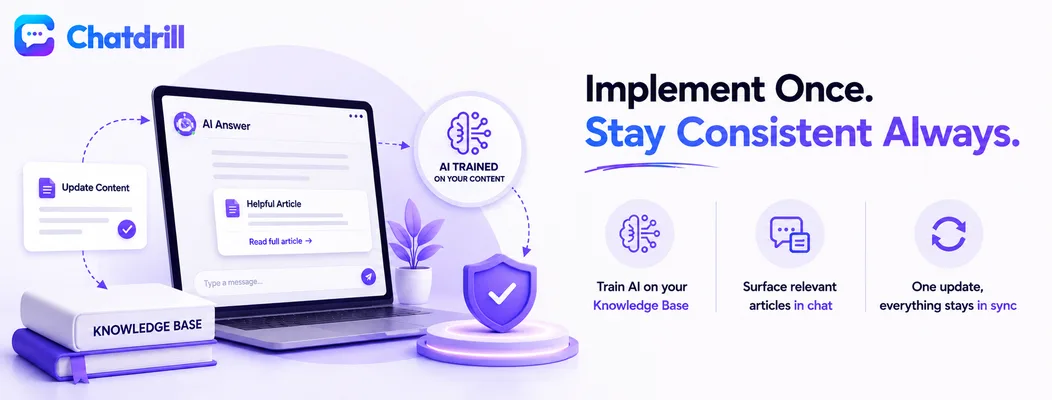
A strong implementation trains AI directly on knowledge base content, surfaces relevant articles proactively within conversations, and keeps both systems updated through one shared process.
Training AI directly on knowledge base content
Feeding your actual knowledge base articles into your chat platform's AI training, rather than maintaining a separate, parallel set of training content, ensures the two stay genuinely aligned.
This direct connection also reduces the ongoing maintenance burden, since updating content once, in the knowledge base, propagates to chat rather than requiring duplicate updates.
Surfacing relevant articles within conversations
Configuring chat to share a direct link to a relevant, specific article when a question calls for more depth than a conversational answer alone provides gives customers a genuinely useful path to deeper information.
This should feel like a natural extension of the conversation, not a deflection, ideally accompanied by a brief summary rather than just a bare link with no context.
Maintaining one shared update process
Establishing a single process for updating both the knowledge base and confirming chat AI training reflects those updates keeps the two systems from silently drifting apart over time.
This unified maintenance approach is what actually sustains the consistency benefit long-term, rather than achieving it only briefly at initial setup.
Common Mistakes in Pairing Knowledge Base and Chat
The most common mistakes are maintaining separate, disconnected content for each channel, using chat only to deflect to the knowledge base without direct answers, and letting the two drift out of sync after initial setup.
Maintaining separate, disconnected content
Writing distinct training content for chat AI, separate from the actual knowledge base articles, risks the two eventually giving different, inconsistent answers as each is updated independently over time.
Connecting chat directly to knowledge base content from the start avoids this gradual, often unnoticed drift.
Using chat only to deflect, never to answer directly
Configuring chat to respond to every question with only a link to a knowledge base article, rather than a direct conversational answer plus the link for more depth, misses much of the value real-time chat is meant to provide.
A direct answer paired with an optional deeper resource respects both the customer's immediate need and their potential interest in more detail.
Letting the two drift out of sync over time
Updating the knowledge base without a corresponding process to confirm chat AI training reflects the change eventually produces exactly the inconsistency this pairing was meant to prevent.
A single, disciplined update process, applied consistently, is what actually sustains this integration's value over the long term.
How ChatDrill Connects to Your Knowledge Base
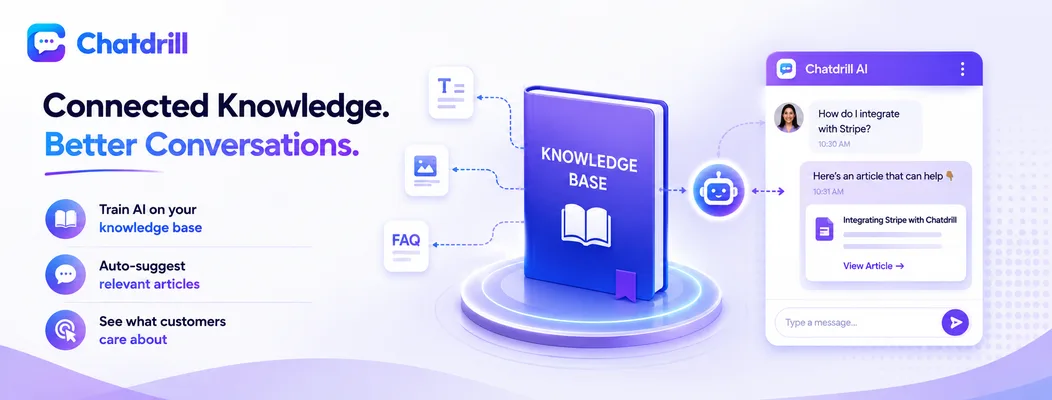
ChatDrill can train directly on your existing knowledge base content and surface relevant articles within conversations automatically, keeping both channels genuinely aligned.
Direct knowledge base training integration
ChatDrill supports training AI directly from your existing knowledge base content, rather than requiring a separately maintained training set, keeping chat answers automatically aligned with your official documentation.
This integration significantly reduces the ongoing maintenance burden compared to managing two genuinely separate content sources.
Automatic relevant article suggestions
When a conversation touches a topic with a genuinely relevant, more detailed knowledge base article available, ChatDrill can surface that article directly within the chat, giving customers an easy path to deeper information.
This automatic surfacing happens without requiring a human agent to manually search for and share the right link each time, extending the efficiency benefit across every relevant conversation.
Tracking which surfaced articles actually get clicked also reveals which knowledge base content genuinely resonates with customers in the moment, a useful signal for prioritizing future content updates.
Structuring Knowledge Base Content for AI Training
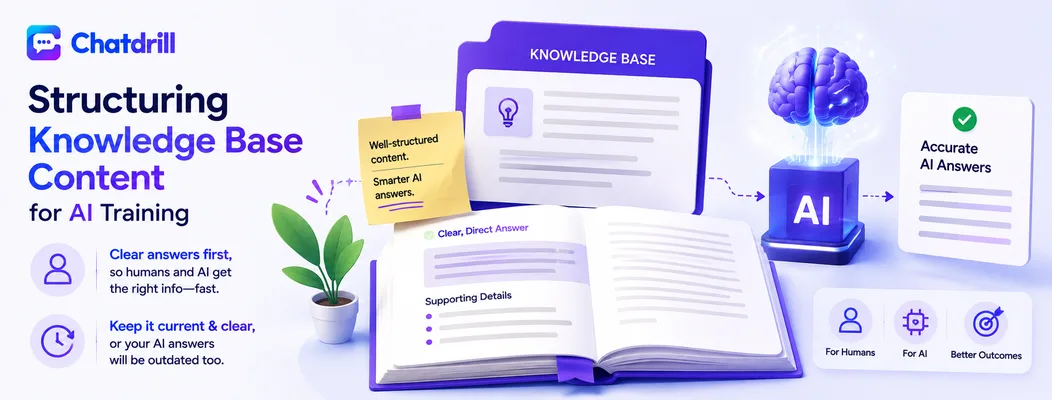
Knowledge base articles written for a human reader browsing at their own pace don't always translate directly into ideal AI training material without some deliberate structural consideration.
Writing with both audiences in mind
Structuring articles with a clear, direct answer near the top, followed by supporting detail, serves both a human skimming the page and an AI drawing a concise answer from the same content.
This dual-audience writing style is worth adopting as a standing practice for new knowledge base content, rather than only for articles specifically written with AI training in mind.
Keeping content current and unambiguous
An article containing outdated information or ambiguous, conditional guidance produces an equally outdated or ambiguous AI answer, since the AI can only reflect what the source content actually says.
Regular content audits, checking specifically for currency and clarity, protect both the human-facing knowledge base and the AI-generated answers drawing from it.
Handling Content That Chat Shouldn't Surface Directly
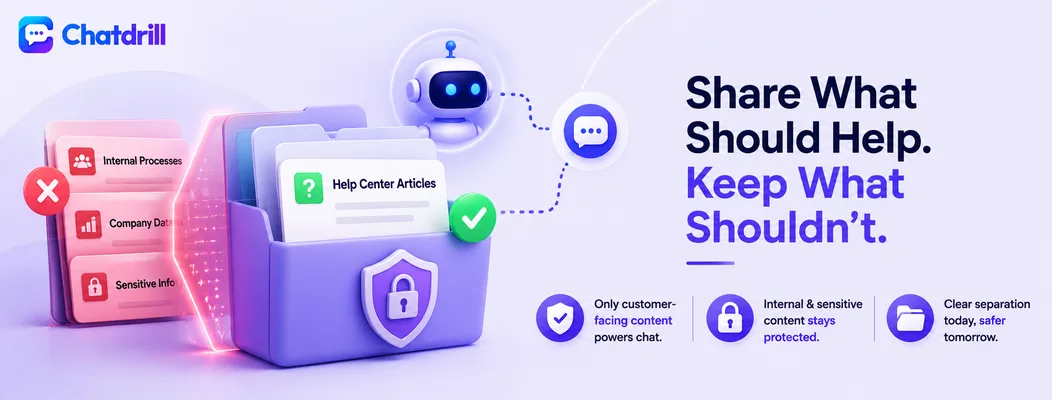
Not every knowledge base article is appropriate for direct chat surfacing, some internal or sensitive content needs explicit exclusion from what AI can reference in a customer-facing conversation.
Identifying content that needs exclusion
Internal process documentation, anything containing sensitive business details, or content written for internal staff rather than customers should be explicitly excluded from what chat AI can draw from or reference.
Reviewing your knowledge base structure specifically for this distinction before connecting it to chat training avoids an accidental exposure of content never meant for a customer-facing conversation.
Maintaining this separation as content grows
As new knowledge base content gets added over time, maintaining a clear, consistent process for tagging or organizing what's customer-facing versus internal keeps this separation reliable rather than something that quietly erodes as the content library grows.
This is worth building into your content creation workflow from the start, rather than trying to audit and separate everything retroactively once the library has grown large.