
An SLA set based on what sounds impressive rather than what your team can genuinely, consistently deliver tends to become a source of constant, demoralizing failure rather than a meaningful commitment that guides real behavior.
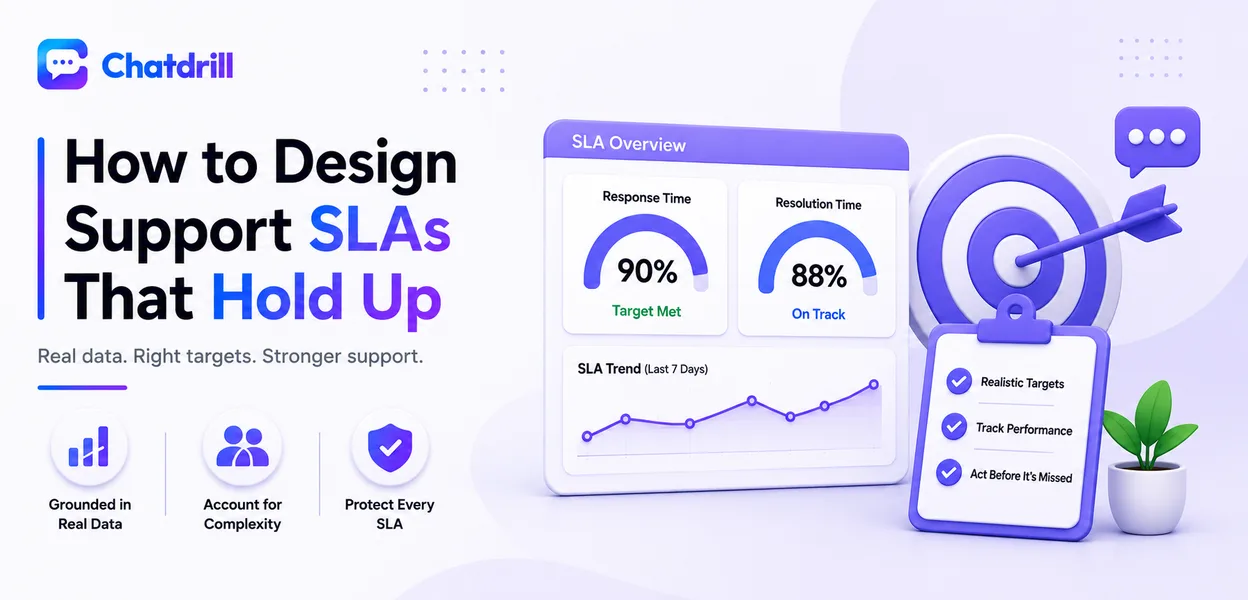
A support SLA that actually holds up over time reflects honest performance data, accounts for genuine complexity variation across conversation types, and includes a real mechanism for catching and addressing an at-risk target before it's missed.
Getting this right protects both the customer relationship, since a broken promise damages trust more than a modest but consistently honored one, and the support team's own morale and credibility.
This guide covers how to set SLA targets that genuinely hold up, structuring them by conversation type, common mistakes, and how ChatDrill helps track and protect SLA performance.
Quick answer: A support SLA holds up when its targets are grounded in genuine, achievable performance data rather than aspiration, when it accounts for realistic variation by conversation complexity, and when it includes a clear escalation path for when a target is at risk of being missed.
Setting Targets Grounded in Real Data
A genuinely sustainable SLA starts from your actual historical performance data, not an aspirational number chosen because it sounds competitive.
Starting from actual historical performance
Reviewing your real, current response and resolution time data, rather than an assumed or aspirational figure, reveals what your team can genuinely, consistently deliver today.
Setting a target slightly above current performance, as a genuine stretch goal, works better than setting one dramatically beyond what your current operation can realistically sustain.
Building in reasonable variance
A target expressed as a hard, absolute promise, every single conversation resolved within X minutes, tends to be more fragile than one expressed as a percentage, for example 90% of conversations meeting the target time.
This percentage-based framing acknowledges genuine, reasonable variation while still holding the team to a meaningful, trackable standard overall.
Structuring SLAs by Conversation Type
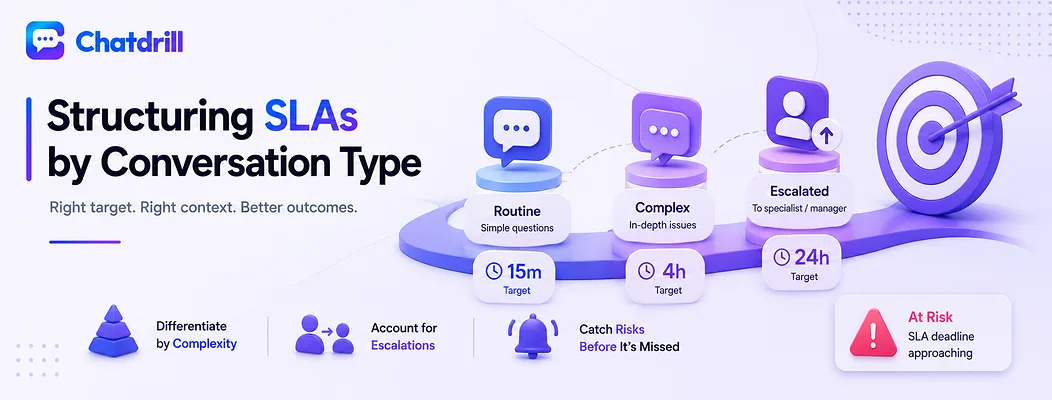
A single SLA applied uniformly across genuinely different conversation types tends to be either too loose for simple questions or too aggressive for complex ones.
Differentiating by complexity tier
Setting a faster target for routine, well-understood questions and a more generous one for genuinely complex issues respects that these categories have fundamentally different realistic resolution timelines.
This tiered approach produces SLAs that are both more accurate and more motivating, since each target genuinely reflects what's achievable for its specific category.
Accounting for escalated conversations separately
A conversation that escalates to a specialist or manager reasonably warrants a different SLA clock than one resolved directly by the first agent, since the escalation itself represents added, legitimate complexity.
Building this distinction into your SLA structure avoids penalizing appropriate escalation with an SLA target that doesn't account for its added complexity.
Common Mistakes in SLA Design
The most common mistakes are setting an aspirational target disconnected from real data, applying one blanket SLA regardless of conversation complexity, and having no mechanism to catch an at-risk target before it's missed.
Setting an aspirational, disconnected target
Choosing an SLA number because it sounds competitive, without grounding it in genuine current performance data, sets the team up for chronic, demoralizing failure against an unrealistic standard.
Starting from real data, even if the resulting number feels less impressive, produces an SLA the team can genuinely meet and build credibility around.
One blanket SLA for all complexity levels
Applying the same target to both routine and genuinely complex conversations either sets an unrealistic bar for complex issues or an unnecessarily loose one for simple questions.
Tiering SLA targets by conversation complexity produces a more accurate, more genuinely useful standard for each category.
No mechanism to catch at-risk targets
Only discovering an SLA breach after it's already happened, rather than flagging a conversation approaching its deadline while there's still time to act, misses the opportunity to prevent the miss entirely.
Building in a proactive alert for conversations nearing their SLA deadline lets a team intervene before a target is actually broken.
How ChatDrill Helps Track and Protect SLA Performance
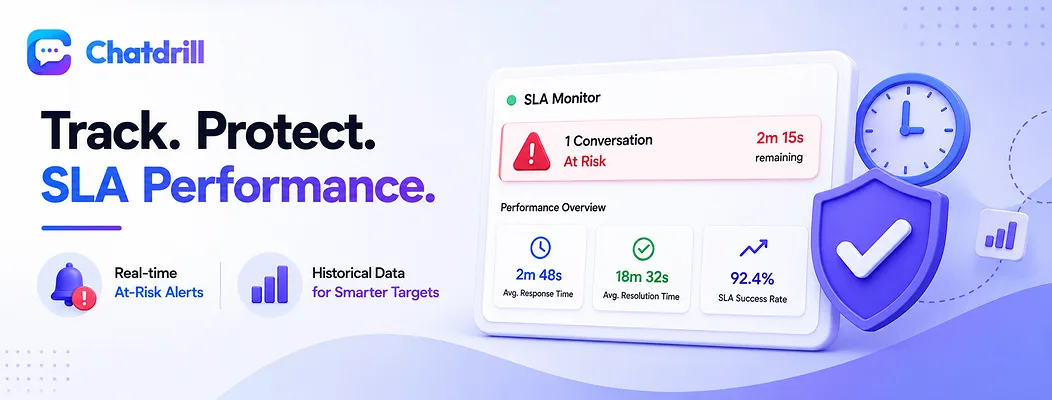
ChatDrill's real-time SLA tracking flags at-risk conversations before a deadline is missed, and its historical reporting gives you the genuine performance data needed to set realistic targets in the first place.
Real-time at-risk conversation flagging
ChatDrill can surface a conversation approaching its SLA deadline while there's still time for a team lead or another agent to intervene, turning SLA management from reactive reporting into proactive prevention.
This visibility is what actually protects SLA performance in practice, rather than only measuring compliance after the fact.
Historical data for setting realistic targets
Pulling your actual historical response and resolution time data directly from ChatDrill gives you the genuine baseline needed to set an SLA that reflects real, achievable performance rather than aspiration.
This same data, segmented by conversation type, supports the tiered SLA structure covered earlier, grounding each tier in your own actual performance for that category.
Reviewing this historical data over a full quarter, rather than a single unusually good or bad week, produces a more genuinely representative baseline to build targets from.
Communicating SLAs Internally and Externally
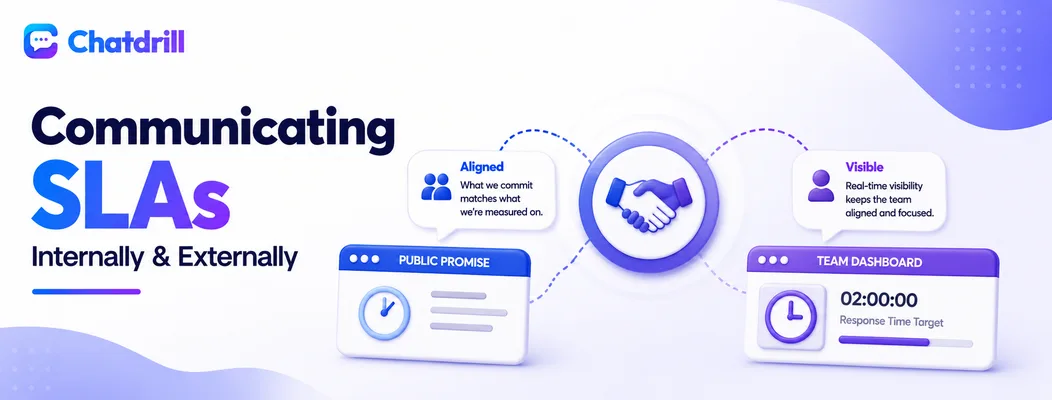
An SLA that lives only in an internal document, disconnected from what customers are told to expect, creates a genuine risk of mismatched expectations on both sides.
Aligning internal targets with external promises
Whatever response time commitment is communicated publicly to customers should match, or be more conservative than, the internal SLA target the team is actually held to, avoiding a gap where the team is measured against a stricter internal number than customers were ever promised.
This alignment prevents the confusing situation where a team technically meets its internal target while customers still feel like a promised timeframe was missed.
Making the SLA visible to the team itself
An SLA that agents can see in real time, not just something reported on after the fact by a manager, helps the target genuinely guide daily behavior rather than existing only as an abstract, occasionally referenced number.
This visibility also builds a shared sense of ownership over hitting the target, rather than treating SLA performance as purely a management concern.
Revisiting SLAs as Your Team and Volume Change
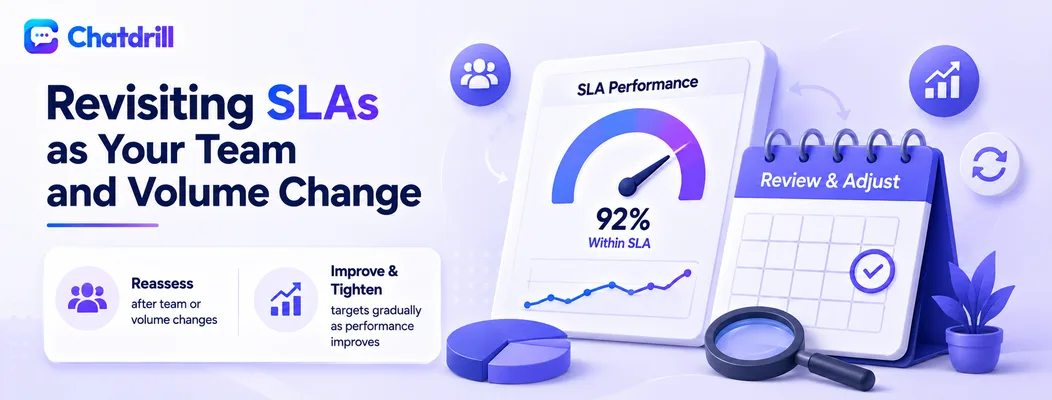
An SLA that was genuinely realistic a year ago may no longer fit as team size, volume, or AI deflection has changed, making periodic reassessment a necessary companion to initial design.
Reassessing after significant team or volume changes
A meaningful change in headcount, conversation volume, or AI deflection rate is a natural trigger point to revisit whether current SLA targets still reflect genuinely achievable performance.
Waiting for a scheduled annual review alone, rather than reacting to these specific triggers, risks running with an outdated SLA for longer than necessary.
Tightening targets gradually as performance improves
As genuine performance improves, through better AI training or team growth, gradually tightening the SLA target keeps it functioning as a meaningful stretch goal rather than becoming an artificially easy bar the team consistently exceeds without effort.
This gradual tightening should still be grounded in real data, the same principle underlying the original target-setting approach, rather than an arbitrary reduction.