
Cost per conversation is one of the clearest, most comparable metrics for understanding your support operation's genuine efficiency, yet many teams either don't calculate it at all or calculate it in a way that blends AI and human costs into one misleading average.
The real value of this metric comes from calculating it separately for AI-resolved and human-resolved conversations, revealing the genuine cost gap that justifies continued AI investment and informs where further efficiency gains are actually available.
Getting the calculation right also means being honest about what counts as a true cost, not just the obvious platform fee, but the fully loaded cost of the people and systems actually handling conversations.
This guide covers the core formula, how to calculate it separately by resolution type, common mistakes, and how ChatDrill supports this calculation.
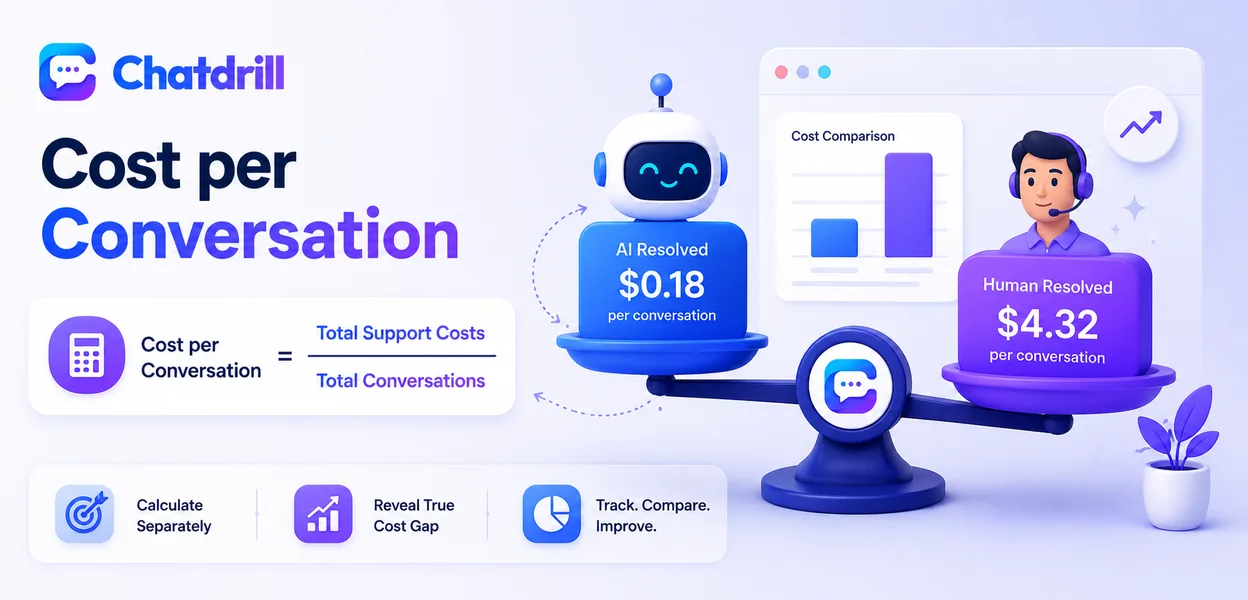
Quick answer: Cost per conversation equals your total support costs (agent salaries, overhead, platform fees) for a given period divided by total conversations handled in that same period, calculated separately for AI-resolved and human-resolved conversations to reveal the genuine cost difference between the two.
The Core Cost per Conversation Formula
The formula divides total support costs for a period by total conversations handled in that same period, producing a straightforward average cost figure.
The formula itself
Cost per conversation equals total support costs for a given period divided by total conversations handled in that same period, a simple structure that becomes genuinely useful once the inputs are calculated honestly.
This straightforward formula is what makes the metric so comparable, both over time within your own operation and, cautiously, against industry benchmarks.
What counts as a true total cost
Total cost should include agent salaries, relevant overhead, and platform or tooling fees, not just the most obvious line item like a chat platform subscription alone.
A fully loaded cost figure, even if harder to calculate precisely, produces a genuinely more accurate and useful metric than one based only on the most visible cost component.
Calculating Separately for AI and Human Resolution
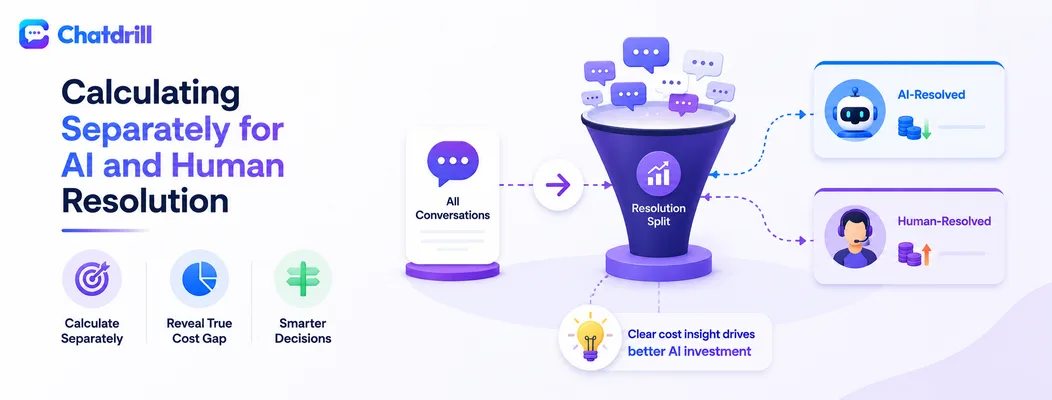
Splitting the calculation between AI-resolved and human-resolved conversations reveals the genuine cost gap between the two, which a single blended average would obscure entirely.
AI-resolved conversation cost
For AI-resolved conversations, cost is largely the platform fee allocated proportionally, plus a share of ongoing training and maintenance time, typically producing a considerably lower per-conversation figure than human resolution.
This lower cost is exactly what justifies continued investment in expanding AI training coverage, making the specific number worth calculating and tracking explicitly.
Human-resolved conversation cost
For human-resolved conversations, cost includes the fully loaded agent time, salary, overhead, management, divided by the volume of conversations that specific agent or team actually handles.
This figure typically comes in meaningfully higher than AI-resolved cost, a gap worth quantifying explicitly rather than leaving as a general assumption.
Why the comparison matters for decision-making
Seeing the genuine cost gap between AI and human resolution in real numbers, rather than a general sense that "AI is cheaper," makes a considerably more persuasive case for continued or expanded AI training investment.
This comparison also helps prioritize where further AI training would deliver the most cost benefit, focusing on question categories that currently require expensive human resolution.
Common Mistakes in Calculating Cost per Conversation
The most common mistakes are blending AI and human costs into one misleading average, using only obvious costs while ignoring overhead, and calculating the metric once without tracking it over time.
Blending AI and human costs together
Calculating one average cost per conversation across all resolution types obscures the genuine, often dramatic cost difference between AI and human resolution, hiding exactly the insight this metric is most useful for revealing.
Splitting the calculation, even though it takes slightly more effort, produces a considerably more actionable and honest picture.
Ignoring overhead and management costs
Calculating human-resolved cost using only base agent salary, without overhead or management time, understates the genuine cost and can make human resolution look more competitive with AI than it actually is.
A fully loaded cost figure, even approximate, produces a more accurate and defensible comparison.
Calculating once without ongoing tracking
Computing cost per conversation as a one-time exercise, rather than tracking it consistently over time, misses the chance to see whether efficiency is genuinely improving as AI training matures.
Building this into a regular reporting cadence, alongside other core metrics, keeps the insight current and genuinely useful for ongoing decisions.
How ChatDrill Supports Cost per Conversation Tracking
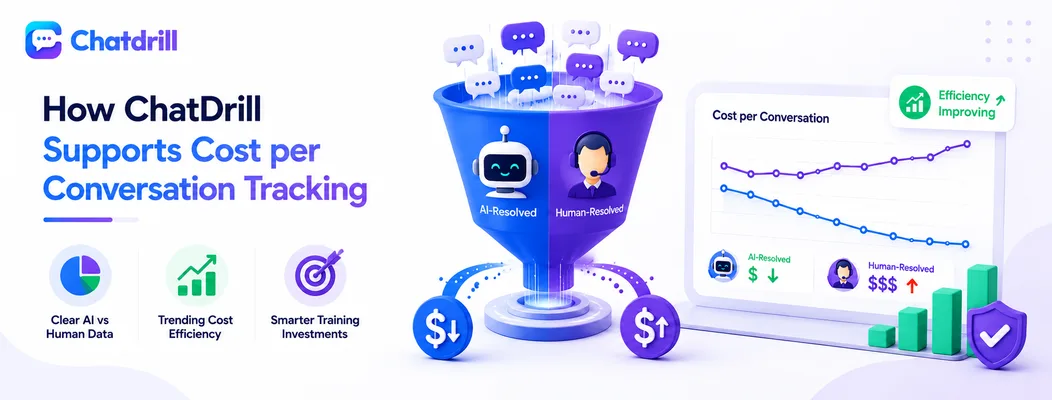
ChatDrill's built-in deflection tracking makes it straightforward to separate AI-resolved from human-resolved volume, the foundational split this calculation depends on.
Clear AI versus human resolution data
Because ChatDrill tracks which conversations AI resolves independently versus which require human involvement, you have the exact volume split needed to calculate cost per conversation separately for each category.
This clarity removes what would otherwise be a genuinely difficult manual tracking exercise, especially at meaningful conversation volume.
Trending cost efficiency as AI training matures
Reviewing this split over time reveals whether your AI-resolved cost advantage is genuinely growing as training content improves, providing concrete evidence for the value of continued training investment.
This trend data also helps identify which specific training investments produced the clearest efficiency gains, informing where to focus further effort.
Sharing this trend with finance or leadership in concrete dollar terms often makes a more persuasive case for continued AI investment than a general efficiency argument alone.
Using This Metric to Justify Further AI Investment
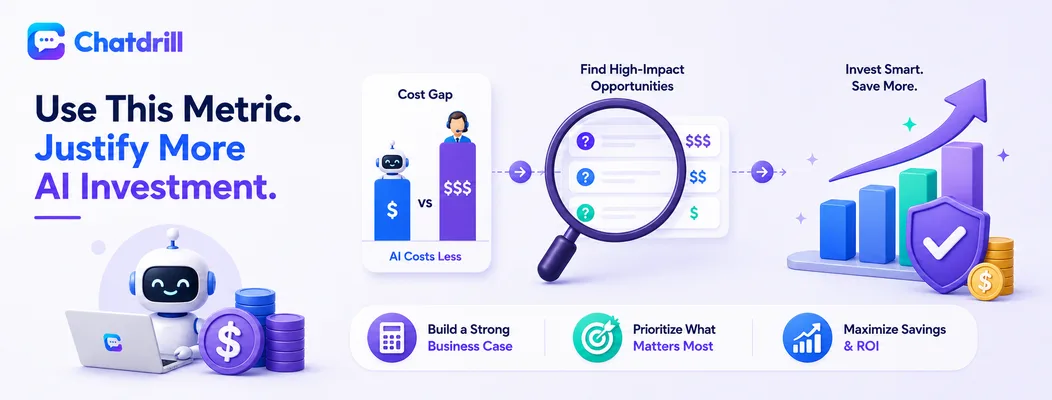
A concrete cost-per-conversation gap between AI and human resolution translates directly into a business case for expanding AI training coverage to additional question categories.
Building a business case from the cost gap
Multiplying the per-conversation cost difference by the volume of a specific question category still requiring human resolution produces a concrete, defensible estimate of the savings available from training AI on that category specifically.
This kind of specific, dollar-denominated case tends to be considerably more persuasive for securing further investment than a general statement that AI training would help.
Prioritizing training investment by potential savings
Ranking untrained or poorly trained question categories by their volume and current human-resolution cost reveals where the next training investment would deliver the largest genuine return.
This prioritization ensures limited training effort goes toward the categories with the most significant cost impact first, rather than being spread evenly regardless of actual potential savings.
Benchmarking Against Industry Data Cautiously
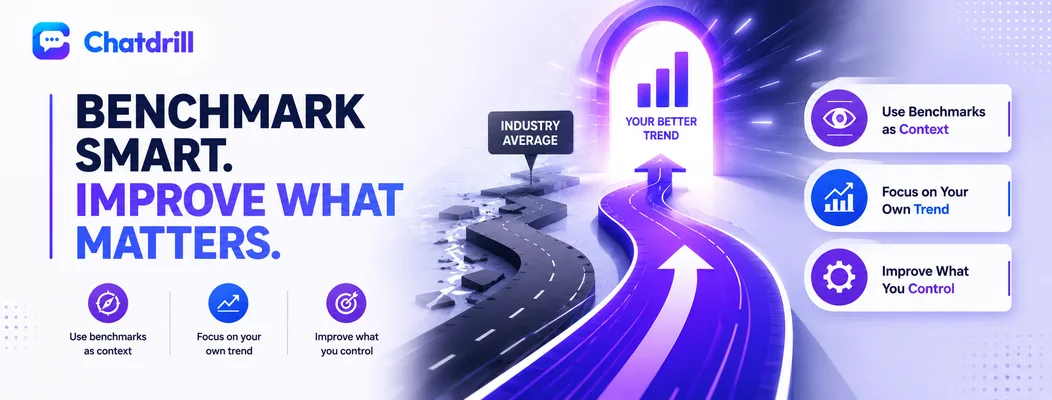
External cost-per-conversation benchmarks can offer useful context but should be treated cautiously given how much this figure genuinely varies by industry, geography, and conversation complexity.
Why external benchmarks need careful interpretation
A published industry average cost per conversation may reflect a genuinely different mix of conversation complexity, regional labor costs, or AI adoption maturity than your own specific situation.
Treating such a benchmark as a rough directional reference, rather than a precise target, avoids drawing an unfair or misleading comparison.
Prioritizing your own trend over external comparison
Your own cost-per-conversation trend over time, whether it's genuinely improving as you invest in AI training, is usually a more actionable signal than how you compare to an external, less directly comparable benchmark.
This internal focus keeps the metric oriented toward continuous improvement within your own specific context, rather than chasing an external number that may not fairly apply.