
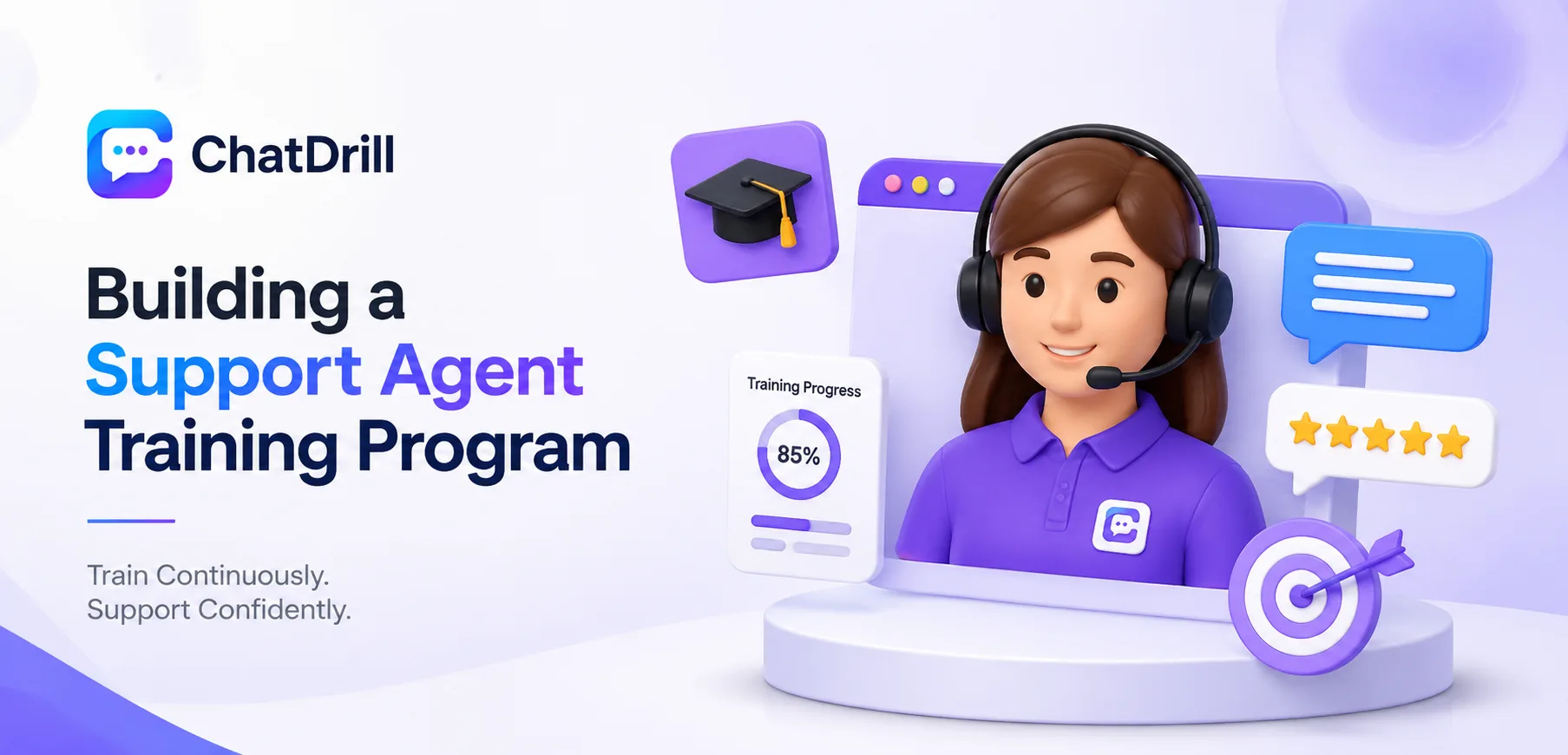
A training program built as a single onboarding event, rather than an ongoing system, tends to produce agents who plateau quickly, since the skills that matter most, judgment, tone, handling ambiguity, develop through sustained practice and feedback rather than a one-time course.
The support teams with genuinely strong, consistent performance tend to treat training as infrastructure, something maintained and revisited continuously, not a checkbox completed during a new hire's first week and then forgotten.
Getting this right also means balancing structure with real practice, a program heavy on documentation but light on supervised, real conversation experience tends to leave agents underprepared for the actual judgment calls their job requires.
This guide covers what a strong training program includes, how to structure it, common mistakes, and how ChatDrill supports ongoing training and coaching.
Quick answer: A strong support agent training program combines structured product and policy foundations, supervised practice with real conversations, and an ongoing coaching cadence after initial onboarding, rather than treating training as a one-time event that ends once an agent starts handling live conversations.
What a Strong Training Program Includes
A strong program combines structured foundational knowledge, supervised practice with real conversations, and an ongoing coaching cadence that continues well past initial onboarding.
Structured foundational knowledge
Product details, company policies, and common customer scenarios need to be taught systematically, not picked up incidentally through overheard conversations or scattered documentation.
This foundation should be tested for genuine comprehension, not just attendance, before an agent moves to handling real customer conversations.
Supervised practice with real conversations
Structured shadowing followed by supervised, real conversation handling builds the practical judgment that no amount of documentation alone can substitute for.
This practice period should progress gradually, from simple, low-stakes conversations to more complex ones, rather than throwing a new agent into the full range of conversation types immediately.
An ongoing coaching cadence
Training doesn't end once an agent reaches independence, regular coaching based on real conversation review keeps skills sharp and catches drift before it becomes a habitual pattern.
This ongoing cadence, even if less intensive than initial onboarding, is what actually distinguishes a genuinely mature training program from one that only handles the first few weeks well.
Structuring the Program Across Time
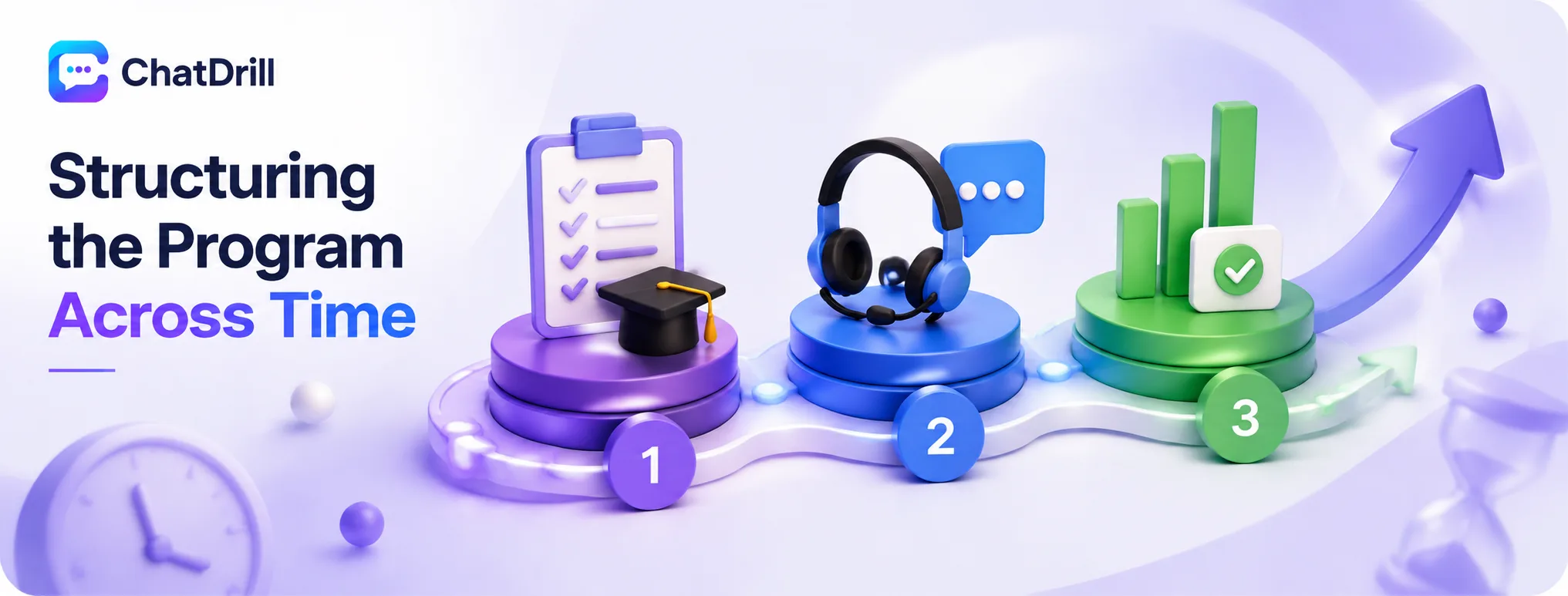
A well-structured program moves from intensive initial training through progressively more independent practice, then settles into a sustainable ongoing coaching rhythm.
The initial intensive period
The first two to four weeks typically carry the heaviest structure, foundational knowledge, close supervision, and frequent feedback, building the base everything else depends on.
This period benefits from a deliberate, staged approach, rather than assuming a fixed timeline works identically for every new agent regardless of their individual pace.
The transition to independence
As an agent demonstrates competence with increasingly complex conversation types, supervision frequency should decrease correspondingly, rather than dropping off abruptly at an arbitrary date.
This transition should be based on demonstrated readiness, not simply calendar time, since agents genuinely progress at different rates.
The ongoing maintenance phase
Once an agent reaches full independence, training shifts to periodic coaching, refresher content when policies change, and continued QA-based feedback rather than active supervision.
This maintenance phase is easy to under-invest in relative to initial onboarding, even though it's what sustains performance over an agent's entire tenure.
Common Mistakes in Support Training Programs
The most common mistakes are treating training as a one-time event, relying too heavily on documentation without real practice, and applying a fixed timeline regardless of individual readiness.
Treating training as a one-time event
A program that ends the moment an agent completes onboarding misses how much genuine skill development happens through sustained practice and feedback over time.
Building an ongoing coaching cadence into the program from the start, rather than as an afterthought, prevents this common gap.
Over-relying on documentation
A training program consisting mostly of reading material, with limited supervised practice, tends to leave agents underprepared for the actual judgment calls their job requires.
Balancing documentation with genuine, supervised real-conversation practice produces more capable agents than either approach alone.
Applying a rigid, fixed timeline
Pushing every agent to full independence on exactly the same schedule regardless of individual pace can set someone up to struggle if they genuinely need more support time.
Using a general timeline as a guide while remaining flexible about individual readiness produces better outcomes than rigid adherence to a fixed calendar.
How ChatDrill Supports Ongoing Training
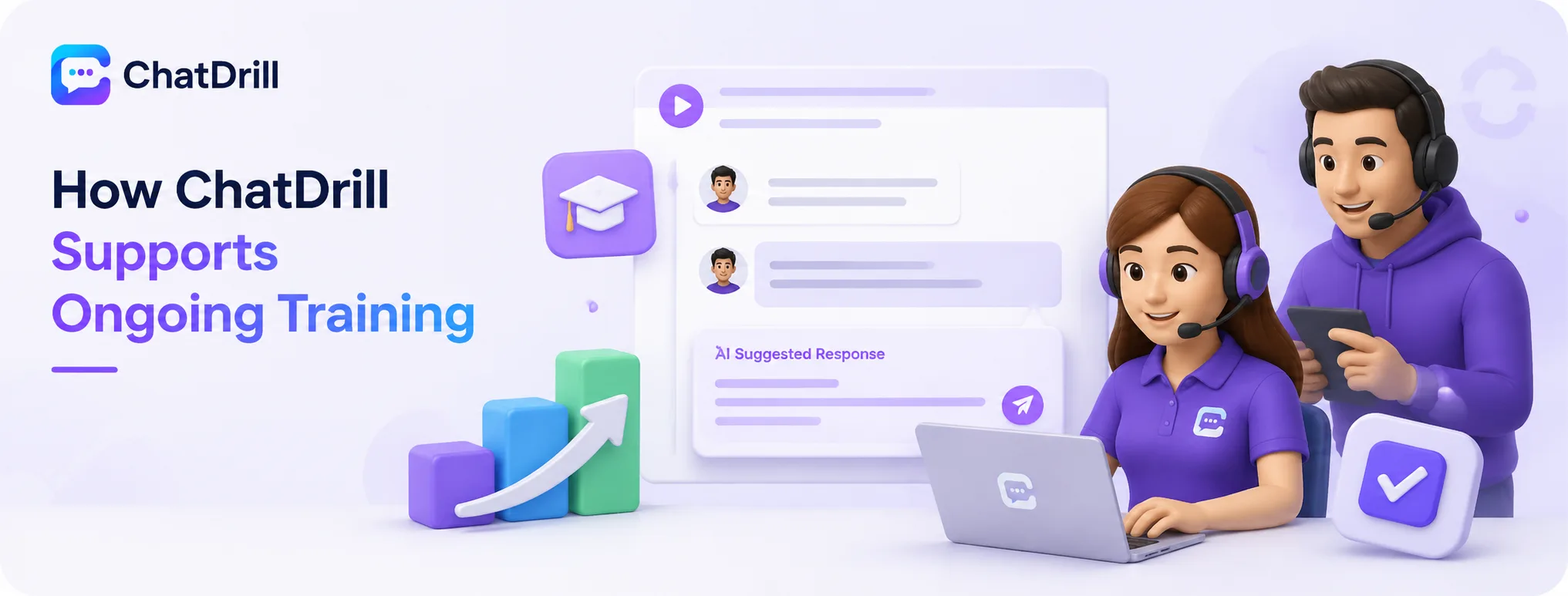
ChatDrill's transcript review and AI-suggested responses give both new agents and coaches concrete material to work from, turning training feedback into a specific, evidence-based process rather than a general reminder.
Real conversation transcripts for coaching material
Reviewing an agent's actual conversations directly within ChatDrill gives a coach specific, concrete examples to reference during feedback, rather than relying on general impressions or memory.
This concrete approach, pointing to an actual exchange, tends to produce more genuine, lasting improvement than an abstract reminder about general best practices.
AI-suggested responses as a learning aid during ramp-up
During the supervised practice phase, ChatDrill's AI-suggested reply feature gives a new agent a starting point they can adapt, reducing pressure while their own product knowledge is still developing.
As an agent gains confidence, naturally relying on these suggestions less, this becomes a visible, trackable signal of genuine skill progression for a coach to reference.
This gradual weaning off suggested replies also gives a coach an objective, data-backed way to judge readiness for the next stage, rather than relying purely on subjective impression.
Measuring Whether Training Is Actually Working
A training program should be judged by real downstream outcomes, time to independence, early QA scores, and retention, not just whether the curriculum was completed.
Time to independence as a leading indicator
Tracking how long it genuinely takes each new cohort of agents to reach full independence reveals whether the program is accelerating or, over time, quietly slowing down as the product and policies grow more complex.
A lengthening time-to-independence trend, even if gradual, is worth investigating directly, since it often signals that training content hasn't kept pace with a growing product surface area.
Comparing this metric across cohorts trained under slightly different program versions also reveals which specific changes genuinely accelerated ramp-up and which didn't move the needle.
Early QA scores as a quality signal
Reviewing a new agent's QA scores during their first month against the team's overall baseline shows whether training is producing genuinely competent agents or just fast ones.
A new agent reaching independence quickly but scoring consistently below baseline suggests the program may be prioritizing speed over the depth needed for genuinely reliable performance.
Retention as a longer-term signal
Tracking whether agents who went through a particular training cohort stay with the team longer than average offers a longer-term, if slower-arriving, signal about whether the program is setting people up for genuine, sustained success.
This retention data is worth reviewing periodically alongside the more immediate metrics, since a program that produces fast but ultimately unsustainable competence may show up here even when earlier metrics looked fine.
Adapting the Program as Your Product Evolves
A training program built once and never revisited gradually falls out of step with a growing product, making a regular review and update cycle a genuine necessity, not an optional refinement.
Scheduling a regular content review
Setting a recurring cadence, quarterly is common, to review whether training materials still reflect the current product, policies, and common question patterns keeps the program from quietly becoming outdated.
This review is worth treating as seriously as any other recurring operational task, since outdated training content directly undermines every other investment made in the program.
Incorporating feedback from recent graduates
Asking agents who just went through the program what felt genuinely useful and what felt like a gap, while the experience is still fresh, surfaces practical improvement ideas a program designer working from the outside might miss.
This feedback loop, built into the end of each cohort's onboarding, keeps the program continuously refined based on real, current experience rather than assumption.