
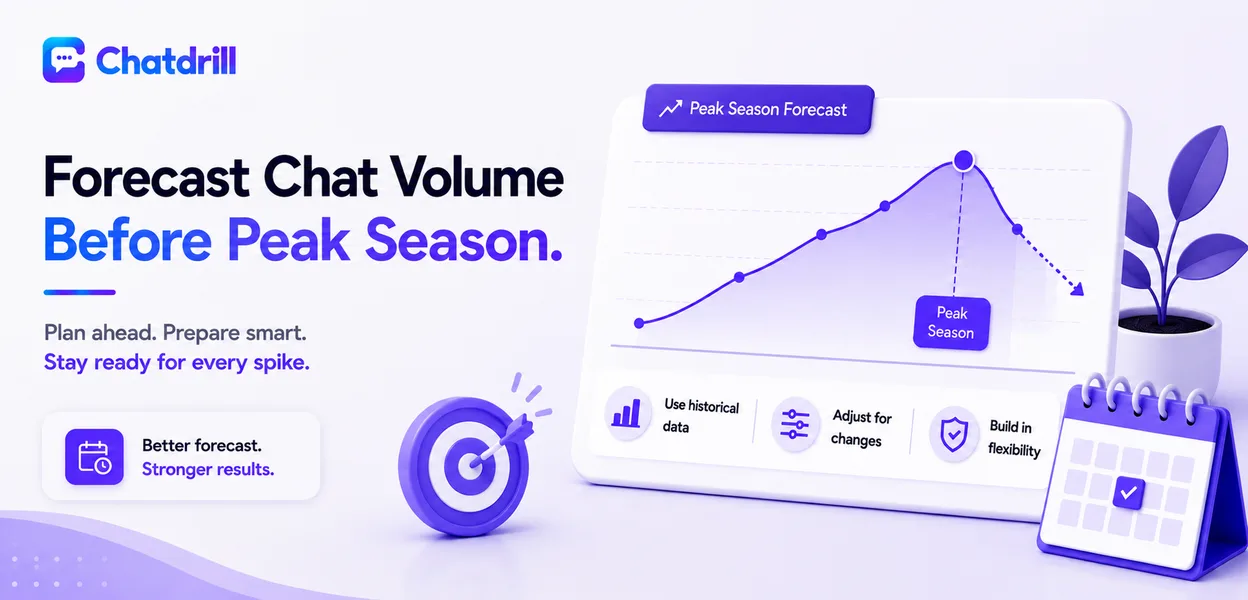
A business caught unprepared for a genuine peak season volume spike faces a difficult choice in the moment, either let response times and quality suffer, or scramble to add capacity too late to train it properly.
Forecasting well before peak season arrives turns this from a crisis response into a planned, deliberate staffing and AI-training decision made with enough lead time to actually execute well.
Getting the forecast reasonably accurate matters, but building in genuine flexibility matters just as much, since even a well-researched forecast is an estimate, not a guarantee, of what actual peak volume will look like.
This guide covers how to build a genuine forecast, adjusting for known changes, common mistakes, and how ChatDrill supports peak-season readiness.
Quick answer: Forecasting chat volume before peak season starts with reviewing your own historical peak-period data, adjusting for known changes like new products or marketing campaigns, and building in a buffer for genuine uncertainty, since even a good forecast benefits from planned flexibility rather than a single fixed number.
Building a Forecast From Historical Data
A genuine forecast starts with your own actual historical peak-period volume, not an assumed multiple of average daily volume.
Reviewing your actual past peak periods
Pulling real volume data from your previous peak seasons, rather than assuming a generic multiplier over average daily volume, grounds your forecast in genuine, business-specific historical pattern.
This review should look specifically at the shape of the spike, how quickly it ramped up and down, not just the peak number itself, since staffing and AI readiness need to account for the full pattern.
Accounting for year-over-year growth
If your overall business has grown since the last comparable peak period, adjusting your historical baseline upward to reflect this growth avoids underestimating the coming peak based on outdated volume levels.
This adjustment should reflect your actual growth trajectory specifically, rather than an assumed universal growth rate that might not match your particular situation.
Adjusting for Known Changes
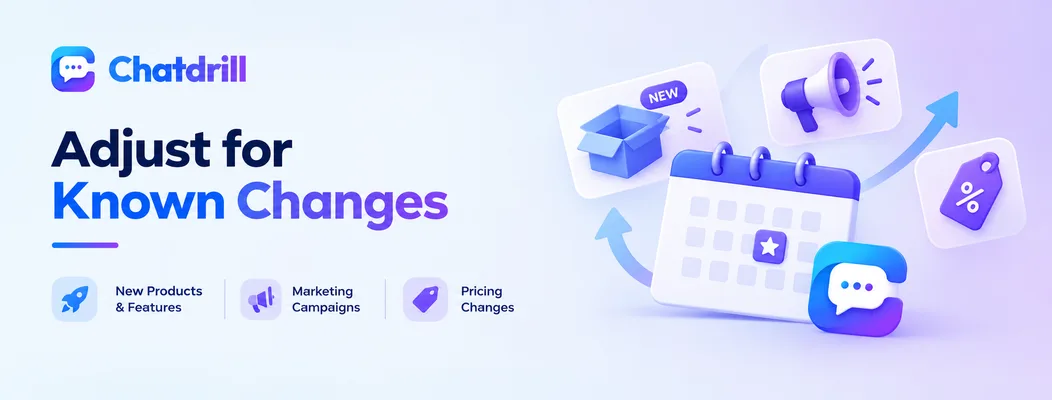
A genuine forecast should account for specific, known changes, new product launches, planned marketing campaigns, pricing changes, that could shift volume beyond what pure historical pattern would suggest.
New products or features driving new question types
A new product launch happening before or during peak season likely introduces genuinely new question categories your historical data wouldn't capture, worth planning for explicitly.
This means ensuring AI training and staff briefing cover these new topics specifically, not just relying on historical question patterns that predate the launch.
Planned marketing campaigns and promotions
A significant planned promotion or marketing push during peak season can meaningfully amplify volume beyond a typical historical pattern, worth factoring into your forecast directly.
Coordinating with marketing on the timing and expected scale of major campaigns gives your forecast genuine, specific input beyond historical data alone.
Building in Genuine Flexibility
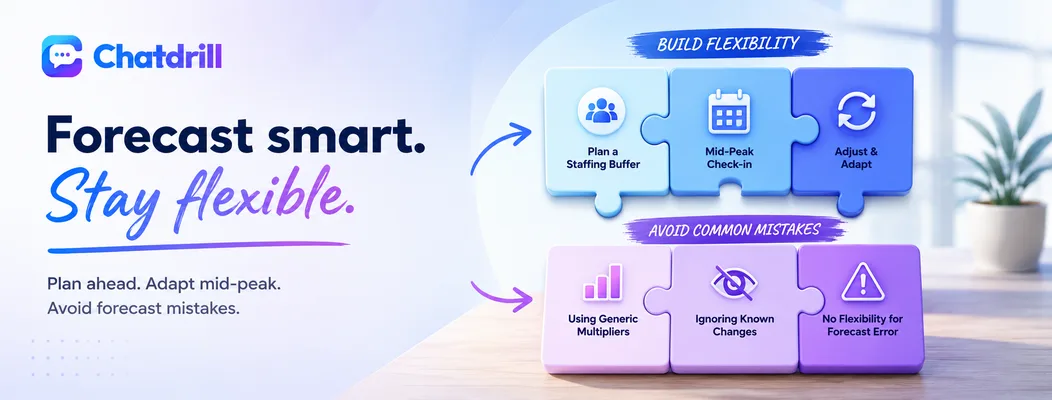
Even a well-researched forecast benefits from planned flexibility, since actual peak volume will likely differ somewhat from any single predicted number.
Planning a staffing buffer
Building in some flexible capacity, whether through on-call staff, flexible AI coverage, or a temporary staffing plan, protects against a forecast that turns out to be somewhat conservative relative to actual demand.
This buffer is worth planning explicitly rather than hoping the initial forecast happens to be exactly right.
Setting a mid-peak check-in point
Reviewing actual volume against the forecast partway through the peak period, rather than only after it ends, gives you a chance to adjust staffing or AI coverage while there's still time to act.
This check-in discipline turns forecasting into an ongoing, adaptive process rather than a single upfront prediction left unexamined until after the fact.
Common Mistakes in Peak Season Forecasting
The most common mistakes are using a generic volume multiplier instead of real historical data, ignoring known upcoming changes, and having no flexibility built in when the actual peak differs from the forecast.
Using a generic multiplier instead of real data
Assuming peak volume will simply be some generic multiple of average daily volume, rather than reviewing your own actual historical peak pattern, risks a forecast disconnected from your genuine business reality.
Grounding the forecast in your own real historical data produces a more reliable, business-specific estimate.
Ignoring known upcoming changes
Building a forecast purely from historical pattern, while ignoring a known upcoming product launch or major campaign, misses genuine, predictable volume drivers specific to this particular peak season.
Incorporating known changes explicitly, not just historical extrapolation, produces a more accurate forecast for the specific period ahead.
No flexibility for forecast error
Treating the forecast as a precise, guaranteed number, with no staffing buffer or mid-peak adjustment plan, leaves no room to respond if actual volume differs meaningfully from the prediction.
Building in genuine flexibility, both in staffing and in willingness to adjust mid-peak, protects against the inevitable imprecision of any forecast.
How ChatDrill Supports Peak Season Readiness
ChatDrill's historical reporting gives you the real data needed for an accurate forecast, and its AI can absorb a meaningful share of peak volume automatically, reducing how much additional human staffing you need to plan for.
Historical volume data for accurate forecasting
Pulling your actual past peak-period volume and pattern directly from ChatDrill's reporting gives you the genuine historical foundation this forecasting approach depends on.
This data, reviewed alongside known upcoming changes, produces a forecast grounded in your real business rather than generic assumption.
AI absorbing a share of the peak surge automatically
Because ChatDrill's AI scales without requiring additional hiring or training time, it can absorb a meaningful share of peak-period volume spikes without the lead time human staffing would require.
This capability meaningfully reduces the staffing buffer you need to plan for separately, since AI capacity naturally scales with volume rather than requiring advance headcount planning.
Reviewing deflection rate specifically during your last peak period, compared to normal periods, shows whether AI held up well under genuine peak pressure or whether training gaps emerged only at that higher volume.
Learning From Each Peak Season Afterward
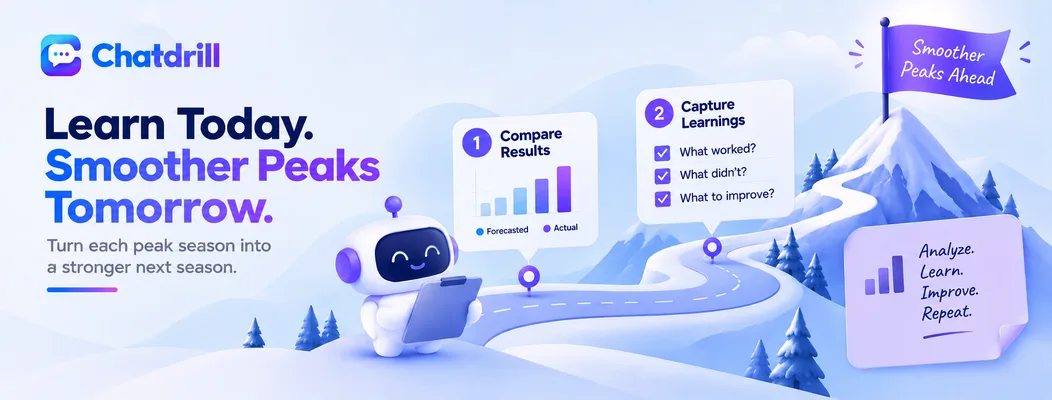
A brief, deliberate post-peak review comparing actual volume against the forecast turns each season into a genuine input for improving the next one's accuracy.
Comparing actual results against the forecast
Reviewing where the forecast was accurate and where it missed, and by how much, builds a genuine track record that makes next year's forecast more reliable than starting from scratch each time.
This comparison is worth documenting explicitly, not just discussed informally, since specific written notes are more useful to a future planning process than general recollection.
Capturing what worked operationally
Beyond the volume number itself, noting which specific staffing or AI-readiness decisions worked well and which created friction gives the next planning cycle concrete operational lessons, not just a better volume estimate.
This operational learning often matters as much as the numerical forecast accuracy for making the next peak season genuinely smoother.
Communicating the Forecast Across Teams

A forecast that stays solely within the support team misses the chance to coordinate with other departments whose own plans, marketing pushes, product launches, directly affect the volume the forecast is trying to predict.
Sharing the forecast with marketing and product
Giving marketing and product visibility into your peak-season readiness plan invites them to flag any campaign or launch timing that could meaningfully shift the forecast beyond what historical data alone would suggest.
This two-way communication turns forecasting into a genuinely collaborative process rather than an isolated support-team exercise disconnected from what's actually planned elsewhere in the business.
Setting expectations with leadership early
Sharing the forecast and associated readiness plan with leadership well before peak season arrives, rather than only if something goes wrong, builds understanding and support for any staffing or budget decisions the forecast implies.
This early communication also means leadership isn't hearing about a coverage gap for the first time during the actual peak, when there's little time left to help address it.