
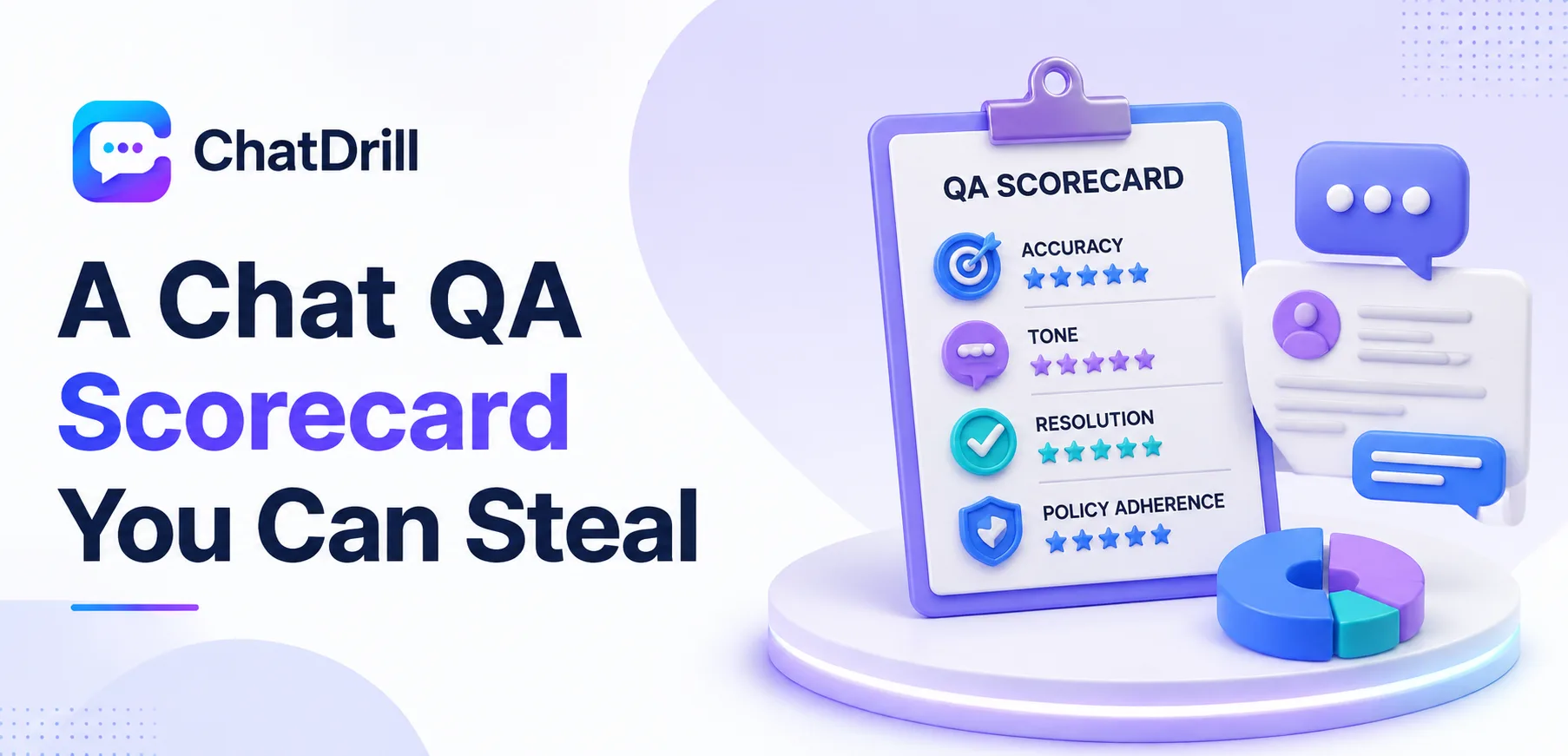
A QA scorecard is only as useful as its categories are specific and its scoring is consistent, a vague scorecard asking reviewers to rate "overall quality" produces inconsistent, hard-to-act-on results compared to one with clearly defined, specific criteria.
This scorecard covers the four categories that matter most for chat conversations specifically, accuracy, tone, resolution, and policy adherence, each with concrete scoring criteria you can use directly or adapt to your own context.
Beyond the scorecard itself, how you calibrate and apply it matters just as much, a technically sound scorecard used inconsistently across reviewers still produces unreliable, hard-to-trust data.
This guide provides the scorecard structure and criteria, along with guidance on calibration and turning scores into genuine coaching value.
Quick answer: A strong chat QA scorecard scores conversations across accuracy, tone, resolution, and policy adherence on a consistent scale, weighted toward the categories that most affect customer outcomes, and should be calibrated regularly against real conversation review to stay meaningful.
The Four Core Scoring Categories
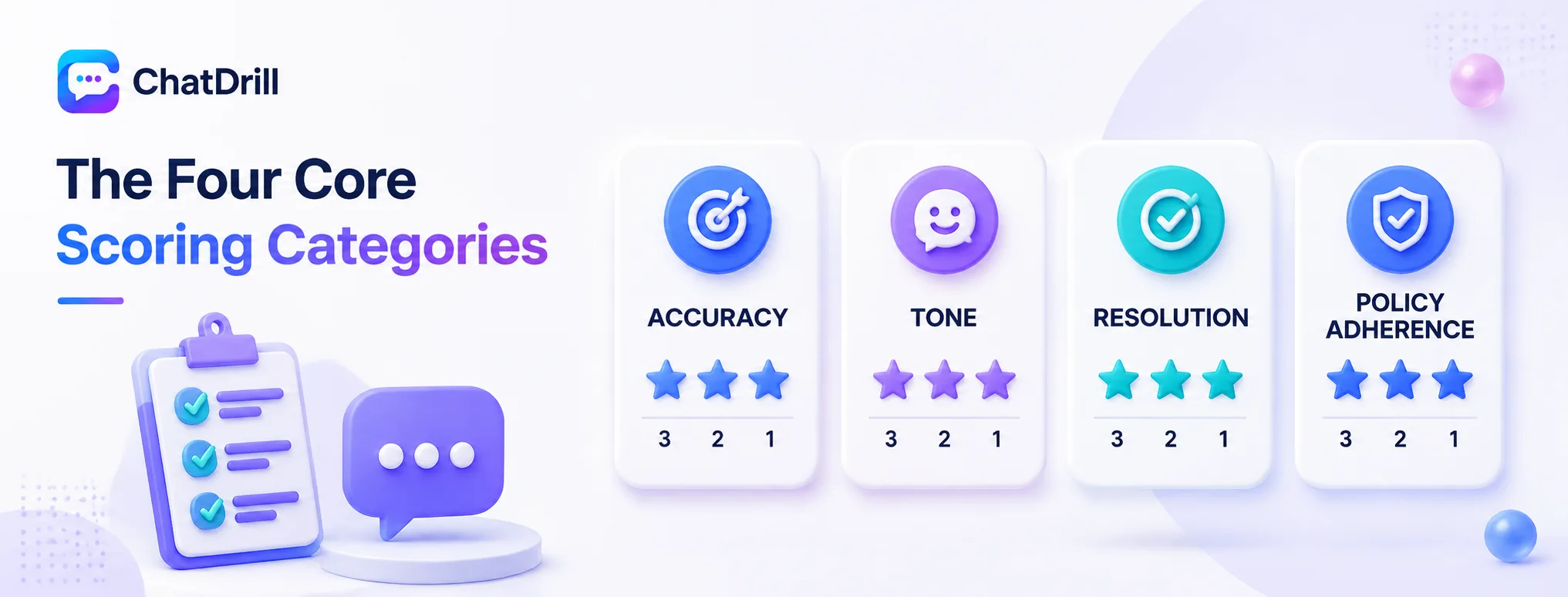
The scorecard covers accuracy, tone, resolution, and policy adherence, each scored on a consistent scale with specific, observable criteria rather than vague, subjective impressions.
Accuracy scoring criteria
Score 3 (excellent): information provided was completely accurate and specific to the customer's actual situation, with no corrections needed.
Score 2 (acceptable): information was generally accurate with a minor, non-critical imprecision that didn't affect the outcome.
Score 1 (needs improvement): information contained a meaningful inaccuracy that could have misled the customer or required correction.
Tone scoring criteria
Score 3 (excellent): tone was genuinely warm, appropriately matched to the situation's emotional context, and felt authentic rather than scripted.
Score 2 (acceptable): tone was professional and appropriate but somewhat generic or impersonal.
Score 1 (needs improvement): tone was mismatched to the situation, either too casual for a serious issue or too cold for a frustrated customer.
Resolution scoring criteria
Score 3 (excellent): the customer's actual underlying need was fully resolved within this conversation, with no follow-up contact needed.
Score 2 (acceptable): the immediate question was answered, though some ambiguity remained about whether the underlying need was fully addressed.
Score 1 (needs improvement): the conversation ended without genuinely resolving the customer's actual need, likely requiring a follow-up contact.
Policy adherence scoring criteria
Score 3 (excellent): all applicable policies, including any required disclosures or escalation triggers, were followed correctly.
Score 2 (acceptable): policies were generally followed with a minor, low-risk deviation.
Score 1 (needs improvement): a policy violation occurred that could create genuine risk or inconsistency.
Weighting the Scorecard for Your Context
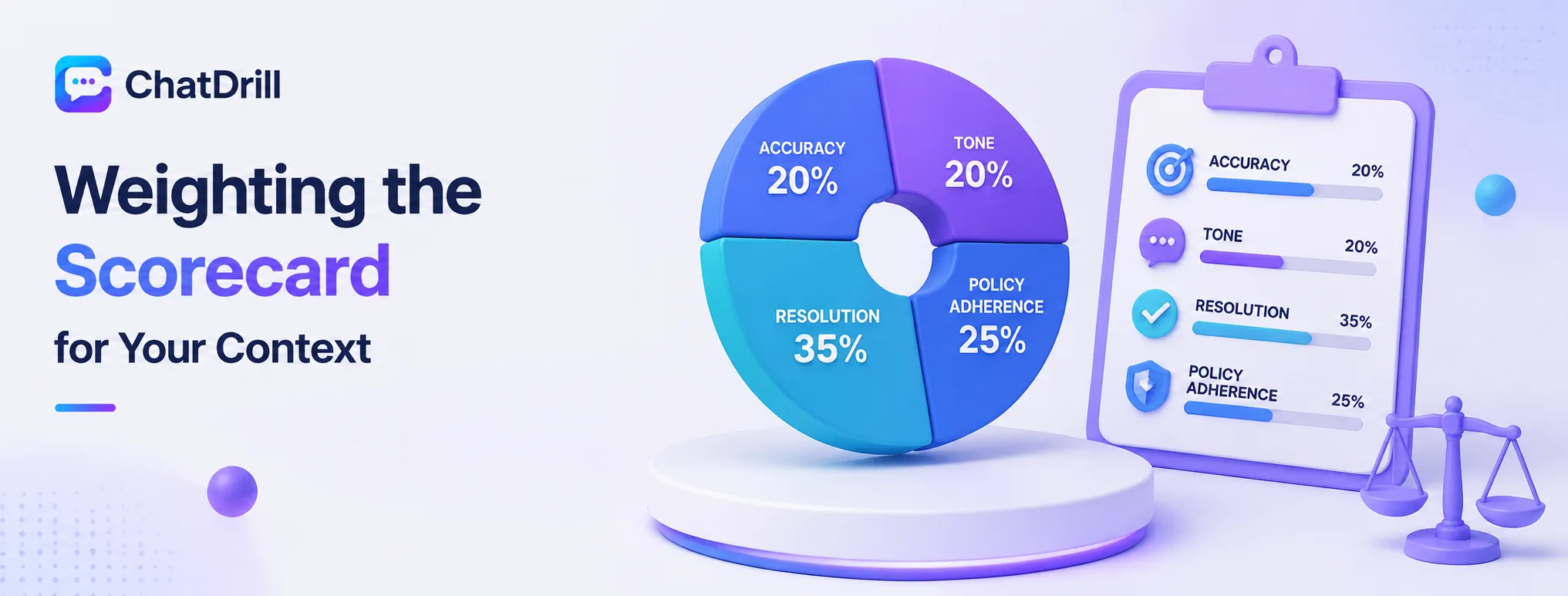
Weighting should reflect what most affects your specific customer outcomes, a regulated industry might weight policy adherence more heavily, while a support-heavy business might weight resolution most.
Adjusting weights to your business context
A business in a regulated industry might weight policy adherence at 40% given the genuine compliance stakes, while a general ecommerce support team might weight resolution and tone more heavily instead.
This customization ensures the scorecard reflects what genuinely matters most for your specific customer outcomes, rather than a generic, one-size-fits-all weighting.
Avoiding an overly complex weighting scheme
A scorecard with too many finely tuned weighting variables becomes difficult to apply consistently across reviewers, undermining the reliability the scoring is meant to provide.
Keeping weighting relatively simple, even if slightly less precise, tends to produce more consistent, genuinely usable results in practice.
Calibrating the Scorecard Across Reviewers
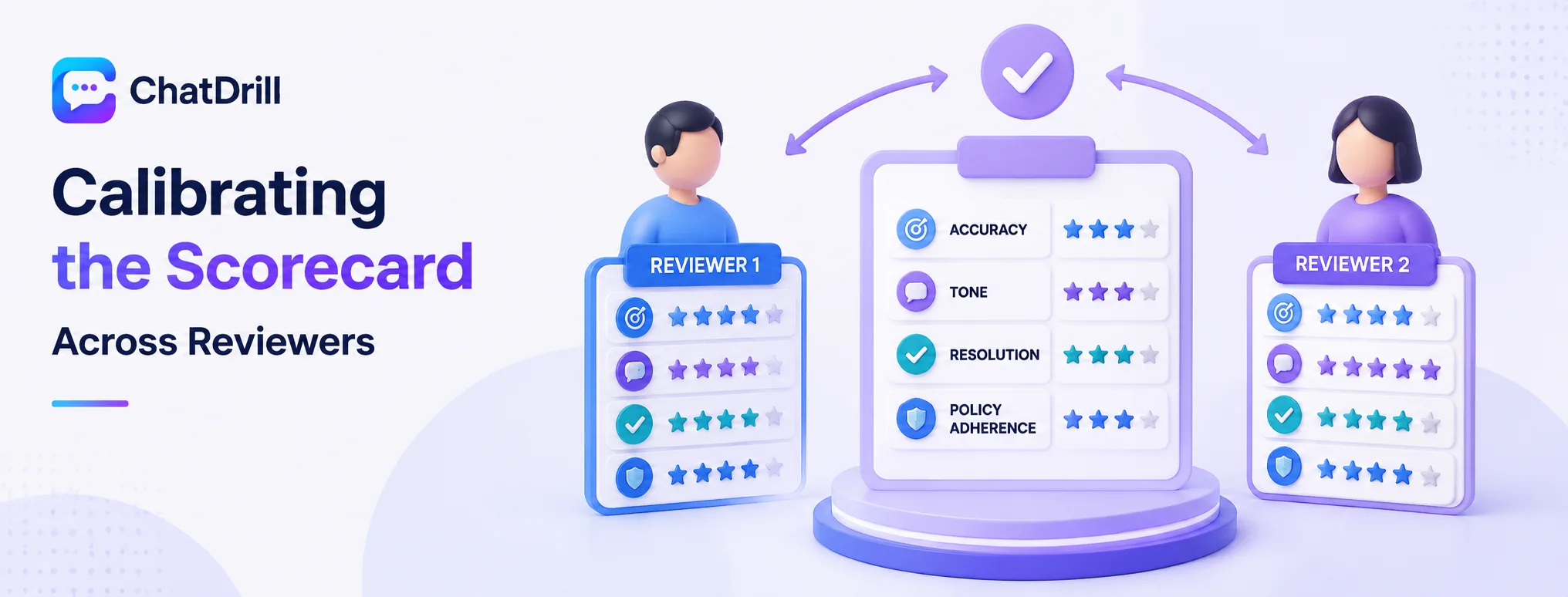
Calibration means having multiple reviewers score the same sample conversations and comparing results, adjusting criteria definitions until scores converge reasonably consistently.
Running a calibration session
Having two or more reviewers independently score the same set of sample conversations, then comparing and discussing any significant differences, reveals where criteria definitions need more clarity.
This calibration process should happen before broader rollout and periodically afterward, since scoring drift can occur even among experienced reviewers over time.
Refining criteria based on calibration gaps
Where calibration reveals genuine disagreement between reviewers, refining the specific criteria language to be more concrete and observable reduces future inconsistency.
This refinement process is worth treating as ongoing rather than a one-time setup task, given how scoring interpretation can shift over time.
Turning Scores Into Genuine Coaching Value
Scores deliver real value only when they translate into specific, constructive coaching conversations rather than being filed away as a number with no follow-up action.
Connecting scores to specific coaching
Using a low score in a specific category as the direct basis for a targeted coaching conversation, rather than a generic overall performance review, makes the feedback genuinely actionable.
This specificity helps an agent understand exactly what to improve, rather than receiving vague, hard-to-act-on general feedback.
Tracking trends over time, not just individual scores
Reviewing how an individual agent's or the team's scores trend over multiple reviews, rather than reacting to any single score in isolation, reveals genuine patterns worth addressing.
This trend view also helps distinguish a genuine, ongoing issue from a single unusual conversation that doesn't reflect typical performance.
How ChatDrill Supports QA Scoring and Coaching
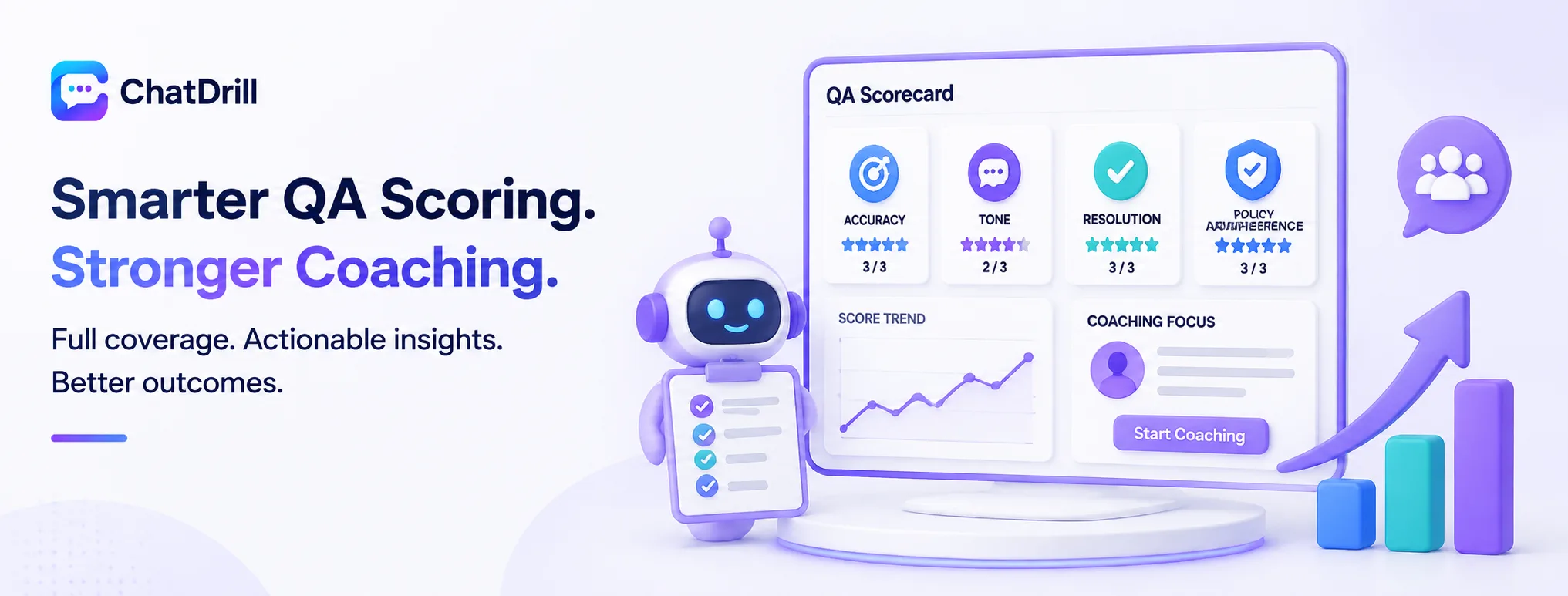
ChatDrill's AI-scored conversation review can apply a scorecard like this one across every conversation automatically, giving you the full-coverage QA data that manual, sample-based review can't practically deliver.
Applying scoring criteria at full conversation coverage
Rather than a human reviewer manually scoring a small sample each month, ChatDrill's AI can apply defined scoring criteria across every conversation, surfacing patterns a limited manual sample would likely miss entirely.
This full-coverage approach doesn't replace human calibration, it makes the calibration process more valuable, since you're validating AI scoring against a genuinely representative view rather than a handful of hand-picked examples.
Configuring your own scorecard categories and weights directly within ChatDrill keeps the scoring aligned with what genuinely matters for your specific business context.
Connecting scores directly to coaching workflows
Because ChatDrill surfaces scoring trends by agent and by category, a team lead can go straight from a low trend in a specific area to a targeted coaching conversation without manually compiling the underlying data first.
This direct connection between scoring and coaching shortens the feedback loop considerably compared to a manual QA process reviewed only periodically.