
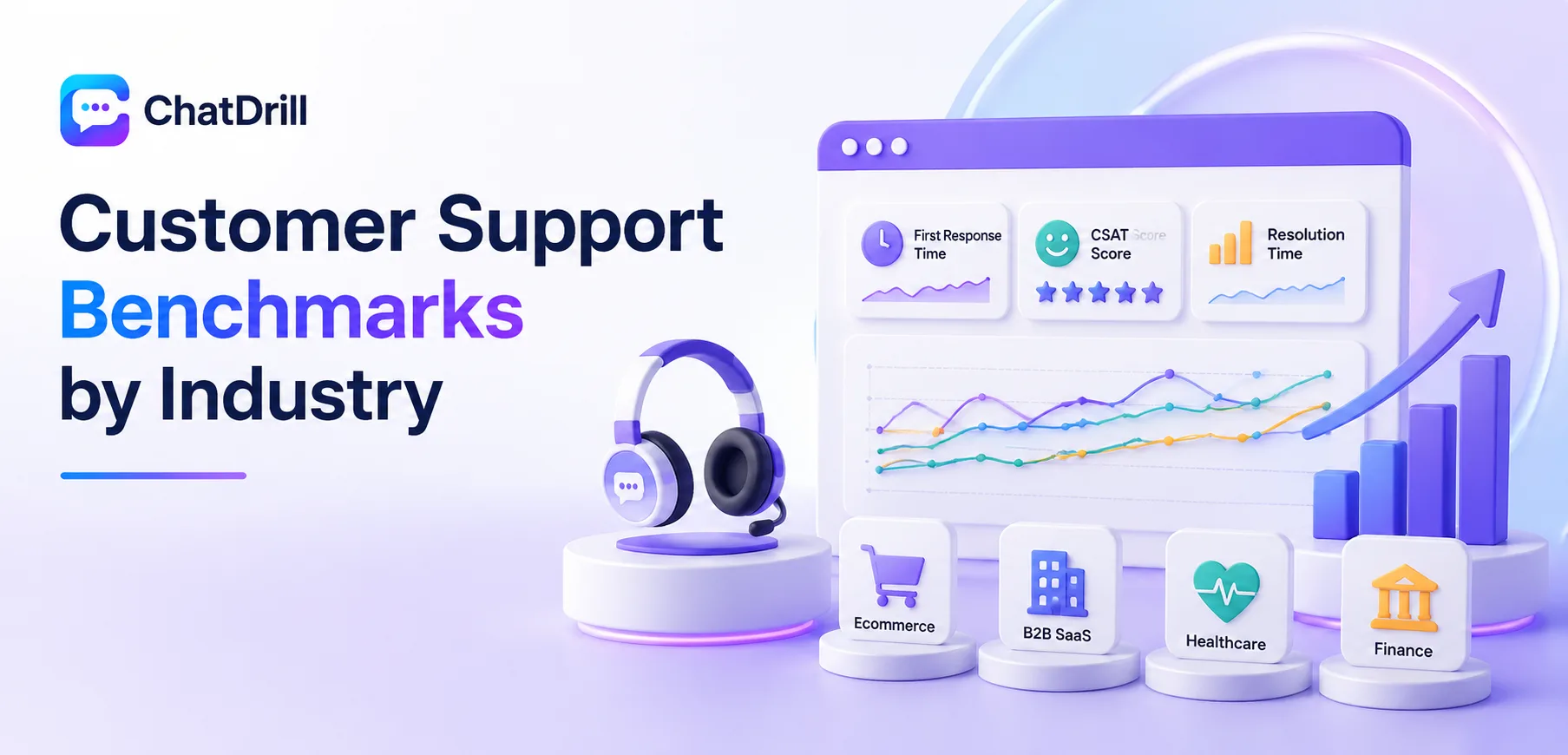
Comparing your support metrics against a single, generic industry average can be genuinely misleading, since what counts as a strong first response time or CSAT score varies meaningfully depending on your specific industry's typical complexity and customer expectations.
A benchmark pulled from ecommerce, where questions are often quick and transactional, simply doesn't apply the same way to a B2B software company handling technical, multi-step support conversations.
Understanding these industry-specific differences helps you set realistic internal goals and correctly interpret whether your own numbers reflect genuine performance issues or simply the natural complexity of your specific business.
This guide covers benchmark ranges across major industries, what drives the differences between them, and how to apply these numbers to your own support operation responsibly.
Quick answer: Customer support benchmarks vary meaningfully by industry, ecommerce and SaaS typically target first response times under two minutes and CSAT above 90%, while more complex B2B or regulated industries often run longer resolution times but still aim for CSAT in the mid-to-high 80s, making industry context essential before judging your own numbers.
Why Benchmarks Vary So Much by Industry
Support benchmarks differ by industry primarily because of typical question complexity, customer expectations shaped by the purchase itself, and how much of the support volume can reasonably be automated.
Question complexity as the core driver
An ecommerce order-status question and a B2B software integration issue require fundamentally different amounts of time and expertise to resolve, directly shaping realistic response and resolution benchmarks for each.
This complexity difference explains much of the benchmark variation across industries more than any difference in team quality or effort.
Recognizing this upfront prevents an unfair comparison between industries with genuinely different underlying support challenges.
Customer expectations shaped by the purchase
A customer buying a low-cost, quick ecommerce item typically expects near-instant resolution, while a customer navigating a complex enterprise software purchase often accepts a longer, more thorough support process as reasonable.
These expectation differences, formed well before the support interaction even begins, meaningfully shape what counts as satisfactory performance in each context.
Benchmark Ranges by Major Industry
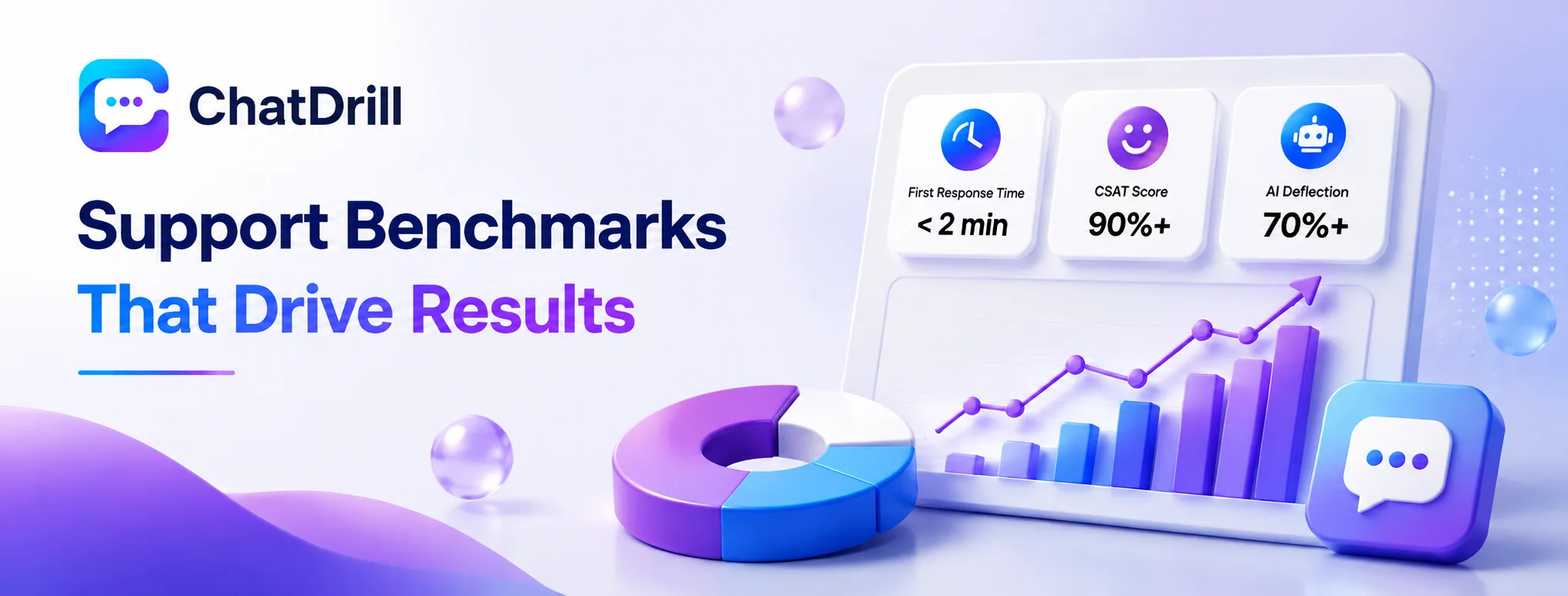
Ecommerce and SaaS tend to target the fastest response times and highest CSAT, while healthcare, financial services, and complex B2B typically run longer resolution times with somewhat lower but still strong CSAT expectations.
Ecommerce and D2C benchmarks
Ecommerce businesses typically target a first response time under two minutes and a CSAT score above 90%, reflecting the generally quick, transactional nature of most order and product questions.
Resolution time in this industry is often measured in minutes rather than hours, given how much of the volume, order status, simple returns, is genuinely straightforward to resolve.
AI deflection rates also tend to run higher here than in more complex industries, since so much volume falls into repetitive, well-defined categories.
SaaS and technology benchmarks
SaaS companies commonly target a first response time under five minutes with CSAT in the high 80s to low 90s, balancing speed against the genuinely more technical nature of many support conversations.
Resolution time varies more widely here, a simple account question resolves quickly while a genuine technical issue can reasonably take hours or longer.
Trial-stage support response time specifically tends to be held to a tighter standard than general support, given its direct connection to conversion.
Healthcare, financial services, and regulated industries
These industries often run longer resolution times, sometimes by design given compliance and verification requirements, with CSAT commonly targeted in the mid-to-high 80s rather than the 90s common in ecommerce.
First response time benchmarks here still emphasize speed for routine questions, while accepting that anything touching genuine complexity or compliance will reasonably take longer.
Comparing these industries directly against ecommerce benchmarks without adjusting for this complexity difference produces an unfair, misleading comparison.
How to Apply These Benchmarks Responsibly
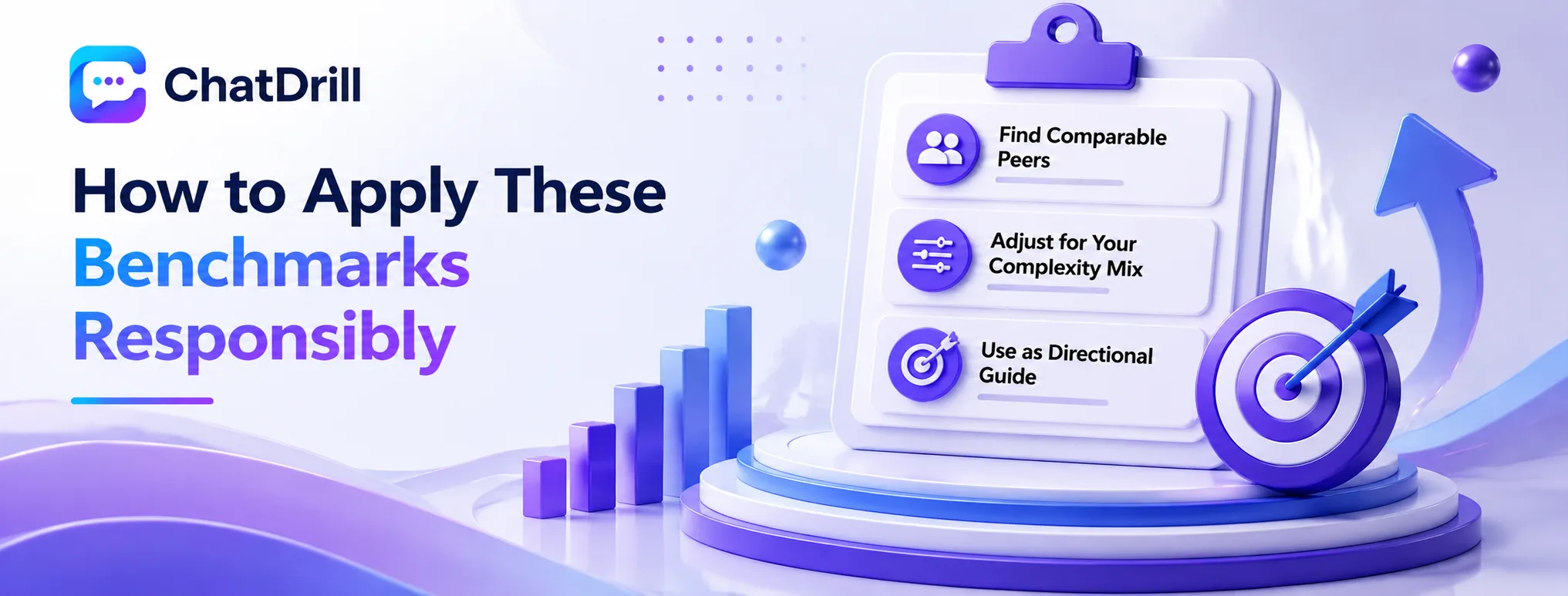
Applying benchmarks well means comparing against your genuine industry peers, adjusting for your specific complexity mix, and treating benchmarks as a directional guide rather than a rigid target.
Finding genuinely comparable peers
Comparing your numbers against a broad, generic "customer support" benchmark rather than one specific to your actual industry and business model risks drawing the wrong conclusions about your performance.
Seeking out benchmark data specific to your sub-industry, not just a broad category, produces a more genuinely useful comparison.
Adjusting for your specific complexity mix
Even within an industry, a business with a higher share of genuinely complex support cases should expect somewhat different numbers than a competitor with a simpler typical support volume.
Understanding your own volume's complexity distribution helps you interpret whether a given benchmark gap reflects genuine underperformance or a legitimately different support mix.
Treating benchmarks as directional, not absolute
A benchmark is most useful as a general sense of what's achievable and where you stand relative to it, not as an exact target that ignores your specific business context entirely.
Using benchmarks to identify genuinely worthwhile improvement areas, rather than chasing an exact number regardless of context, keeps this data actually useful.
Common Mistakes When Using Support Benchmarks
The most common mistakes are comparing against the wrong industry benchmark, chasing a number without considering your specific context, and ignoring benchmark data that doesn't fit oversimplified expectations.
Comparing against the wrong benchmark
Using a broad, generic customer support benchmark rather than one specific to your actual industry produces a comparison that doesn't genuinely reflect your realistic performance context.
Seeking out industry-specific data, even when it takes more effort to find, avoids this common and genuinely misleading mistake.
Chasing a number without context
Pursuing a benchmark CSAT or response time target without considering your own specific complexity mix can lead to superficial fixes that improve the metric without genuinely improving customer experience.
Understanding what's actually driving your current numbers matters more than the number itself when deciding where to focus improvement effort.
Dismissing benchmarks that don't fit expectations
Ignoring a benchmark that shows your numbers lagging, simply because it's uncomfortable, misses a genuine opportunity to identify and address a real performance gap.
Taking benchmark data seriously, even when it's not flattering, is what actually makes this exercise valuable for improvement.
How ChatDrill Helps You Track and Hit These Benchmarks
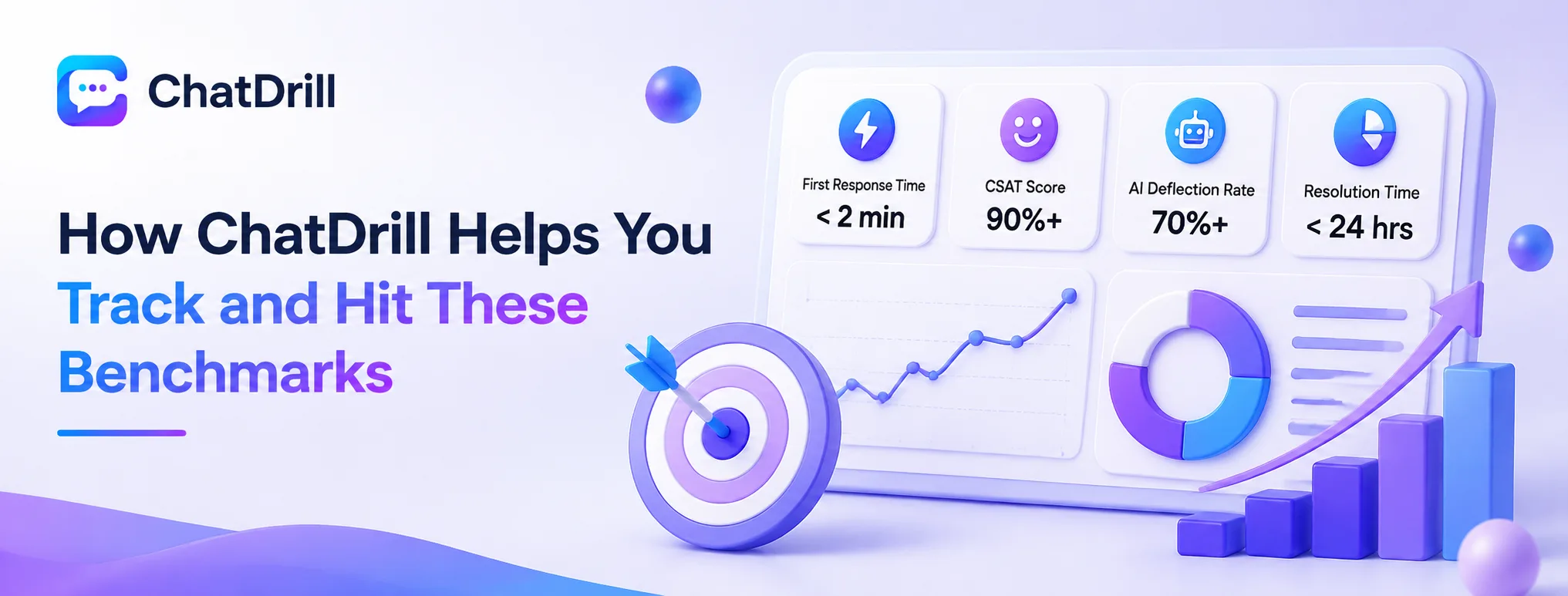
ChatDrill surfaces first response time, CSAT, and deflection data broken out in a way that makes industry-specific comparison practical, while its AI handles enough routine volume to meaningfully move these numbers toward benchmark ranges.
Built-in visibility into the metrics that matter
ChatDrill's reporting tracks first response time, resolution time, CSAT, and AI deflection rate as standard metrics, giving you the exact inputs needed to compare against industry benchmark ranges without cobbling data together manually.
Segmenting this data by conversation type, rather than only a single blended average, helps you see whether your numbers reflect genuine underperformance or simply a naturally more complex mix of questions.
This visibility removes much of the manual reporting work that would otherwise stand between you and a genuine, apples-to-apples benchmark comparison.
AI deflection that moves your numbers toward target
Training ChatDrill's AI on your specific, common questions lets a meaningful share of routine volume resolve instantly, directly improving your first response time and freeing agent capacity for the more complex conversations that genuinely need it.
For a business currently lagging its industry's typical benchmark range, this deflection often represents the most direct, measurable lever available, since it addresses response time without requiring additional headcount.
Reviewing which specific question categories ChatDrill resolves most reliably helps you identify where further training investment would close the remaining benchmark gap fastest.