

Concurrency, how many chat conversations a single agent handles simultaneously, is one of the most direct levers on both efficiency and quality, yet many teams set it based on an arbitrary round number rather than genuine analysis of their specific conversation mix.
Too low a concurrency setting leaves agent capacity underused, while too high a setting degrades response quality and speed across every conversation an overloaded agent is juggling at once.
The right number isn't universal, it depends heavily on your typical conversation complexity, how much AI is absorbing routine volume, and your own team's genuine capability.
This guide covers what determines the right concurrency level, how to find your own number, common mistakes, and how ChatDrill supports concurrency management.
Quick answer: Most support teams find 3 to 5 simultaneous conversations per agent to be a sustainable concurrency level for moderately complex chat, though the right number depends heavily on average handling time and conversation complexity, with simpler, more repetitive volume supporting higher concurrency and complex, technical conversations supporting less.
What Determines the Right Concurrency Level
The right concurrency level depends primarily on average conversation complexity, how much AI is deflecting routine volume, and your specific team's genuine capability to multitask effectively.
Conversation complexity as the primary driver
Simple, quick questions support meaningfully higher concurrency than genuinely complex, technical conversations requiring sustained focus and careful, accurate answers.
A business with a highly repetitive, simple question mix can often sustain higher concurrency than one where most conversations require genuine problem-solving.
AI deflection's effect on the remaining mix
When AI resolves routine questions automatically, the conversations reaching human agents concentrate more heavily in genuinely complex territory, which generally argues for a lower per-agent concurrency setting than raw volume alone would suggest.
This shift is worth reflecting explicitly in your concurrency setting rather than assuming a number set before meaningful AI deflection remains appropriate afterward.
Genuine team capability
Individual and team-level comfort with multitasking varies, and pushing concurrency above what your specific team can genuinely sustain degrades quality regardless of what a generic industry benchmark suggests.
Testing and adjusting based on your own team's actual performance at different concurrency levels produces a more reliable number than adopting someone else's default.
Finding Your Own Right Number
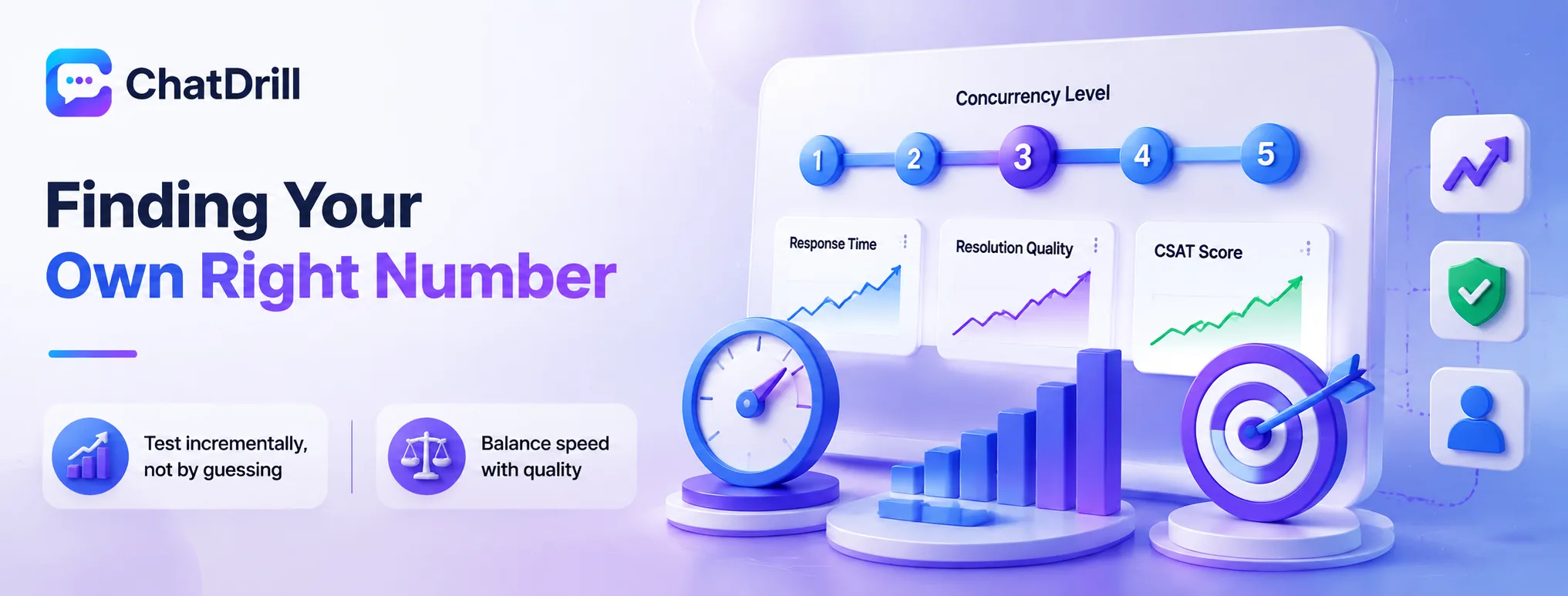
Finding your right concurrency level means testing different settings against real quality and speed metrics, rather than assuming a generic industry number applies to your specific situation.
Testing incrementally rather than guessing
Adjusting concurrency in small increments, then measuring the effect on response time, resolution quality, and agent-reported experience, reveals your genuine sustainable ceiling more reliably than an assumed default.
This incremental approach also makes it easier to identify the specific point where quality begins to degrade, rather than discovering it only after a significant overcorrection.
Weighing speed against quality tradeoffs
Higher concurrency can improve raw efficiency metrics while quietly degrading answer accuracy or the customer's actual experience, a tradeoff worth evaluating deliberately rather than optimizing for efficiency alone.
Tracking CSAT specifically at different concurrency levels helps ensure efficiency gains aren't coming at a genuine cost to the customer experience.
Common Mistakes in Setting Concurrency
The most common mistakes are adopting a generic industry number without testing it, setting concurrency uniformly regardless of conversation type, and never revisiting the setting as AI deflection improves.
Adopting a generic number without testing
Setting concurrency based on a number seen elsewhere, without validating it against your own team's genuine capability and conversation mix, risks either underusing capacity or degrading quality.
Testing directly against your own real data produces a more reliable, genuinely appropriate setting than borrowing a number from a different context.
Uniform concurrency regardless of conversation type
Applying the same concurrency limit to every agent regardless of what kind of conversations they typically handle misses the opportunity to set higher limits for simpler queues and lower limits for complex ones.
Differentiating concurrency by queue or conversation type, where your platform supports it, better matches the setting to actual complexity.
Never revisiting as AI deflection improves
Continuing to use a concurrency setting established before significant AI deflection was in place can leave agents overloaded, since the remaining human-handled volume has become more concentrated in complex conversations.
Revisiting this setting periodically, alongside your broader AI training progress, keeps it aligned with genuine current conditions.
How ChatDrill Helps Manage Concurrency
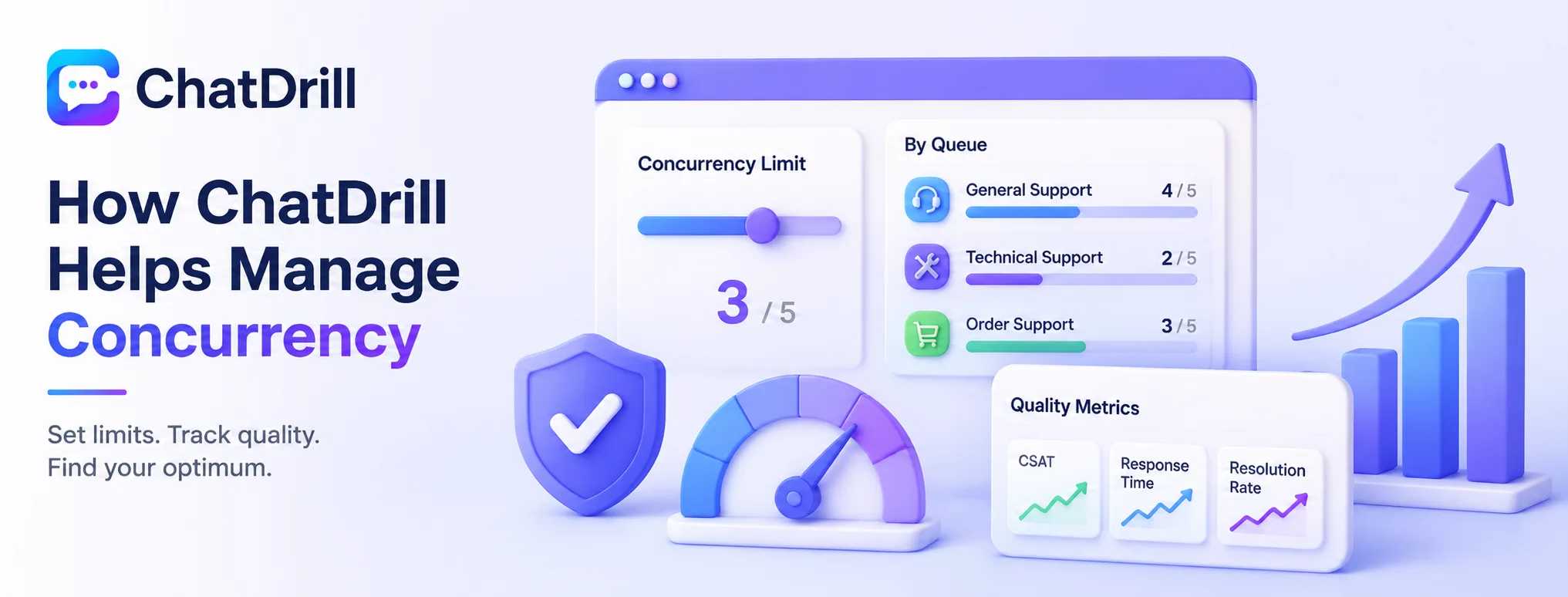
ChatDrill lets you set and adjust concurrency limits directly, segment them by queue or conversation type, and track quality metrics at different concurrency levels to find your own genuine optimum.
Configurable, queue-specific concurrency limits
ChatDrill supports setting different concurrency limits for different queues or conversation types, letting a simpler support queue run at a higher limit than a genuinely complex technical queue.
This granularity lets your concurrency setting reflect actual complexity differences rather than applying one blanket number across fundamentally different conversation types.
Quality tracking tied to concurrency changes
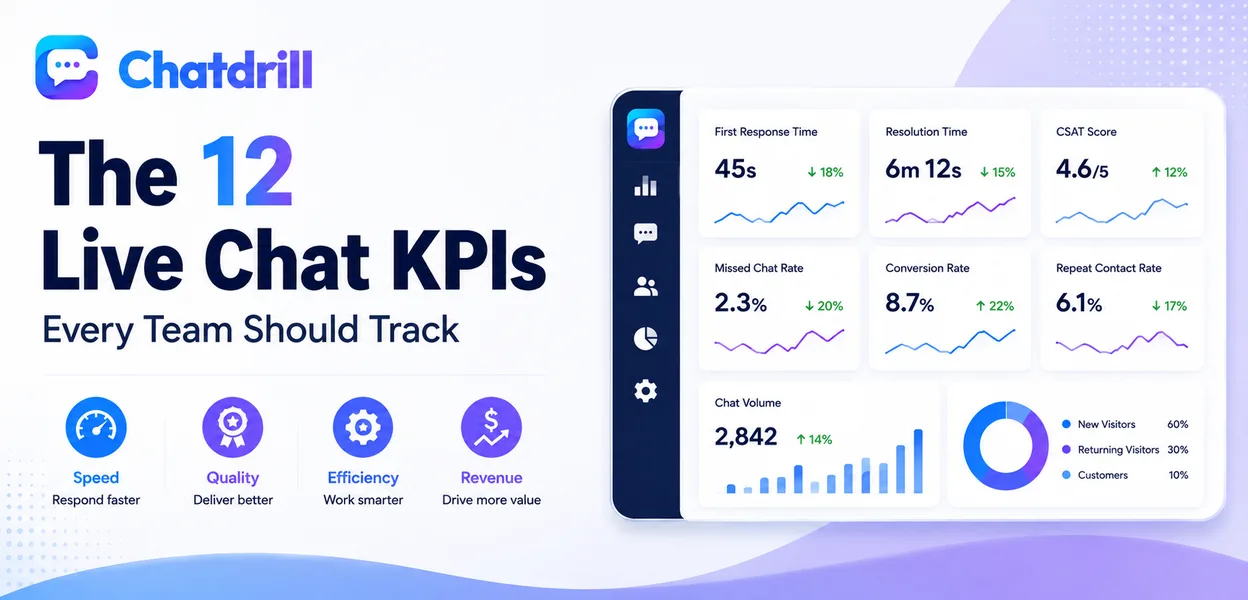
Because ChatDrill tracks CSAT, response time, and resolution rate consistently, you can directly compare these metrics before and after a concurrency change, confirming whether an adjustment genuinely improved efficiency without degrading quality.
This data-driven approach removes much of the guesswork from finding your team's genuine sustainable concurrency ceiling.
Running this comparison over a full week rather than a single day also accounts for natural day-to-day variation, giving a more reliable read on the true effect of the change.
Concurrency for Different Agent Experience Levels

A new agent still building confidence and product knowledge genuinely handles fewer simultaneous conversations well than a seasoned agent who has internalized common answers and can multitask more fluidly.
Starting new agents at lower concurrency
Setting a lower concurrency limit for agents still in their first weeks respects that they're simultaneously learning the product while handling live conversations, a genuinely heavier cognitive load than an experienced agent carries for the same task.
Gradually raising this limit as the agent demonstrates comfort with the current level, rather than jumping straight to the team standard, mirrors the same progressive approach used in broader onboarding.
Allowing experienced agents to handle more
A genuinely experienced agent who consistently maintains strong quality metrics at the standard concurrency level may be a good candidate for a modestly higher personal limit, recognizing real, demonstrated capability.
This differentiation should be based on actual tracked performance, not tenure alone, since not every experienced agent necessarily wants or performs better at higher concurrency.
Signs Your Current Concurrency Setting Is Wrong
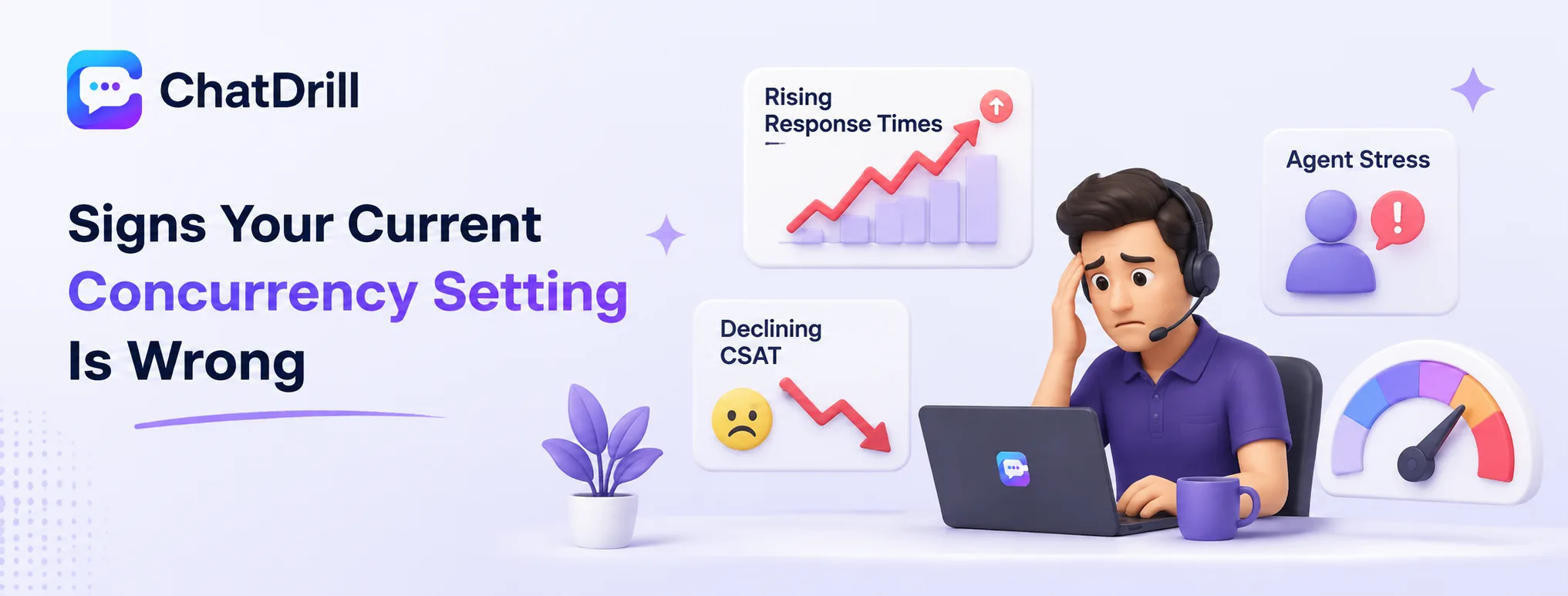
Rising response times despite stable headcount, declining CSAT concentrated during high-volume periods, and agent-reported stress specifically tied to juggling conversations all signal a concurrency setting worth revisiting.
Rising response times without a corresponding volume increase
If response times are creeping upward even though total volume and headcount have stayed roughly flat, an overly high concurrency setting stretching agents too thin is a reasonable first hypothesis to investigate.
Checking whether this pattern concentrates during specific hours or queues helps pinpoint whether the issue is a genuinely universal concurrency problem or specific to one segment.
CSAT specifically dipping during busy periods
A CSAT score that holds up well during quieter periods but drops noticeably during high-volume stretches suggests the current concurrency setting doesn't hold up under genuine peak pressure, even if it looks fine on average.
This pattern is easy to miss if only reviewing an averaged CSAT figure, making it worth specifically segmenting by volume level when investigating.