
Staffing a chat team by guesswork, or simply matching whatever your competitor seems to run, tends to leave you either overstaffed and wasting budget or understaffed and missing your response time targets during real traffic peaks.
A proper staffing formula grounds this decision in your actual conversation volume, typical handling time, and a realistic occupancy target, producing a defensible headcount number rather than an intuition-based guess.
Getting this calculation right matters especially as your business scales, since a formula-based approach adjusts predictably as volume grows, while a fixed headcount assumption quickly becomes outdated.
This guide covers the core staffing formula, what inputs you need, how to adjust for AI deflection, and mistakes worth avoiding.
Quick answer: The core chat staffing formula is: (average daily conversations × average handling time) divided by (agent available hours × target occupancy rate), which gives you the number of agent-hours needed per day before dividing by shift length to get headcount.
The Core Chat Staffing Formula
The formula divides total required agent-hours, driven by volume and handling time, by available hours per agent adjusted for a realistic occupancy target, producing your needed headcount.
The formula itself
Required agent-hours per day equals average daily conversations multiplied by average handling time, then divided by your target occupancy rate to account for realistic, sustainable workload.
Dividing this agent-hours figure by your typical shift length then gives you the actual headcount needed to cover that volume.
This structure ensures the calculation reflects genuine, sustainable capacity rather than an unrealistic assumption of 100% continuous agent availability.
Why occupancy rate matters so much
Occupancy rate accounts for the reality that agents can't be handling conversations 100% of their shift, breaks, brief gaps between conversations, and administrative time all reduce genuinely available capacity.
A typical target occupancy rate for chat, often 70-85%, reflects a sustainable pace rather than an unrealistic assumption that ignores genuine human capacity limits.
Gathering the Inputs You Need

Accurate staffing requires real data on your average daily conversation volume, genuine average handling time, and a realistic occupancy target based on your team's actual sustainable pace.
Average daily conversation volume
Pulling this directly from your chat platform's analytics, ideally averaged over a representative period rather than a single unusually quiet or busy day, gives a genuine baseline.
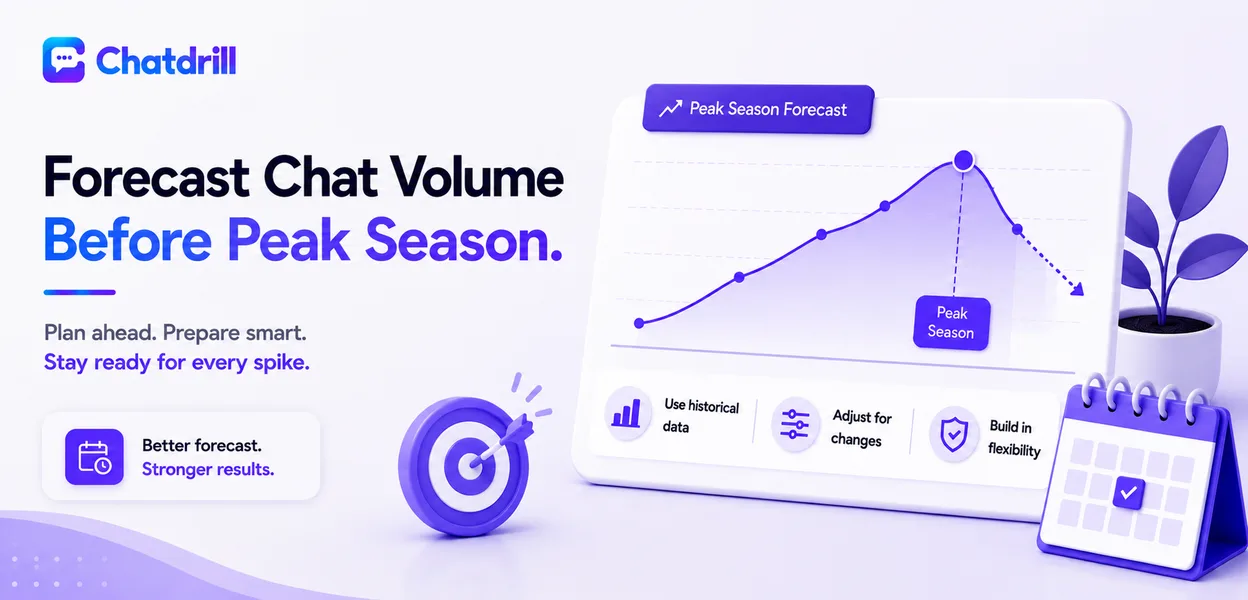
This volume should also account for known seasonal or day-of-week patterns, since a flat daily average can understate genuine peak-period needs.
Genuine average handling time
Calculating actual average time an agent spends per conversation, from your real historical data rather than an assumed estimate, ensures the formula reflects genuine, current team performance.
This figure is worth segmenting by conversation type where possible, since a simple question and a complex issue have genuinely different handling times that a single blended average might obscure.
A realistic occupancy target
Setting occupancy too high, assuming agents can sustain a near-constant workload, produces an understaffed calculation that burns out your actual team.
A reasonable, sustainable occupancy target, informed by your own team's actual experience, produces a more genuinely accurate and humane staffing number.
Adjusting the Formula for AI Deflection
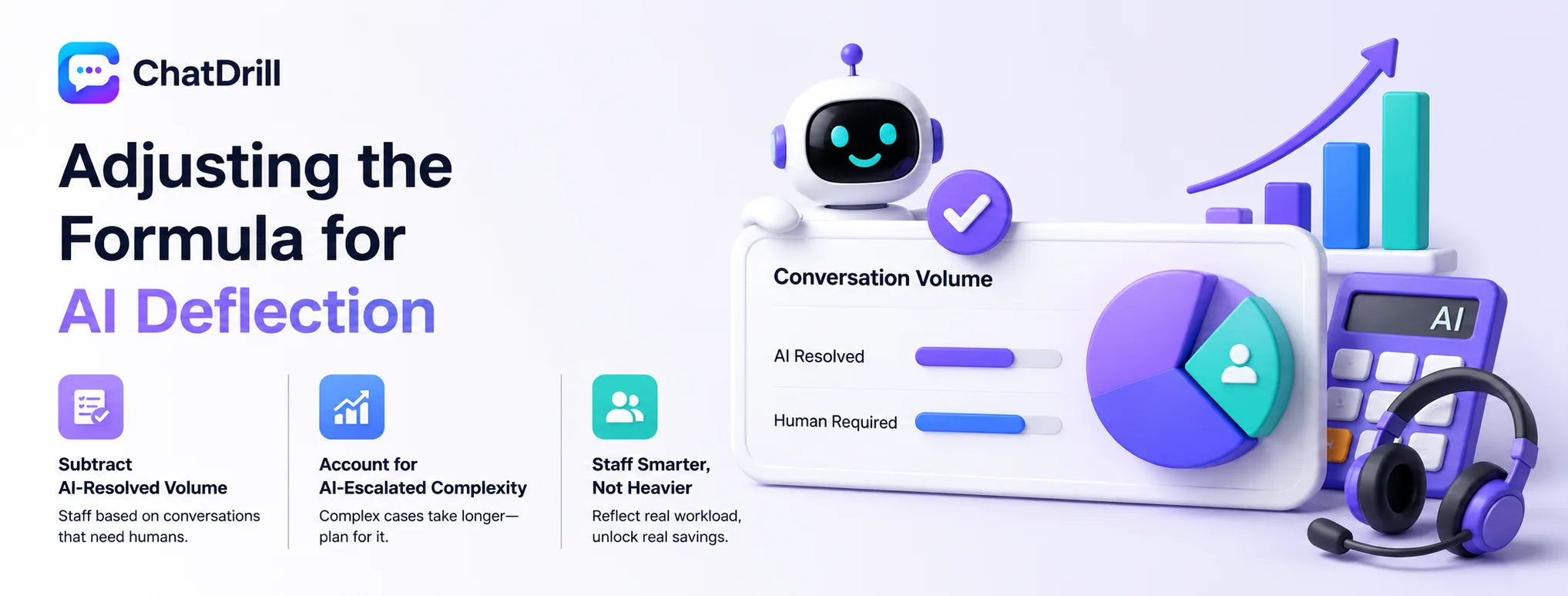
When AI resolves a meaningful share of conversations without human involvement, adjusting your volume input to reflect only the conversations genuinely requiring a human agent produces a more accurate staffing number.
Subtracting AI-resolved volume
Using only the conversation volume that genuinely requires human handling, after subtracting what AI resolves independently, in your staffing calculation avoids overstaffing based on total raw volume.
This adjustment can meaningfully reduce required headcount for a business with strong, well-trained AI deflection, representing genuine cost savings from that investment.
Accounting for AI-escalated complexity
Conversations that AI escalates specifically because they're genuinely complex may have a higher-than-average handling time, worth reflecting in your calculation rather than using a blended average that understates this.
This adjustment ensures your staffing calculation reflects the genuine nature of the volume actually reaching your human team, not a generic average across all conversation types.
A Worked Example
Walking through a concrete example with real numbers shows how the formula translates into an actual staffing decision.
Example calculation
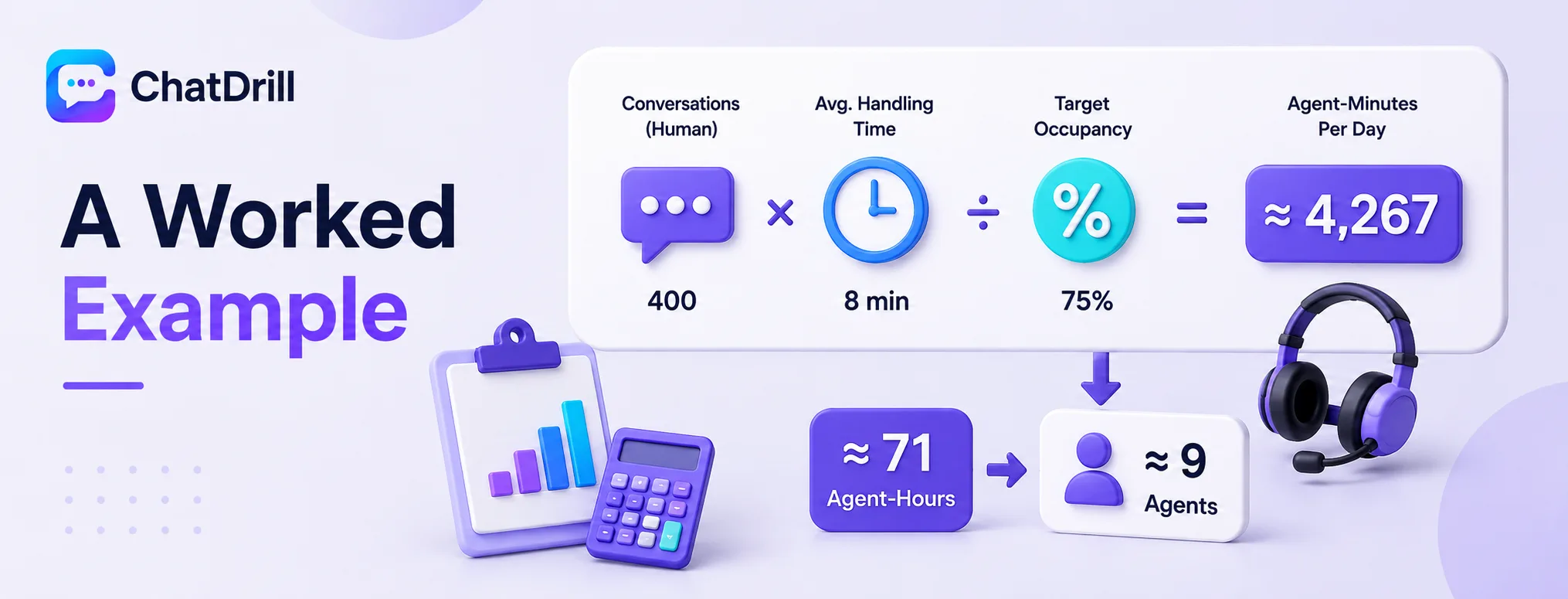
For a business with 400 daily conversations requiring human handling, an average handling time of 8 minutes, and a target occupancy of 75%, required agent-minutes per day equal 400 times 8 divided by 0.75, or roughly 4,267 minutes, about 71 agent-hours.
Dividing 71 agent-hours by an 8-hour shift length suggests approximately 9 agents needed to cover that volume at the target occupancy level.
This example illustrates how directly the formula translates real inputs into an actionable headcount number, rather than relying on intuition alone.
Common Mistakes in Chat Staffing Calculations
The most common mistakes are using an unrealistic occupancy assumption, ignoring seasonal or peak-period volume variation, and failing to adjust the calculation as AI deflection improves over time.
Unrealistic occupancy assumptions
Assuming agents can sustain occupancy rates well above what's genuinely realistic produces an understaffed calculation that looks efficient on paper but burns out your actual team in practice.
Grounding occupancy assumptions in your own team's genuine, sustainable experience avoids this common overcorrection.
Ignoring peak-period variation
Using a flat daily average without accounting for known peak periods, certain days or hours, can leave you understaffed exactly when volume is highest and stakes are greatest.
Layering in peak-period-specific staffing on top of the baseline formula addresses this gap directly.
Not adjusting as AI deflection improves
Continuing to staff based on total raw volume, without updating the calculation as AI deflection genuinely improves over time, results in ongoing overstaffing relative to actual human-required volume.
Revisiting this calculation periodically, as your AI training and deflection rate evolve, keeps staffing aligned with genuine current need.
How ChatDrill Changes Your Staffing Math
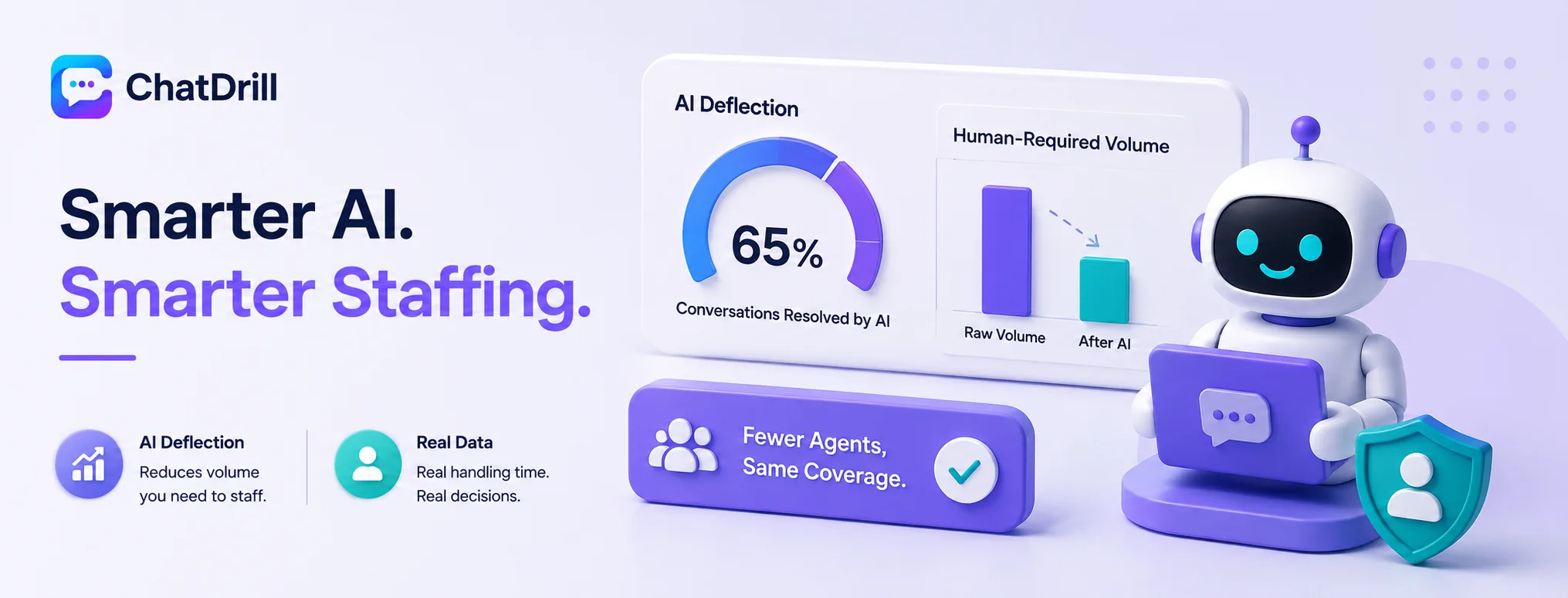
ChatDrill's AI deflection reduces the raw conversation volume your formula needs to account for, while its reporting gives you the real handling-time and deflection data the calculation actually depends on.
Real deflection data feeding the formula directly
Rather than estimating what share of volume AI might resolve, ChatDrill's dashboard shows your actual current deflection rate, letting you plug a genuine, current number into the staffing formula instead of a guess.
As training content matures and deflection improves, this number updates accordingly, giving you an ongoing, accurate basis for revisiting your staffing calculation rather than relying on a one-time estimate.
This real data also makes it easier to model a future staffing scenario, projecting what headcount you'd need if deflection improved by a specific amount through further training investment.
Reducing required headcount without reducing coverage
For a team using ChatDrill to handle routine, high-volume question categories, the human-required volume in the formula shrinks accordingly, often meaningfully reducing the headcount the calculation produces.
This reduction doesn't come at the cost of coverage, since AI is handling the deflected volume rather than it going unanswered, letting a smaller human team focus on the conversations that genuinely need their judgment.