
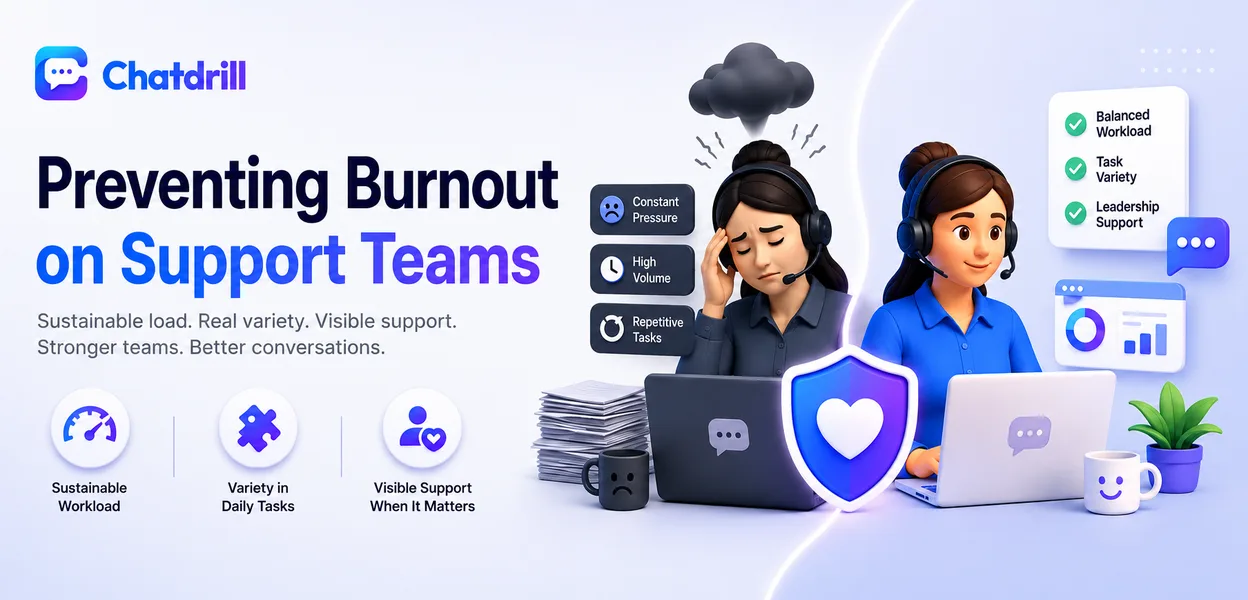
Support work carries a specific kind of cumulative strain, repeated exposure to frustrated customers, the pressure of real-time response expectations, and often limited variety in daily tasks, that can wear down even genuinely resilient agents over time.
Burnout rarely announces itself dramatically, it builds gradually through small, unaddressed strains accumulating, making early recognition and proactive prevention considerably more effective than trying to address it only after it's already severe.
The teams that manage this well don't treat burnout prevention as a wellness perk bolted onto the job, they build it into how workload, escalation support, and task variety are actually structured day to day.
This guide covers what drives support-specific burnout, practical prevention strategies, common mistakes, and how ChatDrill helps reduce the load that contributes to it.
Quick answer: Preventing burnout on support teams comes down to sustainable workload management, genuine variety in daily tasks, and visible support from leadership when a conversation goes badly, since burnout tends to build gradually from cumulative, unaddressed strain rather than any single difficult day.
What Drives Burnout Specifically in Support Roles
Support burnout tends to stem from cumulative emotional strain, sustained real-time pressure, and limited task variety, distinct from more general workplace stress factors.
Cumulative emotional strain
Repeated exposure to frustrated or upset customers, even when each individual interaction is handled well, accumulates a genuine emotional cost over time that a single difficult conversation alone wouldn't produce.
This cumulative nature means burnout often isn't traceable to one bad day, but to sustained, unaddressed strain building gradually across many days.
Sustained real-time response pressure
The expectation of consistently fast response, conversation after conversation, creates a different kind of sustained pressure than work with more natural breaks between tasks.
This pressure compounds particularly during high-volume periods, when the pace rarely lets up long enough for genuine mental recovery between conversations.
Limited variety in daily tasks
A role consisting almost entirely of similar, repetitive conversation types, day after day, can produce a specific kind of fatigue distinct from workload volume alone.
This monotony factor is often underestimated relative to volume as a genuine burnout contributor, worth addressing directly rather than assuming volume alone is the whole story.
Practical Prevention Strategies
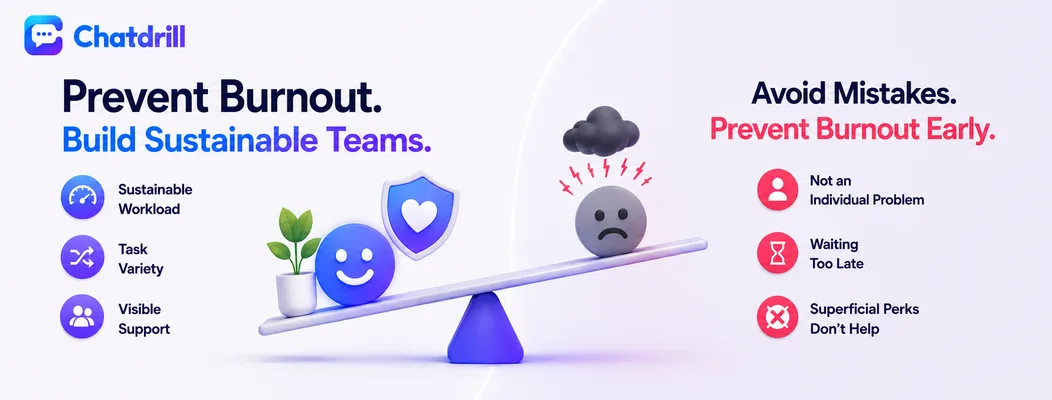
Effective prevention includes sustainable workload management, genuine task variety, and visible, proactive leadership support after difficult conversations.
Sustainable workload management
Setting concurrency and volume expectations that genuinely match team capability, rather than maximizing efficiency at the expense of sustainability, protects against the gradual accumulation that leads to burnout.
This requires the same honest, data-grounded approach to capacity planning covered in related staffing and concurrency guidance, rather than assuming a team can indefinitely absorb increasing pressure.
Genuine variety in daily responsibilities
Rotating agents through different conversation types, or occasionally different responsibilities like QA review or training support, breaks up the monotony that contributes to burnout beyond volume alone.
This variety doesn't need to be elaborate, even modest rotation meaningfully improves the day-to-day experience compared to strict, unvarying repetition.
Visible support after difficult conversations
A manager checking in genuinely, not just procedurally, after an agent handles a particularly difficult or upsetting conversation signals real care rather than treating the agent as simply a processing unit for volume.
This visible support, even brief, helps process the cumulative emotional strain before it silently accumulates into genuine burnout.
Common Mistakes in Burnout Prevention
The most common mistakes are treating burnout as an individual resilience problem rather than a systemic one, waiting until burnout is severe before acting, and offering superficial wellness perks without addressing genuine workload issues.
Framing burnout as individual weakness
Treating burnout as a sign an individual agent simply isn't resilient enough misses how much of it stems from genuinely systemic factors, workload, task variety, support structure, that affect the whole team similarly.
Addressing the systemic drivers directly, rather than placing the burden on individual coping alone, produces more genuine, lasting prevention.
Waiting until burnout is already severe
Only addressing burnout once an agent is already struggling significantly, or has left, misses the much larger opportunity to prevent it through earlier, proactive attention to workload and support.
Building in regular, genuine check-ins before problems become severe catches early warning signs while they're still manageable.
Superficial wellness perks without workload change
Offering a wellness stipend or occasional team event, without addressing genuine workload or emotional support gaps, tends to feel like a hollow gesture rather than a real solution.
Prevention that actually changes daily working conditions, workload, variety, support, delivers more genuine value than perks layered on top of an unchanged, unsustainable structure.
How ChatDrill Helps Reduce Burnout-Contributing Load
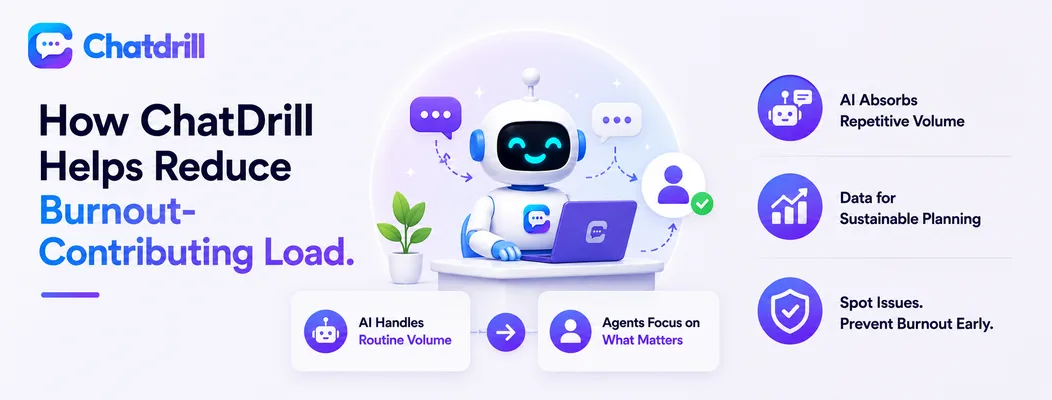
By absorbing routine, repetitive volume through AI, ChatDrill reduces both the sheer workload and the monotony factor that contribute significantly to support burnout.
AI absorbing the most repetitive volume
When ChatDrill's AI handles genuinely routine, repetitive questions, the conversations reaching human agents shift toward more varied, substantive interactions, directly addressing the monotony factor in burnout.
This shift also reduces sheer volume pressure, giving agents more genuine breathing room between the conversations that do require their full attention.
Concurrency and capacity data for sustainable planning
ChatDrill's reporting on volume, handling time, and concurrency gives support leaders the real data needed to set genuinely sustainable workload expectations, rather than guessing at capacity.
This data-grounded approach to capacity planning is itself a genuine burnout prevention tool, since unsustainable workload is one of the most direct, addressable contributors.
Reviewing this data specifically for warning signs, a team consistently running above sustainable capacity, lets leadership intervene before the workload actually translates into burnout.
Recognizing Burnout Before It Becomes Severe
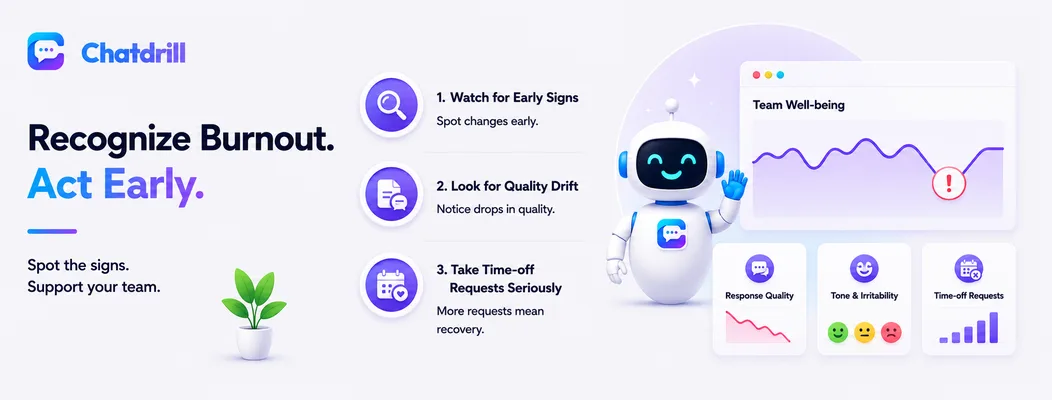
Early warning signs, subtly declining response quality, increased irritability in tone, more frequent time-off requests, tend to appear well before an agent reaches genuine crisis, making early recognition genuinely valuable.
Watching for quality drift rather than waiting for a complaint
A gradual decline in response thoroughness or warmth, visible in transcript review before it ever shows up as a customer complaint, is often the earliest observable sign of building strain.
Reviewing transcripts specifically with this in mind, not just for accuracy or policy adherence, adds a genuinely useful early-warning dimension to routine QA review.
Taking increased time-off requests seriously
An agent who begins requesting time off more frequently than their usual pattern, even for seemingly minor reasons, is often signaling a need for recovery before they'd necessarily frame it that way themselves.
Responding to this pattern with genuine flexibility, rather than scrutiny, tends to address the underlying need before it develops into something more serious.
Building Recovery Time Into the Schedule
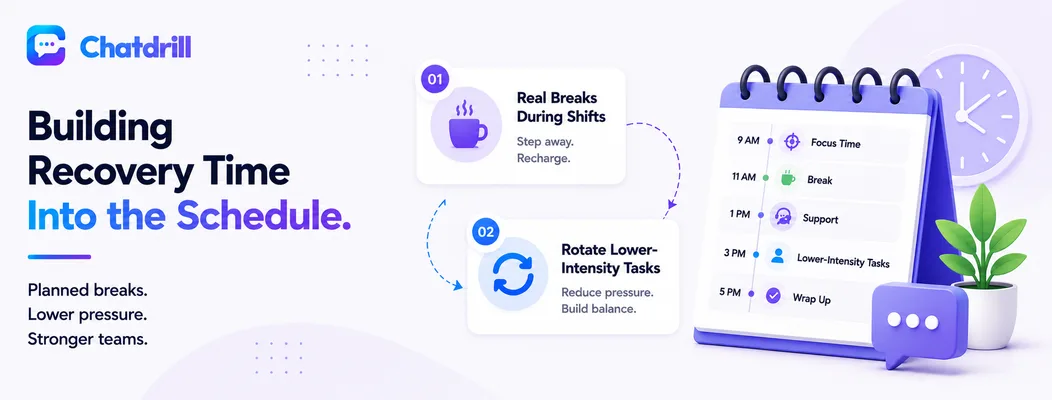
Deliberately scheduled breaks and lower-intensity periods, built into the regular rhythm rather than left to individual initiative, protect against the cumulative strain that builds during sustained high-pressure stretches.
Scheduling genuine breaks during shifts
Ensuring agents take real breaks away from the queue during their shift, rather than technically having break time available but rarely using it under volume pressure, requires active reinforcement from management, not just a policy on paper.
This might mean actively covering someone's queue during their break, removing the guilt or pressure that otherwise discourages agents from actually stepping away.
Rotating in lower-intensity responsibilities
Periodically assigning an agent to a lower-pressure task, documentation review, training material updates, gives genuine recovery time within the work itself, distinct from vacation time alone.
This rotation also has the side benefit of contributing to the task variety covered earlier as a distinct burnout-prevention factor.