

How many chats one agent should reasonably handle per day is a genuinely important workforce planning question, and cited industry data offers useful reference points even though the right number for any specific team depends on concurrency settings and question complexity.
Quick answer Cited industry data suggests a typical chat agent resolves around 7 chats per hour when handling 3 to 5 conversations simultaneously, spending roughly 3 hours and 18 minutes actively chatting per day according to LiveChat's cited customer service data, translating to somewhere between 40 and 60 resolved chats across a typical shift depending on question complexity and concurrency settings.
Rather than one fixed universal number, the available cited data points toward a reasonable range built from concurrency capacity, per-chat resolution speed, and total daily active chat time.
Understanding how these specific factors combine helps a business build its own genuinely appropriate daily target rather than adopting a generic number that might not reflect its actual conversation mix.
This guide covers the cited benchmark data points, how to combine them into a daily estimate, what changes the realistic number, and how ChatDrill supports appropriate daily workload planning.
Cited Benchmark Data Points for Daily Chat Volume

Cited research points to roughly 7 resolved chats per hour at typical concurrency, with agents spending around 3 hours 18 minutes actively chatting across a typical day.
The concurrency-to-resolution-rate figure
Cited research from Tidio's 2026 statistics roundup finds most chat agents handling 3 to 5 conversations at once, translating to approximately 7 resolved chats per hour at this typical concurrency level.
This hourly figure provides a genuinely useful building block for estimating a reasonable daily total, since it reflects real, aggregated agent performance rather than a theoretical maximum.
Total daily active chat time
Separate cited data from LiveChat's customer service reporting finds individual agents spending an average of 3 hours 18 minutes actively chatting with customers across a typical day.
This figure reflects genuine active chat time specifically, distinct from an agent's full shift, which naturally includes other tasks, breaks, and non-chat responsibilities beyond active conversation handling.
Combining These Figures Into a Daily Estimate
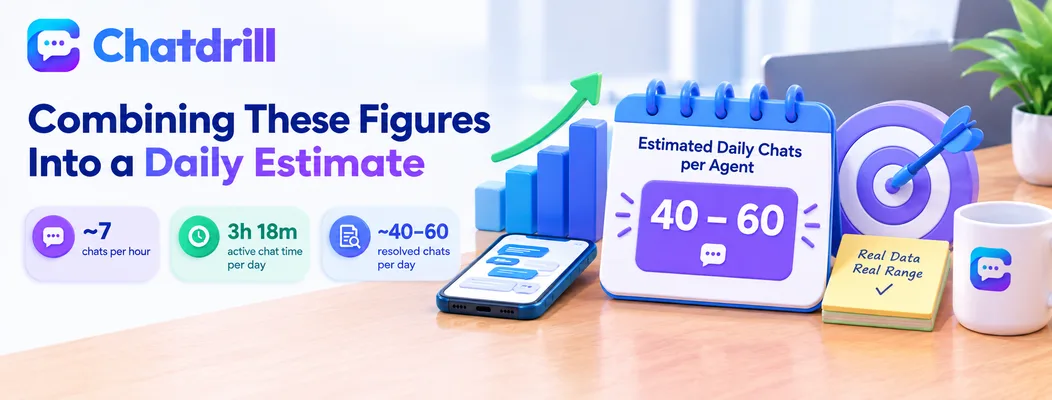
Multiplying the cited hourly resolution rate by cited daily active chat time produces a reasonable estimate landing between roughly 40 and 60 resolved chats per agent per day.
The basic calculation
Applying the cited roughly 7 chats per hour figure across the cited 3 hours 18 minutes of daily active chat time produces an estimate landing in the neighborhood of 23 chats purely from this multiplication, though real-world figures commonly run higher when accounting for genuinely simpler question mixes or higher concurrency settings.
This kind of grounded calculation, built from cited data points rather than an arbitrary guess, gives a business a genuinely reasonable starting estimate to test against its own actual data.
Why real-world figures often land higher
A team with a simpler, more routine question mix, or one running higher concurrency settings than the typical 3-to-5 range, can reasonably expect a higher daily total than this baseline calculation suggests.
This means the roughly 40-to-60 range some industry sources cite for daily chat volume per agent reflects genuine variation around this baseline, shaped by a team's specific complexity and concurrency configuration.
What Changes the Realistic Daily Number

Question complexity, concurrency settings, and AI deflection all meaningfully shift what a reasonable daily chat volume looks like for a specific team.
Question complexity and concurrency settings
A team handling genuinely complex, technical questions reasonably resolves fewer chats per day than one handling simple, routine ones, even at identical concurrency settings, given the different depth each conversation type requires.
Similarly, a team running a higher concurrency setting, more simultaneous conversations per agent, naturally supports a higher daily total, provided quality doesn't suffer as a result.
AI deflection changing the human-handled mix
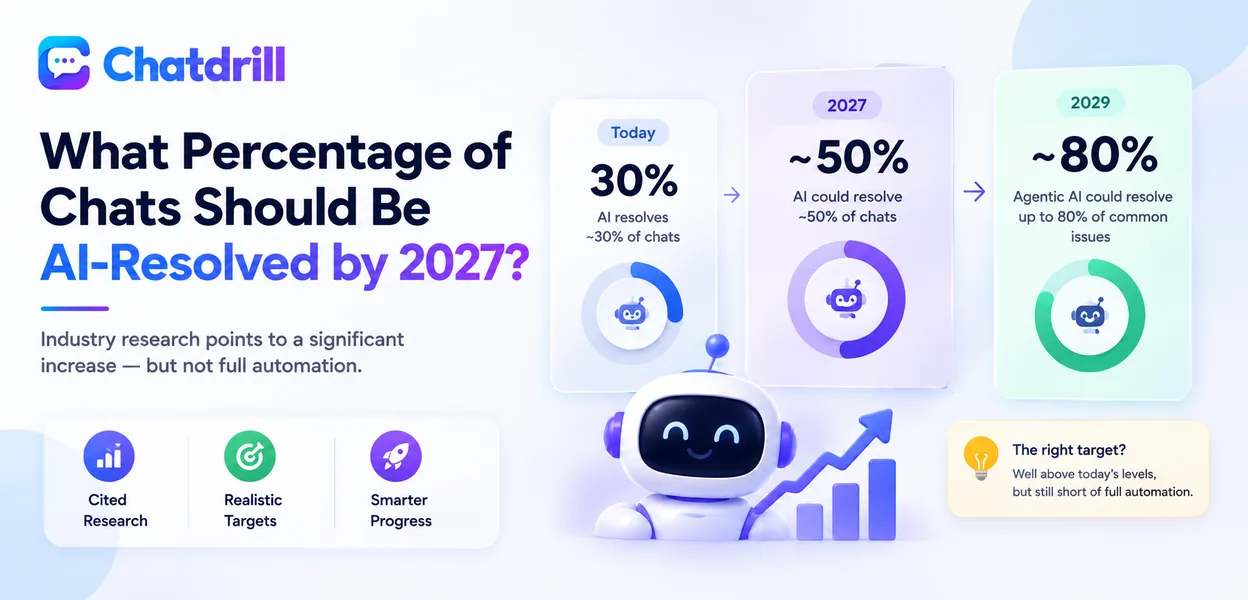
As AI absorbs a growing share of routine, simple questions, the conversations reaching human agents concentrate more heavily in complex territory, meaning a business with strong AI deflection reasonably expects human agents to resolve fewer, but more complex, chats per day.
This shift means daily volume targets set before significant AI deflection was in place may need meaningful downward adjustment as automation absorbs more routine volume.
Setting a Realistic Target for Your Own Team
Building your daily target from your own team's actual concurrency, complexity, and AI deflection data produces a genuinely more accurate number than adopting a generic industry figure.
Starting from your own real performance data
Reviewing your own team's actual resolved-chat count per agent per day over a representative period provides a more genuinely accurate baseline than assuming the cited general figures apply directly to your specific situation.
This real data, compared against the cited benchmark ranges, reveals whether your team is operating within a reasonable, sustainable range or genuinely over or under a healthy target.
Revisiting the target as your team and AI capability evolve
As AI deflection grows or your team's typical question complexity shifts, periodically revisiting your daily target keeps it genuinely reflective of current, real conditions rather than an outdated assumption.
This ongoing recalibration matters given how directly AI adoption specifically changes the realistic daily volume a human agent should reasonably be expected to handle.
How ChatDrill Supports Appropriate Daily Workload Planning

ChatDrill's real-time data on concurrency, resolution volume, and AI deflection gives a business the genuine information needed to set an appropriate, evidence-based daily target.
Real-time visibility into actual per-agent volume
ChatDrill tracks actual resolved conversations per agent, giving a business the real, current data needed to compare against cited industry benchmarks rather than relying on assumption.
This visibility supports the evidence-based target-setting approach this guide recommends, grounding daily workload expectations in genuine data specific to your own team.
AI deflection data informing realistic human targets
ChatDrill's deflection rate tracking shows exactly how much routine volume AI is absorbing, directly informing how the resulting, more complex human-handled mix should reasonably shift daily volume expectations for human agents.
This data-grounded approach avoids setting an outdated daily target that doesn't reflect how AI adoption has already changed your team's actual, current workload composition.