
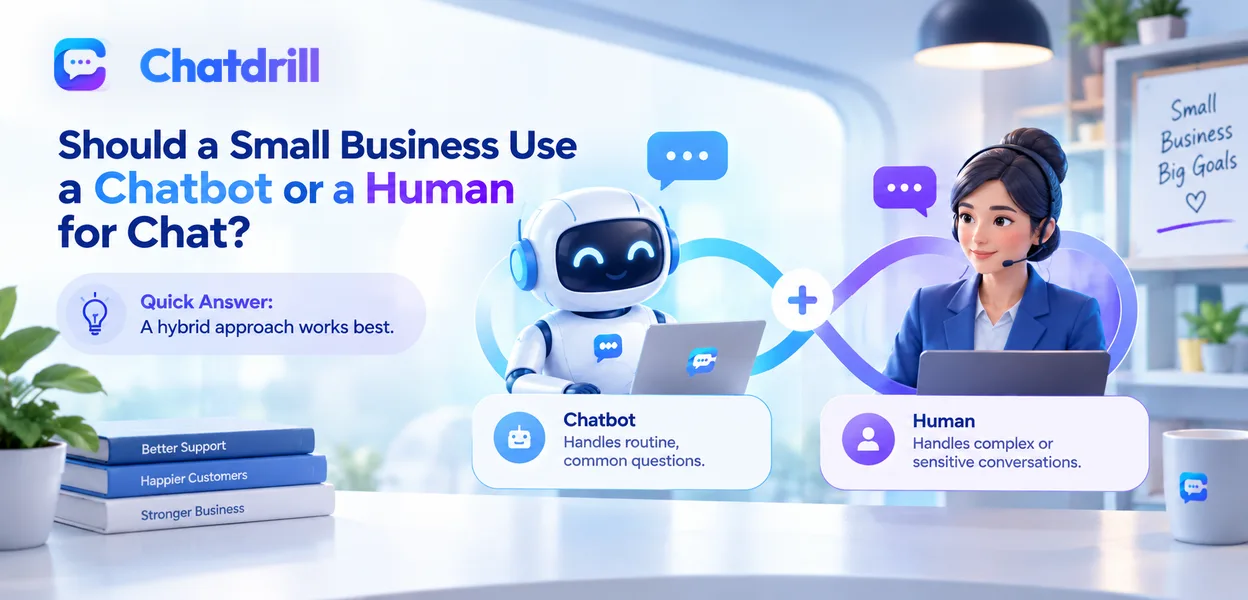
Deciding between a chatbot and a human for chat is a genuinely practical question for a small business with limited staff and budget, and the honest answer for most small businesses is a hybrid approach rather than an exclusive choice.
Quick answer: Most small businesses benefit from a hybrid approach, using a chatbot for routine, common questions while keeping a human available for genuinely complex or sensitive conversations, rather than choosing exclusively one or the other, since this combination captures chatbot efficiency without sacrificing the human judgment small businesses often rely on for relationship-building.
A pure human-only approach can struggle with coverage and consistency given typical small business staffing constraints, while a pure chatbot-only approach risks feeling impersonal for the relationship-driven interactions many small businesses genuinely rely on.
Understanding how to combine both approaches deliberately, rather than defaulting entirely to one, produces a genuinely better outcome for most small business situations than an all-or-nothing choice.
This guide covers the case for chatbot-handled routine questions, the case for human-handled complex conversations, how to structure a genuine hybrid approach, and how ChatDrill supports this combination for a small business.
The Case for Chatbot-Handled Routine Questions
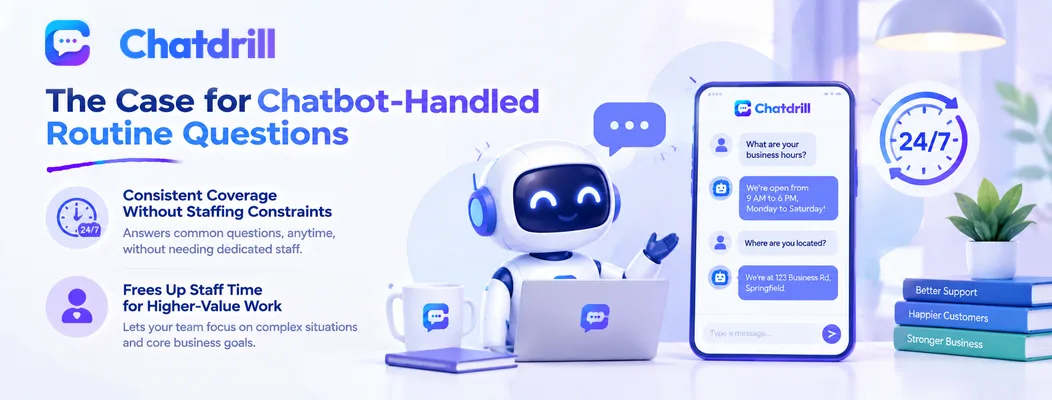
A chatbot genuinely excels at handling a small business's routine, repetitive questions consistently and around the clock, without requiring dedicated staff time.
Consistent coverage without staffing constraints
A chatbot can answer common questions, hours, location, basic product details, consistently and at any time, without requiring a small business to staff someone specifically for this coverage around the clock.
This consistent availability directly addresses one of the most common small business limitations, the inability to staff comprehensive coverage the way a larger company with more resources might.
Freeing limited staff time for higher-value work
Handling routine questions through a chatbot frees a small business's limited staff time for higher-value work, whether that's genuinely complex customer situations or core business operations that don't scale as easily as answering repetitive questions.
This time-freeing effect matters disproportionately for a small business, where staff time represents a genuinely scarce, valuable resource.
The Case for Human-Handled Complex Conversations
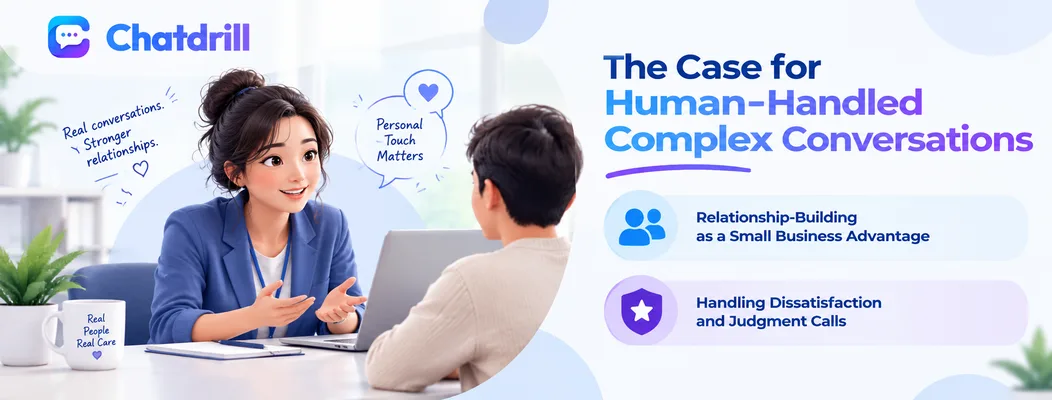
Genuine relationship-building, handling a dissatisfied customer, and situations requiring real judgment still benefit from a human's personal touch, something many small businesses specifically value as a competitive advantage.
Relationship-building as a small business advantage
Many small businesses compete specifically on personal relationships and genuine, individual attention, an advantage a purely automated chat experience risks undermining if applied indiscriminately to every interaction.
Preserving human involvement for interactions where personal connection genuinely matters protects this competitive advantage rather than sacrificing it for automation efficiency alone.
Handling dissatisfaction and judgment calls
A dissatisfied customer or a situation requiring genuine judgment, a policy exception, a unique circumstance, benefits from human handling given the empathy and flexible reasoning current AI still doesn't fully replicate.
Reserving human attention specifically for these situations ensures the small business's limited human capacity goes toward the interactions where it matters most.
Structuring a Genuine Hybrid Approach
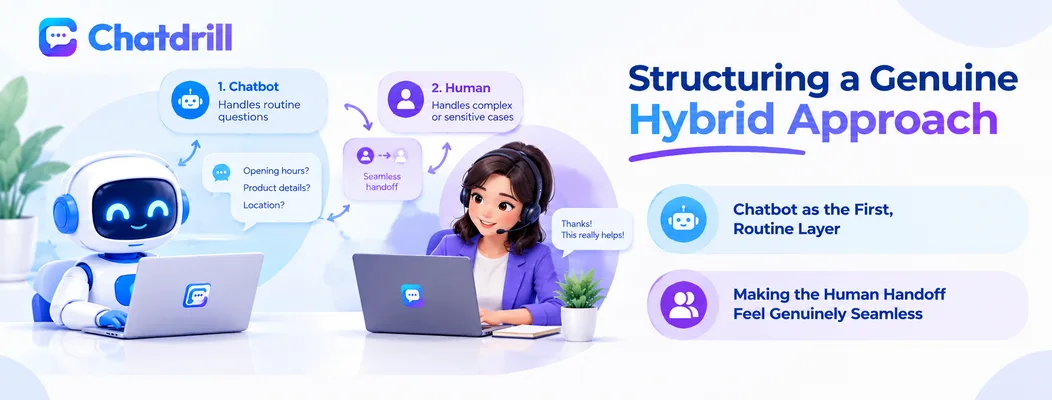
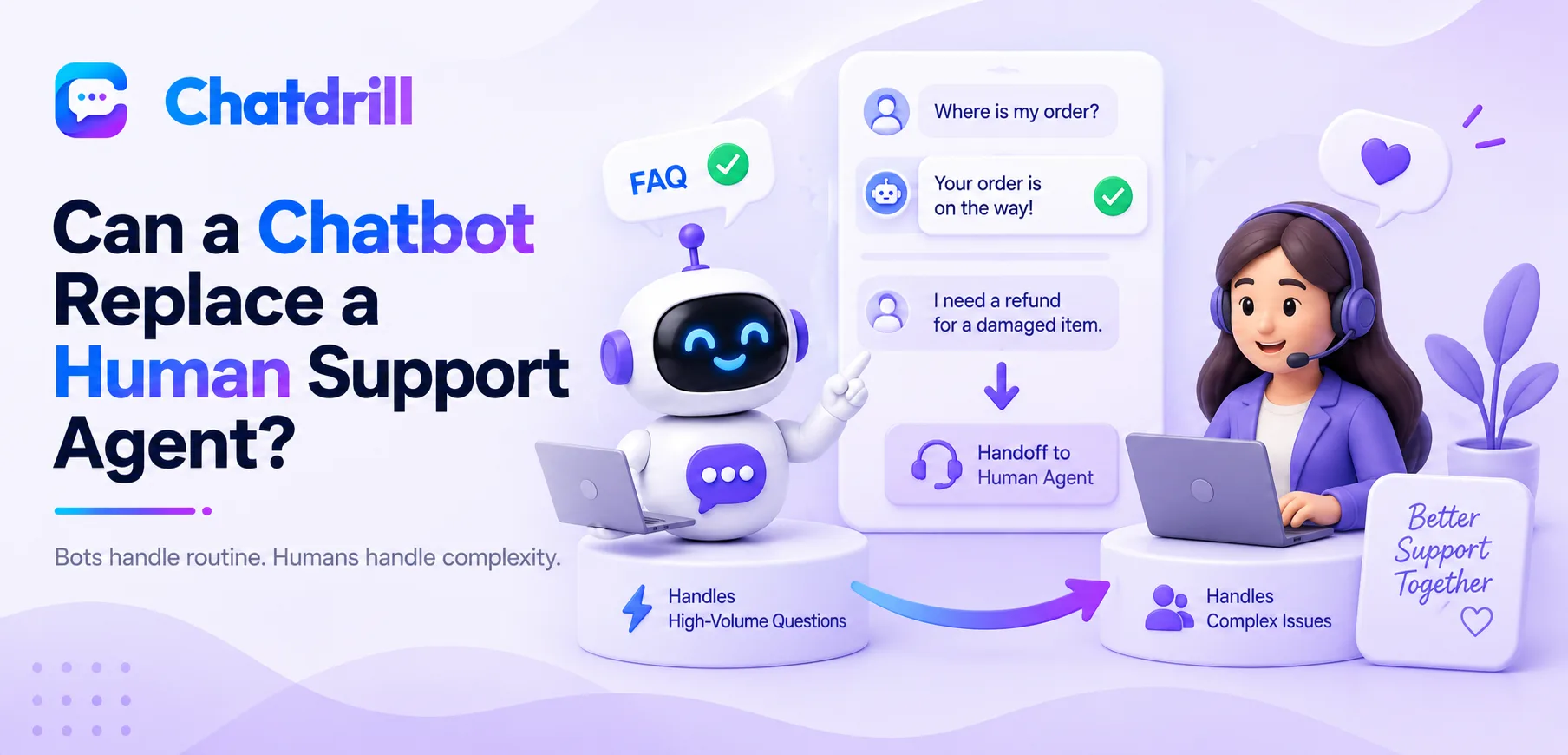
A well-structured hybrid approach uses chatbot resolution as the first layer, with clear, honest escalation to a human for anything genuinely beyond that scope.
Chatbot as the first, routine layer
Configuring the chatbot to handle clearly routine, common questions directly, while recognizing genuinely complex or sensitive situations and escalating them promptly, creates a structure that captures chatbot efficiency without sacrificing human judgment where it's genuinely needed.
This layered structure respects that most small business chat volume is genuinely routine, while still protecting the human touch for the meaningful minority of interactions that need it.
Making the human handoff feel genuinely seamless
Ensuring the transition from chatbot to human happens smoothly, with full context transferred rather than forcing the customer to repeat themselves, preserves the positive impression the hybrid approach is meant to create.
This seamless handoff quality is what actually determines whether the hybrid approach feels genuinely thoughtful or like an awkward, poorly integrated combination of two separate systems.
How ChatDrill Supports This Hybrid Approach for Small
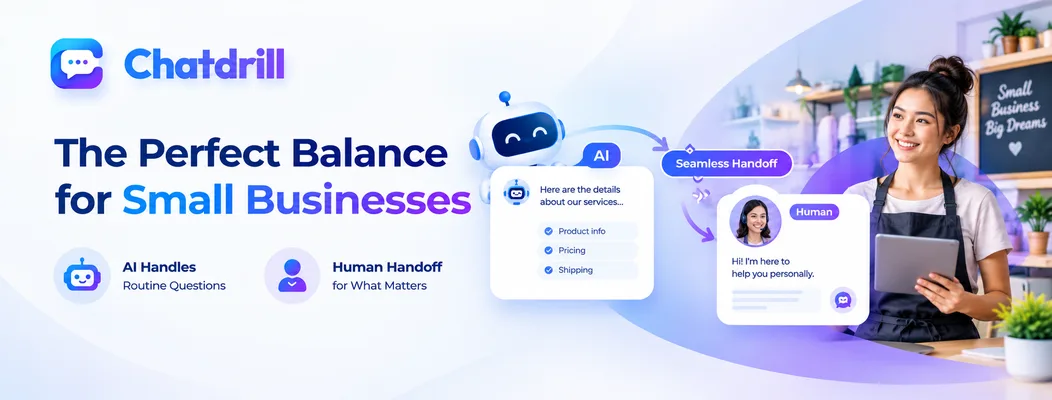
ChatDrill combines accurate AI resolution for routine questions with seamless human handoff, letting a small business capture chatbot efficiency without sacrificing the personal touch that often defines its competitive advantage.
Accurate AI handling routine small business questions
ChatDrill's AI, trained on your specific small business content, handles routine questions consistently and accurately, providing the coverage advantage this guide identifies without requiring additional staffing investment.
This capability directly addresses the staffing constraint challenge many small businesses face when trying to offer comprehensive chat coverage.
Seamless handoff preserving the human touch
When a conversation genuinely calls for human attention, relationship-building, a dissatisfied customer, a judgment call, ChatDrill hands off smoothly with full context, preserving the personal touch this guide identifies as a genuine small business competitive advantage.
This combination reflects the deliberate hybrid structure this guide recommends, rather than forcing a small business into an all-or-nothing choice between automation and genuine human connection.
Because the owner or a single staff member often plays both the oversight and the relationship-building role in a small business, this seamless handoff also reduces the mental overhead of tracking which conversations still need personal attention.
A Practical Starting Point for a Small Business
A small business can begin with a modest, deliberate hybrid setup and refine the specific division between chatbot and human involvement as real experience accumulates.
Defining your own routine-versus-complex line initially
Listing out the handful of questions that come up most repetitively in your specific business, and starting the chatbot there while keeping everything else routed to a human, gives a genuine, practical starting point without requiring extensive upfront planning.
This initial line doesn't need to be perfect, since it can be refined naturally as you observe how conversations actually unfold in practice.
Adjusting the balance based on real experience
Reviewing how the initial chatbot-versus-human split is actually working after a few weeks, and adjusting which questions the bot handles based on genuine observed accuracy and customer response, refines the hybrid structure over time.
This iterative refinement respects that the ideal split is specific to your particular business and customers, something no generic guidance alone can fully determine in advance.