
An AI chatbot understands what a visitor means even when they phrase it unexpectedly; a rule-based chatbot only understands the exact paths someone designed in advance, and the right choice between them depends entirely on how varied your conversations actually are.
The confusion usually starts because both get called "chatbots" on a pricing page, when in practice they solve different problems. Picking the wrong one either wastes money on AI a business didn't need, or frustrates visitors with a rigid bot that can't handle a real question.
The stakes of getting this wrong are higher than they first appear. A rule-based bot deployed where questions vary widely creates a stream of dead-end conversations that push visitors toward frustration, while AI deployed on a narrow, stable set of questions can be an expensive way to solve a problem a simple decision tree already handled fine.
Neither option is a permanent commitment either, many businesses start with one and move to the other, or a hybrid of both, as their chat volume and question variety change over time.
This guide covers how each type actually works, the concrete differences between them, real examples of businesses using each approach successfully, a practical way to decide which one, or which combination, fits a given business, and the mistakes worth avoiding either way.
What Is an AI Chatbot vs a Rule-Based Chatbot?
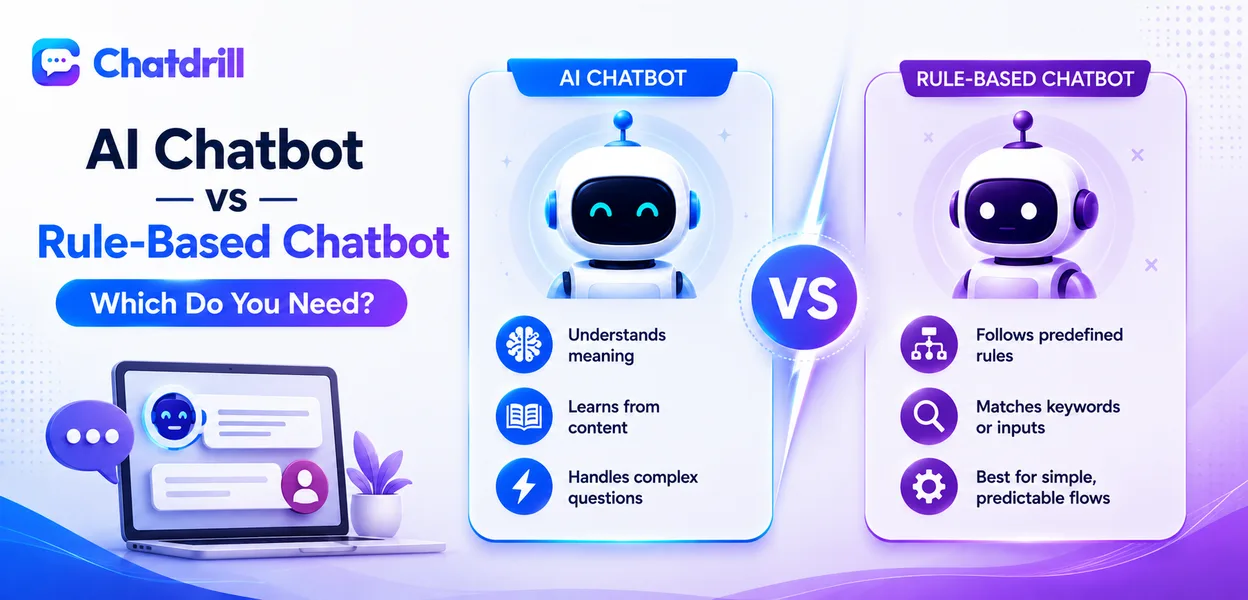
An AI chatbot uses natural language understanding to interpret open-ended messages and generate a relevant reply, while a rule-based chatbot follows a fixed decision tree, matching a visitor's message to pre-written options and paths.
Simple definition of each
A rule-based chatbot is essentially a flowchart, if the visitor clicks or types A, show B; an AI chatbot instead interprets the intent behind a message and responds even to phrasing it wasn't explicitly programmed for.
The practical difference shows up the moment a visitor asks something slightly off-script, a rule-based bot either matches a close-enough keyword or fails outright, while an AI chatbot generally still understands what's being asked.
Neither type is inherently better in the abstract, the right choice depends entirely on how predictable a business's chat questions actually are in practice.
How they're built differently
Rule-based bots are built by mapping out every expected question and response by hand; AI chatbots are trained on a knowledge base and conversation examples, then generalize from that training to new phrasing.
Building a rule-based bot is closer to writing a script or a spreadsheet of if-then logic, while training an AI chatbot is closer to teaching it from existing content, help docs, past conversations, product pages, and then reviewing how it performs.
This difference in build process also shapes who's typically responsible for each, a rule-based bot is often owned by whoever manages support operations, while an AI chatbot increasingly involves whoever manages the underlying content it's trained on.
Where the confusion usually comes from
Many platforms market both as "chatbots" without distinguishing them, so a business can end up comparing a scripted FAQ bot against a full AI agent without realizing they solve different problems.
The safest way to cut through the marketing is to ask directly during a demo: does this bot generate its own responses, or is it selecting from a pre-written set based on matched keywords, the answer usually clarifies which category a platform actually falls into.
It's also worth asking specifically what happens when the bot doesn't recognize a question, that failure behavior reveals more about the underlying technology than any feature list.
How Rule-Based Chatbots Work
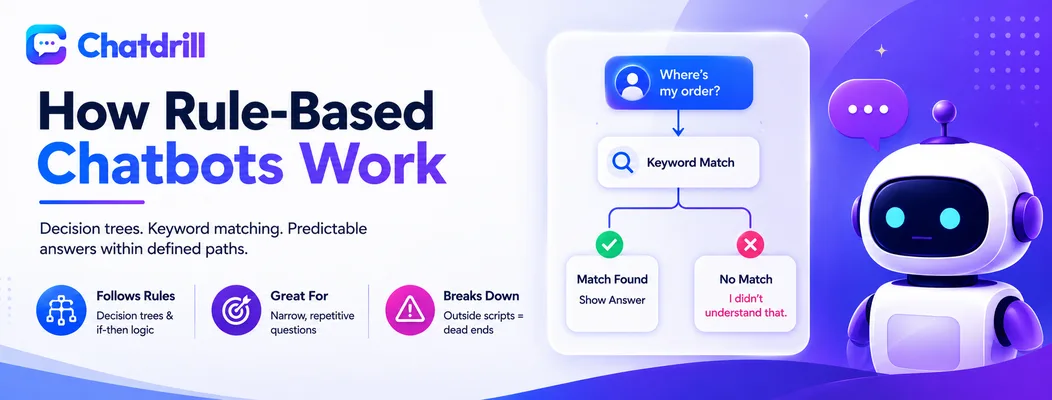
Rule-based chatbots work through decision trees and keyword matching, offering visitors a fixed set of buttons or recognized phrases, which makes them predictable and easy to control but unable to handle anything outside their scripted paths.
Decision trees and if-then logic
A visitor's click or typed phrase is matched against a predefined set of options, and the bot follows the corresponding branch, with no interpretation beyond that match.
This structure is also what makes rule-based bots easy to audit, every possible path can be mapped out and tested in advance, which some regulated industries specifically value for predictability.
The trade-off for that predictability is rigidity, the bot can only ever do exactly what its map specifies, with no ability to improvise even slightly outside those defined branches.
What rule-based bots are good at
They excel at narrow, repetitive, high-volume questions, like "what are your hours" or "where's my order", where the exact question and answer are known in advance.
They're also cheap to run and fast to deploy, a small business with a handful of predictable questions can have a functional rule-based bot live within a day, with no ongoing training required.
This makes them a genuinely good fit for a narrow use case, rather than a lesser version of an AI chatbot, the two are simply built for different situations.
Where rule-based bots break down
Any question phrased differently than expected, or that combines two topics at once, tends to dead-end the bot into an unhelpful "I didn't understand that" loop.
This failure mode compounds badly at scale, once a business's questions grow more varied, a rule-based bot's map of decision branches becomes exponentially harder to maintain without gaps appearing.
Visitors who hit this dead end repeatedly tend to abandon the chat entirely rather than trying to rephrase, which is one of the more common sources of chat frustration.
How AI Chatbots Work
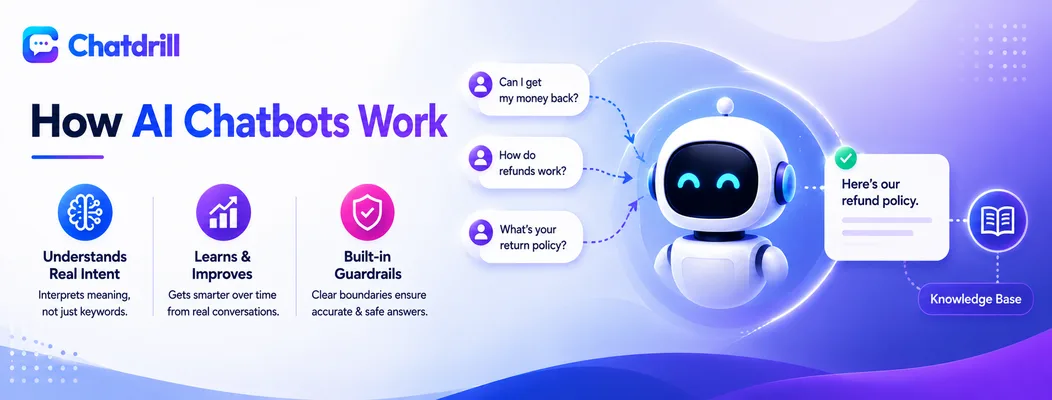
AI chatbots work by using natural language understanding to interpret a visitor's actual intent, drawing on a trained knowledge base to generate a relevant answer even to questions phrased in ways it hasn't seen verbatim before.
Natural language understanding
Instead of matching exact phrases, the AI interprets meaning, so "can I get my money back" and "how do refunds work" both correctly route to the same underlying answer.
This is also what allows an AI chatbot to handle multi-part questions in a single message, something a rule-based bot typically can't do without the visitor being guided through separate, sequential prompts.
The quality of this understanding varies across platforms too, worth testing directly with a business's own real questions rather than assuming any AI labeled chatbot performs equally well.
Learning from conversation data
AI chatbots improve over time as they're trained on real conversations and knowledge base content, refining how they handle edge cases and ambiguous questions.
In practice this means reviewing a sample of real conversations periodically, updating the knowledge base where the AI struggled, is what separates a chatbot that keeps improving from one that plateaus shortly after launch.
This ongoing review is a genuinely different kind of maintenance than a rule-based bot requires, less about mapping new paths and more about curating and correcting the source content the AI draws from.
Where AI chatbots still need guardrails
Without clear boundaries on what it should and shouldn't answer, an AI chatbot can confidently generate an incorrect or off-brand response, which is why scoping and review still matter.
Most mature platforms, including ChatDrill, let a business explicitly define topics the AI should always escalate rather than attempt, pricing exceptions or legal questions being common examples worth hard-coding as boundaries.
Setting these boundaries before launch, rather than reactively after a mistake, is a small upfront investment that meaningfully reduces the risk of an embarrassing or costly AI error.
AI Chatbot vs Rule-Based Chatbot: Key Differences
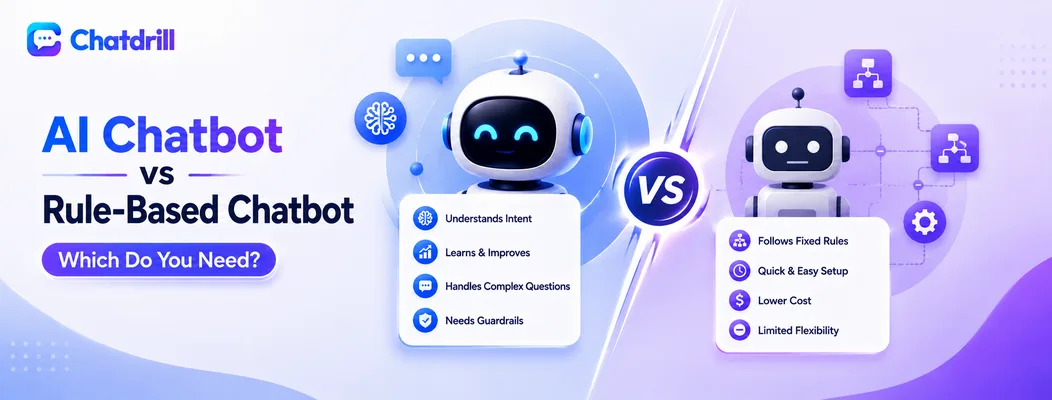
The two differ most in flexibility, setup effort, cost, and risk: AI chatbots handle open-ended conversation and lead qualification but cost more and need oversight, while rule-based bots are cheap and predictable but limited to narrow, well-defined questions.
Flexibility and conversation handling
AI chatbots handle unexpected phrasing and multi-part questions; rule-based bots only handle the exact paths they were built for.
This flexibility gap widens further with multi-turn conversations specifically, an AI chatbot can maintain context across several back-and-forth messages, while a rule-based bot generally treats each step as a fresh decision point.
For a business with genuinely varied customer questions, this gap tends to be the deciding factor over cost alone, since a rigid bot creates more frustration than it saves in setup time.
Setup time and maintenance
A rule-based bot requires manually mapping every path, and updating it means editing that map by hand; an AI chatbot is trained on existing content and adapts to new phrasing without a rebuild.
That said, AI chatbots aren't maintenance-free either, they still need periodic review and knowledge base updates, the difference is that the effort scales with new content rather than with every new way a question might be phrased.
Over a year or two, this difference in how maintenance scales tends to matter more than the initial setup time either way.
Cost and scalability
Rule-based bots are typically cheaper and simpler to run at any scale; AI chatbots cost more but scale to a far wider range of questions without proportional manual work.
The cost gap has narrowed as AI features have become standard across more live chat platforms, so the decision increasingly comes down to actual need rather than affordability alone.
It's worth modeling the cost of maintaining a growing rule-based bot's decision tree over time too, since that hidden labor cost is often underestimated when comparing sticker price alone.
Accuracy and risk of errors
A rule-based bot fails predictably, it simply doesn't understand; an AI chatbot can fail less predictably by confidently answering something incorrectly, which is why response boundaries matter more for AI.
This is also why review matters more for AI deployments specifically, spot-checking a sample of AI conversations regularly catches confidently wrong answers before they become a pattern that erodes trust.
The two failure modes also feel very different to a visitor, a rule-based bot's dead end reads as an obvious limitation, while an AI's confident wrong answer can be genuinely misleading if left unchecked.
Which One Does Your Business Actually Need?
A rule-based chatbot is enough for a small set of well-defined, repetitive questions, while an AI chatbot is worth the investment once conversations vary widely or need to qualify leads, and many businesses end up using both together.
When a rule-based chatbot is enough
If the same five or six questions make up nearly all chat volume, a rule-based bot answers them reliably at a fraction of the cost and setup time of an AI system.
This is common for very early-stage businesses with a narrow product and a small, predictable set of buyer questions, where the variety AI is built to handle simply hasn't emerged yet.
It's also a sensible choice for a specific, narrow use case within a larger operation, even a business that mostly needs AI might still use a rule-based flow for a handful of guaranteed, high-stakes answers.
When you need an AI chatbot
Once conversations vary, involve qualifying a lead, or need to draw on a larger knowledge base, an AI chatbot handles that range in a way a decision tree simply can't.
This is especially true for B2B businesses where visitor questions often combine product, pricing, and use-case details in one message, exactly the kind of nuanced, multi-part question a rule-based bot struggles with.
Growing question variety over time is also a useful signal, a business that started with a rule-based bot and keeps hitting its limits is usually ready to move to AI.
Using both together
A common pattern is a rule-based layer for a handful of instant, guaranteed-accurate answers, with AI handling everything else, combining speed on the basics with flexibility on the rest.
In practice this might mean a rule-based flow for the very first message, hours, location, order status, with AI seamlessly taking over the moment a question goes beyond those fixed paths.
This hybrid setup tends to be underused simply because it requires a bit more upfront configuration, though the payoff in both reliability and flexibility is usually worth that initial effort.
Common Mistakes to Avoid
The most common mistakes are paying for AI when a simple rule-based bot would have covered the actual question volume, launching an AI chatbot with no guardrails on what it should answer, and underestimating how much manual upkeep a growing rule-based bot needs.
Choosing AI when a simple bot would do
A business with a narrow, stable set of questions can overspend on AI capability it never actually uses, when a rule-based bot would have handled the same volume for less.
The way to check this before committing is simple, review three months of past chat transcripts, if the same handful of questions account for most of the volume, a rule-based bot is likely the more efficient starting point.
It's worth revisiting this decision periodically too, since a business's question variety tends to grow over time even if it started out genuinely narrow.
Launching an AI chatbot without guardrails
An AI chatbot given no boundaries on what it should answer can generate confident but incorrect responses, particularly on pricing or policy questions where accuracy matters most.
Defining a short list of topics the AI must always escalate, before launch rather than after a mistake happens, is a small upfront step that prevents most of the reputational risk this creates.
Reviewing a sample of AI conversations weekly during the first month after launch specifically helps catch any gap in those guardrails before it becomes a bigger pattern.
Underestimating rule-based maintenance
A rule-based bot that looked simple to set up can become a maintenance burden as the number of paths grows, with every new question requiring another manually mapped branch.
Teams that hit this wall often end up migrating to AI anyway, having spent months maintaining an increasingly tangled decision tree that an AI chatbot would have handled with far less ongoing effort.
Recognizing this pattern early, before the decision tree becomes genuinely unmanageable, makes the eventual migration to AI considerably smoother than waiting until it's a clear operational problem.
Real-World Examples of Each Chatbot Type
Seeing how different businesses actually deploy rule-based and AI chatbots makes the abstract comparison concrete, from a small store handling store-hours questions to an enterprise using AI for technical triage.
A small business using a rule-based bot for store hours and returns
A local retail business with a narrow, predictable set of questions, hours, location, return policy, deployed a simple rule-based bot and had it fully configured within an afternoon.
Because the questions rarely changed, the bot required almost no ongoing maintenance after launch, making it a genuinely cost-effective fit rather than an underpowered choice.
The business later considered adding AI as it grew, but found the rule-based setup was still covering the vast majority of its chat volume adequately, so it held off on the added cost.
An enterprise SaaS company using AI for technical support triage
A larger SaaS company facing highly varied, often technical support questions deployed an AI chatbot trained on its full documentation set to handle initial triage before escalating to a specialist.
The AI's ability to understand nuanced, differently phrased technical questions was the deciding factor, a rule-based bot would have required an unmanageable number of decision branches to cover the same range.
The company also found that reviewing AI-handled conversations regularly helped it identify documentation gaps, since a question the AI struggled with often meant the underlying docs needed improvement too.
An ecommerce brand using a hybrid setup
A mid-sized ecommerce brand used a rule-based flow for its highest-volume, simplest questions, order status and shipping, while routing anything else to an AI chatbot trained on its product catalog.
This combination gave the brand instant, guaranteed-accurate answers on its most common questions while still covering the long tail of more varied product and sizing questions through AI.
The setup also proved easier to manage than expected, since the rule-based layer handled the bulk of volume reliably, leaving a smaller, more manageable set of conversations for the AI to cover.
A B2B company using AI purely for lead qualification
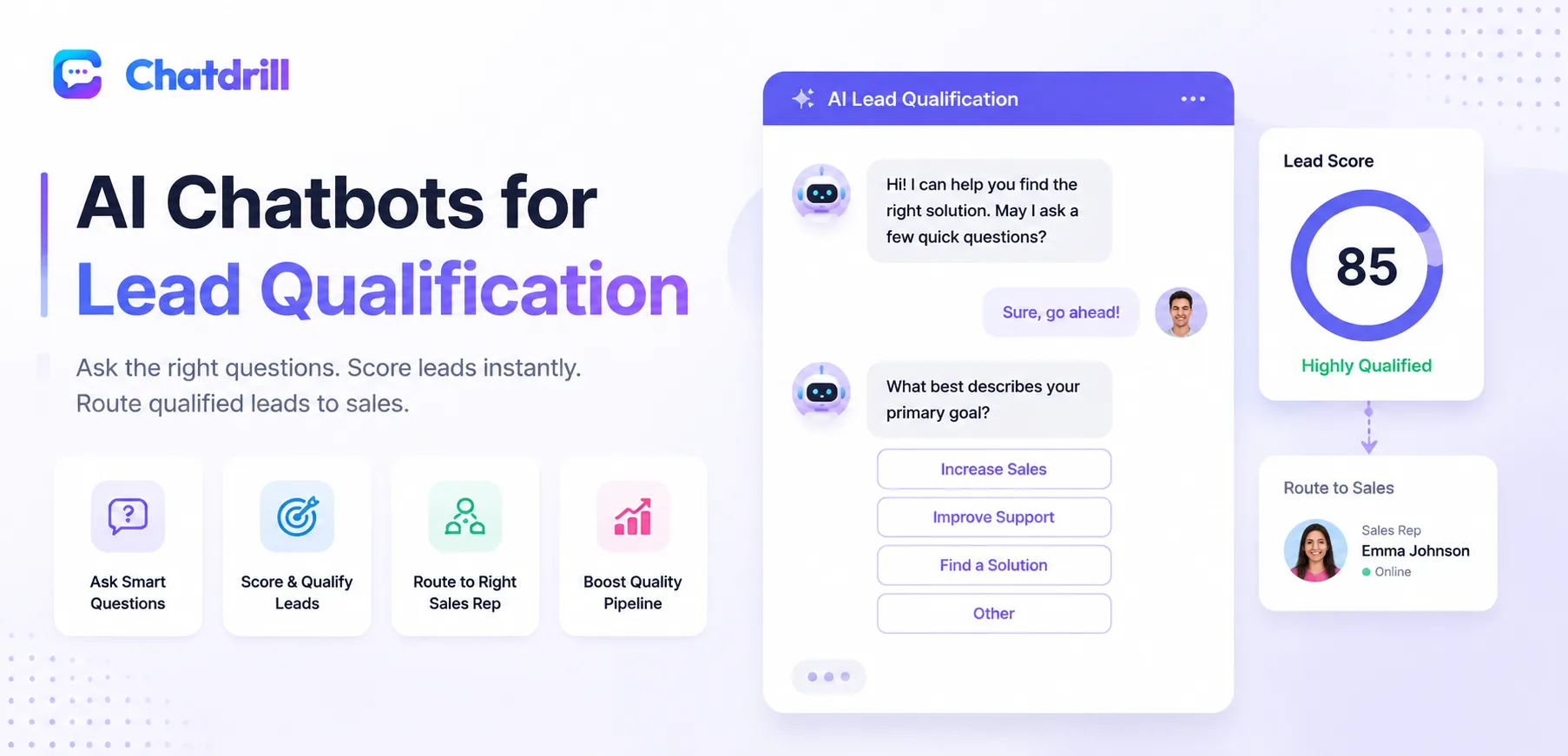
A B2B software company used AI specifically for lead qualification, not general support, asking about team size and use case before routing a scored lead to sales.
Because the goal was qualification rather than broad question-answering, the AI was scoped narrowly, which also made it easier to review and keep accurate over time.
This narrow scoping meant the company avoided many of the guardrail concerns that come with a broader, general-purpose AI deployment, since the AI's job was limited to a small, well-defined task.
What these examples reveal about fit
In each case, the choice tracked directly to conversation variety, narrow and predictable favored rule-based, varied and nuanced favored AI, and mixed volume favored a hybrid setup.
None of these businesses made the choice based on which technology seemed more advanced, they matched the tool to their actual conversation patterns instead.
Questions to ask before choosing either approach
Reviewing a sample of real past conversations, asking how varied the phrasing and topics actually are, is the most reliable way to predict which approach will perform well.
It's also worth asking how much conversation variety is expected to grow over the next year, since a rule-based bot that fits today's needs may not fit next year's without a rebuild.