

A manufacturer or exporter's chat visitors are typically buyers or procurement professionals evaluating a potential supplier relationship, meaning conversations center on specifications, quantities, and lead times rather than the simpler, transactional questions common in consumer-facing industries.
This is a genuinely longer, more considered sales cycle than most other industries covered in this series, meaning chat's role is less about immediate conversion and more about efficient, accurate initial qualification before a deeper sales conversation begins.
International and export-specific considerations, shipping logistics, documentation, regional certification requirements, add another layer of complexity worth addressing directly in chat rather than deferring every specific question to a lengthy email exchange.
This guide covers why B2B manufacturing chat differs from consumer-facing chat, what buyers typically ask, a practical setup approach, and mistakes worth avoiding.
Why B2B Manufacturing Chat Differs From Consumer Chat
Manufacturing and export chat serves a longer, more considered sales cycle where the goal is efficient initial qualification rather than immediate conversion, with buyers asking genuinely technical and logistics-heavy questions.
The qualification-first nature of B2B manufacturing sales
A buyer reaching out via chat is rarely ready to complete a purchase in that conversation, making chat's role more about efficiently gathering initial requirements and routing to the right sales contact than closing a deal directly.
This distinction shapes chat design meaningfully, success looks like a well-qualified conversation reaching the right sales engineer or account manager quickly, not an immediate transaction.
Why specifications and quantities matter so much
Unlike a consumer product with fixed specifications, a manufacturing inquiry often involves custom quantities, tolerances, or material requirements that need to be captured accurately for a meaningful follow-up conversation.
Chat that captures these specifics well sets up a considerably more productive sales conversation than one that only gathers generic contact information.
What Buyers Typically Ask
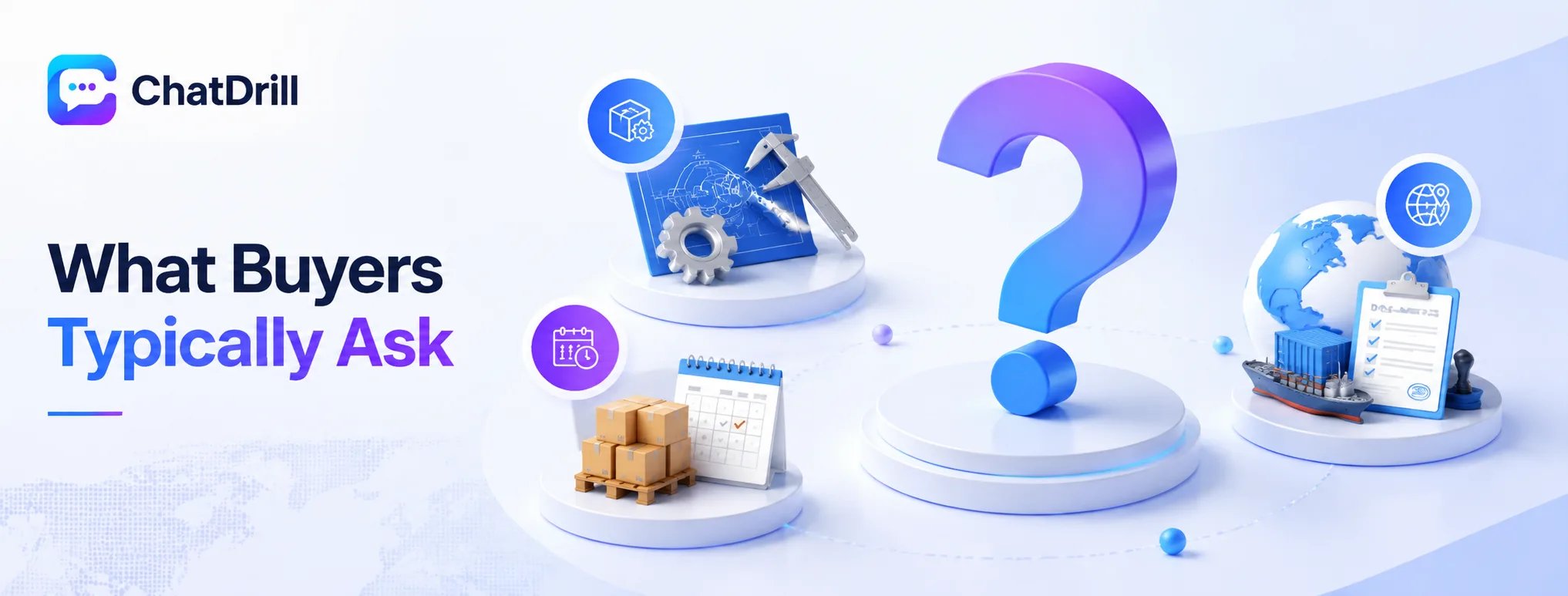
Buyers ask about product specifications and customization options, minimum order quantities and lead times, and export-specific logistics like shipping terms and documentation requirements.
Specifications and customization
Questions about material options, tolerances, and customization possibilities are common and benefit from AI trained on your actual product specification range, capturing enough detail for a meaningful sales follow-up.
This category rewards genuine technical depth in training content, a vague or generic response tends to signal insufficient manufacturing sophistication to a genuinely technical buyer.
Minimum order quantities and lead times
MOQ and lead time questions are consistently high-priority for a procurement buyer evaluating whether your business fits their sourcing needs, worth answering with specific, accurate information rather than a vague estimate.
This category directly influences whether a buyer continues the conversation or moves to a competitor, making accuracy and specificity genuinely valuable here.
Export logistics and documentation
For an export-focused business, questions about shipping terms, required documentation, and regional certification requirements come up regularly and benefit from clear, accurate guidance specific to the buyer's likely destination market.
This category is worth training thoroughly given how much friction unclear export logistics information can create for an international buyer evaluating multiple suppliers.
Setup Playbook for B2B Manufacturing Chat
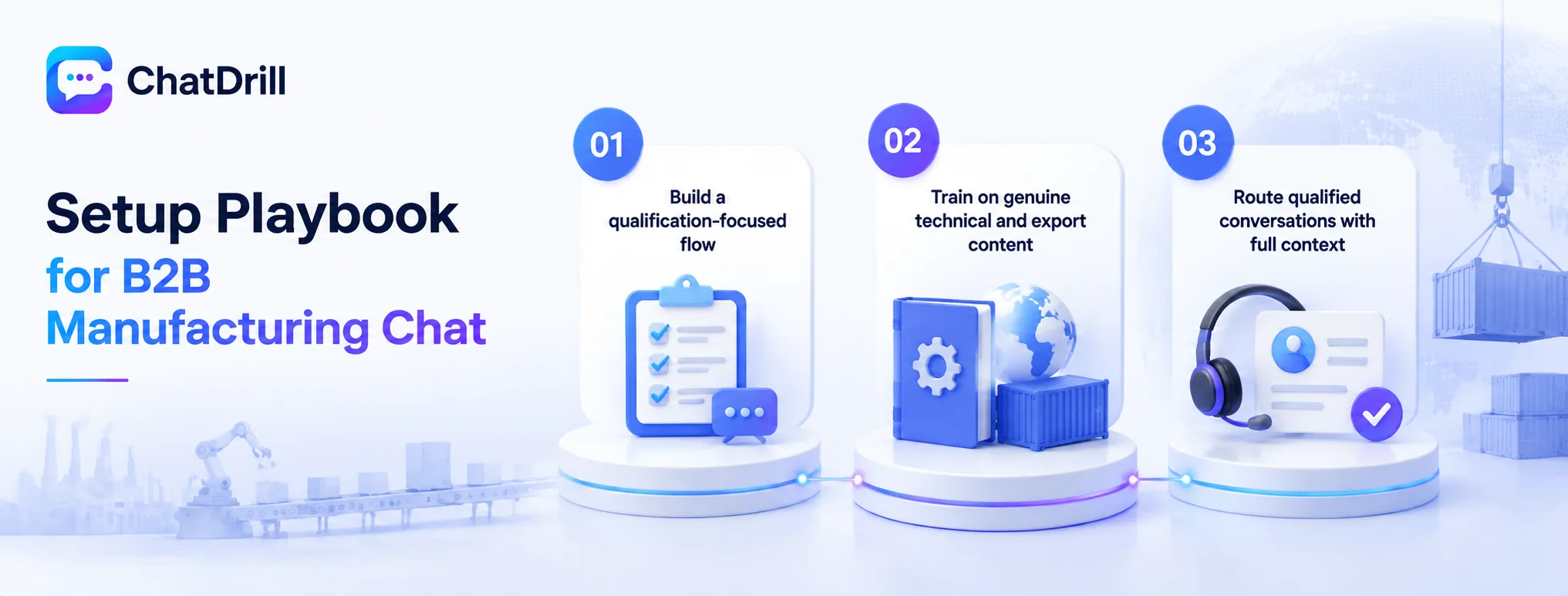
A strong setup builds a qualification-focused flow capturing specific requirements before routing to sales, trains AI on genuine technical specifications and export logistics, and connects qualified conversations to the right sales contact with full context.
Step 1: Build a qualification-focused flow
Design chat to ask targeted questions about quantity, specifications, and timeline before offering to connect the buyer with a sales representative, mirroring the qualification approach covered in a related guide on AI lead qualification.
This structured qualification produces a considerably more useful handoff than an open-ended conversation that captures only basic contact information.
Step 2: Train on genuine technical and export content
Feed AI real product specification ranges and accurate export logistics information, avoiding generic content that would signal insufficient depth to a genuinely technical, informed buyer.
This depth investment directly affects whether a buyer perceives your business as a credible, capable supplier during this early evaluation stage.
Step 3: Route qualified conversations with full context
Ensure a qualified conversation transfers to the appropriate sales contact with complete context, specifications discussed, quantities mentioned, destination market, avoiding the need for the buyer to repeat information already shared.
This clean handoff, covered in more depth in a related guide, matters especially here given how much specific technical detail a B2B manufacturing conversation typically involves.
Common Mistakes B2B Manufacturers Make With Chat
The most common mistakes are treating chat as a simple support tool rather than a qualification tool, giving vague answers to specification and MOQ questions that signal insufficient depth, and losing captured buyer detail during handoff to sales.
Treating chat as pure support rather than qualification
Approaching B2B manufacturing chat the same way as a consumer support widget misses its genuine potential as an efficient initial qualification tool for a longer, more considered sales process.
Recognizing this distinct role shapes better chat design, prioritizing structured requirement-gathering over simply answering isolated questions.
Vague specification and MOQ answers
A generic, non-specific response to a technical specification or MOQ question can signal to a sophisticated buyer that your business lacks the depth or organization they're looking for in a supplier.
Investing in genuinely specific, accurate training content is what actually builds credibility with this typically well-informed, comparison-shopping buyer audience.
Losing buyer detail during handoff
A qualified conversation that loses its captured specification and quantity detail during handoff forces the buyer to repeat information, undermining the efficiency gain the qualification flow was meant to provide.
This handoff quality issue is worth addressing directly, given how much specific, valuable detail a typical B2B manufacturing conversation captures that shouldn't be lost in transition.
Measuring Success for B2B Manufacturing Chat
Track qualified-conversation-to-sales-meeting conversion rate, the completeness of captured requirements at handoff, and feedback from sales on lead quality reaching them through chat.
Qualified conversation to sales meeting
Tracking what share of qualified chat conversations result in an actual scheduled sales conversation quantifies chat's genuine contribution to your pipeline for this longer sales cycle.
This metric reflects chat's realistic role in this industry, efficient initial qualification rather than direct transaction completion.
Requirement capture completeness
Reviewing whether qualified conversations consistently capture key details, specifications, quantity, timeline, destination, reveals whether your qualification flow is genuinely thorough enough to produce useful sales handoffs.
This review is worth doing directly with sales team input, confirming the captured information genuinely matches what they need for an effective follow-up conversation.
Sales feedback on lead quality
Directly asking your sales team whether chat-qualified leads feel genuinely useful and well-prepared provides a qualitative check the conversion numbers alone might not fully capture.
This feedback loop helps refine the qualification flow over time, ensuring it continues capturing genuinely useful, sales-relevant detail as your product line or market evolves.
Rolling Out Chat Across Sales Engineering
Piloting the qualification flow with one product line before expanding catalog-wide, and getting sales engineering involved early in reviewing technical answers, helps a manufacturer's chat rollout earn credibility with a sophisticated buyer audience from day one.
Piloting with one product line
Launching chat first for a single, well-documented product line lets you validate both the qualification flow and the technical depth of AI answers before expanding to your full catalog.
This narrower scope makes it easier to catch a specification answer that reads as vague or generic, correcting the training content before it's replicated across a wider product range.
Sales engineering should review a sample of real conversations during this pilot, since they're best positioned to judge whether the technical depth would satisfy a genuinely informed buyer.
Getting sales engineering involved early
Involving sales engineers in reviewing both training content and real conversation transcripts before wider rollout catches gaps a purely marketing-focused reviewer would likely miss.
This involvement also helps ensure the qualification flow captures the specific details, tolerances, materials, quantities, that sales engineering actually needs for an effective, well-prepared follow-up call.
Keeping this review cadence going even after full rollout, not just during the pilot, helps the qualification flow stay aligned as your product line or typical buyer profile evolves.