
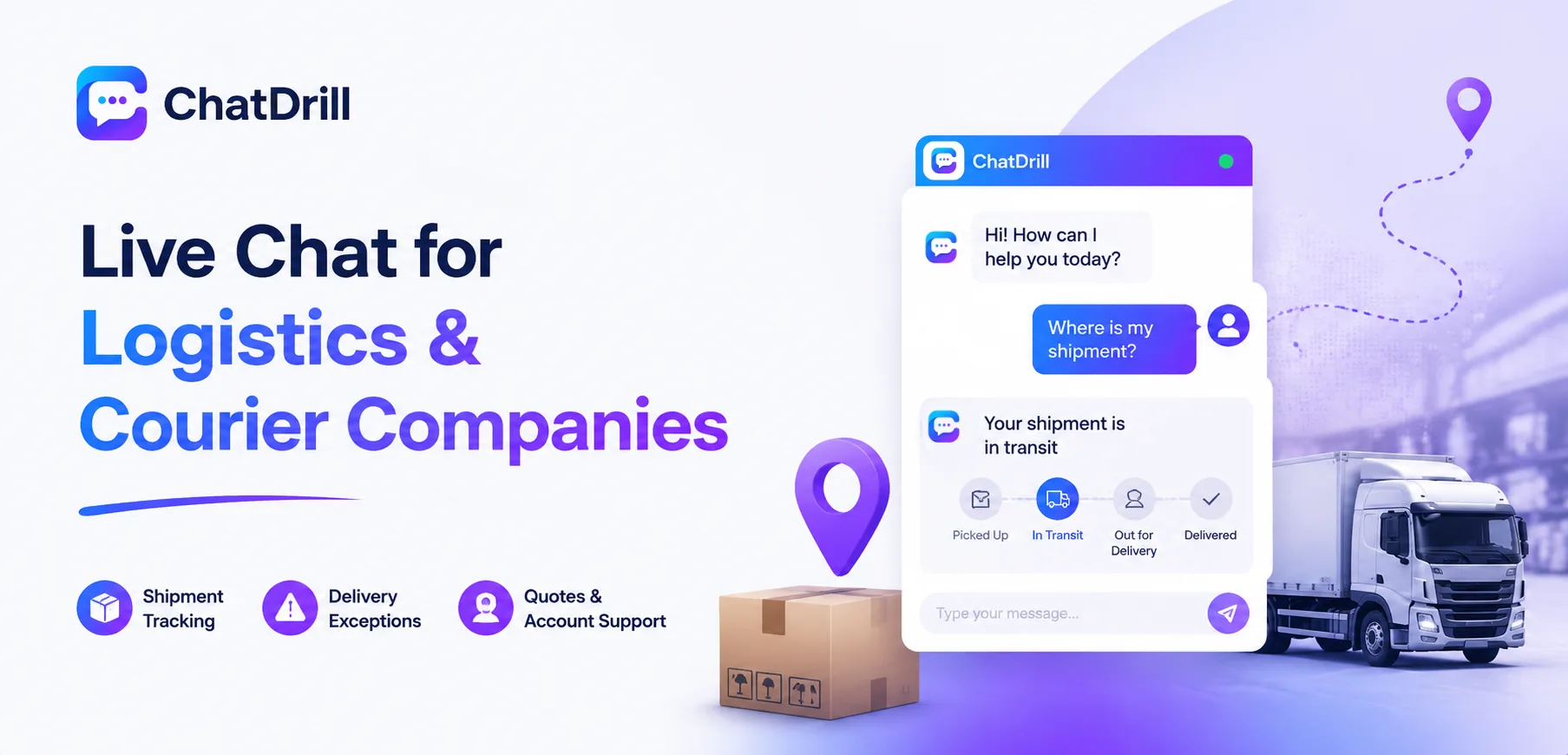
Logistics and courier chat volume is dominated by one overwhelming category, shipment status and tracking, which makes this one of the clearest, highest-ROI cases for connecting chat directly to real, live tracking data rather than relying on generic responses.
Beyond routine tracking, delivery exceptions, a delay, a failed delivery attempt, a damaged package, represent a smaller but genuinely higher-stakes category where customers are often frustrated and want fast, clear resolution rather than a scripted, unhelpful response.
For companies serving business shippers specifically, quote requests and account-level questions add another distinct category, one that benefits from a more sales-oriented, qualification-focused chat approach rather than pure support automation.
This guide covers why tracking dominates logistics chat, what customers typically ask, a practical setup approach, and mistakes worth avoiding.
Why Tracking Dominates Logistics Chat Volume
Shipment status questions consistently represent the largest single category of logistics chat volume, making direct integration with real tracking data the single highest-leverage investment for this industry specifically.
The sheer volume of tracking questions
"Where's my package" and its many variations dominate chat volume for any courier or logistics business handling meaningful shipment volume, a pattern consistent across the industry regardless of specific business size.
This volume concentration means even modest automation success in this single category delivers outsized overall efficiency impact compared to a more evenly distributed question mix.
Why exceptions carry disproportionate weight
A delayed, failed, or damaged delivery represents a smaller share of total volume but a disproportionately larger share of customer frustration, deserving careful, fast handling beyond routine automated tracking responses.
Recognizing and appropriately escalating this category, rather than treating it identically to a routine tracking check, protects the customer relationship during exactly the moments most likely to affect satisfaction.
What Customers Typically Ask
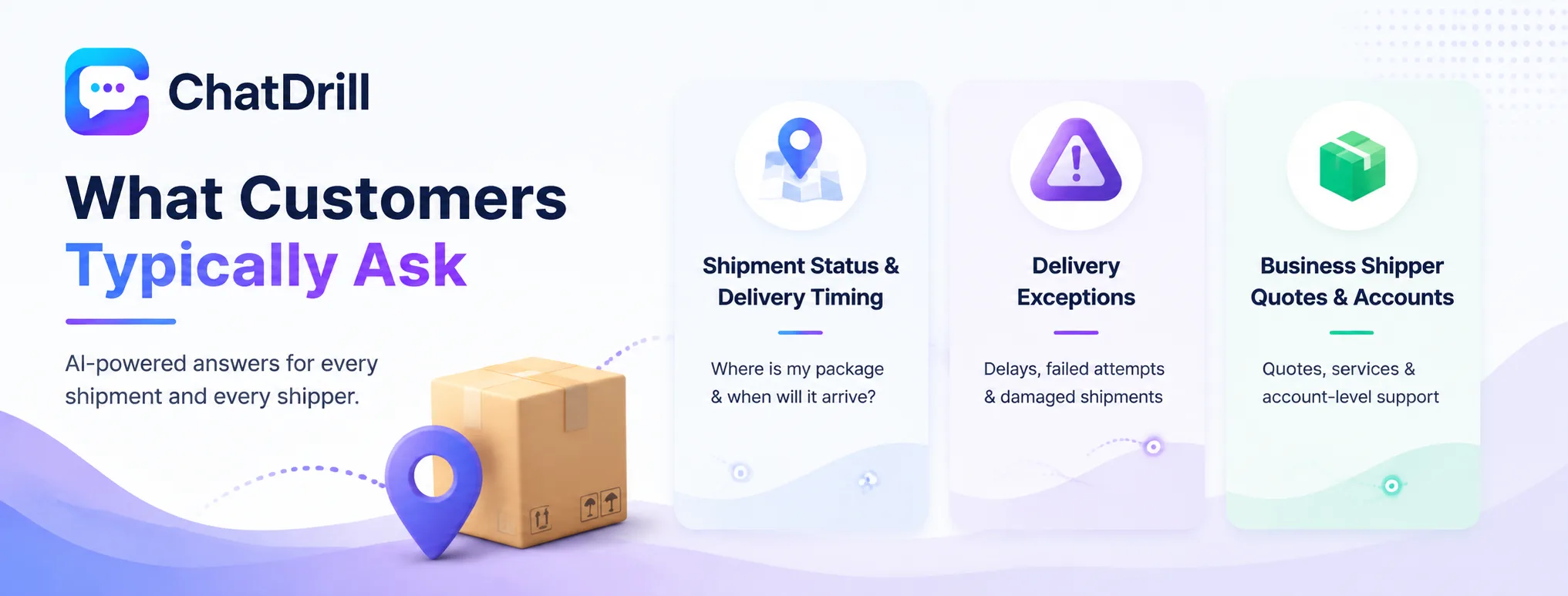
Individual customers ask primarily about shipment status and expected delivery time, while business shippers more often ask about shipping quotes, service options, and account-level logistics questions.
Shipment status and delivery timing
Where a specific shipment currently is and when it's expected to arrive make up the overwhelming majority of individual customer chat volume, highly automatable given access to real tracking data.
This category rewards direct data connection heavily, since even a sophisticated AI without real tracking access can't actually answer this question accurately.
Delivery exceptions
Questions about a delayed shipment, a failed delivery attempt, or a damaged package require careful, often escalated handling given the genuine frustration typically involved.
This category benefits from AI recognizing the exception pattern and either providing clear, specific next steps or routing quickly to a human who can resolve the actual issue.
Business shipper quotes and account questions
For companies serving business customers, questions about shipping rates, service level options, and account-specific logistics arrangements represent a distinct, more sales-oriented category.
This category benefits from a qualification-style approach, similar to B2B lead qualification in other industries, gathering shipping volume and destination details before providing a relevant quote.
Setup Playbook for Logistics Chat
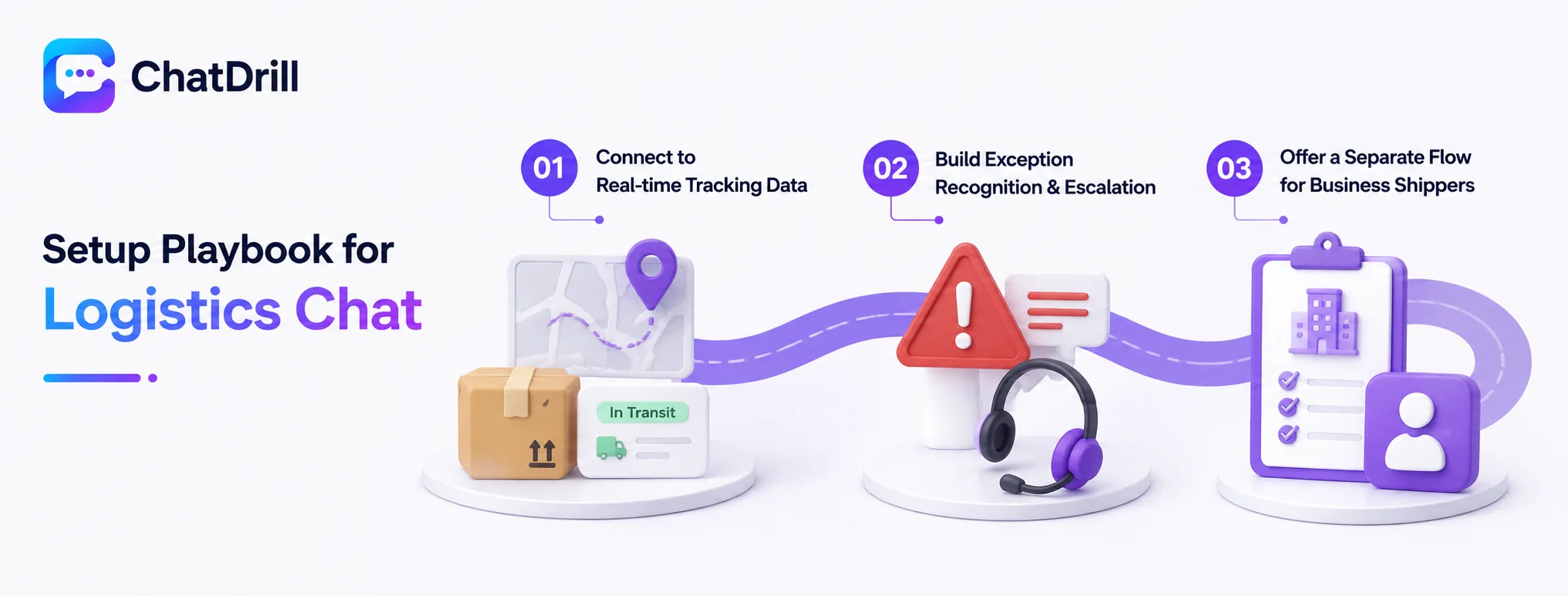
A strong setup connects chat directly to real-time tracking data as the top priority, builds explicit recognition and fast escalation for delivery exceptions, and offers a separate, qualification-focused flow for business shipping inquiries.
Step 1: Connect to real-time tracking data
Integrating chat with your tracking system lets AI provide accurate, current shipment status directly, resolving the single largest category of logistics chat volume without any human involvement needed.
This connection alone often delivers the majority of a logistics business's overall chat automation value, given how concentrated volume typically is in this specific category.
Step 2: Build exception recognition and escalation
Configure chat to recognize language suggesting a delay, failed delivery, or damage complaint, providing clear initial guidance and fast escalation to a human who can genuinely resolve the issue.
This recognition should be tested with realistic exception scenarios, confirming the flow appropriately distinguishes frustrated, exception-related messages from routine tracking checks.
Step 3: Offer a separate flow for business shippers
Building a distinct, qualification-oriented chat path for business shipping inquiries, gathering volume, destination, and service needs before connecting to a sales or account representative, serves this audience meaningfully better than generic support-focused chat.
This separation mirrors the audience-specific approach worth taking in other industries serving genuinely distinct customer types through the same chat channel.
Common Mistakes Logistics Companies Make With Chat
The most common mistakes are running a chatbot with no real tracking data connection, treating a delivery exception with the same generic response as a routine status check, and offering no distinct path for business shippers with genuinely different needs.
No real tracking data connection
A chatbot unable to look up actual, current shipment status ends up deflecting the single highest-volume question category to human agents, undermining most of chat's potential efficiency value for this industry.
This gap is worth prioritizing above nearly any other chat improvement, given how concentrated logistics chat volume typically is in this exact category.
Treating exceptions like routine questions
Responding to a frustrated customer describing a failed or damaged delivery with the same generic, routine tracking response fails to acknowledge the genuine issue and can worsen the customer's frustration.
Building explicit recognition for this category, with an appropriately different, more careful response, respects the real difference in what these customers need.
No distinct path for business shippers
Treating a business shipper's quote request identically to an individual customer's tracking question misses the opportunity for a more sales-oriented, qualification-focused approach this audience genuinely needs.
This missed distinction can mean losing genuine business pipeline opportunity by routing a potentially valuable account inquiry through generic, support-focused chat handling.
Measuring Success for Logistics Chat
Track AI deflection rate specifically on tracking questions, escalation speed for delivery exceptions, and quote-to-account conversion rate for business shipper inquiries.
Tracking question deflection
Tracking how much shipment status volume AI resolves without human involvement quantifies the efficiency gain from your tracking data connection, typically the clearest and most impactful metric for this industry.
A ChatDrill setup connected to real tracking data, for a logistics business using it, tends to show consistently strong deflection in this specific, high-volume category.
Exception escalation speed
Tracking how quickly a flagged delivery exception reaches a human agent confirms whether your recognition and escalation setup is genuinely working during the moments most likely to affect customer satisfaction.
This metric deserves particular attention given the direct connection between exception handling speed and customer retention in a competitive courier market.
Business shipper quote conversion
Tracking what share of business shipping inquiries convert into an actual account or shipment quantifies the value of your qualification-focused chat flow for this distinct, higher-value audience.
This is worth tracking separately from consumer chat metrics, given how different the underlying business value and conversation pattern is for this audience.
Rolling Out Chat Across Support and Sales Teams
Launching chat first for tracking questions, the highest-volume and most straightforward category, before adding exception handling and business shipper flows gives a logistics team a proven foundation to build the rest on.
Starting with tracking automation
Focusing initial launch on connecting chat to live tracking data resolves the single largest category of chat volume quickly, delivering measurable efficiency gains before more complex flows are introduced.
This phase is straightforward to validate, since accuracy is easy to check directly against your own tracking system, catching any data connection issues before they affect meaningful volume.
The efficiency gains from this single connection are usually visible within days of launch, given how concentrated logistics chat volume typically is in exactly this category.
Adding exception handling and business flows
Once tracking automation is stable, layering in exception recognition requires more careful testing, since a missed or delayed exception escalation carries real customer-frustration cost worth avoiding.
Running realistic exception scenarios through the flow before wider launch, then reviewing a sample of real flagged conversations in the first weeks after, helps confirm the recognition logic works as intended.
The business-shipper qualification flow is worth building and testing separately, ideally with input from your sales or account team on what information actually helps them follow up effectively.