
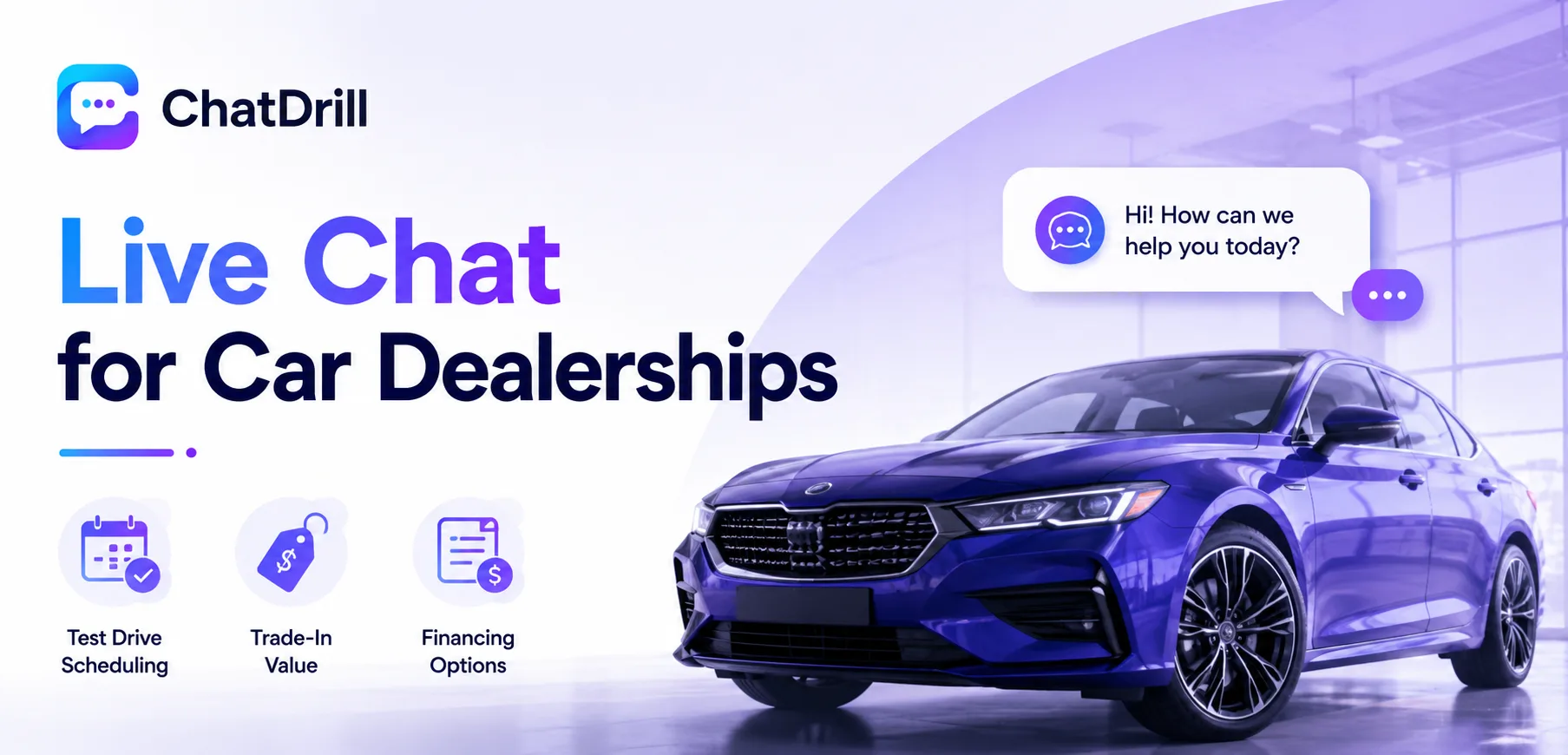
A car dealership's chat visitors are typically deep into a considered, high-value purchase decision, comparing specific vehicles, pricing, and financing options, which means generic responses fall noticeably short of what a genuinely engaged buyer expects.
Test drive scheduling and trade-in value questions represent two of the highest-intent moments in this process, and how quickly and specifically these get handled often determines whether a prospect continues engaging with your dealership or moves to a competitor.
Financing questions add another layer of complexity, since general guidance is useful but specific approval details require the kind of verification and human judgment that shouldn't be attempted through automated chat alone.
This guide covers why dealership chat centers on high-consideration decisions, what prospects typically ask, a practical setup approach, and mistakes worth avoiding.
Why Dealership Chat Centers on High-Consideration Decisions
A car purchase is a significant, carefully researched decision, meaning dealership chat visitors are typically comparing specific vehicles and pricing across multiple dealers, rewarding fast, specific answers over generic reassurance.
The comparison-shopping reality
A prospective buyer researching a specific vehicle is often comparing inventory, pricing, and dealer reputation across several dealerships simultaneously, similar to the competitive dynamic in real estate chat.
This means the dealership that provides the fastest, most specific answer to a prospect's question often has a genuine edge in keeping that prospect engaged rather than moving to a competitor.
Why test drives and trade-ins are especially high-value moments
A prospect asking to schedule a test drive or requesting a trade-in estimate has demonstrated concrete, actionable interest, making fast, frictionless handling of these specific requests particularly valuable.
These moments deserve prioritized attention in chat design, similar to how cart and checkout pages deserve prioritized attention in ecommerce chat strategy.
What Prospects Typically Ask
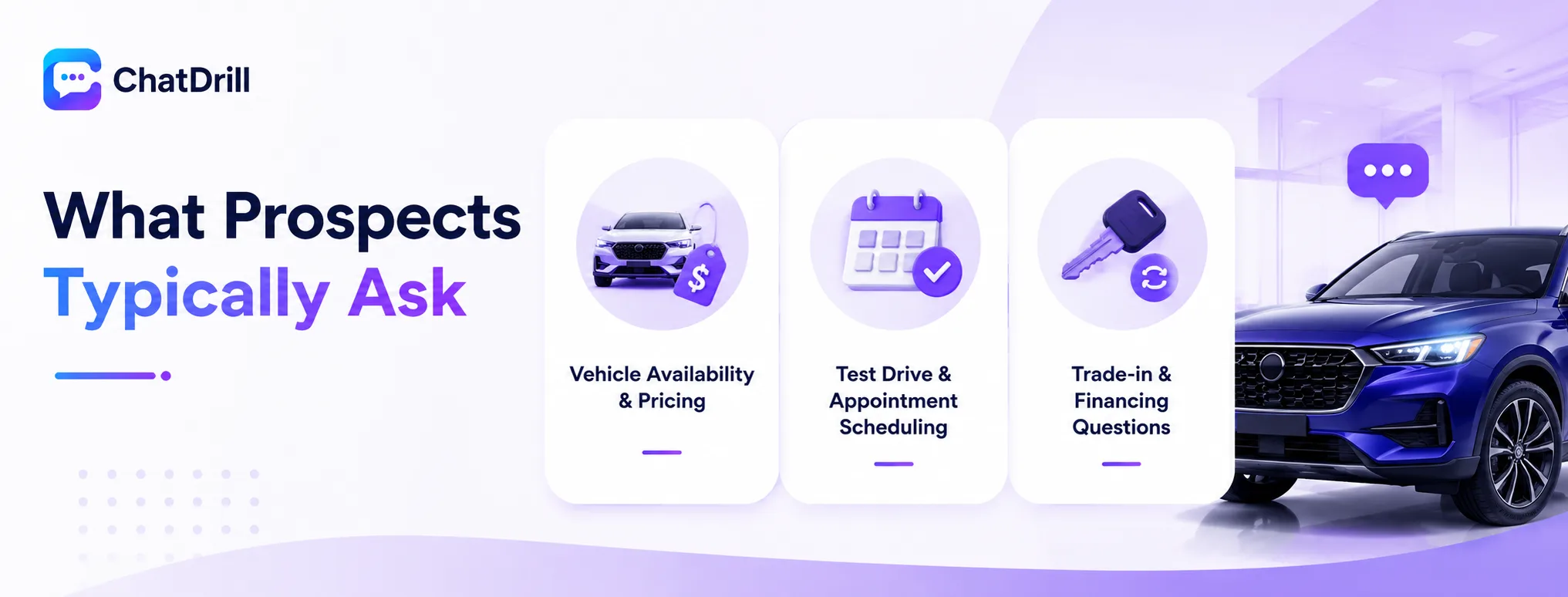
Prospects ask about specific vehicle availability and pricing, test drive scheduling, trade-in value estimates, and general financing options, a mix of inventory-specific and process questions.
Vehicle availability and pricing
Questions about whether a specific vehicle is in stock, its current price, and available trim or color options dominate chat volume, best answered with AI connected to your actual, current inventory.
A chatbot without real inventory access ends up deflecting exactly the specific questions a comparison-shopping prospect wants answered quickly.
Test drive and appointment scheduling
Requests to schedule a test drive or an in-person visit represent high-intent moments worth handling with minimal friction, ideally booking directly within the chat conversation.
This category benefits significantly from embedded scheduling, similar to how appointment booking works well embedded directly in chat across several other industries covered in related guides.
Trade-in and financing questions
General trade-in value estimates and financing option overviews are useful for AI to provide, while specific approval details and precise trade-in appraisals genuinely require human involvement and often an in-person or documented process.
Being clear about this distinction in chat, general guidance from AI, specific verification from a human, sets appropriate expectations rather than promising more precision than chat alone can responsibly provide.
Setup Playbook for Dealership Chat
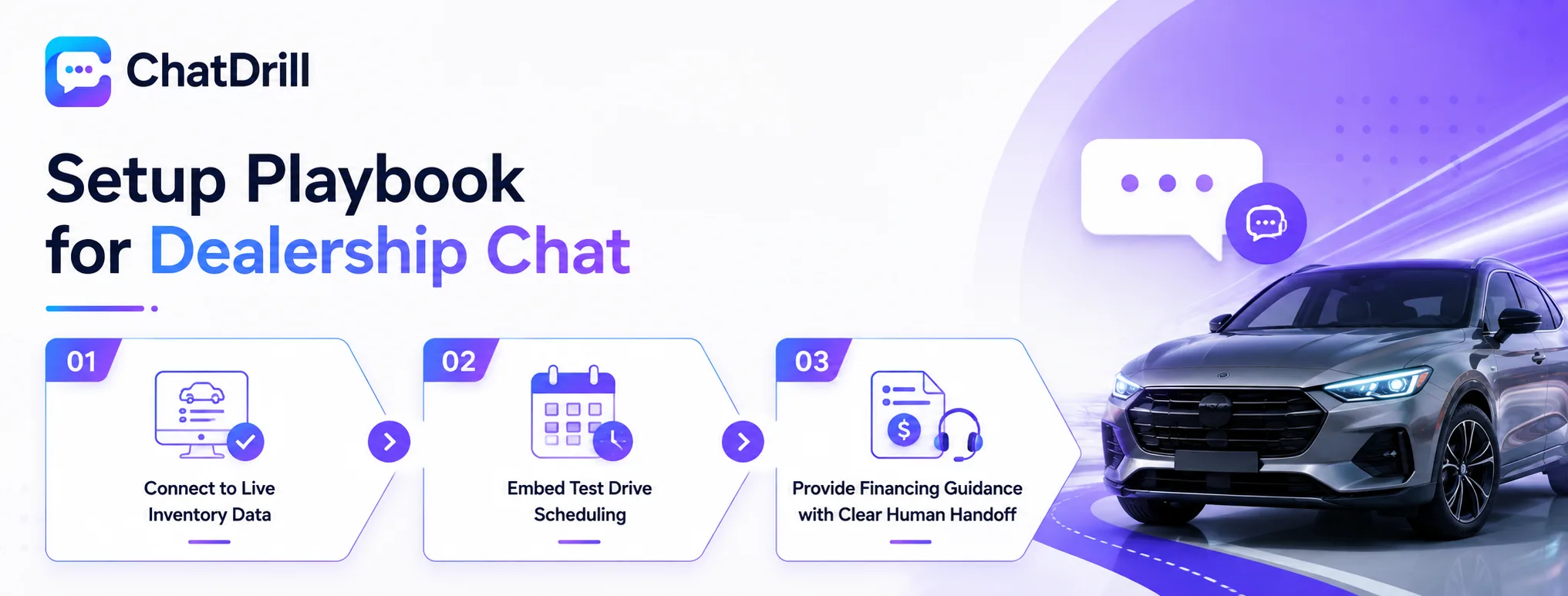
A strong setup connects chat to real-time inventory data, embeds test drive scheduling directly into the conversation, and provides general financing guidance while clearly routing specific approval questions to a human.
Step 1: Connect to live inventory data
Integrating chat with your inventory management system lets AI answer specific vehicle availability and pricing questions accurately, rather than giving outdated or generic responses.
This connection is the single highest-value setup investment, given how central specific vehicle questions are to a typical dealership's chat volume.
Step 2: Embed test drive scheduling
Letting a prospect book a test drive directly within the chat conversation, rather than requiring a separate call or form, captures interest at its peak and reduces the friction that causes genuine intent to fade.
This is a relatively straightforward addition that tends to meaningfully improve actual booked test drives compared to a chat setup without this capability.
Step 3: Provide general financing guidance with clear human handoff
Train AI to give helpful, general financing information while clearly directing anything requiring specific approval or precise numbers to a finance team member, avoiding overpromising what chat alone can responsibly deliver.
This clear boundary protects both the prospect's expectations and the dealership from any confusion around informal chat guidance versus an actual financing commitment.
Common Mistakes Dealerships Make With Chat
The most common mistakes are showing outdated inventory or pricing information, requiring a separate step to schedule a test drive instead of embedding it in chat, and letting AI attempt to provide specific financing approval details it can't responsibly guarantee.
Outdated inventory information
A chatbot not connected to real-time inventory risks telling a prospect a vehicle is available when it's actually sold, creating a frustrating, trust-damaging experience right at a critical decision point.
This accuracy gap is worth addressing directly, given how central specific vehicle availability is to the comparison-shopping process most dealership prospects are in.
Requiring a separate scheduling step
Sending an interested prospect to a separate scheduling page for a test drive, rather than embedding this directly in chat, introduces friction at exactly the moment their interest is highest.
This friction reduction is worth prioritizing given how directly test drive scheduling connects to eventual sale conversion.
AI overpromising on financing
Allowing AI to give specific-sounding financing approval details it can't actually guarantee creates a real risk of setting an expectation the dealership then can't honor.
Keeping financing guidance appropriately general, with clear escalation for specifics, avoids this mismatch between chat promises and actual approval outcomes.
Measuring Success for Dealership Chat
Track chat-to-test-drive booking rate, AI deflection on inventory and pricing questions, and chat-engaged prospect conversion to an actual sale compared to non-engaged visitors.
Chat-to-test-drive conversion
Tracking what share of vehicle-interested chat conversations result in an actual booked test drive quantifies chat's direct contribution to your sales pipeline's most concrete early milestone.
This is worth segmenting by vehicle type or price range where possible, revealing whether certain inventory categories see stronger chat-driven engagement.
Inventory question deflection
Tracking how much vehicle availability and pricing question volume AI resolves without staff involvement shows the efficiency gain from a well-connected inventory data setup.
A consistently strong deflection rate here frees sales staff time for in-person and more complex negotiation conversations.
Chat-engaged sale conversion
Comparing eventual sale conversion between chat-engaged and non-engaged prospects reveals chat's genuine contribution to closed deals, not just earlier funnel metrics.
This is often the most compelling metric for justifying continued dealership chat investment, tying the tool directly to actual revenue outcomes.
Rolling Out Chat Across Sales and Service
Launching chat first on new inventory pages with sales team involvement, then extending to service scheduling once the inventory connection is proven, keeps a dealership's rollout focused on its highest-value opportunity first.
Starting with sales and inventory
Focusing initial launch on vehicle availability, pricing, and test drive scheduling lets your sales team validate inventory data accuracy before the tool takes on additional responsibilities like service scheduling.
This phase is the right time to catch any lag between your actual lot and what chat is showing, an accuracy gap worth resolving before it affects more prospects during full launch.
Reviewing real conversations with sales staff during this pilot also surfaces which financing and trade-in questions come up most, informing how to scope the general-guidance boundary discussed earlier.
Extending to service department scheduling
Once sales-side chat is stable, connecting chat to service department scheduling brings a genuinely different, appointment-focused use case worth its own dedicated testing before wider rollout.
Service advisors should be involved reviewing early conversations in this area, since their scheduling constraints and typical customer questions differ meaningfully from what the sales team's chat experience covers.
This staged expansion also makes it easier to track which department is driving the strongest chat-attributed results, useful for justifying continued investment in either area specifically.