
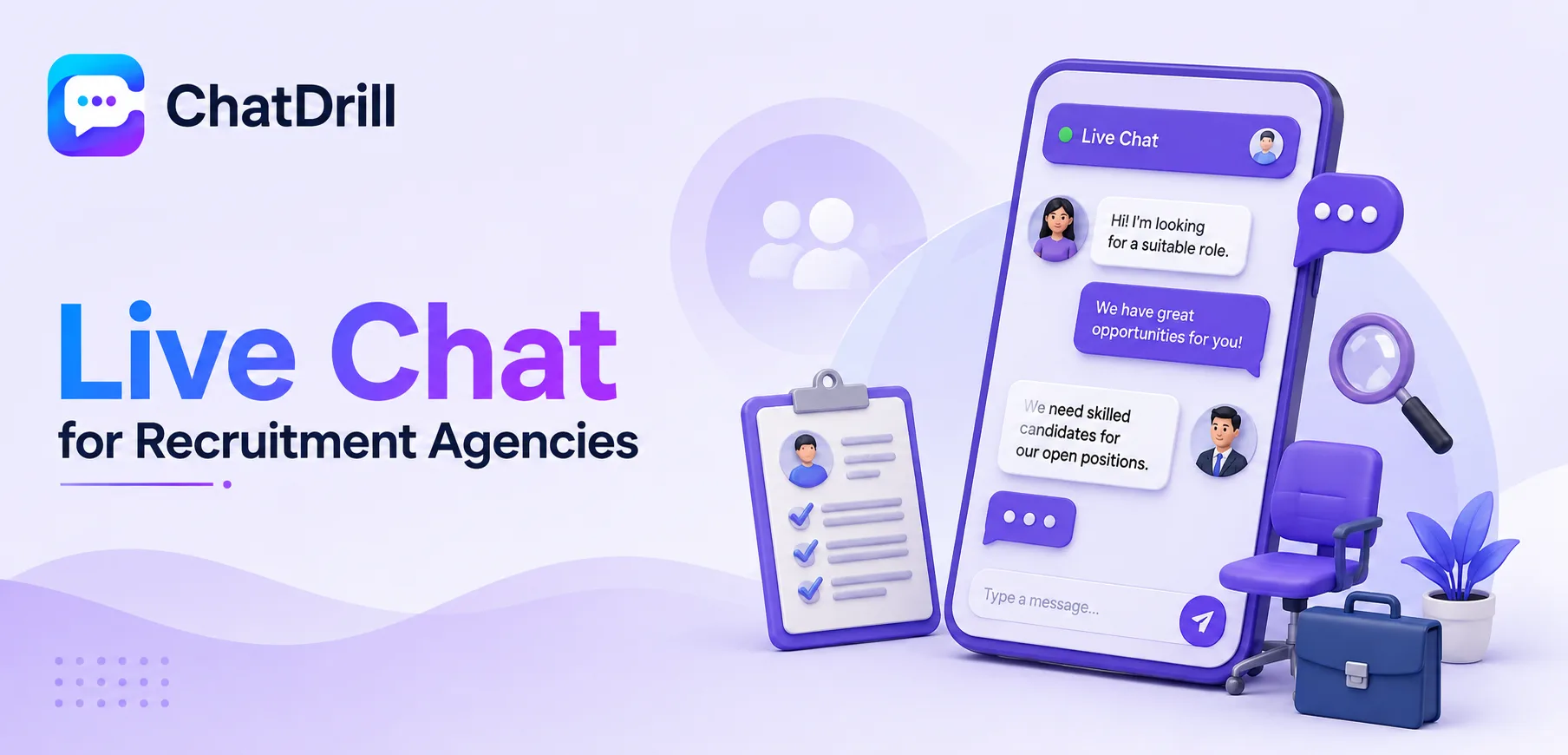
A recruitment agency's chat visitors split into two genuinely distinct audiences, candidates checking on an application or exploring a role, and client companies with a staffing need, each expecting a different kind of conversation and a different pace of response.
Candidate-side chat carries a real competitive dimension too, a strong candidate is often talking to several agencies or applying to several roles at once, and the agency that responds fastest with a relevant, specific answer often keeps that candidate engaged longer than one that goes quiet for a day.
Client-side conversations matter differently, an employer reaching out about a staffing need is often evaluating whether this agency can move quickly and understand the role well enough to send qualified candidates rather than a scattershot of resumes.
This guide covers why recruitment chat needs to serve these two audiences differently, what candidates and clients typically ask, a practical setup approach, and mistakes worth avoiding.
Why Recruitment Agency Chat Serves Two Different Audiences
A recruitment agency's chat needs to serve candidates checking on applications and client companies with staffing needs, two audiences with different urgency levels and different questions that benefit from distinct handling.
The candidate engagement window
A candidate actively job-hunting is often applying through multiple agencies and job boards simultaneously, making a fast, specific chat response a real factor in whether they stay engaged with a particular agency or move on.
This competitive dynamic means candidate-facing chat benefits from treating speed and relevance with the same seriousness a sales team would, since a disengaged candidate represents a lost placement opportunity.
The client relationship dimension
A client company reaching out about a staffing need is often implicitly evaluating the agency's responsiveness and understanding of the role, factors that influence whether they trust the agency with future openings too.
Recognizing this evaluative undertone helps shape a client-facing chat experience that feels attentive and genuinely informed, not just transactional.
What Candidates and Client Companies Actually Ask
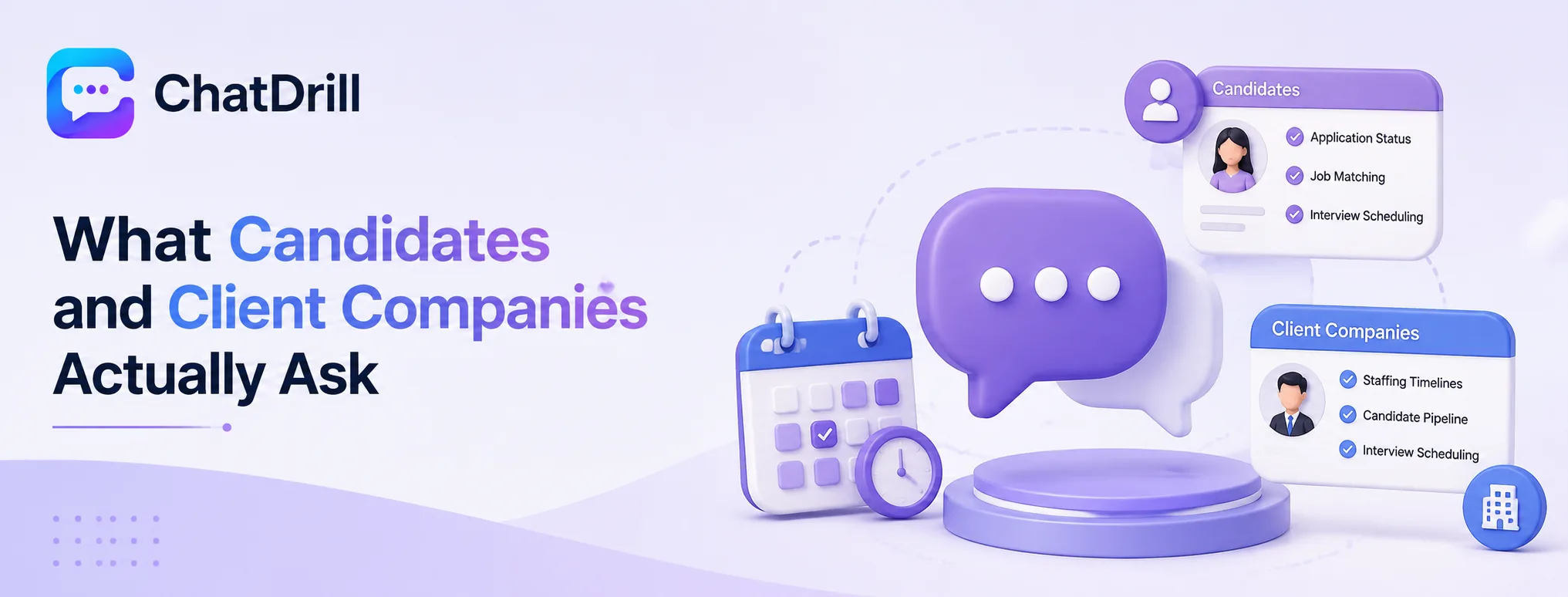
Candidates ask about application status and job matching, client companies ask about staffing timelines and candidate pipeline, and both sides ask scheduling questions around interviews, each benefiting from tailored, accurate handling.
Candidate application and status questions
Where an application currently stands, whether a resume was received, and what happens next in the process make up the bulk of candidate-side chat volume, well suited to automation once connected to your applicant tracking data.
This category rewards genuine specificity, a vague "we'll be in touch" response tends to increase candidate anxiety and disengagement compared to a clear, accurate status update.
Job matching and role fit questions
Candidates frequently ask whether a specific role matches their experience or salary expectations, questions that benefit from AI trained on your actual open roles rather than generic career advice.
Handling this well means a candidate leaves the conversation either genuinely encouraged about a real fit or clearly informed it isn't, rather than left with an ambiguous non-answer.
Client staffing needs and pipeline questions
Client companies ask about typical time-to-fill for a role type, what the current candidate pipeline looks like, and how to submit a new staffing request, questions best answered with accurate, current agency data.
This category directly shapes the client relationship, a specific, confident answer about pipeline and timeline builds more trust than a generic, noncommittal response.
Setup Playbook for Recruitment Agency Chat
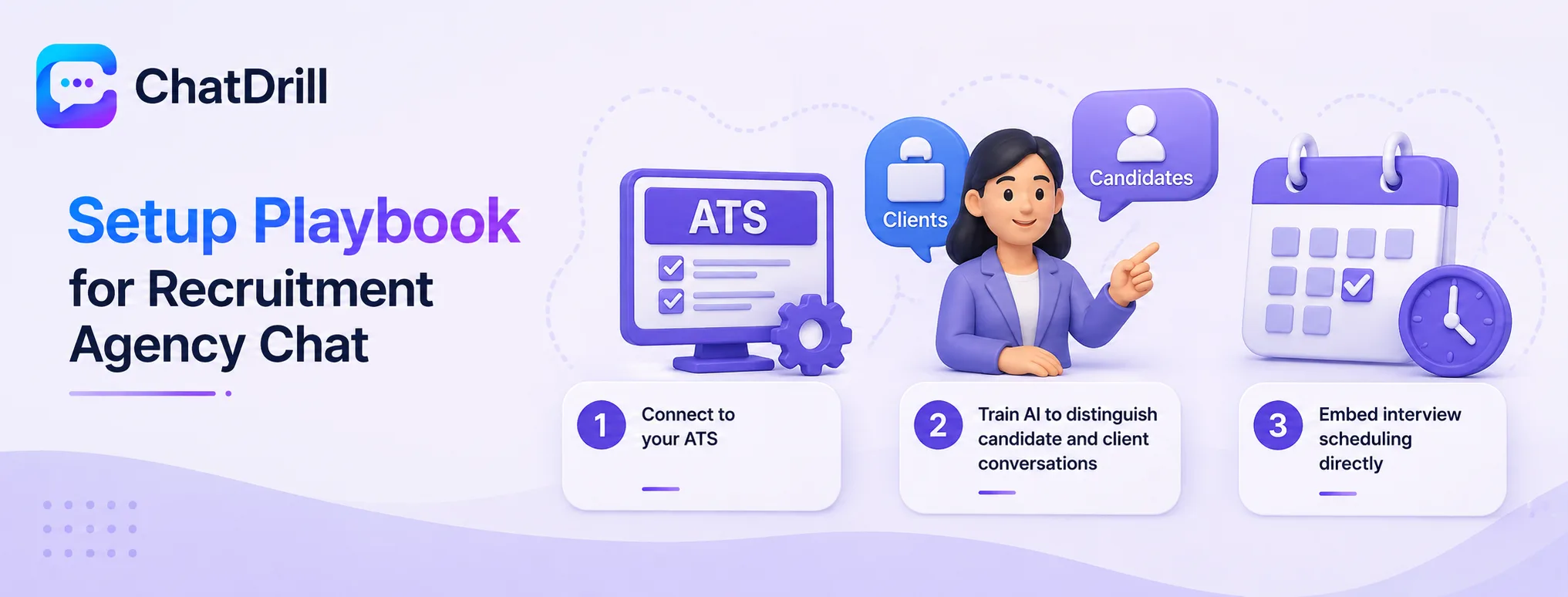
A strong setup connects chat to your applicant tracking system for accurate status updates, trains AI to distinguish candidate from client conversations, and embeds interview scheduling directly to reduce back-and-forth.
Step 1: Connect to your ATS
Integrating chat with your applicant tracking system lets AI answer specific application-status questions accurately, rather than giving a generic response that doesn't reflect where a candidate actually stands.
This connection is the single highest-value setup investment for candidate-side chat, given how much volume typically concentrates in status and follow-up questions.
Step 2: Train AI to distinguish candidate and client conversations
Configuring chat to recognize whether a visitor is a candidate or a client company, and routing tone and content accordingly, ensures each audience gets an appropriately tailored experience rather than one generic flow.
This distinction also supports better internal routing, directing client staffing requests to account managers and candidate questions to recruiting coordinators.
Step 3: Embed interview scheduling directly
Letting a candidate or client book an interview slot directly within the chat conversation, rather than requiring a separate email exchange, removes friction at exactly the moment momentum matters most.
This addition tends to meaningfully reduce the scheduling back-and-forth that otherwise slows down a placement process considerably.
Common Mistakes Recruitment Agencies Make With Chat
The most common mistakes are running a chatbot with no real ATS connection, treating candidate and client conversations identically, and requiring a separate step outside chat to schedule an interview.
No real ATS connection
A chatbot unable to check actual application status forces every candidate question back to a recruiter, undermining much of the efficiency chat is meant to provide for this high-volume category.
This gap is worth prioritizing early, given how concentrated candidate-side chat volume typically is in exactly this status-checking function.
Treating candidates and clients identically
Applying the same generic chat flow to a job-seeking candidate and a hiring client company misses the opportunity to serve each of these genuinely different needs and expectations well.
Recognizing and routing these audiences distinctly produces a considerably better experience for both than a one-size-fits-all approach.
Requiring a separate scheduling step
Sending an interested candidate or client to a separate scheduling tool, rather than embedding this directly in chat, introduces friction at exactly the moment their engagement is highest.
This friction reduction is worth prioritizing given how directly interview scheduling speed connects to keeping both candidates and clients engaged through to a placement.
Measuring Success for Recruitment Agency Chat
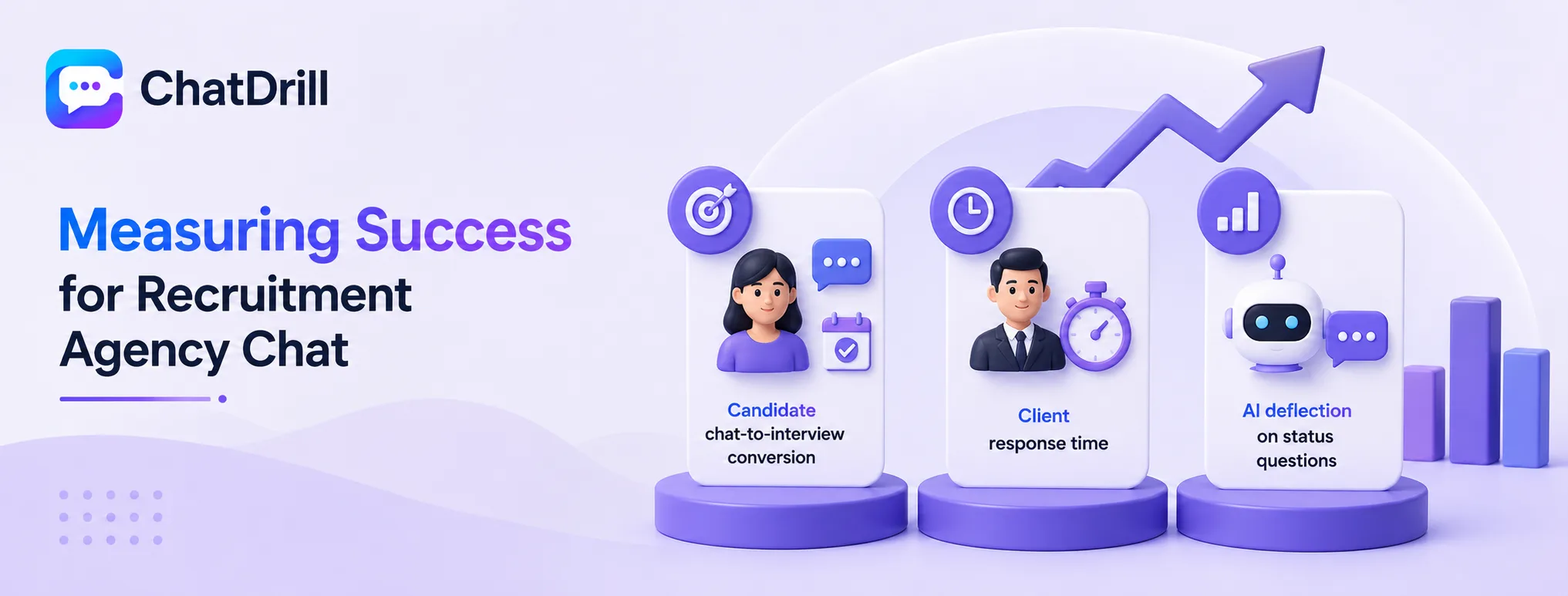
Track candidate chat-to-interview conversion rate, client response time given the relationship stakes involved, and AI deflection on routine status questions.
Candidate chat-to-interview conversion
Tracking what share of candidate chat conversations result in an actual scheduled interview quantifies chat's direct contribution to keeping candidates moving through the pipeline rather than disengaging.
This metric is worth segmenting by role type where possible, revealing whether certain roles see stronger chat-driven engagement than others.
Client response time
Tracking response time specifically for client-facing conversations, given how directly this shapes the client's broader impression of the agency's responsiveness, matters more here than a general average would suggest.
A consistently fast response to a client staffing inquiry helps build the trust that leads to repeat business and referrals.
AI deflection on status questions
Tracking how much application-status volume AI resolves without recruiter involvement quantifies the efficiency gain from a well-connected ATS integration.
A consistently rising deflection rate here frees recruiter time for the genuinely high-value work of sourcing and interviewing rather than answering repetitive status questions.
Rolling Out Chat Across Recruiters and Client Teams
Launching chat first for candidate-facing status questions, then extending to client staffing inquiries once the ATS connection is proven, keeps a recruitment agency's rollout focused on its highest-volume need first.
Starting with candidate-facing chat
Focusing initial launch on application status and job matching questions lets your recruiting coordinators validate ATS data accuracy before client-facing volume, with its different tone and stakes, is added.
This phase is also a good opportunity to review real candidate conversations for tone, confirming the AI feels genuinely helpful rather than bureaucratic during an already anxious job-search process.
A few weeks of close review here typically surfaces whether status updates are landing clearly before wider reliance on the setup.
Extending to client staffing conversations
Once candidate-facing chat is stable, adding client staffing inquiries brings a genuinely different, more relationship-focused conversation type worth testing with account managers involved in review.
Interview scheduling deserves particular attention during this expansion, tested directly with realistic booking scenarios to confirm it reduces friction as intended for both sides of the conversation.
Account managers should be briefed on how a client chat inquiry routes to them, ensuring a genuine staffing request receives prompt, informed follow-up rather than sitting in a generic queue.