
Healthcare chat carries a distinct set of considerations most other industries don't face, patient privacy expectations, sensitivity around health-related questions, and a genuine need to keep AI within clearly defined, conservative boundaries given the stakes involved.
This doesn't mean chat isn't valuable for a clinic or healthcare provider, appointment scheduling, basic administrative questions, and general practice information are all well suited to chat, the key is being deliberate about where AI's role should end and human, clinical judgment should begin.
Getting this balance right protects both patients and the practice, since a chatbot confidently answering a genuinely clinical question carries real risk that a well-defined escalation boundary can prevent entirely.
This guide covers what makes healthcare chat different, what patients typically ask, a setup approach that respects these considerations, and mistakes worth avoiding.
What Makes Healthcare Chat Different
Healthcare chat requires navigating genuine privacy sensitivity, avoiding AI overreach into clinical territory, and maintaining a consistently reassuring, careful tone given how personal and sometimes anxious health-related conversations can be.
The privacy and trust dimension
Patients reaching out about a health concern are often sharing genuinely sensitive information, requiring a chat experience that feels trustworthy and appropriately careful, not just fast or efficient.
This trust dimension shapes design choices throughout the setup, from what information is collected to how conversations are handled and stored.
Why AI boundaries matter more here than almost anywhere else
A chatbot confidently answering a question that genuinely requires clinical judgment carries real risk, both to patient wellbeing and to the practice, making conservative escalation boundaries especially important in this industry specifically.
This is a case where erring toward more human involvement, rather than maximizing automation, is usually the right call for anything touching genuinely clinical territory.
What Patients Typically Ask in Chat
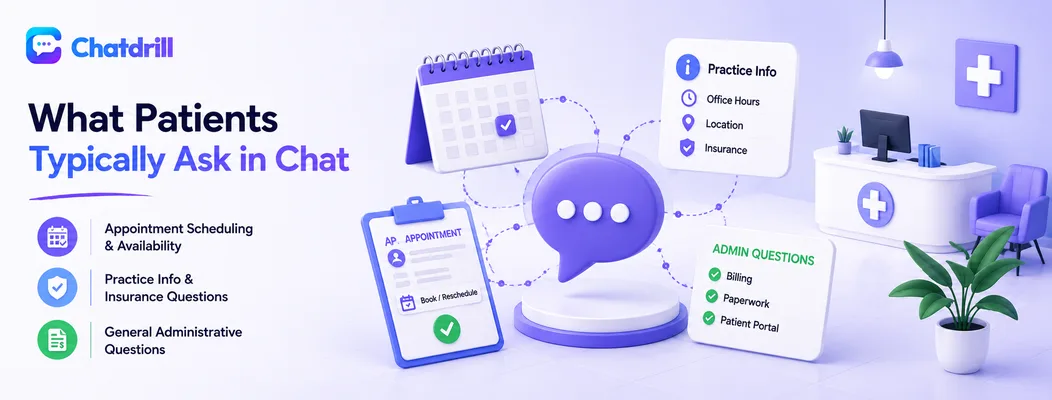
Patient chat volume centers on appointment scheduling, basic practice information like hours and insurance acceptance, and general administrative questions, categories well suited to chat automation without venturing into clinical judgment.
Appointment scheduling and availability
Booking, rescheduling, or checking availability for an appointment is consistently one of the highest-volume, most automatable categories, a genuinely administrative task well suited to chat handling.
This category delivers real value with minimal risk, since it doesn't require any clinical judgment, purely logistics that a well-connected scheduling system can handle directly.
Practice information and insurance questions
Questions about office hours, location, accepted insurance plans, and general practice policies are common, low-risk, and well suited to AI trained on your actual, current practice details.
This category benefits from accuracy and currency specifically, an outdated insurance list or incorrect hours creates real patient frustration even though the question itself carries low clinical risk.
General, non-clinical administrative questions
Questions about billing, paperwork requirements before a visit, or how to access patient portal information fall into a useful automatable category, distinct from any question requiring clinical assessment.
Clearly distinguishing this administrative category from anything clinical, in both training content and escalation rules, keeps AI appropriately scoped to what it should genuinely handle.
Setup Playbook for Healthcare Chat
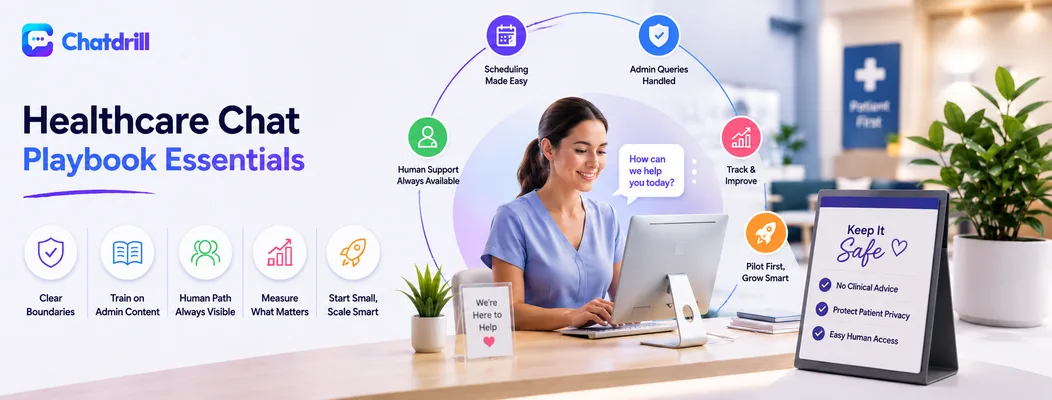
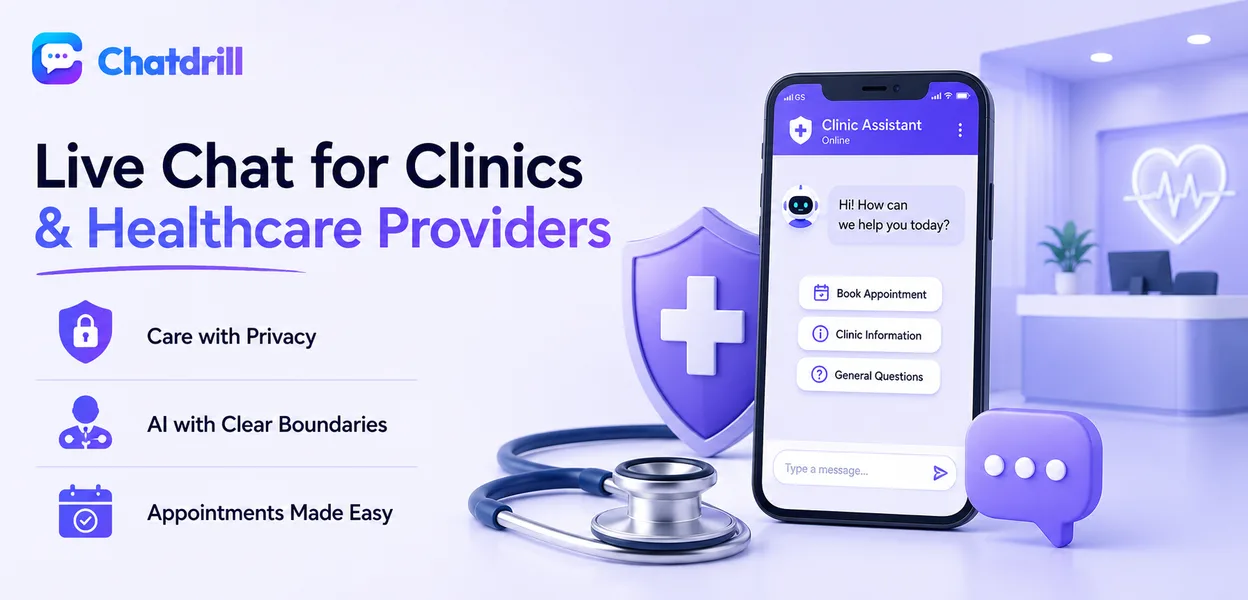
A responsible healthcare chat setup defines clear, conservative boundaries around clinical topics, trains AI specifically on administrative and scheduling content, and maintains an easy, always-visible path to human staff for anything beyond that defined scope.
Step 1: Define clear clinical boundaries
Explicitly configure the AI to escalate any question touching symptoms, diagnosis, treatment, or medical advice, rather than attempting to answer, establishing a firm, conservative line before launch.
This boundary-setting is worth treating as a non-negotiable first step, not an optional refinement, given the genuine stakes involved in getting this wrong.
Step 2: Train on administrative content specifically
Focus AI training on scheduling, hours, insurance, and general practice policy content, the categories that deliver real value without touching clinical territory.
This focused scope keeps the AI genuinely useful for its intended purpose while avoiding the temptation to expand into higher-risk territory it isn't equipped to handle responsibly.
Step 3: Maintain an always-visible human path
Ensuring a patient can easily reach a human staff member at any point in the conversation, not just after an AI escalation trigger, respects that some patients will prefer human interaction for health-related conversations regardless of the specific question.
This visible option also builds trust, signaling that the practice takes the sensitivity of health-related communication seriously rather than funneling every interaction through automation by default.
Common Mistakes Healthcare Providers Make With Chat
The most common mistakes are allowing AI to attempt anything resembling clinical guidance, failing to clearly communicate privacy practices around chat conversations, and making it hard for a patient to reach a human when they specifically want to.
Allowing AI into clinical territory
Even a seemingly simple symptom-related question carries genuine risk if answered by AI rather than escalated, a boundary worth enforcing strictly rather than allowing case-by-case judgment calls that could drift into overreach.
This is the single most important mistake to avoid in healthcare chat specifically, given the direct connection to patient wellbeing and practice liability.
Unclear privacy communication
Patients reasonably want to understand how their chat conversation is handled and stored, and failing to communicate this clearly can undermine trust even if the actual privacy practices are genuinely sound.
A brief, clear note about privacy practices, rather than assuming patients will simply trust the process, meaningfully improves comfort with using chat for health-related communication.
Making human access hard to find
Burying the option to reach a human staff member behind several automated steps frustrates patients who specifically prefer human interaction for a health-related conversation from the start.
Keeping this option visible and easy to access respects patient preference rather than assuming every patient wants to interact primarily with AI.
Measuring Success for Healthcare Chat
Track appointment booking completion rate through chat, AI deflection on purely administrative questions, and escalation rate to confirm clinical boundaries are being respected consistently rather than eroding over time.
Appointment booking completion
Tracking how many chat conversations about scheduling actually result in a booked appointment quantifies chat's direct value for this highest-priority, lowest-risk use case.
This is often the most straightforward and compelling metric for demonstrating chat's value to a healthcare practice specifically.
Administrative deflection rate
Tracking how much practice-information and scheduling volume AI resolves without staff involvement shows the efficiency gain from a well-scoped, appropriately limited automation setup.
This metric should be reviewed alongside escalation data, confirming the deflection reflects genuine administrative resolution, not AI inappropriately handling something it shouldn't.
Escalation rate and boundary integrity
Regularly reviewing what share of conversations escalate, and specifically why, confirms clinical boundaries are being respected consistently rather than gradually eroding as the system is used over time.
This review is worth treating as an ongoing governance practice, not a one-time setup check, given how important boundary integrity is in this specific industry.
Rolling Out Chat Across Your Practice
Starting with a single department or a limited scheduling pilot, and briefing staff clearly on where the AI's boundaries sit, lets a practice validate the escalation rules in a controlled setting before wider adoption.
Staff training on boundaries
Front-desk and clinical staff should understand exactly what the AI is configured to escalate and why, so an escalated conversation is received as expected rather than as a surprise or an unclear handoff.
Walking staff through a handful of real example conversations, including ones that correctly escalated a symptom question, builds shared confidence in where the boundary sits before go-live.
This training is worth revisiting periodically, not just at launch, since staff turnover and evolving AI configuration can both introduce drift if left unaddressed.
Starting with a pilot department
Launching chat first for general scheduling and practice-information questions, before expanding to any department handling more sensitive inquiries, keeps early risk contained while the escalation setup is validated.
This narrower start also gives staff a manageable volume to review closely, catching any boundary gaps while the stakes of a missed escalation are still relatively low.
Expanding department by department, rather than practice-wide at once, lets each team's specific administrative questions be reflected accurately in training content before that team goes live.