
Chat for an NGO or nonprofit serves a genuinely mixed audience, a prospective donor deciding whether to give, a volunteer interested in getting involved, and someone seeking information about the programs or services the organization provides, each deserving a distinct, appropriately tailored response.
Donation-related conversations carry particular weight, since a hesitating prospective donor who doesn't get a clear, timely answer about impact or how funds are used often simply doesn't complete the donation, representing genuine lost support for the mission.
Volunteer inquiries and program information requests represent different but equally valuable engagement, and treating these with the same generic response as a donation question misses the opportunity to serve each visitor's actual interest well.
This guide covers why nonprofit chat serves genuinely different audiences, what each typically asks, a practical setup approach, and mistakes worth avoiding.
Why Nonprofit Chat Serves Genuinely Different Audiences
An NGO's chat needs to serve prospective donors, interested volunteers, and people seeking program information, each with distinct motivations and questions that benefit from tailored rather than generic handling.
The donor decision moment
A prospective donor engaging with chat is often deciding whether and how much to give, making clear, specific answers about impact and fund usage genuinely influence whether that donation actually happens.
This moment deserves particular care, since a hesitating donor who doesn't get a satisfying answer often simply doesn't follow through, representing real lost support for the mission.
The volunteer and program-seeker moments
Someone interested in volunteering or seeking information about services the organization provides has genuinely different needs than a prospective donor, deserving its own tailored, relevant response path.
Recognizing and appropriately routing these distinct visitor types, rather than funneling everyone through identical generic chat handling, serves each audience's actual interest more effectively.
What Each Audience Typically Asks
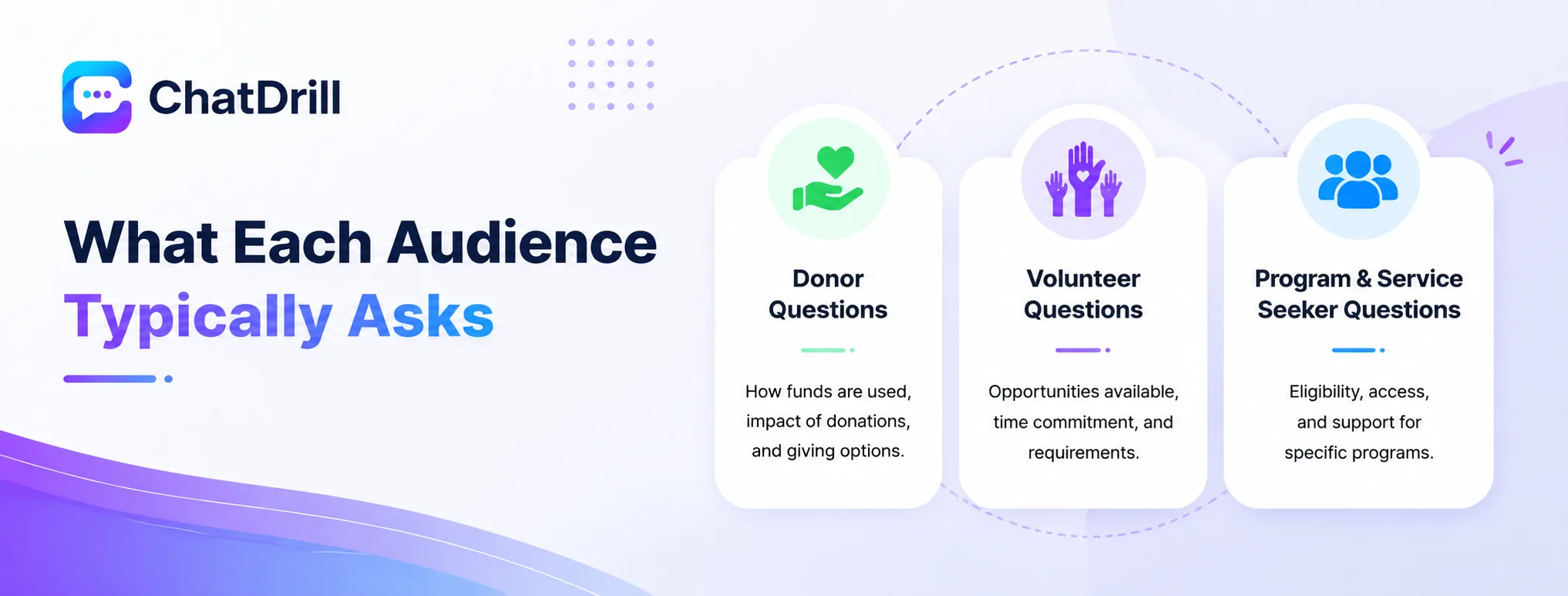
Prospective donors ask about how funds are used and donation impact, prospective volunteers ask about opportunities and requirements, and program seekers ask about eligibility and how to access services.
Donor questions
Questions about how donations are specifically used, what impact a gift has, and available giving options dominate donor-related chat volume, best answered with clear, specific, and genuinely compelling content.
This category rewards transparency and specificity heavily, a vague answer about fund usage tends to increase donor hesitation rather than build the confidence needed to complete a gift.
Volunteer questions
Questions about available volunteer opportunities, time commitment, and any requirements or training needed come up consistently and benefit from clear, encouraging, and accurate information.
This category benefits from a genuinely welcoming tone, since converting interest into an actual volunteer commitment depends partly on how approachable and clear the initial chat interaction feels.
Program and service seeker questions
For an NGO providing direct services, questions about eligibility, how to access a specific program, and what support is available represent a genuinely important, sometimes urgent category deserving careful, accurate handling.
This category sometimes involves people in genuinely difficult circumstances, worth training AI and staff to respond with appropriate care and clear, actionable next steps.
Setup Playbook for Nonprofit Chat
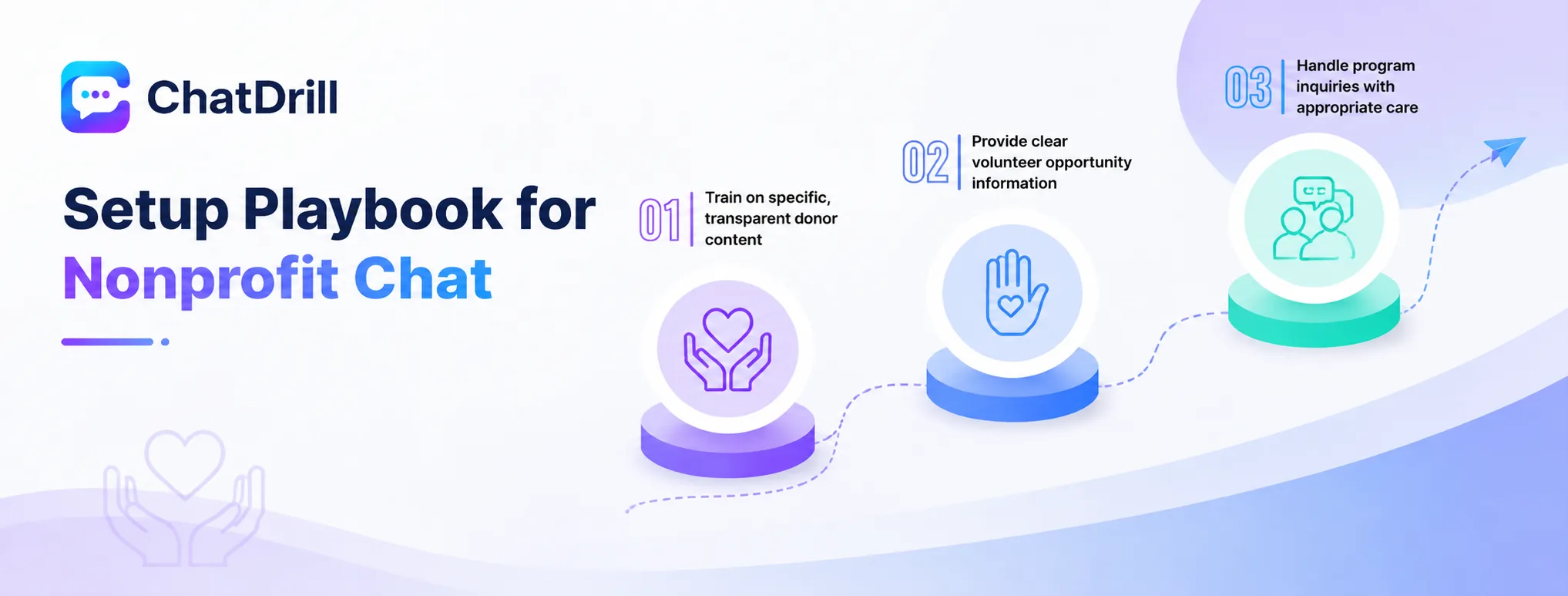
A strong setup trains AI on specific, transparent content about fund usage and impact for donors, provides clear, encouraging volunteer opportunity information, and handles program or service inquiries with particular care given the circumstances some visitors may be facing.
Step 1: Train on specific, transparent donor content
Feed AI genuinely specific information about how donations are used and what impact they achieve, avoiding vague, generic language that fails to build the confidence a hesitating prospective donor needs.
This specificity investment directly affects donation completion, given how much a donor's understanding of impact influences their decision to give.
Step 2: Provide clear volunteer opportunity information
Train AI on your actual current volunteer opportunities, requirements, and next steps, presented with a genuinely welcoming tone that encourages someone's initial interest to develop into real commitment.
This clarity and warmth matters given how much a positive initial interaction can influence whether someone actually follows through on volunteering.
Step 3: Handle program inquiries with appropriate care
Design program and service-related chat flows with particular sensitivity, recognizing that some visitors may be reaching out during genuinely difficult circumstances, and ensure clear escalation to human staff for anything beyond basic informational questions.
This care mirrors the conservative approach worth taking in other sensitive contexts, prioritizing appropriate human involvement over aggressive automation for anything touching someone's genuine, personal need.
Common Mistakes Nonprofits Make With Chat
The most common mistakes are giving vague, unconvincing answers about fund usage that fail to build donor confidence, treating volunteer and donor conversations identically despite their different needs, and handling program inquiries with insufficient care given the circumstances some visitors face.
Vague fund usage answers
A generic, non-specific response about how donations are used fails to build the confidence a hesitating donor needs to complete their gift, representing genuine lost support for the mission.
Investing in clear, specific, and genuinely compelling impact content is what actually helps convert donor interest into a completed gift.
Treating every visitor identically
Applying the same generic chat response to a prospective donor, an interested volunteer, and someone seeking program services misses the opportunity to serve each of these genuinely different needs well.
Recognizing and routing these distinct audiences appropriately produces a considerably better experience for each than a one-size-fits-all approach.
Insufficient care on program inquiries
Handling a program or service inquiry with the same casual efficiency as a general question misses that some visitors reaching out about services may be in genuinely difficult circumstances deserving particular sensitivity.
This care is worth building deliberately into chat design, ensuring appropriate tone and fast human escalation where needed for this specific category.
Measuring Success for Nonprofit Chat
Track chat-to-donation completion rate, volunteer inquiry-to-signup conversion, and satisfaction specifically on program or service inquiry interactions given their potentially sensitive nature.
Chat-to-donation completion
Tracking what share of donor-related chat conversations result in an actual completed donation quantifies chat's direct contribution to fundraising, the organization's core revenue function.
This metric is worth reviewing alongside the specificity of your fund-usage training content, since improvements here often correlate with improved conversion.
Volunteer signup conversion
Tracking what share of volunteer-interested chat conversations result in an actual signup or next step reveals whether your clear, encouraging approach to this category is genuinely working.
This metric helps justify continued investment in volunteer-focused chat content, tying it directly to a concrete, valuable organizational outcome.
Program inquiry satisfaction
Tracking satisfaction specifically for program and service-related conversations, given their potentially sensitive nature, confirms whether your careful, appropriately human-involved approach is genuinely serving these visitors well.
This distinct tracking deserves particular attention given the real stakes involved for someone reaching out about a genuine personal need.
Rolling Out Chat Across Programs and Development Teams
Launching chat first for donor-facing questions with development team input, then extending carefully into program and service inquiries with program staff involved, respects how differently these audiences need to be served.
Starting with donor conversations
Focusing initial launch on fund-usage and impact questions lets your development or fundraising team validate that AI content is specific and genuinely compelling before other, more sensitive categories are added.
This phase is a good opportunity to pressure-test your impact messaging directly, since a donor's real chat questions often reveal which explanations land clearly and which still feel vague or unconvincing.
A few weeks reviewing real donor conversations typically surfaces whether the content is building the confidence needed to meaningfully improve completion rates for hesitating prospective donors.
Extending to program and volunteer inquiries
Once donor-facing chat is stable, adding volunteer opportunity information can launch relatively quickly, given its comparatively lower sensitivity, while program and service inquiries deserve more careful, staged testing.
Program staff should be closely involved reviewing this expansion, given the genuine care needed for visitors who may be reaching out during difficult circumstances, confirming escalation triggers work as intended.
Running the program-inquiry escalation flow through realistic, sensitive scenarios before wider launch helps confirm it reliably connects a visitor with appropriate human support rather than leaving them with an automated response alone.