

Chat on a crypto or trading platform carries a distinct urgency most other industries don't face, a user reaching out during a market swing or a stuck transaction is often watching real money move in real time, making response speed and accuracy matter more than almost anywhere else.
Security sits at the center of nearly every design decision too, verifying identity before discussing account specifics, staying alert to scam-adjacent conversations, and being genuinely careful about what AI should never attempt to resolve on its own.
Beyond the urgent, security-sensitive categories, a steady volume of routine questions, deposit and withdrawal timing, fee structure, KYC verification steps, is well suited to automation once trained on your actual platform specifics.
This guide covers why crypto and trading chat needs particular care, what users typically ask, a practical setup approach, and mistakes worth avoiding.
Why Crypto and Trading Chat Requires Particular Care
Crypto and trading chat combines genuine urgency around live market activity with real security stakes around account access and identity verification, a combination that demands both speed and caution simultaneously.
The urgency of live market activity
A user reaching out mid-trade or during a volatile market move is often experiencing real financial stress in the moment, making a fast, accurate response meaningfully more valuable than it would be for a lower-stakes support category.
This urgency should shape staffing and AI coverage decisions specifically around volatile trading periods, not just general business hours.
The security and scam-awareness dimension
Crypto platforms are a common target for social engineering, meaning chat needs to be trained not just to help genuine users but to recognize patterns that suggest a scam attempt or account compromise in progress.
This makes conservative escalation boundaries around anything account-security-related worth treating as seriously as the equivalent boundaries in fintech chat.
What Users Actually Ask
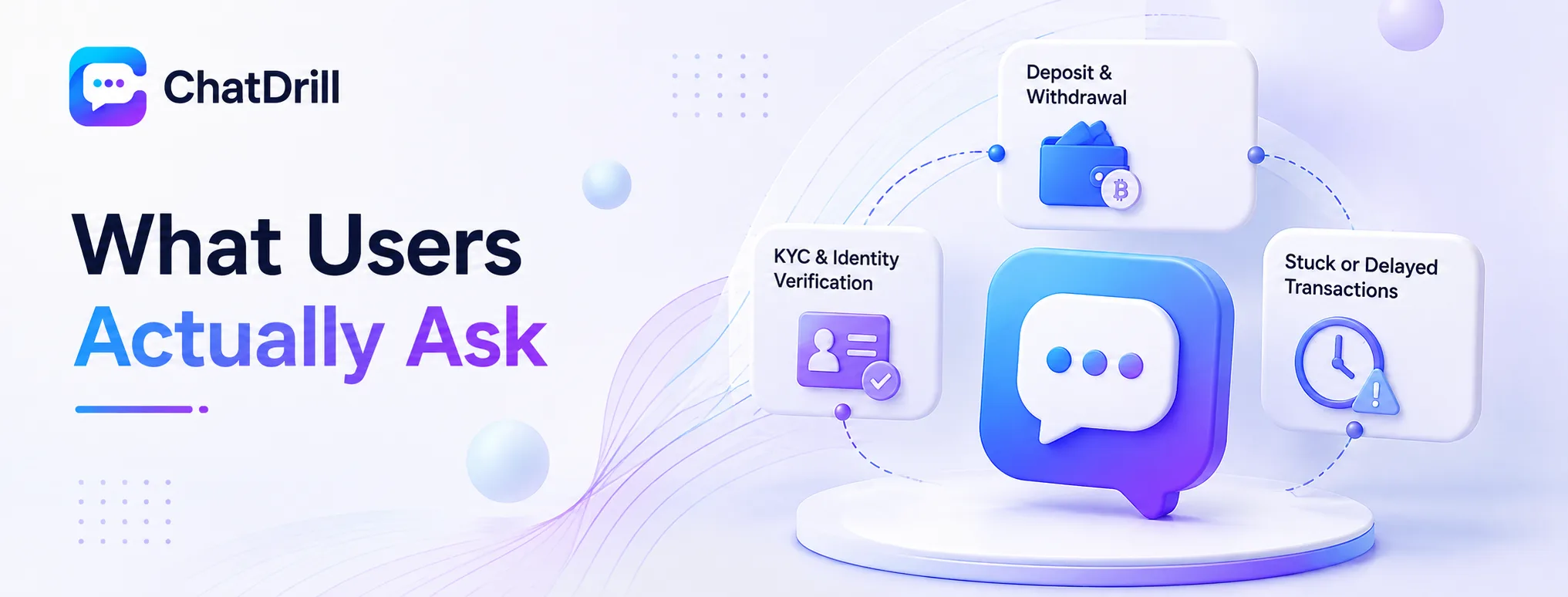
Users ask about deposit and withdrawal status, KYC verification steps, and stuck or delayed transactions, with the last category carrying the most urgency and requiring the most careful handling.
Deposit and withdrawal questions
Where a deposit or withdrawal currently stands, and how long it typically takes, make up a large share of routine chat volume, well suited to AI trained on your actual processing timelines and current network conditions.
This category rewards specificity, a vague "it can take some time" answer tends to increase user anxiety compared to a clear, current estimate.
KYC and identity verification questions
Questions about what documentation is needed, why verification is taking a certain amount of time, and what to do if a submission was rejected are common and benefit from clear, accurate process guidance.
This category is worth training thoroughly given how directly it affects whether a user can actually use the platform at all.
Stuck or delayed transaction concerns
A transaction that appears stuck or hasn't confirmed represents one of the highest-anxiety categories in this industry, deserving both fast acknowledgment and, where genuinely unresolved, quick escalation to a specialist.
AI can often provide a genuinely useful first response here, checking transaction status against real data, but should escalate quickly rather than guessing when something looks genuinely wrong.
Setup Playbook for Crypto and Trading Chat

A strong setup connects chat to real transaction and account status data, trains AI to recognize and escalate scam-adjacent conversations, and prioritizes fast response during volatile market periods.
Step 1: Connect to transaction and account data
Integrating chat with your transaction ledger and account systems lets AI answer specific deposit, withdrawal, and verification-status questions accurately rather than giving a generic response.
This connection is the highest-value setup investment given how much of this industry's chat volume concentrates in exactly these status-checking questions.
Step 2: Train AI to recognize scam-adjacent patterns
Configuring chat to recognize language suggesting a user may be a target of social engineering, or a request that shouldn't be fulfilled through chat regardless of how it's phrased, protects both the user and the platform.
This training deserves the same conservative, escalate-by-default approach worth applying to any security-sensitive category, given the real financial stakes involved.
Step 3: Prioritize speed during volatile periods
Planning extra AI coverage or staffing specifically around known high-volatility periods, rather than maintaining flat coverage year-round, matches resources to when user anxiety and chat volume are both highest.
Testing your setup's performance under a simulated volume spike helps confirm it holds up before an actual volatile market event puts it to the test.
Common Mistakes Crypto Platforms Make With Chat
The most common mistakes are giving vague answers to transaction status questions, failing to train AI on scam-recognition patterns, and being caught understaffed during a volatile market period.
Vague transaction status answers
A generic "transactions can take time" response fails to address the genuine anxiety a user feels about a specific, real transaction, especially compared to a specific, accurate status update.
Investing in real transaction data connection is what actually resolves this category well rather than leaving users to guess.
No scam-recognition training
A chatbot with no awareness of common scam patterns risks either helping facilitate a bad outcome or failing to flag a user who may be in the middle of being targeted.
This gap is worth closing early, given the real financial harm a missed scam pattern can cause.
Understaffing during volatile periods
Maintaining flat, average-day staffing during a known high-volatility period leaves the platform unable to handle the anxiety-driven volume spike that reliably follows major market moves.
Reviewing historical volume patterns around past volatile periods helps anticipate and prepare for these predictable spikes.
Measuring Success for Crypto and Trading Chat
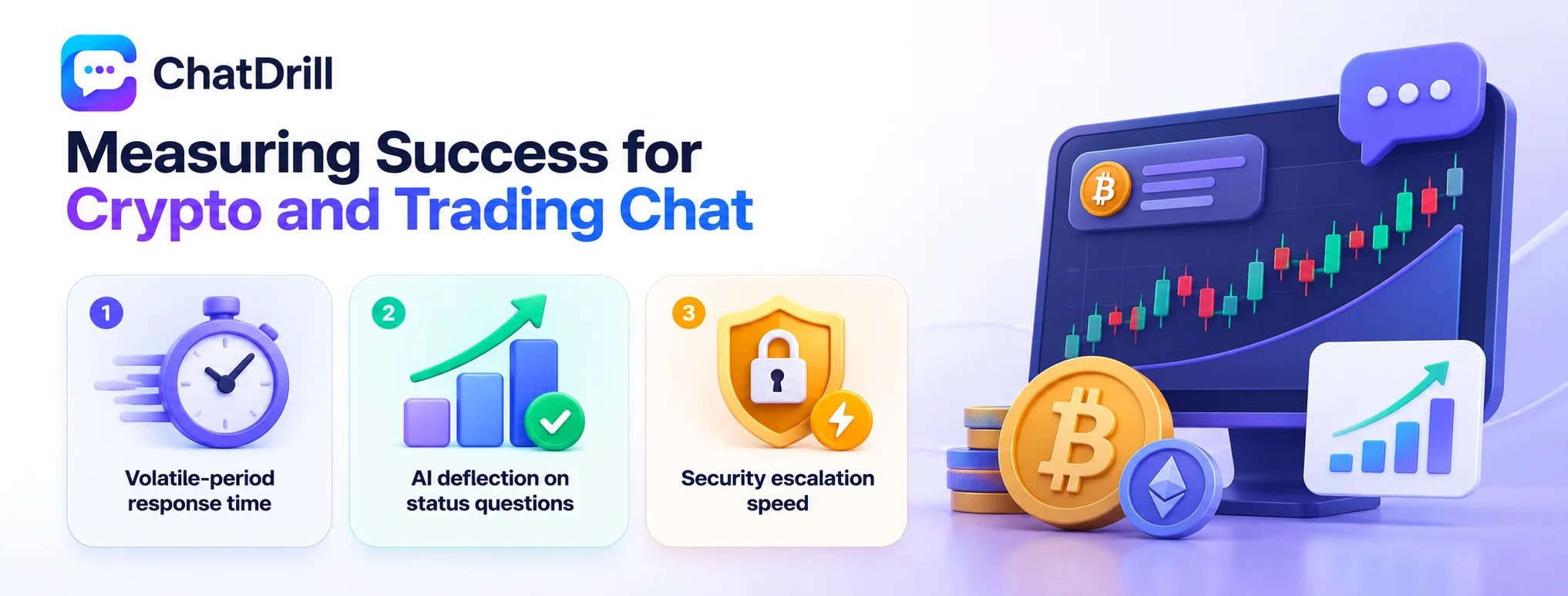
Track response time specifically during volatile periods, AI deflection on routine status questions, and how quickly a flagged security concern reaches a human specialist.
Volatile-period response time
Tracking response time specifically during known high-volatility windows, separately from average daily performance, reveals whether coverage genuinely holds up when it matters most.
A strong general average can mask a real gap during these specific, highest-stakes periods.
Deflection on routine status questions
Tracking how much deposit, withdrawal, and KYC volume AI resolves without human involvement shows the efficiency gain from a well-connected setup.
A ChatDrill setup connected to real transaction data, for a platform using it, tends to show strong deflection in this specific, high-volume category.
Security escalation speed
Tracking how quickly a flagged scam-adjacent or account-security conversation reaches a human specialist confirms whether your protective boundaries are genuinely working as intended.
This metric deserves particular attention given the real financial harm a delayed response to a genuine security concern could allow.
Rolling Out Chat for a Crypto or Trading Platform
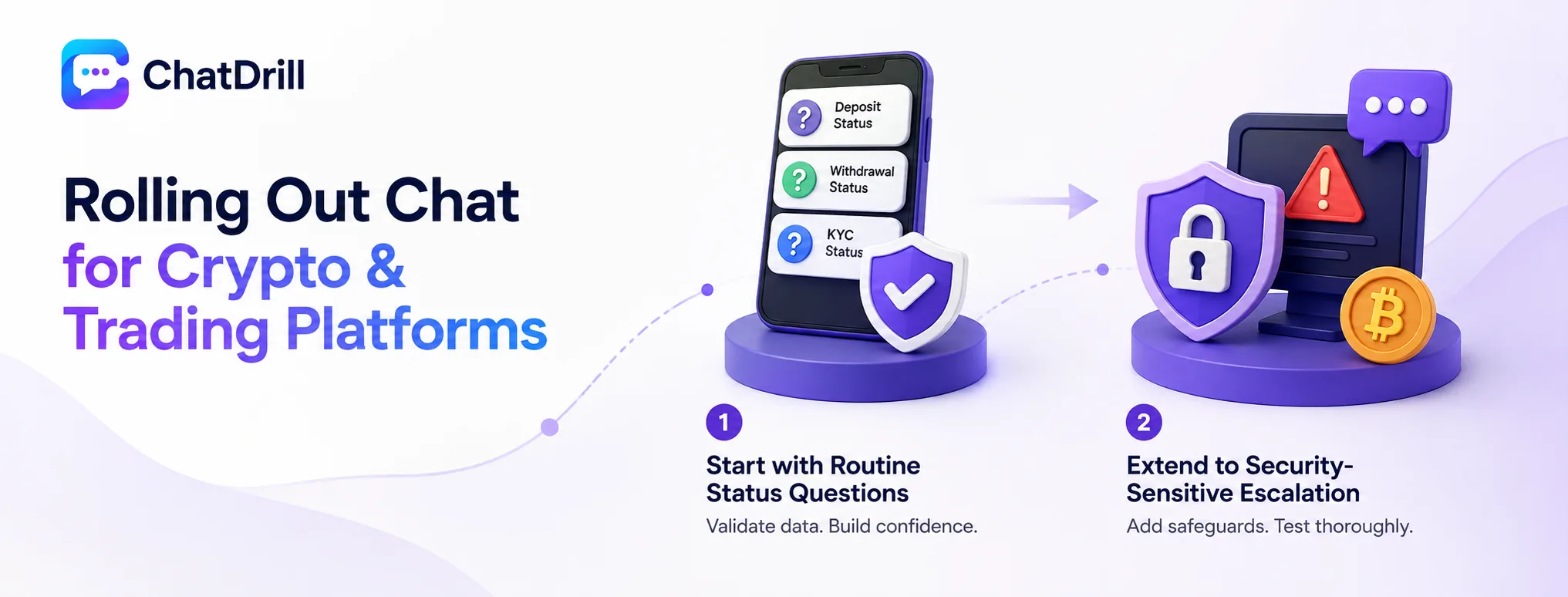
Launching chat first for routine status questions, then extending carefully into security-sensitive territory once escalation boundaries are proven, keeps a platform's rollout appropriately cautious given the stakes involved.
Starting with routine status questions
Focusing initial launch on deposit, withdrawal, and KYC status questions lets your team validate data accuracy in a genuinely lower-risk category before anything security-sensitive is layered in.
This phase is also a good opportunity to stress-test transaction data connections against real, current activity before wider reliance on the setup.
A few weeks of close review here typically surfaces any data lag or accuracy issues before they affect a larger volume of anxious users.
Extending to security-sensitive escalation
Once routine chat is stable, adding scam-recognition and security escalation logic should happen with your security team directly involved in reviewing real conversations.
Running the escalation flow through realistic, adversarial test scenarios before wider launch confirms it reliably catches the patterns it's meant to catch.
This phase deserves the most scrutiny of the entire rollout, given how directly it connects to protecting users from real financial harm.