
Insurance chat sits at a genuine tension point, prospective customers want fast, specific answers about coverage and pricing to make a purchase decision, while existing policyholders, especially anyone in the middle of a claim, need careful, accurate handling given the real stakes involved.
Getting quote and coverage questions right for prospects directly affects new business, a prospective customer comparing several insurers often chooses based partly on which one made understanding coverage and pricing easiest and fastest.
Claims-related conversations require a genuinely different approach, given how stressful a claims situation often is for a policyholder and how much specific, accurate guidance actually matters in that moment.
This guide covers why insurance chat spans these different needs, what prospects and policyholders ask, a practical setup approach, and mistakes worth avoiding.
Why Insurance Chat Spans Genuinely Different Needs
Insurance chat needs to serve prospective customers comparing coverage and pricing options and existing policyholders, particularly those navigating a claim, each requiring a meaningfully different approach given their different stakes and needs.
The prospective customer comparison moment
A prospect shopping for insurance is typically comparing coverage and pricing across several providers, making fast, clear answers a genuine factor in which insurer ultimately gets their business.
This comparison-shopping context rewards specificity and clarity, a vague or generic answer about coverage tends to push a prospect toward a competitor with clearer communication.
The claims moment specifically
A policyholder reaching out about an active claim is often dealing with a genuinely stressful situation, an accident, property damage, a health issue, requiring careful, accurate, and appropriately paced handling.
This moment carries real stakes beyond typical customer service, both for the policyholder's actual outcome and for the insurer's relationship with that customer going forward.
What Prospects and Policyholders Ask
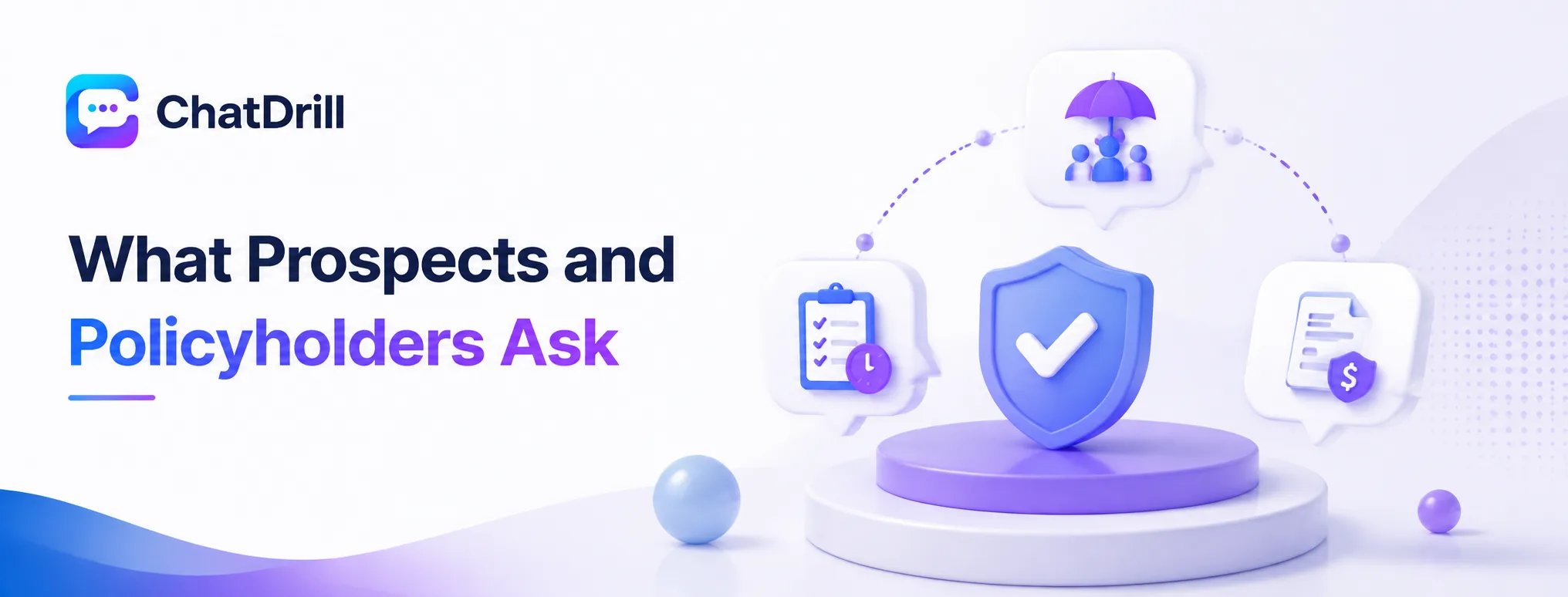
Prospective customers ask about coverage options, pricing, and policy comparisons, while existing policyholders more often ask about claims status, coverage details for their specific policy, and billing or renewal questions.
Prospective customer questions
Coverage type comparisons, pricing estimates, and questions about what's included in a specific policy option dominate prospect chat volume, best handled with AI trained on your actual current product offerings.
This category directly ties to new business conversion, making clarity and speed particularly valuable given how directly comparable insurance offerings are across providers during this research phase.
Claims status and process questions
Questions about an active claim's status, what happens next in the process, and what documentation is needed represent high-stakes, high-anxiety conversations requiring careful, accurate handling.
This category benefits from a genuinely reassuring, clear tone, given the stress a policyholder is often experiencing when reaching out about an active claim.
Billing, renewal, and policy detail questions
Questions about premium billing, renewal timing, and specific policy coverage details make up steady, largely administrative volume well suited to AI once trained on your actual policy and billing systems.
This category tends to be highly automatable, similar to administrative questions in other regulated industries, given its largely factual, non-judgment-requiring nature.
Setup Playbook for Insurance Chat
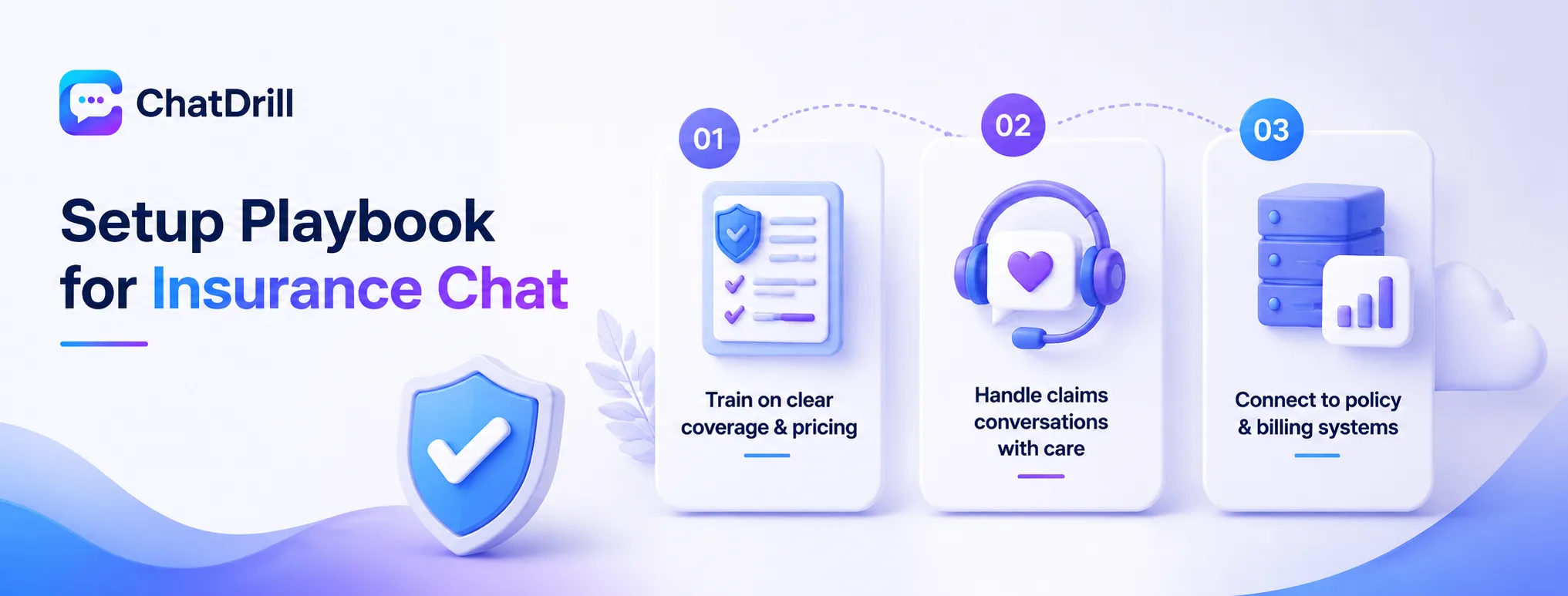
A strong setup trains AI on clear, accurate coverage and pricing content for prospects, handles claims-related conversations with particular care and appropriate escalation,
Step 3: Connect to policy and billing systems
answers.
Step 1: Train on clear coverage and pricing content
Feed AI genuinely clear, accurate content about coverage options and pricing, avoiding vague or overly technical language that leaves a prospect more confused rather than more informed.
This clarity investment directly affects conversion, given how much a prospect's understanding of coverage influences their purchase decision during comparison shopping.
Step 2: Handle claims conversations with particular care
Design claims-related chat flows with an appropriately careful, reassuring tone, and configure clear escalation to a human claims specialist for anything beyond basic status updates.
This careful handling respects the genuine stress a policyholder is likely experiencing, treating claims conversations as meaningfully different from routine administrative questions.
Step 3: Connect to policy and billing systems
Integrating chat with your policy management system lets AI answer specific billing and coverage questions accurately for a verified policyholder, rather than giving generic answers that don't reflect their actual policy.
This connection meaningfully expands what AI can handle for existing customers, similar to how connected data expands capability in other industries covered in related guides.
Common Mistakes Insurance Companies Make With Chat
The most common mistakes are giving vague, unclear coverage answers that don't actually help a prospect decide, handling claims conversations with the same generic approach as routine questions, and lacking a connection to real policy data for accurate policyholder-specific answers.
Vague coverage and pricing answers
A generic, unclear response to a coverage question fails to actually help a prospect make their comparison decision, undermining the purpose of engaging with chat in the first place.
Investing in genuinely clear, specific training content is what actually makes insurance chat useful for the comparison-shopping context prospects are typically in.
Treating claims conversations generically
Handling a claims-related conversation with the same tone and process as a routine billing question misses the genuine stress and stakes a policyholder is likely experiencing in that moment.
This mismatch can feel jarring and unhelpful to a policyholder navigating a genuinely difficult situation, worth avoiding through deliberate, claims-specific conversation design.
No connection to real policy data
A chatbot unable to reference a specific policyholder's actual coverage or billing details ends up giving generic answers that don't genuinely address their specific situation.
This gap limits how much genuine value existing policyholders can get from chat, pushing more volume to human agents than a well-connected setup would require.
Measuring Success for Insurance Chat
Track chat-to-quote or chat-to-policy conversion for prospects, satisfaction specifically on claims-related chat interactions, and AI deflection on routine billing and policy-detail questions.
Chat-to-quote conversion
Tracking what share of prospective-customer chat conversations result in a completed quote request or new policy quantifies chat's direct contribution to new business.
This is worth segmenting by coverage type where possible, revealing whether certain product lines see stronger chat-driven conversion than others.
Claims chat satisfaction
Tracking satisfaction specifically for claims-related conversations, separately from general chat metrics, reveals whether your careful, appropriately paced approach to this category is genuinely landing well with policyholders.
This distinct tracking matters given how directly claims experience connects to overall customer retention and loyalty.
Deflection on routine policy questions
Tracking how much billing and general policy-detail volume AI resolves without human involvement shows the efficiency gain from a well-connected setup for existing policyholders.
A rising deflection rate here frees staff time for the genuinely complex claims and coverage situations that benefit most from human expertise.
Rolling Out Chat Across Sales and Claims Teams
Launching chat first for prospect-facing quote and coverage questions, then extending carefully into claims support once escalation rules are proven, respects how different these two conversation types are in tone and stakes.
Starting with quote and coverage conversations
Focusing initial launch on prospect-facing pricing and coverage questions gives your sales team a contained environment to confirm AI answers are clear and accurate before claims volume, with its higher stakes, is added.
This phase is a good opportunity to review real conversations against your actual current product lineup, catching any outdated or unclear coverage explanations before they reach a genuinely comparison-shopping prospect.
A few weeks of close review here typically validates whether the tone and clarity are strong enough to meaningfully influence the comparison-shopping decision this category depends on.
Extending carefully into claims support
Once quote and coverage chat is stable, adding claims status and process questions should happen with claims team involvement from day one, given the genuine sensitivity this category carries.
Running the claims escalation flow through realistic, stress-tested scenarios before launch confirms it reliably routes anything beyond basic status updates to a human specialist as intended.
Claims staff should review a sample of AI-handled status conversations regularly during this phase, catching any tone or accuracy issues before they affect a policyholder navigating a genuinely difficult situation.