
Dental chat serves patients at very different points, someone booking a routine cleaning, someone with a dental emergency who needs help now, and someone comparing practices based on cost and insurance coverage before ever calling, each needing a distinct response.
The emergency category specifically deserves particular attention, a patient in pain reaching out via chat is in a genuinely urgent situation, and how quickly and appropriately that gets handled shapes both their immediate experience and their impression of the practice.
Cost and insurance transparency also matters more here than in many other healthcare contexts, since dental cost concerns are a common reason patients delay care, and clear, upfront answers in chat can meaningfully reduce that hesitation.
This guide covers why dental chat needs differ by patient situation, what patients typically ask, a practical setup approach, and mistakes worth avoiding.
Why Dental Chat Needs Vary So Much by Situation
A dental practice's chat needs to serve routine appointment booking, genuine dental emergencies requiring urgent handling, and cost-conscious prospective patients comparing practices, each calling for a distinctly different response approach.
The emergency situation specifically
A patient reaching out about sudden pain or a dental emergency is in genuine distress, and chat should recognize this urgency immediately and either provide clear next steps or route quickly to a human who can help.
This category carries real stakes beyond typical customer service, a slow or generic response to someone in pain reflects poorly on the practice regardless of how well other chat interactions go.
The cost-conscious prospective patient
Dental cost is a common reason people delay or avoid care entirely, meaning a prospective patient asking about pricing or insurance coverage is often deciding whether to proceed with an appointment at all.
Clear, direct answers in this category can meaningfully reduce the hesitation that otherwise causes a prospective patient to simply not follow through.
What Patients Typically Ask
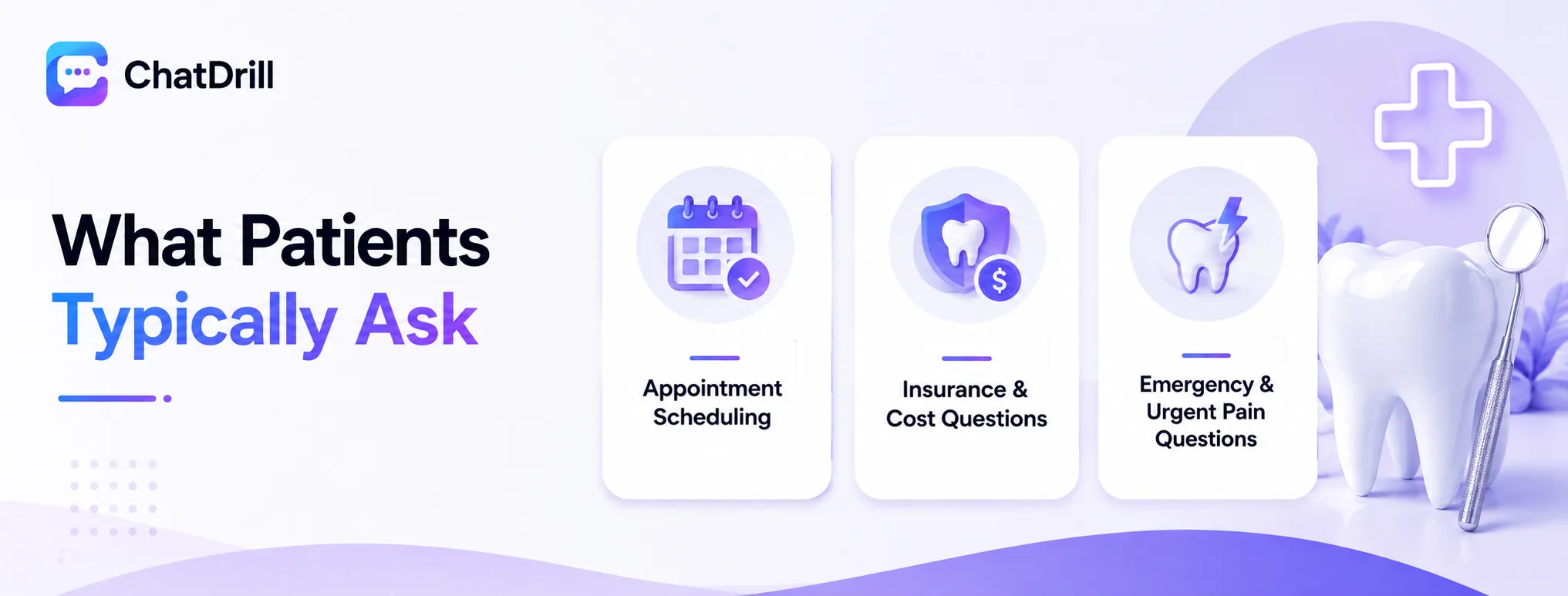
Patients ask about appointment scheduling and availability, insurance acceptance and estimated costs, and, for a smaller but urgent share, what to do about sudden pain or a dental emergency right now.
Appointment scheduling
Booking, rescheduling, or checking appointment availability makes up the bulk of routine chat volume, a straightforward, highly automatable category once connected to your actual scheduling system.
This category delivers reliable, low-risk value, freeing front-desk staff time for in-person patients and more complex phone conversations.
Insurance and cost questions
Whether a specific insurance plan is accepted and what a procedure typically costs are consistently high-value questions worth answering clearly and specifically rather than deferring to a phone call.
AI trained on your actual accepted insurance plans and typical procedure cost ranges handles this category considerably better than a vague, generic response.
Emergency and urgent pain questions
A smaller but genuinely urgent share of chat volume involves a patient describing sudden pain or a dental emergency, needing immediate, clear guidance and a fast path to human help.
This category should never be handled with a generic, delayed response, worth building explicit recognition and fast escalation into the chat flow specifically for this situation.
Setup Playbook for Dental Practice Chat
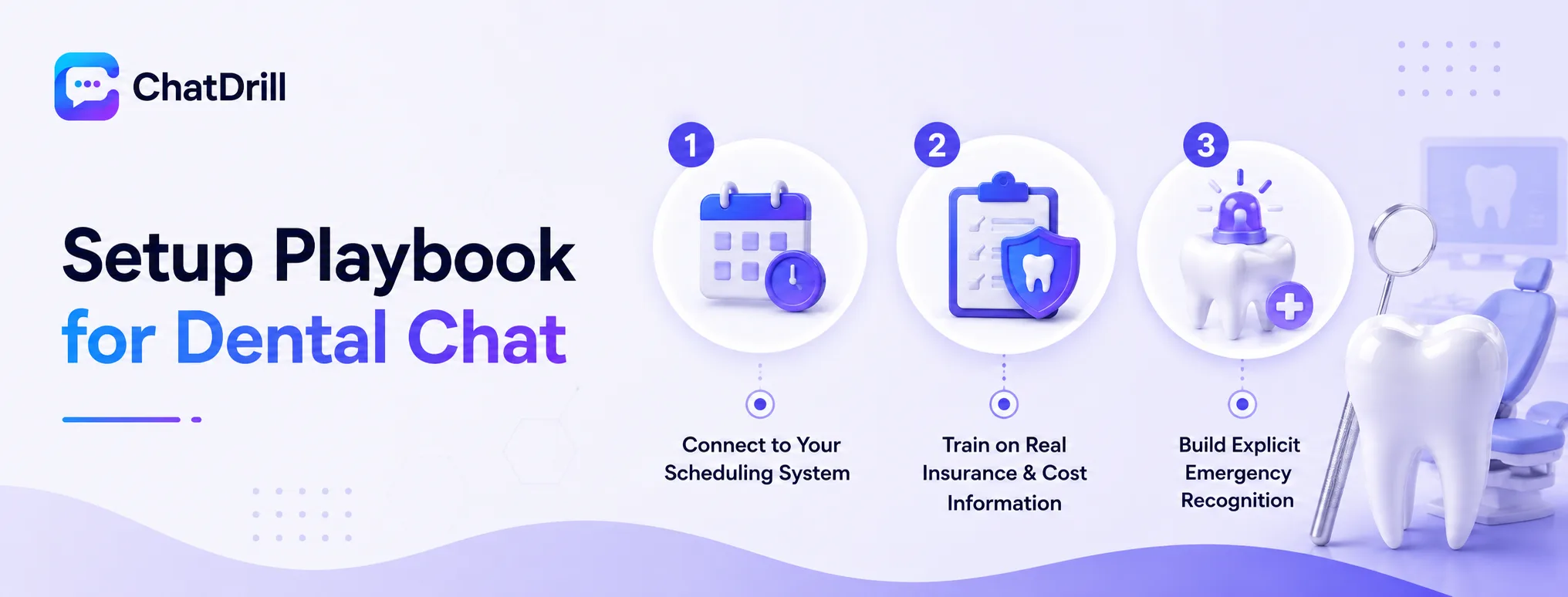
A strong setup connects chat to your scheduling system for reliable booking, trains AI on your specific insurance and cost information, and builds explicit emergency recognition with fast escalation to available staff.
Step 1: Connect to your scheduling system
Integrating chat with your practice management or scheduling software lets patients book, reschedule, or check availability directly within the conversation, without requiring a phone call for routine scheduling needs.
This connection is the highest-value, most reliably automatable investment for a dental practice's chat setup given how much volume this category represents.
Step 2: Train on real insurance and cost information
Feed AI your actual list of accepted insurance plans and typical procedure cost ranges, giving prospective and existing patients the specific, clear answers that reduce hesitation around cost.
Vague responses here tend to push a cost-conscious patient toward simply not following up, making specificity genuinely worth the training investment.
Step 3: Build explicit emergency recognition
Configure chat to recognize language suggesting pain or a dental emergency and immediately provide clear guidance plus a fast path to reach staff, rather than treating it like a routine scheduling question.
This recognition should be tested directly with realistic emergency phrasing, confirming the flow genuinely triggers appropriate urgency rather than defaulting to standard, slower handling.
Common Mistakes Dental Practices Make With Chat
The most common mistakes are treating an emergency message with the same pace as a routine scheduling question, giving vague cost answers that don't actually reduce patient hesitation, and having no direct scheduling connection requiring every booking to go through a phone call anyway.
Not recognizing genuine urgency
Responding to a pain or emergency message with the same generic pace as a routine question fails a patient in genuine distress and reflects poorly on the practice's overall care quality impression.
This is worth treating as a critical, non-negotiable design consideration, not an edge case to handle only if time permits.
Vague cost and insurance answers
A generic "contact us to discuss pricing" response fails to actually reduce the hesitation a cost-conscious prospective patient is experiencing, often resulting in them simply not following up at all.
Investing in specific, genuinely useful cost and insurance training content directly addresses one of the most common reasons patients delay dental care.
No real scheduling integration
A chatbot that can't actually check or book an appointment forces every scheduling request back to a phone call anyway, undermining much of chat's efficiency value for this specific, high-volume category.
This gap is worth prioritizing early, given how directly it affects the highest-volume, most valuable automation opportunity for a typical dental practice.
Measuring Success for Dental Chat
Track appointment booking completion rate through chat, response time specifically for emergency-flagged conversations, and how many cost or insurance questions get resolved without requiring a follow-up phone call.
Appointment booking completion
Tracking what share of scheduling-related chat conversations result in an actual booked appointment quantifies chat's direct value for this highest-priority use case.
A ChatDrill setup connected to a real scheduling system, for a practice using it, makes this specific metric straightforward to track without manual cross-referencing.
Emergency response time
Tracking how quickly an emergency-flagged conversation gets appropriate attention confirms whether your urgency-recognition setup is genuinely working as intended for these high-stakes situations.
This metric deserves particular scrutiny given the direct connection to patient wellbeing and the practice's care-quality reputation.
Cost question resolution without follow-up call
Tracking how many cost and insurance questions resolve fully within chat, without requiring an additional phone call, reveals whether your training content is genuinely specific and useful enough.
A low resolution rate here suggests training content needs more specificity, worth revisiting the actual cost and insurance information provided to AI.
Rolling Out Chat at Your Practice
Testing the emergency-recognition flow thoroughly before launch, and briefing front-desk staff on how escalated conversations will reach them, keeps a practice's rollout from having gaps in exactly the category that matters most.
Testing emergency recognition before launch
Running the chat through a range of realistic pain and emergency phrasing, not just the most obvious wording, confirms the recognition logic genuinely triggers appropriate urgency across how patients actually describe distress.
This testing should include ambiguous cases too, phrasing that isn't clearly an emergency but could be, checking that the system errs toward faster attention rather than assuming routine handling by default.
Involving a clinical staff member in this review adds a perspective a purely technical test might miss, given how much they understand about how patients actually describe urgent symptoms.
Briefing front-desk staff on escalation
Front-desk staff should know exactly how an escalated emergency conversation will reach them, whether through a notification, a flagged queue, or a direct handoff, before the system goes live.
Walking through a couple of realistic escalation scenarios together builds confidence that a genuine emergency reaches a person quickly rather than surfacing as just another item in a general queue.
This briefing is worth revisiting after the first few real escalations, using them as concrete examples to refine the handoff process if anything didn't work as smoothly as intended.