
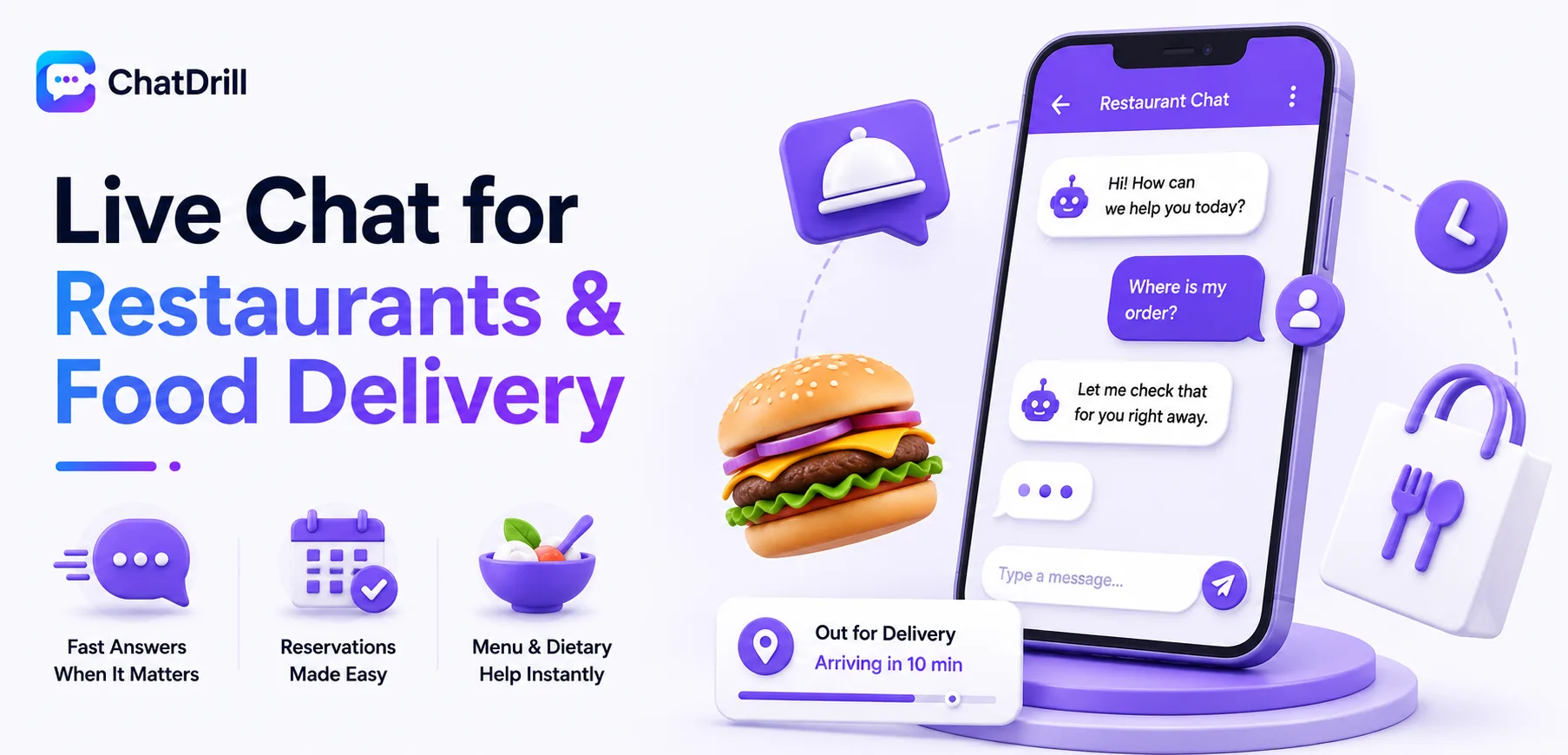
Restaurant and food delivery chat operates on a genuinely compressed timeline, an order issue or a delivery question needs resolution within minutes, not hours, given how directly it affects an experience already in progress.
This urgency requirement distinguishes food and delivery chat from many other industries, where a delayed response is inconvenient but rarely as immediately consequential as a wrong order, a missing item, or a significantly delayed delivery someone is actively waiting on.
Beyond active order issues, reservation booking and menu or dietary questions represent a calmer, more planning-oriented category that benefits from a different, less urgent handling approach.
This guide covers why speed matters especially for this industry, what customers typically ask, a practical setup approach, and mistakes worth avoiding.
Why Speed Matters More Here Than in Most Industries
A food order or delivery issue is almost always time-sensitive in a way many other support categories aren't, a customer waiting on a delayed or incorrect order needs resolution within minutes, not the hours that might be acceptable elsewhere.
The compressed timeline of an active order
Unlike many support categories where a delayed response is merely inconvenient, an active food order issue directly affects an experience the customer is living through right now, hunger, a planned meal, a time-sensitive event.
This immediacy requirement should shape staffing and AI coverage decisions specifically around active order support hours, not just general business hours.
Why this differs from pre-order questions
A reservation inquiry or a menu question from someone planning a future visit carries meaningfully less urgency than an active order issue, worth recognizing as a genuinely different category deserving different handling.
This distinction matters for both AI training and staffing prioritization, ensuring the most urgent category gets the fastest possible response.
What Customers Typically Ask
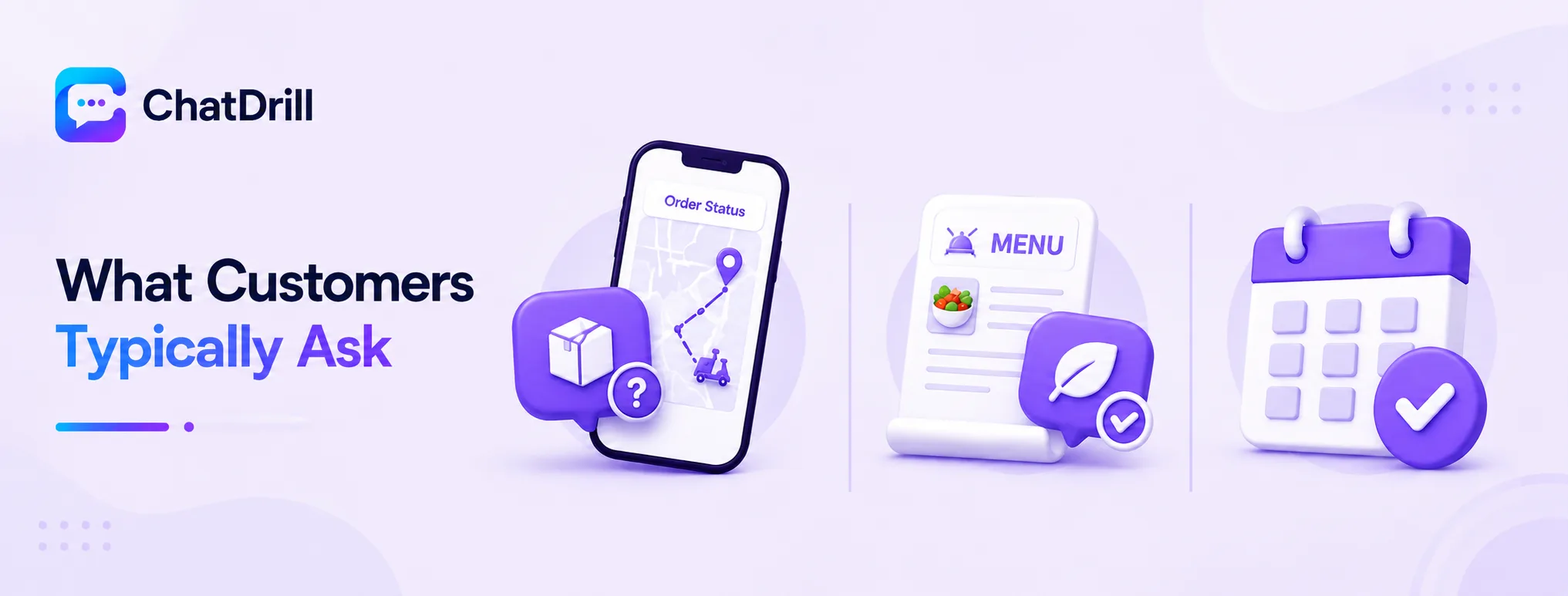
Customers ask about active order status and issues, menu items and dietary or allergy information, and reservation booking, with order-related questions carrying the most time pressure of the three.
Active order status and issues
Questions about order status, a missing item, or a significantly delayed delivery represent the most urgent, time-sensitive category, deserving immediate attention and, ideally, direct connection to real order data.
This category benefits enormously from AI connected to live order status, similar to how order data connection transforms chat value for ecommerce businesses.
Menu, dietary, and allergy questions
Questions about specific menu items, ingredients, and allergy information come up consistently and carry genuine importance given the health implications of an inaccurate allergy answer specifically.
This category rewards accuracy heavily, worth training AI on genuinely current, verified menu and ingredient information rather than approximate or outdated content.
Reservation booking
For a restaurant taking reservations, booking and availability questions represent a calmer, planning-oriented category well suited to direct chat handling, including embedded booking within the conversation itself.
This category benefits from the same embedded-booking principle covered in other industries, removing friction between interest and an actual confirmed reservation.
Setup Playbook for Restaurant and Delivery Chat
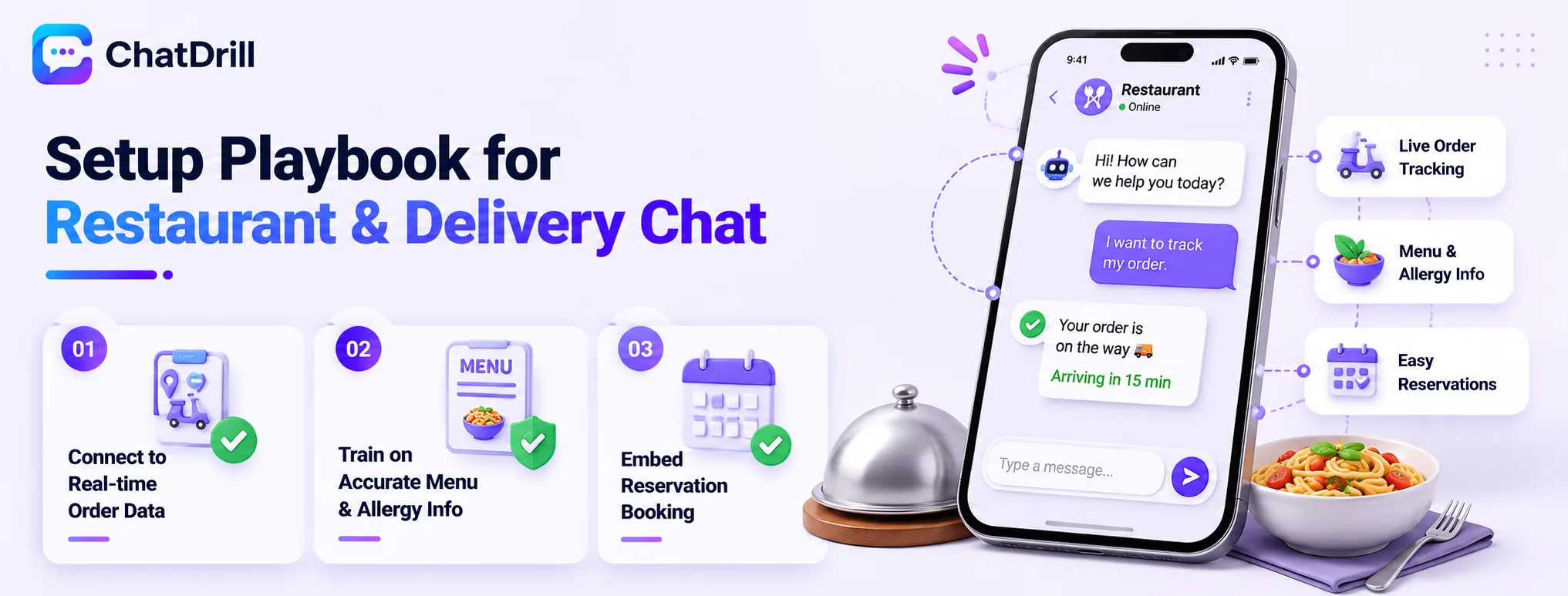
A strong setup connects chat to real-time order status for the highest-urgency category, trains AI on accurate, current menu and allergy information, and embeds reservation booking directly for a low-friction planning experience.
Step 1: Connect to real-time order data
Integrating chat with your order management or delivery tracking system lets AI address active order issues with accurate, current information, resolving the most urgent category quickly.
This connection is worth prioritizing above almost any other setup investment, given how directly it affects the category carrying the most immediate customer impact.
Step 2: Train on accurate menu and allergy content
Feed AI genuinely current, verified menu and ingredient information, treating allergy accuracy with particular care given the real health stakes involved in getting this wrong.
This content requires more careful maintenance than typical FAQ training, given how directly menu changes and ingredient updates need to be reflected quickly and accurately.
Step 3: Embed reservation booking
Letting a customer book a reservation directly within the chat conversation, rather than requiring a separate call or booking page, removes friction from this lower-urgency but still valuable conversion category.
This addition tends to meaningfully improve actual booked reservations compared to a chat setup that only discusses availability without offering direct booking.
Common Mistakes Restaurants and Delivery Services Make With Chat
The most common mistakes are treating an active order issue with the same response time as a general inquiry, giving outdated or inaccurate allergy information, and requiring a separate step to complete a reservation instead of embedding it in chat.
Slow response on active order issues
Responding to an active order problem at the same pace as a general question about future dining plans fails to recognize the genuine time pressure the customer is experiencing right now.
This is worth addressing directly through prioritized staffing or AI coverage specifically for active order support hours, not just general business hours.
Outdated or inaccurate allergy information
Training AI on stale or approximate ingredient information risks giving a customer inaccurate allergy guidance, a genuinely serious mistake given the real health stakes involved.
This category deserves more rigorous, frequently updated maintenance than typical training content, given what's at risk if the information is wrong.
Requiring a separate reservation step
Directing an interested customer to a separate booking page for a reservation, rather than embedding this directly in chat, introduces unnecessary friction at a moment their interest is already established.
This is a relatively straightforward fix worth prioritizing given how directly it affects actual booked reservations versus abandoned inquiries.
Measuring Success for Restaurant and Delivery Chat
Track response time specifically for active order issues, chat-to-reservation conversion rate, and AI accuracy on allergy and dietary questions given the genuine stakes involved in this category.
Active order response time
Tracking response time specifically for order-issue conversations, separately from general inquiry response time, confirms whether your highest-urgency category is genuinely getting the fastest possible handling.
This distinct tracking matters given how much more directly this category's speed connects to immediate customer experience compared to general inquiries.
Chat-to-reservation conversion
Tracking what share of reservation-interested chat conversations result in an actual booked table quantifies the value of your embedded booking capability.
This metric benefits from comparison against reservation completion through other channels, revealing whether chat's lower-friction booking genuinely outperforms alternatives.
Allergy and dietary answer accuracy
Given the genuine stakes involved, periodically reviewing AI responses to allergy and dietary questions specifically for accuracy is worth treating as an ongoing, dedicated quality check rather than folded into general satisfaction monitoring.
This dedicated review reflects the same elevated care worth applying to any category where an inaccurate answer carries real health risk.
Rolling Out Chat During Service Hours
Starting with reservation and menu questions during quieter hours before extending to active order support during peak service, lets a restaurant validate accuracy and response quality before the highest-stakes category goes live.
Piloting with reservations and menu questions
Launching chat first for reservation booking and menu or dietary questions during lower-volume periods gives staff a manageable environment to review accuracy, especially on allergy content, before peak-hour pressure is added.
This phase is the right time to verify menu and ingredient training content is genuinely current, catching any gaps against your actual, latest menu before that content is relied on more heavily.
A kitchen or management team member reviewing allergy-related answers specifically during this pilot adds a layer of scrutiny worth having before this content reaches wider use.
Extending to active order support at peak hours
Once the foundation is validated, connecting chat to real-time order and delivery data for active issue support should be tested specifically during genuine peak service hours, when the urgency this category demands is most real.
Staff should know clearly how an escalated active-order issue reaches them during a busy service period, since delays here carry more direct customer impact than almost any other category covered.
Reviewing response times specifically during peak hours after launch confirms the setup holds up under real pressure, not just during the calmer conditions of an initial pilot.