
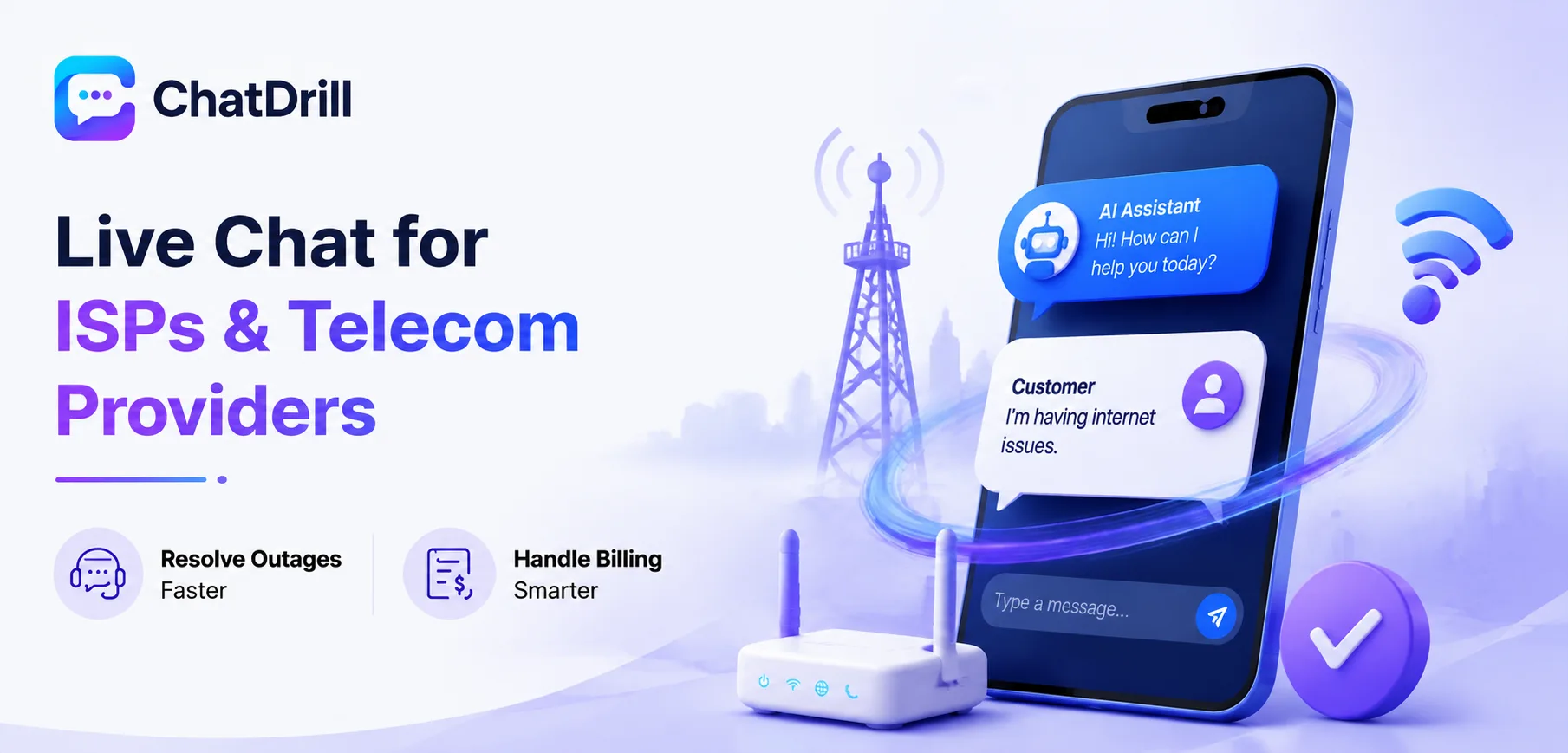
ISP and telecom chat volume is defined by two dominant categories, technical support for an outage or connectivity issue and plan or billing questions, both extremely high in volume given how essential and how frequently used these services are.
The technical support category carries genuine urgency, a customer without internet or phone service is often unable to work, communicate, or access other essential services, making fast, effective troubleshooting through chat directly valuable rather than a mere convenience.
Given the sheer scale of typical support volume in this industry, AI automation has an unusually large potential impact here, provided it's genuinely capable of walking a customer through real troubleshooting steps rather than just deflecting to a phone queue.
This guide covers why this industry sees such concentrated, high-urgency chat volume, what customers typically ask, a practical setup approach, and mistakes worth avoiding.
Why ISP and Telecom Chat Volume Is So Concentrated and Urgent
Internet and phone service outages represent a uniquely urgent category given how essential connectivity has become, while the sheer scale of a typical ISP's customer base makes even routine questions add up to enormous total volume.
The genuine urgency of connectivity issues
A customer without internet or phone service is often unable to work, attend a video call, or access other services depending on that connectivity, making a fast, effective chat response directly valuable rather than a mere convenience.
This urgency should shape both AI training depth and staffing priority around technical support specifically, treating it with the seriousness the actual customer impact warrants.
Why scale makes automation especially valuable here
A typical ISP or telecom provider serves a customer base large enough that even routine plan and billing questions represent enormous total chat volume, making automation's efficiency impact particularly significant in this industry.
This scale advantage means investment in genuinely effective AI training pays off disproportionately here compared to a smaller business with more modest total volume.
What Customers Typically Ask
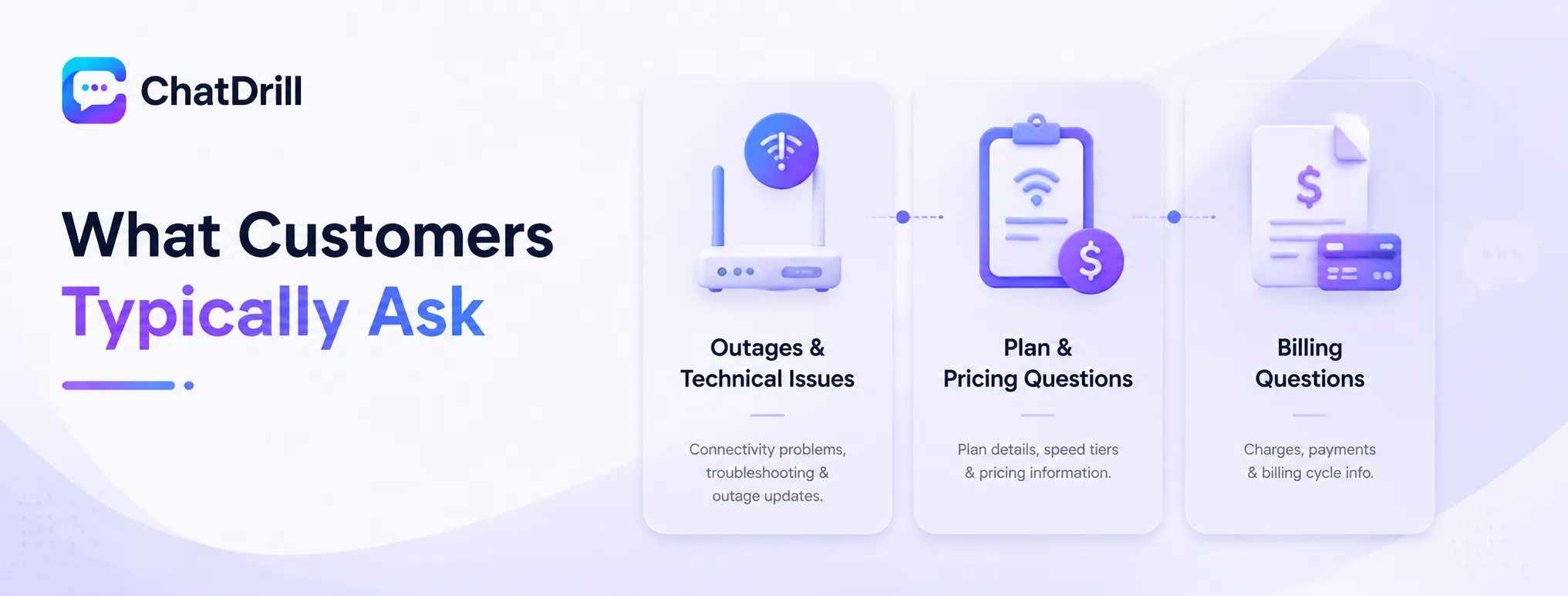
Customers ask about outages and connectivity troubleshooting, plan details and pricing, and billing questions, with technical support carrying the most urgency and volume of the three.
Outages and technical troubleshooting
Connectivity issues, from a full outage to a slow or intermittent connection, represent the highest-urgency, often highest-volume category, well suited to a structured AI troubleshooting flow that can resolve common issues without human involvement.
This category rewards genuinely thorough training, covering common troubleshooting steps, known outage information, and clear escalation for anything a structured flow can't resolve.
Plan and pricing questions
Questions about available plans, speed tiers, and pricing come up consistently from both prospective and existing customers, well suited to direct AI handling once trained on your actual current offerings.
This category directly influences both new customer acquisition and existing customer plan changes, worth training with genuine accuracy and clarity.
Billing questions
Questions about a specific charge, payment options, or billing cycle timing make up steady, largely administrative volume well suited to automation once connected to actual account and billing data.
This category benefits significantly from real account data connection, letting AI answer a specific, personal billing question rather than only generic policy information.
Setup Playbook for ISP and Telecom Chat
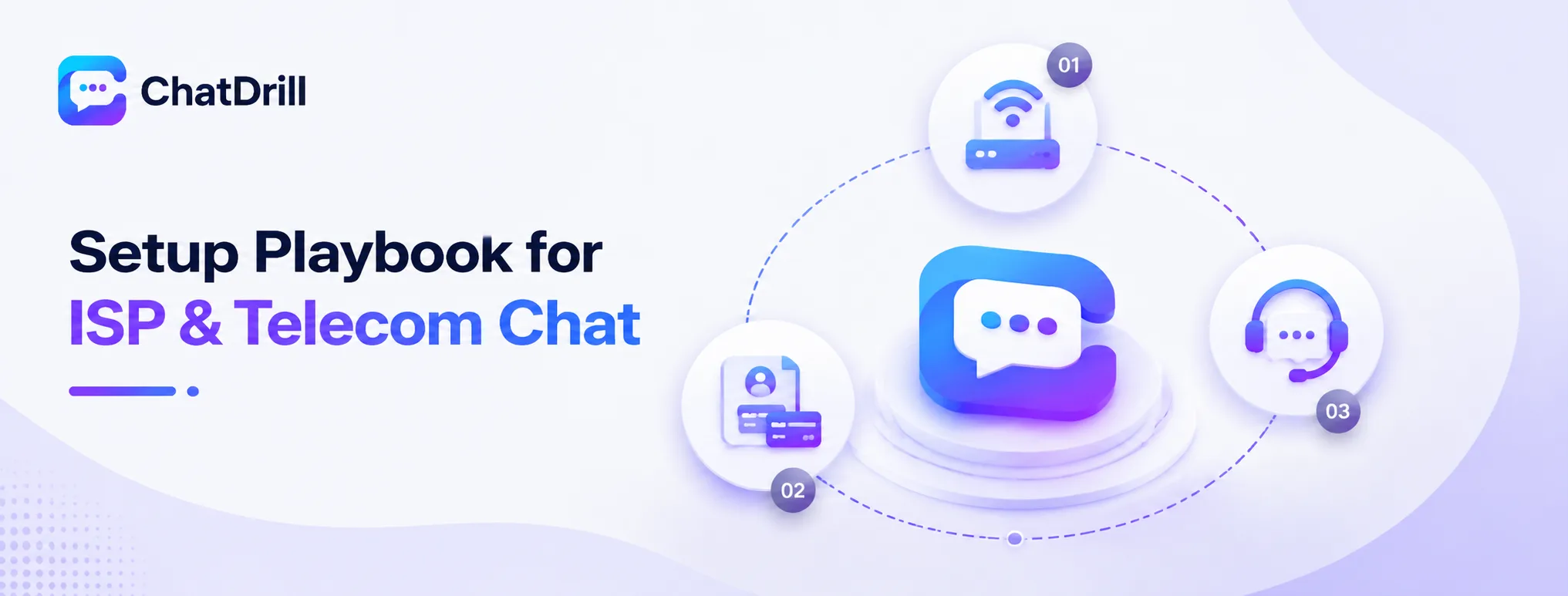
A strong setup builds a genuinely thorough AI troubleshooting flow for common connectivity issues, connects chat to account and billing data for accurate, specific answers, and maintains fast escalation to technical support for anything the automated flow can't resolve.
Step 1: Build a thorough troubleshooting flow
Design AI to walk a customer through common connectivity troubleshooting steps, checking connections, restarting equipment, verifying known outage status, before escalating to a human technical support agent if unresolved.
This structured flow can resolve a meaningful share of connectivity issues without human involvement, given how often the underlying cause is a common, well-understood problem.
Step 2: Connect to account and billing data
Integrating chat with your account management system lets AI answer specific billing and plan questions accurately for a verified customer, rather than giving only generic policy information.
This connection meaningfully expands what AI can handle for existing customers, similar to how account data connection expands capability across several other industries covered in related guides.
Step 3: Maintain fast technical escalation
Ensure any connectivity issue the automated troubleshooting flow can't resolve escalates quickly to a human technical support agent, respecting the genuine urgency a customer without service is experiencing.
This fast escalation path protects the customer experience during exactly the moments carrying the most real, immediate impact on their ability to work or communicate.
Common Mistakes ISPs and Telecom Providers Make With Chat
The most common mistakes are a shallow troubleshooting flow that fails to actually resolve common issues, no connection to real account data forcing every billing question to a human, and slow escalation for connectivity issues given the genuine urgency involved.
A shallow troubleshooting flow
A troubleshooting flow that only asks one or two generic questions before deflecting to a phone queue fails to capture the genuine efficiency potential of AI-assisted technical support at this industry's typical scale.
Investing in a genuinely thorough, well-designed flow covering common connectivity issues is what actually delivers meaningful deflection for this high-volume, high-urgency category.
No real account data connection
A chatbot unable to reference actual account or billing details forces every specific question to a human agent, undermining much of the efficiency gain possible given this industry's typical support volume scale.
This gap is worth prioritizing given how much billing and plan question volume a typical provider handles.
Slow escalation for connectivity issues
Delaying escalation for an unresolved connectivity issue fails to respect the genuine urgency a customer without service is experiencing, potentially unable to work or communicate during the delay.
This is worth addressing directly through fast, clearly defined escalation triggers specifically for this high-stakes category.
Measuring Success for ISP and Telecom Chat
Track AI deflection rate specifically on technical troubleshooting given its scale and urgency, resolution rate for connectivity issues within chat before escalation, and deflection on billing and plan questions.
Technical troubleshooting deflection
Tracking how much connectivity troubleshooting volume AI resolves without human involvement quantifies the efficiency gain from your structured troubleshooting flow, typically the highest-impact metric given this category's scale.
A ChatDrill setup with a well-trained troubleshooting flow, for a provider using it, tends to show meaningful deflection improvement as the flow is refined based on real customer interactions.
In-chat connectivity resolution rate
Tracking what share of connectivity issues resolve fully within chat, without escalation, reveals whether your troubleshooting flow is genuinely thorough enough to handle common issues effectively.
This metric is worth reviewing alongside customer satisfaction specifically for this category, confirming resolution reflects genuine problem-solving, not just a closed conversation.
Billing and plan question deflection
Tracking how much billing and plan question volume AI resolves without staff involvement shows the efficiency gain from your account data connection, a meaningful metric given this category's typical volume at scale.
A rising deflection rate here frees support staff time for the genuinely complex technical issues that benefit most from human expertise.
Rolling Out Chat Across Support Tiers
Launching the troubleshooting flow first, given its scale and urgency, before extending to account and billing integration, lets an ISP validate the highest-impact category before layering in additional capability.
Starting with troubleshooting automation
Focusing initial launch on connectivity troubleshooting resolves the highest-volume, highest-urgency category first, delivering measurable deflection gains before account-specific capability is added.
This phase deserves particularly thorough testing given the genuine urgency involved, running through realistic troubleshooting scenarios and confirming escalation triggers correctly for anything the flow can't resolve.
Reviewing real troubleshooting conversations closely during the first few weeks helps refine the flow's coverage, since actual customer phrasing often reveals gaps a purely internal test wouldn't catch.
Adding account and billing integration
Once troubleshooting automation is stable, connecting chat to account and billing systems extends coverage to a second high-volume category, worth testing separately given its different data requirements.
This expansion is a good opportunity to involve billing and account support staff directly, since they can quickly judge whether AI-provided answers are accurate against real customer account scenarios.
Tracking deflection separately for troubleshooting versus billing during this phase helps clarify which category is delivering the strongest efficiency gains as the rollout matures.